
Non-Standard Crane Design for Extreme Environments
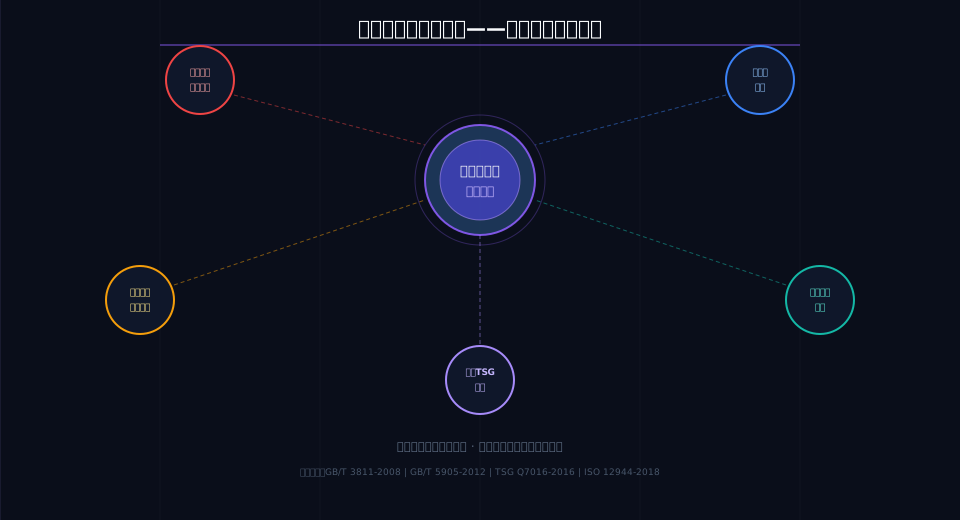
This advanced guide to non-standard crane design covers five core engineering disciplines: non-standard hoisting mechanism design (drum, hook, wire rope), finite element analysis (load combinations, buckling checks, fatigue), material selection and protection for extreme environments (high temperature, dust, marine), full-process manufacturing tolerance control (cutting, assembly, inspection), and on-site installation & commissioning with TSG acceptance. The collection features five in-depth technical articles.
Advanced non-standard crane design goes beyond standard configurations, requiring specialized hoisting parameters, FEA verification of heavy-lift structures, material selection for harsh operating conditions, tight tolerance management throughout fabrication, and rigorous on-site installation acceptance. Building on the previous series—which covered end carriages and wheel blocks, dual lifting point synchronization, welding distortion, curved rail heavy-load operation, and control cabinets—this collection dives deeper into five higher-level engineering challenges. Kelude's engineering practice spans the entire chain, from drum diameter calculations to preparing TSG acceptance documentation.
Five Core Technical Articles at a Glance
| Serial No. | Technical Field | Core Content | Link |
|---|---|---|---|
| 06 | Hoisting mechanism Non-standard Design | drum diameter D≥20d/Length L=H×m/π D+Allowance, Hook DG34CrMo/G20, Wire Rope6×36WS/Safety factorn≥4~7.1 | Reading |
| 07 | finite element analysis | Load combination ABCThree Duty Conditions, Flangeb/tf≤15Web platehw/tw≤160, Buckling Coefficientphi≥1.0, fatigue life N≥2×10^6Times | Reading |
| 08 | Material Selection & Protection for Extreme Environments | High Temperature Q390D+HClass180/HClass Insulation, Dust IP65+centralized lubrication, Anti-corrosion C3~C5-Mhot-dip galvanizing280um, Waterproof IP68 | Reading |
| 09 | manufacturing tolerance Control | Cutting±1mm/Web plate Perpendicularity≤1mm/300mm/Camber L/1000~L/800/End Carriage Diagonal≤5mm/Wheel Run-out≤1mm | Reading |
| 10 | Installation TSG (Special Equipment Safety Technical Regulation)Acceptance | 125%static load10min/110%dynamic load/Braking Drop≤v/100/TSG (Special Equipment Safety Technical Regulation) Q7016supervision inspection/Document List/Deliverables | Reading |
Kelude Double-Girder Overhead Crane
Kelude double-girder overhead cranes are engineered for heavy-duty material handling in industrial workshops, warehouses, and production lines. Built with a robust box-type double-girder structure, these cranes deliver exceptional load capacity, stability, and operational efficiency, making them the ideal choice for demanding lifting applications.
High-Capacity Double-Girder Bridge Crane
Our double-girder overhead cranes are available in a wide range of lifting capacities from 5 to 50 tons, with spans up to 35 meters. The dual-girder design distributes loads more evenly, reducing deflection and ensuring smoother, more precise load positioning compared to single-girder alternatives. This makes them particularly well-suited for heavy machinery assembly, steel coil handling, and large-scale manufacturing operations.
Reliable Performance in Demanding Environments
Kelude double-girder overhead cranes are built to withstand continuous, heavy-duty operation in harsh industrial environments. The crane's main girders are fabricated from high-strength steel plates using automatic submerged-arc welding, ensuring consistent weld quality and structural integrity. All key components—including the hoist, trolley, and end carriages—are sourced from reputable manufacturers and rigorously tested to meet international quality standards.
Technical Specifications
| Parameter | Specification |
|---|---|
| Lifting Capacity | 5 – 50 tons (4.5 – 45 metric tons) |
| Span | Up to 35 m (115 ft) |
| Lifting Height | 6 – 18 m (20 – 60 ft), customizable |
| Hoist Type | Wire rope hoist |
| Crane Duty Class | ISO 4301 M5 / M6 (A5 / A6) |
| Control Mode | Pendant / Remote control / Cabin |
| Power Supply | 380V / 50Hz or 460V / 60Hz, 3-phase |
Applications Across Industries
Kelude double-girder overhead cranes are widely used in a variety of industries, including:
- Steel and metal processing plants
- Heavy machinery manufacturing
- Automotive assembly lines
- Warehousing and logistics centers
- Power generation facilities
- Shipbuilding and repair yards
Frequently Asked Questions
Q: What is the maximum span available for a double-girder overhead crane?
A: The maximum span we offer is 35 meters (115 ft). For spans beyond this, we recommend a custom engineering consultation to ensure optimal structural design and load distribution.
Q: Can the crane be operated in explosion-proof environments?
A: Yes, explosion-proof configurations are available for hazardous areas. These cranes feature specially sealed electrical components and anti-spark materials to meet ATEX or equivalent safety certifications.
Q: What is the typical lead time for a custom double-girder crane?
A: Standard models typically ship within 30–45 days. Custom-engineered cranes may require 60–90 days depending on the complexity of the configuration and the availability of components.
Q: Do you provide installation and commissioning services?
A: Yes, we offer on-site installation supervision and commissioning support. Our technical team can also provide operator training to ensure safe and efficient crane operation.
A: Hoisting mechanism Non-standard Design drum diameter D≥20d, Drum Length L=H×m/π D, Hook Load Capacity Grade M/P/T, Wire Rope6×36WSSafety factorn≥4~7.1. | finite element analysis Load combination ABCThree Duty Conditions, Flange Width-to-Thickness Ratiob/tf≤15, Web plate Web Depth-to-Thickness Ratiohw/tw≤160, Buckling Coefficientphi≥1.0, fatigue life N≥2×10^6Times. | Extreme Environment High Temperature Q390D+HClass180, Dust IP65+Labyrinth Seal, Marine C5-Mhot-dip galvanizing280um, Subsea304Stainless Steel+IP68. |
manufacturing tolerance Cutting±1mm, Web plate Perpendicularity≤1mm/300mm, Camber L/1000~L/800, End Carriage Diagonal≤5mm, Wheel Run-out≤1mm. | Installation TSG (Special Equipment Safety Technical Regulation)Acceptance 125%static load10min+110%dynamic load+Braking Drop S≤v/100+safety devices Verification+TSG (Special Equipment Safety Technical Regulation) Q7016supervision inspection. | Related Topics End Carriageand Wheel Block/dual lifting point synchronization/Welding Distortion/Curved Rail Heavy Duty/Control Cabinet MES——Five Core Technologies in Non-standard Design Practice. |
Further Reading
This practical series on non-standard crane design (foundational track) covers: End Carriage and Wheel Block Design, Dual Lifting Point Synchronous Hoisting, Welding Deformation Control, Heavy-Duty Wheels for Curved Rail, and Control Cabinet MES Interface. The advanced track complements the foundational track, covering the full workflow from hoisting mechanism design to installation acceptance. For more on custom crane solutions, see the Complete Guide to Non-Standard Crane Customization.
Non-Standard Crane Design FAQ
Q: What is the difference between the foundational and advanced tracks of the non-standard crane design series?
A: The foundational track covers five key areas—end carriage and wheel block design, dual lifting point synchronization, welding deformation control, heavy-duty wheels for curved rail, and control cabinet MES interfaces—focusing on the most common design requirements for non-standard cranes. The advanced track delves into non-standard hoisting mechanism calculations, finite element analysis, material selection for extreme environments, manufacturing tolerance management, and installation acceptance, targeting more sophisticated technical challenges. Together, the ten articles provide a complete knowledge pathway from introductory concepts to advanced practice in non-standard crane design.
Q: Where can I find the design standards referenced in these articles?
A: A complete list of the Chinese national standards (GB/T) cited across all articles, along with detailed explanations, is available on the International Standards FAQ page and the Crane Standards System Q&A. Core standards referenced in the non-standard design discussions include ISO 4301 (design specification), FEM 1.001 (test specification), TSG Q7016-2016 (installation supervision), and relevant ISO standards.
Q: What types of projects can Kelude handle in non-standard crane design?
A: Kelude Heavy Industry's non-standard crane design capabilities span five product lines: bridge cranes (including metallurgical, explosion-proof, and insulated variants), gantry cranes (including MH, MG, and L-type), electric hoists (including CD1, MD1, and HC models), smart cranes (with remote operation and automation interfaces), and special-purpose cranes (for nuclear power plants, ports, and underwater applications). Non-standard projects can be accommodated with lifting capacities from 0.5t to 500t and spans from 6m to 60m. All non-standard designs are validated through finite element analysis in accordance with ISO 4301.
Q: Will the non-standard crane design series be updated in the future?
A: Yes. Future plans include a dedicated series on electrical system design for non-standard cranes (covering VFD selection, PID tuning, and PROFINET communication) and an engineering case study series that walks through complete projects from design drawings to delivery. All articles will be revised in sync with updates to the relevant GB/T standards.