

How to Choose a Crane Hook: Single vs Double vs Forged Types
📌 Key Takeaways
Crane hook selection is the first line of defense in lifting equipment safety. Forged single hooks are the standard choice for general-purpose cranes up to 125t, while laminated double hooks are predominantly used in metallurgical and foundry applications above 80t. Core selection parameters include hook size matching, material mechanical properties (DG20Mn/DG34CrMo), throat opening tolerance, and torsional deformation limits. Discard criteria follow GB/T 10051.1-2010: any of the following conditions—throat opening increase ≥15%, torsional deformation ≥10°, or cross-section wear ≥10%—mandates immediate retirement. This article provides a full-process technical reference and purchasing guide covering four structural types, material performance selection, installation inspection requirements, and discard criteria.
📖 Related Standards:
• JB/T 10224 — Hook for Electric Hoist: Standard Interpretation: Covers mechanical property grades, hook throat dimensions, and heat treatment requirements for electric hoist hooks.
• ISO 4301 Crane Design Standard: 9 Load Combinations and Work Duty Selection from A1 to A8: Hook load calculations must be verified against Chapter 5 (Loads and Load Combinations) of this standard.
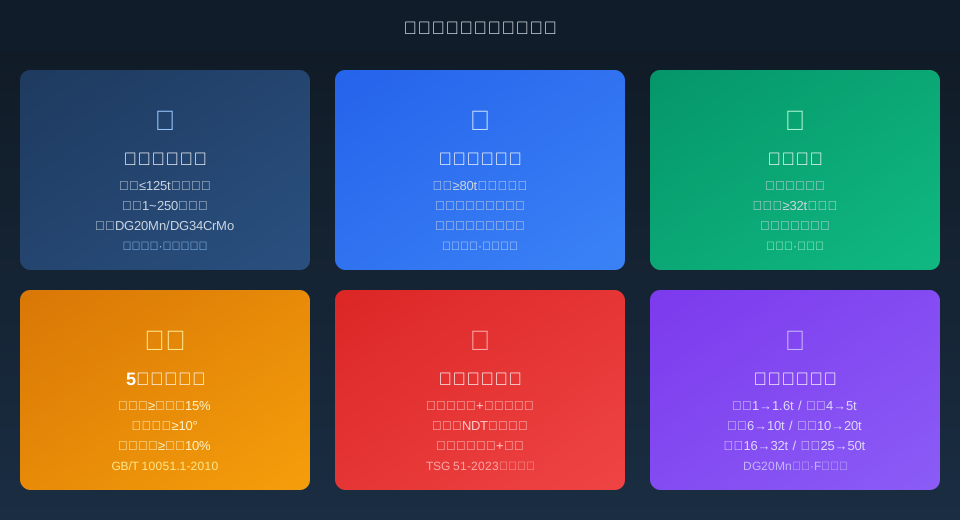
4 Crane Hook Types and Their Application Scenarios
Crane hooks fall into four structural categories: forged single hook, forged double hook, laminated single hook, and laminated double hook. Each type differs significantly in manufacturing process, load-bearing characteristics, and suitable operating conditions. Selection should be based on lifting capacity, work duty, and the operating environment.
The forged single hook is the most widely used type. Made from a single-piece forging of DG20Mn or DG34CrMo alloy steel, it suits general-purpose bridge and gantry cranes up to 125t. Its advantages are low manufacturing cost, short lead times, and simple maintenance.
Forged double hooks are commonly found on heavy-duty bridge cranes above 80t. The symmetrical arrangement balances the load and reduces wire rope fleet angle. Typically made of DG34CrMo, these hooks are quenched and tempered to achieve a tensile strength ≥600 MPa and impact energy AKV ≥41J at -20°C.
Laminated hooks are built from multiple rolled steel plates (typically 6–12mm thick) joined by riveting. They offer high overall strength and a distinct "pre-failure warning" characteristic—crack propagation in one plate does not cause sudden fracture. These are primarily used in metallurgical and foundry cranes rated ≥32t. Kelude Heavy Industry manufactures laminated hooks from Q345B plates with multi-layer riveting and interlaminate gaps ≤0.1mm.
Laminated double hooks add a symmetrical second hook to the single-laminate design and are used as the main hook on metallurgical foundry cranes above 100t. At the standards level, JB/T 10224 specifies detailed throat dimensions and material grades for electric hoist hooks, while heavy-duty hooks must also comply with the additional requirements of YB/T 123 and the Metallurgical Crane Safety Regulations.
Hook Material Properties and Size Matching Chart
The material grade of a crane hook directly determines its load-bearing capacity. Common grades under the Chinese standard system include DG20Mn (yield strength ≥285 MPa), DG34CrMo (yield strength ≥490 MPa), and DG34CrNiMo (yield strength ≥635 MPa). Material selection must follow the principle of a yield strength safety factor ≥2.5.
The hook size (hook number) is the core parameter for standardized selection. Each hook number corresponds to a rated lifting capacity range. The numbering system originates from the GB/T 10051 series of standards—the higher the number, the greater the load capacity.
Hook number to rated lifting capacity matching:
Hook No. 1 → rated capacity 1.6t, for cranes rated 0.5–2t
Hook No. 4 → 5t, for cranes rated 3–5t
Hook No. 6 → 10t, for cranes rated 8–12.5t
Hook No. 10 → 20t, for cranes rated 16–25t
Hook No. 16 → 32t, for cranes rated 25–40t
Kelude Heavy Industry's standard product line covers hook sizes 1 through 250.
Heat treatment directly affects final mechanical properties. DG20Mn is normalized (heated to 880–920°C and air-cooled), achieving a hardness of HB160–200. DG34CrMo is quenched and tempered (quenched at 850–870°C, tempered at 550–650°C), achieving HB220–280. After heat treatment, the grain size must be Grade 5 or finer, and the decarburized layer depth must not exceed 0.3mm.
For extreme low-temperature environments below -20°C, DG34CrNiMo is required. It delivers impact energy AKV ≥27J at -40°C, meeting the low-temperature impact toughness requirements of GB/T 1591. Kelude Heavy Industry offers custom -40°C low-temperature hooks with third-party impact test reports.
6 Critical Inspection Parameters for Hook Installation
After installation, every crane hook must undergo systematic inspection. Any non-conforming item must be corrected before the equipment is put into service. The following six parameters are mandatory checks during both Factory Acceptance Testing and periodic inspections.
① Throat Opening Tolerance: The tolerance for a new hook's throat opening depends on the hook size—±1.0mm for hook sizes ≤6, ±1.5mm for sizes 8–16, and ±2.0mm for sizes ≥20. In service, if the throat opening increases by more than 10% of the original dimension, the hook must be derated; at 15%, it must be scrapped.
② Torsional Deformation: The hook must not exhibit permanent torsional deformation under rated load. The inspection method involves scribing a reference line on the hook shank, applying 1.25 times the rated load, then releasing and measuring the reference line offset. A torsional deformation angle ≥10° means the hook is condemned.
③ Shank Thread: Threads must be complete and undamaged, with effective engagement length ≥1.0 times the thread diameter. No cracks are permitted at the thread root. After installation, a double nut or cotter pin must be used for locking. Kelude Heavy Industry hooks come pre-fitted with locking devices and include a torque inspection report.
④ Surface Cracks: Magnetic Particle Inspection (MPI) or Penetrant Testing (PT) must be performed every inspection cycle, with particular attention to the inner bend of the hook throat, the thread root of the shank, and cross-section transition zones. No surface cracks of any kind are permitted.
⑤ Cross-Section Wear: Wear on the critical section (inner bend of the throat) must not exceed 10% of the original height. Measurement is taken with an optical flat at the three narrowest equidistant cross-sections, using the minimum value.
⑥ Hook Latch: Every hook must be equipped with a safety latch that closes automatically under no-load conditions. The clearance between the latch and the hook tip must be ≤2mm, and the spring force ≥15N. This requirement comes from TSG 51-2023, Section 6.3.2 of the Safety Technical Specification for Special Equipment.
Comparison Table: 4 Hook Types at a Glance
| Comparison Item | Forging Single Hook | Lamellar Type Hook |
|---|---|---|
| Applicable To Lifting Capacity | 0.5~125t | ≥32t |
| Material Grade | DG20Mn/DG34CrMo | Q345B (≈S355J2)/DG20MnLaminated Plates |
| Tensile Strength | ≥510~735MPa | ≥470~630MPa |
| Manufacturing Process | Die Forging+Normalizing/Quenching and Tempering | Rolled Plate Riveting Lamination |
| Failure Mode | Sudden Fracture Risk | Single Plate Cracking First, Obvious Warning Signs |
| Reference Price Range | 0.08~25,000 CNY | 0.5~80,000 CNY |
Hook Inspection and Replacement Criteria: A Quick Reference
| Inspection Comparison Item | Acceptance Criteria | Scrap / Discard/Non-Conformance Determination |
|---|---|---|
| Throat Opening Increment | <Original Dimension10% | ≥Original Dimension15%(《GB/T 10051.1》) |
| Torsion Deformation Angle | <5° | ≥10°(《TSG (Special Equipment Safety Technical Regulation) 51 Safety Technical Specification for Special Equipment-2023 Crane Safety Technical Supervision Regulation》) |
| Cross-Section Wear Throat Opening Increment | <Original Height5% | ≥Original Height10% |
| Surface Crack | MT/PTDetection Free Of Crack | Any Crack Immediate Scrap |
| Hook Shank Thread Damage | Thread Intact Without Deformation | Thread Damage≥1Threads or Root Crack |
| Anti-Detachment Latch Plate | Spring Force≥15N, Automatic Closing | Anti-Detachment Latch Plate Deformation/Fracture/Failure |
Lifting Capacity Range
0.5~500t
Full coverage, Hook Sizes 1–250
Safety Factor
≥2.5
Based on Yield Strength · ISO 4301
Material Grade
DG34CrMo
Quenched & Tempered, Tensile ≥735MPa
Throat Opening Limit
≤15%
Discard when opening exceeds 15% of original
Inspection Frequency
Monthly NDT
MPI monthly · Ultrasonic annually
Brand Assurance
Kelude
All hook sizes · Third-party inspection
📖 Related Reading
Wire rope and hooks are both core lifting components
How to Troubleshoot Load Slipping? 6 Braking System Causes & Drop Acceptance Criteria
Load slipping incidents are closely tied to hook safety devices
ISO 4301 Crane Design Standard: 9 Load Combinations & Duty Classification Selection from A1 to A8
Design basis for hook load calculations
Part of the hoisting mechanism component selection series
Frequently Asked Questions
Q: What is the difference between single-hook and double-hook cranes when it comes to selection?
A: Single hooks are used on general-purpose cranes up to 125t, offering a simple design and lower cost, with Hook Sizes 1–250 covering 0.5–125t duty conditions. Double hooks are specified for heavy-duty cranes above 80t and for metallurgical foundry cranes, where the symmetrical arrangement balances the load and reduces wire rope fleet angle. Double hooks are typically forged from quenched and tempered DG34CrMo steel with a tensile strength of ≥600MPa. The key selection difference: single-hook sizing is driven by hook size vs. capacity matching, while double-hook selection also requires verifying hook spacing and cross beam strength. Kelude provides complete single-hook and double-hook selection calculation reports along with third-party material test certificates.
Q: What are the specific scrapping requirements for hook opening deformation under the GB/T 10051 standard?
A: Clause 8.3 of GB/T 10051.1-2010 mandates that a hook must be scrapped when the opening deformation exceeds 15% of its original dimension. Measurement method: use an optical flat to measure the inner distance across the hook opening (record the original value as S₀), with each inspection recording the measured value S₁. Calculation formula: ΔS=(S₁-S₀)/S₀×100%. When ΔS≥10%, the hook must be derated to 80% of its rated load; when ΔS≥15%, it must be immediately taken out of service and scrapped. Additionally, a torsional deformation angle ≥10°, wear on the critical cross-section exceeding 10% of the original height, or any surface crack all result in immediate scrapping — repair is not permitted. Clause 6.3.5 of TSG 51-2023 further stipulates that a scrapped hook must be replaced as a complete unit; welding, heat straightening, or build-up repair are strictly prohibited.
Q: Can a crane hook with an enlarged opening still be used?
A: It cannot be used as-is; the action depends on the degree of opening deformation. If the increase is less than 10%, the hook may remain in service but requires more frequent monitoring (monthly inspections). If the increase is between 10% and 15%, the hook must be derated to 80% of its rated load and undergo monthly NDT flaw detection. If the increase reaches 15% or more, the hook must be immediately removed from service and replaced. An enlarged opening is often accompanied by plastic deformation and internal micro-cracks; visual inspection alone is insufficient — Magnetic Particle Inspection (MPI) is required to confirm the absence of surface cracks. We recommend contacting the Kelude technical team for an on-site assessment, replacement planning, and rapid delivery of matching spare hooks.
Q: How much does a 10-ton crane hook cost?
A: A forged single hook for a 10-ton crane (hook size 6) typically ranges from approximately $120 to $220 in DG20Mn material, or $180 to $330 in DG34CrMo. Laminated hooks cost roughly 2–3 times more. Price variations depend on material grade, whether third-party inspection reports are included, and the presence of a hook latch. Kelude's standard 10t forged hook quotation includes an MPI NDT report and a safety latch plate, with a normal delivery time of 3–5 business days. Volume orders or larger hook sizes (size 16 and above) qualify for tiered pricing. We recommend confirming the shank thread specification (M30–M48) and cross beam dimensions before requesting a quotation.
Kelude Heavy Industry, a leading domestic manufacturer of crane lifting spreaders, offers a full range of forged and laminated hooks from hook size 1 to 250, with DG20Mn/DG34CrMo as standard materials. Every hook ships with a third-party MPI NDT report and a Material Certificate. Our products are certified under the ISO 9001 Quality Management System, and we support custom non-standard designs as well as 48-hour emergency spare parts delivery. Our technical consultation hotline covers selection calculations, installation guidance, and scrapping assessments from start to finish.
