

Overhead Crane MES and WMS Data Integration Architecture
MES/WMS Data Middleware: Kelude Heavy Industry's Full-Stack Crane System Integration Architecture. In the four-level automation architecture of a smart factory, the overhead crane control system sits at the intersection of Level 3 (Coordination) and Level 4 (Enterprise) — connecting upward to MES (Manufacturing Execution System), WMS (Warehouse Management System), and ERP (Enterprise Resource Planning), and downward to drive individual PLCs and VFDs via OPC UA and PROFINET.
In the four-level automation architecture of a smart factory, the overhead crane control system operates at the intersection of Level 3 (Coordination) and Level 4 (Enterprise) — interfacing upward with MES, WMS, and ERP, and downward with individual PLCs and VFDs through OPC UA and PROFINET. The quality of this vertical integration stack determines whether data flows seamlessly across the plant, whether material handling can be automated, and whether decision-making loops can be closed. Drawing on years of overhead crane control system integration experience, Kelude has built a comprehensive data middleware architecture that enables end-to-end data connectivity from device-level sensors to enterprise-level ERP systems. This article examines the integration of overhead crane systems with MES/WMS from seven perspectives: the four-level architecture, protocol matrix, data middleware, OPC UA specifications, end-to-end WMS material flow, Digital Twin, and retrofit cost considerations.
Data Middleware Role in the Four-Level Automation Architecture
The standardized four-level architecture of an overhead crane control system comprises, from top to bottom: the Enterprise Level, Coordination Level, Control Level, and Drive/Sensor Level. The data middleware spans the Enterprise and Coordination levels, serving as the core hub for data aggregation, protocol conversion, computational resource allocation, and quality control.
The Enterprise Level includes ERP, MES, WMS, and the Cloud Platform, handling production planning, order management, Inventory Management, and data analytics, with communication cycles ranging from seconds to days. The Coordination Level comprises the crane dispatching system, multi-crane collaboration platform, and remote operator cockpit, managing task assignment, Path Planning, conflict resolution, and remote control, with communication cycles from 100 milliseconds to seconds. The Control Level contains PLCs and drivers, responsible for motion control, safety logic, and closed-loop regulation, with communication cycles of 1 to 10 milliseconds. The Drive/Sensor Level includes motors, Encoders, Laser Distance Measurement devices, and vision cameras, with communication cycles below 1 millisecond.
The core challenge the data middleware resolves in integration is the divergent requirements across levels for latency, bandwidth, and real-time performance. The Enterprise Level is latency-tolerant but data-intensive, while the Control Level demands hard real-time response with smaller data volumes. Through layered caching, protocol conversion, and priority queuing, the middleware unifies heterogeneous data from all four levels into a standardized data model for upstream application analysis and decision-making.
Protocol Integration Matrix for MES/WMS and Crane Control Systems
Data exchange between the overhead crane system and MES, WMS, and ERP relies on a diverse set of communication protocols. Kelude has established a standardized protocol selection matrix based on application scenarios.
MES integration supports dual protocols: REST API and WebService. The MES issues production work orders to the crane dispatching system via REST API, including material ID, source station code, destination station code, priority, and expected completion time. After executing each work order, the crane dispatching system returns task status (received/in progress/completed/failed), actual duration, Load records, and exception information through the same interface. For scenarios requiring high real-time performance, WebSocket push is used to ensure task status is synchronized to the MES within 500 milliseconds.
WMS integration is primarily implemented through the OPC UA protocol. Data exchange between WMS and the crane control system covers three sub-modules: bin location management, material tracking, and task coordination. The bin location management module transmits bin codes, bin status (empty/occupied/reserved/fault), and bin coordinates. The material tracking module transmits material ID, material type, Weight, dimensions, and inventory batch numbers. The task coordination module handles crane pickup/putaway/relocation instructions received from WMS and feeds back real-time position and task progress. The object-oriented data model of OPC UA is inherently well-suited to WMS's structured data exchange requirements.
ERP integration relies primarily on WebService and file exchange, mainly for transmitting equipment asset information, maintenance work orders, Spare parts inventory, and energy consumption data. The synchronization Frequency is daily or weekly, with no real-time requirement.
The SCADA System connects directly to the crane PLCs via OPC UA or Modbus TCP, collecting real-time crane status data — position, Speed, Load, Current, operating mode, fault status, and more — at 100-millisecond intervals. As one of the core data sources for the data middleware, SCADA provides device-level real-time data upward to the MES.
The overarching protocol selection principle is: control commands go through OPC UA (structured data model + security certification + automatic discovery), high-frequency status data goes through MQTT (lightweight + QoS levels + one-to-many), upper-level business operations go through REST API (standard web interface + easy integration), and hard real-time closed loops go through PROFINET RT (deterministic latency + industrial-grade reliability).
Kelude Heavy Industry: Overhead Crane and Hoist Solutions
Kelude Heavy Industry is a leading manufacturer of overhead cranes, gantry cranes, and electric hoists, delivering reliable material handling solutions for industrial applications across the United States and Europe. Our product line is engineered for durability, precision, and safety, meeting the demands of workshops, warehouses, and heavy fabrication facilities.
Frequently Asked Questions
Q: What is the typical lead time for a standard overhead crane?
A: For standard single-girder cranes up to 10t, the lead time is typically 30-45 days. For double-girder or customized models, please contact us for a specific schedule based on your requirements.
Q: Do you provide installation services?
A: Yes, we offer professional installation and commissioning services. Our technical team can either supervise the installation or perform it entirely, depending on your preference and site conditions.
Q: Can the crane be operated with a remote control?
A: Absolutely. Most of our cranes can be equipped with a wireless radio remote control for convenient and safe operation. We offer both pendant and remote control options, and can also integrate smart control features.
Q: What safety certifications do your cranes have?
A: Our cranes are designed and manufactured in compliance with international standards such as ISO 4301 for crane classification and IEC 60204-32 for electrical equipment. We can also provide documentation and support for local regulatory approvals.
Q: What is the warranty period for your products?
A: We provide a standard 12-month warranty for all our cranes and hoists, covering defects in materials and workmanship. Extended warranty options are available upon request.
Q: How do I choose the right crane capacity for my application?
A: The required capacity depends on the heaviest load you need to lift, including the weight of any lifting attachments. We recommend consulting with our engineers to determine the appropriate duty class and capacity based on your specific lifting frequency and load profile.
| Docking System | Interface Protocol | Data Exchange Content | Synchronization Frequency |
|---|---|---|---|
| MES Manufacturing Execution | REST API / Web Socket | Production Order, Task Status, Exception Reporting | Real-time(500ms) |
| WMS Warehouse Management | OPC UA Pub/Sub | Bin Status, Material Tracking, Task Collaboration | Real-time(100ms) |
| ERP Enterprise Resource | Web Service / File Exchange | Equipment Asset, Maintenance Order, Spare parts Inventory | Daily/Weekly |
| SCADA Data Acquisition | OPC UA / Modbus TCP | Position/Start Button/Load/Current/Fault Status | 100ms Period |
3. Edge-to-Cloud Data Platform Architecture
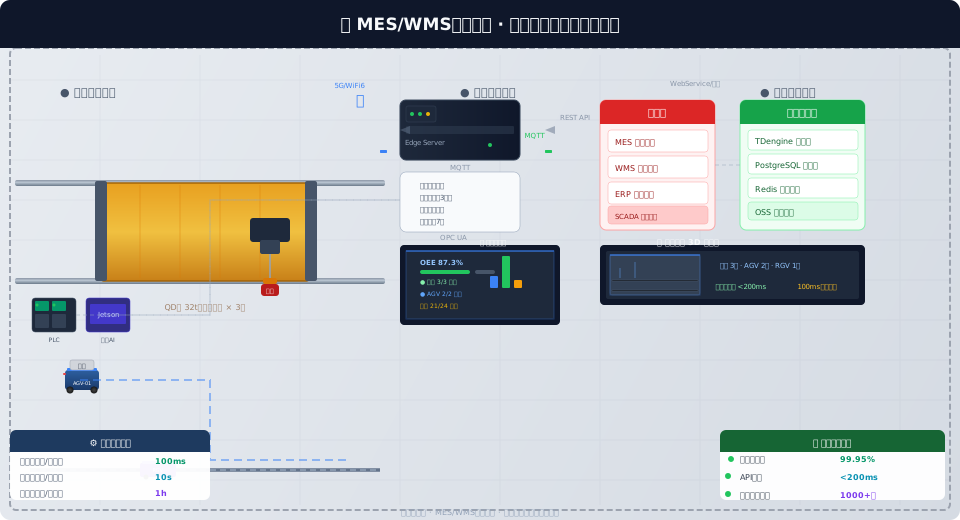
A: Kelude Heavy Industry's data platform is built on a three-tier architecture—device, edge, and cloud—with each tier handling distinct data processing responsibilities.
The device tier sits at the equipment level, comprising the PLCs on each overhead crane (Siemens S7-1500F / Inovance AM600), variable-frequency drives (Siemens G120 / ABB ACS880), a sensor cluster (encoders, laser distance measurement, overload sensors, temperature, and vibration sensors), and edge AI inference units (Jetson Orin NX/AGX). Data acquisition at this tier is frequency-tiered: core control data (position, speed, load, motor current) is sampled every 100 ms; status data (temperature, operating hours, brake status) is sampled every 1 second; and cumulative data (energy consumption, travel distance, cycle count) is aggregated hourly. The device tier also provides local buffering during network outages, retaining at least 7 days of raw data and automatically re-uploading once connectivity is restored.
The edge tier consists of workshop-level edge computing nodes deployed on industrial edge servers (Advantech IPC / Siemens industrial servers), each supporting up to 50 overhead cranes. Core functions at this tier include: real-time data aggregation and cleansing (removing redundant frames, timestamp alignment, unit standardization), protocol conversion (bidirectional translation between PROFINET, OPC UA, and MQTT), local alarm inference (threshold- and rule-engine-based, with alarm push latency under 5 seconds), and local data storage (InfluxDB time-series database for high-frequency data, relational database for business data). The edge tier also powers the central control room monitoring screen, providing a real-time overview of all crane operating statuses across the workshop.
The cloud tier is hosted on Alibaba Cloud or Huawei Cloud, running a microservices architecture on a Docker + Kubernetes cluster. TDengine or InfluxDB stores the full historical time-series data, PostgreSQL manages business data, and Redis serves as the caching layer for real-time status. Core cloud applications span four modules: equipment management, data analytics, alarm center, and Digital Twin dashboard. The system availability target is 99.95%, with API response time under 200 ms.
Data synchronization across the three tiers works as follows: real-time device data is aggregated at the edge and uploaded to the cloud via MQTT in batches every second; low-frequency status data is synced via HTTP REST API on an hourly schedule. Cloud-side analytics results and scheduling commands are pushed back down to the device tier through OPC UA.
| Data Acquisition Grade | Period | Data Item | Purpose |
|---|---|---|---|
| High Speed | 100ms | Real-time Position X/Y/Z, Start Button, Load, Motor Current, Frequency Inverter / VFDTask Status | Real-time Monitoring, Closed-Loop Control |
| Medium Speed | 10s | Motor Temperature, Reducer / Gearbox Temperature, Brake Switch Cycle Count, Cumulative Operating Hours | Condition Assessment, Trend Analysis |
| Low Speed | 1h | Energy Consumption(k Wh), Maximum Load, Cumulative Travel Distance per Axis, Fault Summary | Energy Efficiency Management, Predictive Maintenance |
4. OPC UA Data Exchange Specification
OPC UA is the core communication protocol that integrates the overhead crane control system with MES/WMS platforms. Kelude has established a standardized OPC UA interface specification to ensure consistent, discoverable, and interoperable data models across every overhead crane in the fleet.
The OPC UA server runs on the crane's PLC (natively supported by Siemens S7-1500F) on default port 4840, with Basic256Sha256 as the security policy. Clients must present a valid X.509 certificate for authentication. The communication sampling interval is 100 ms, with each server supporting up to 5 concurrent sessions and 100 subscriptions.
The data node model is organized by crane subsystem. The CraneStatus node contains the operating mode (Manual / Semi-automatic / Fully automatic / Remote / Maintenance), operating state (Running / Stopped / Fault), task state (Idle / Moving / Picking / Placing / Completed / Aborted / Error), and the current task ID. The CranePosition node holds the actual X/Y/Z axis positions (Float, in mm) along with target positions. The CraneLoad node reports current load and rated load (Float, in kg). The CraneSafety node tracks emergency stop status, limit switch status, and interlock status. The CraneDiagnostics node stores the most recent error code, communication status, and cumulative operating hours.
Data exchange between the WMS and overhead cranes uses a publish/subscribe model. The WMS subscribes to crane position and task status nodes, and is automatically notified when a crane reaches its designated position or when a task state changes. Conversely, cranes subscribe to the WMS inventory location status nodes, allowing them to automatically receive new task targets whenever a storage location status changes.
The OPC UA alarm/event mechanism is used to push exception events directly to MES/WMS. Each event payload includes the alarm code, severity level (1–100), localized description text, and a timestamp — significantly reducing polling overhead on the MES side for anomaly detection.
5. End-to-End WMS Material Flow
Using raw material inbound as the starting point — followed by overhead crane transport to production line stations, AGV/RGV transfer, and finished goods warehousing — the data platform orchestrates the complete data flow across the WMS, crane dispatching system, and SCADA as described below.
The WMS issues tasks to the crane dispatching system, specifying the task type (Pick / Place / Relocate) along with the material ID, source storage location code, and destination storage location code. The dispatching system breaks each task into a sequence of sub-instructions (GOTOPICKMOVEPLACE) and writes them sequentially to the crane PLC via OPC UA. During execution, the PLC reports real-time position and task progress every 100 ms. When the crane reaches the source location, the vision AI system (YOLOv8) scans the QR code on the material to confirm correct identification, and the load sensor verifies that the actual weight matches the WMS record before lifting is permitted. After the crane delivers the material to the target station, handoff is completed through a four-stage protocol at the AGV transfer zone. The WMS automatically updates the source storage location to "empty" once the crane completes the pick, and updates inventory records when the AGV confirms arrival at the destination station.
Throughout the entire process, the data platform aggregates real-time position, task progress, and equipment status for every crane and AGV, visualized on a Digital Twin monitoring screen. Exception handling follows standardized procedures: crane faults are automatically reported to MES to trigger task reassignment, while WMS storage location anomalies automatically lock the affected location and notify the dispatching system to route around it.
6. Digital Twin & Real-Time Monitoring Dashboard
Built on the data platform's real-time data stream, Kelude has developed a 3D Digital Twin visualization system rendered with Three.js, providing real-time mapping of crane position, orientation, and load status within the workshop. Data updates at 100 ms intervals, with end-to-end display latency not exceeding 200 ms.
The monitoring screen offers three role-based views. The shop floor management dashboard displays OEE (Overall Equipment Effectiveness) for all cranes, daily task completion rates, energy consumption trends, and alarm statistics. The dispatching console shows a 2D workshop floor plan, real-time crane positions, path planning, and traffic control status. The remote operation & maintenance panel provides detailed data for individual cranes, including three-axis real-time position curves, motor current and temperature trends, and Predictive Maintenance recommendations (based on a Gaussian mixture model anomaly detection combining vibration analysis and cumulative operating hours).
The dashboard also integrates picture-in-picture video surveillance. When an alarm occurs on the production line, the corresponding camera feed is automatically pulled up to assist with Remote Diagnostics.
7. Smart Retrofit Costs & Implementation Roadmap
The cost of retrofitting an overhead crane system for MES/WMS data platform integration varies by equipment age, Positioning Accuracy requirements, communication infrastructure, and site conditions, with a typical variance of ±10% to ±40%. The core cost breakdown is as follows: a single-crane dispatching system (including Web UI, task management, and reporting) ranges from 50,000 to 80,000 CNY; a multi-crane dispatching system (with path planning, anti-collision, and load balancing) ranges from 150,000 to 300,000 CNY; MES/WMS interface development costs 30,000 to 80,000 CNY depending on the number and complexity of interfaces; and vision AI model training (data collection, annotation, training, and deployment) ranges from 50,000 to 150,000 CNY.
The implementation roadmap follows a five-phase approach. Phase 1 (1–2 months): network infrastructure (5G private network / WiFi 6 / fiber optic) and sensor installation. Phase 2 (2–3 months): positioning system calibration, camera installation, and edge gateway deployment. Phase 3 (2–3 months): deployment of the data collection platform, monitoring dashboard, and MES integration — the core phase where the data platform delivers its value. Phase 4 (1–2 months): deployment of the dispatching system and AI models. Phase 5 (1 month): operator training, trial run, and acceptance testing.
Kelude's smart retrofit solution supports a phased investment strategy, progressing incrementally from Level 1 sensor upgrades through to Level 4 ERP integration. Each phase delivers independently measurable efficiency improvements, ensuring retrofit investments remain controllable and predictable.
| Project | Cost Range(10K CNY) | Description |
|---|---|---|
| Single Cranedispatching system | 5 ~ 8 | Web UI + Task Management + Report |
| Multi-Cranedispatching system | 15 ~ 30 | Path Planning + anti-collision + Load Balancing |
| MES/WMSInterface Development | 3 ~ 8 | Billed by Interface Count and Complexity |
| Vision AIModel Training | 5 ~ 15 | Data Acquisition+Annotation+Model Training+Deployment |
| Annual Maintenance Contract | Total Investment×8~12% | Remote Monitoring+Scheduled Inspection+Spare parts |
Frequently Asked Questions
A: Our standard single-girder and double-girder overhead cranes are available in capacities ranging from 1 ton to 50 tons. For specialized applications, we can engineer custom solutions up to 100 tons. Please contact our sales team with your specific requirements for a tailored recommendation.
A: For standard crane models within our standard production range, the typical lead time is 30–45 days from order confirmation. Custom-engineered cranes may require 60–90 days depending on the complexity of the configuration and the current production schedule.
A: Yes, we offer comprehensive installation and commissioning support. Our experienced engineering team can supervise the installation on-site, or we can provide detailed installation drawings and manuals for self-installation. Remote technical guidance is also available throughout the process.
A: All Kelude cranes come with a 12-month warranty covering manufacturing defects and workmanship. Our after-sales support includes readily available spare parts, responsive technical assistance, and optional extended service contracts. We are committed to ensuring your crane operates reliably throughout its service life.
