

Siemens vs. Mitsubishi PLC for Cranes: Hardware & Software Guide
Siemens SIMATIC S7 and Mitsubishi MELSEC iQ are the two dominant PLC platforms in crane electrical control, differing significantly in programming ecosystem, communication protocols, safety functions, and cost structure—Siemens excels with PROFINET full integration and SIL3 safety, while Mitsubishi wins on CC-Link IE TSN high-speed communication and compatibility with Japanese equipment.
In crane electrical control systems, the PLC (programmable logic controller) handles core tasks such as logic interlocking, safety protection, variable-frequency speed control, and data acquisition. When faced with the two major brands—Siemens and Mitsubishi—design institutes and end users often struggle with the selection dilemma. Kelude Heavy Industry has deployed both platforms across hundreds of bridge and gantry cranes, accumulating systematic comparison data. Should you choose the fully integrated automation approach of the Siemens S7-1200/1500 series, or the cost-effective control architecture of the Mitsubishi iQ-R/FX5 series? This article compares five dimensions—CPU performance, programming toolchain, communication capability, safety level, and motion control—to provide engineering-based selection guidance.
Selection should follow IEC 60204-32 (Mechanical Electrical Safety Standard) and the IEC 61131-3 international standard for programming languages. In cranes—classified as special equipment—the PLC must do more than routine logic control; it also handles critical safety functions such as load limiter signal acquisition, multi-step speed command output to VFDs, and safety circuit monitoring. The comparison below examines each dimension in detail.
Core Architecture Role of PLC in Crane Control Systems
Bridge and gantry crane electrical systems typically adopt a four-tier architecture: "PLC + HMI + VFD + remote I/O." The PLC acts as the control hub, receiving dozens of input signals from master switches, limit switches, load sensors, encoders, and other devices. After logic processing, it outputs to VFDs and contactors while exchanging data with the SCADA system via industrial Ethernet.
Tier 1: Operator Input Layer—Master switches, remote transmitters, and HMI touchscreens issue operating commands.
Tier 2: Safety Interlock Layer—Limit switches, overload protectors, and emergency stop buttons connect through PLC safety input modules, providing hardware-redundant interlocking.
Tier 3: Logic Processing Layer—The PLC executes ladder diagram programs, handling interlock logic for hoisting/lowering and trolley/crane travel, multi-step speed switching, and fault diagnosis.
Tier 4: Drive Output Layer—The PLC sends speed commands and start/stop signals to VFDs via PROFINET or CC-Link protocols, enabling precise motor speed control.
In a typical 32t double-girder bridge crane, the PLC I/O count ranges from 80 to 150 points: approximately 60–100 digital inputs (limit switches, pushbuttons, contactor feedback), 20–50 digital outputs (contactors, indicator lights, buzzers), and 4–8 analog inputs (load cells, current transformers). At this scale, the PLC scan cycle must stay within 5 ms to ensure the total latency from limit switch trigger to brake actuation does not exceed 50 ms. Kelude Heavy Industry can provide customers with electrical cabinet assembly, programming commissioning, and after-sales technical support for both brands, recommending the optimal PLC selection based on specific project requirements.
Hardware Architecture and CPU Performance Comparison
The Siemens S7-1200 series (CPU 1214C/1215C) suits single-girder and electric hoist control systems rated below 20t, with a typical configuration of 8DI/6DO transistor outputs and support for 6 high-speed counters (HSC) for encoder pulse acquisition. The S7-1500 series (CPU 1511–1518) targets double-girder and gantry cranes above 32t, delivering bit operation speeds of 60 ns per instruction, up to 5 MB of program memory, and redundant CPUs with hot-standby switching.
The Mitsubishi iQ-F series (FX5U/FX5UC) competes directly with the S7-1200, featuring built-in positioning (4-axis 200 kHz pulse output) and a ladder diagram execution speed of 34 ns per step. The Mitsubishi iQ-R series (R04/R08/R16) rivals the S7-1500, using a RISC CPU architecture with 0.98 ns LD instruction speed, program capacity up to 1,200K steps, and support for redundant systems and CC-Link IE TSN real-time communication. On cost-sensitive 16–20t bridge cranes, the iQ-F solution's total material cost runs approximately 60%–75% of the Siemens equivalent.
| Comparison Item | Siemens S7-1200 | Mitsubishi FX5U | Siemens S7-1500 | Mitsubishi i Q-R |
|---|---|---|---|---|
| CPUModel | S7-1200 1215C | FX5U-80MT/ES | S7-1500 1516-3PN | i Q-R R08CPU |
| Operationspeed | 0.08μs/Bit Instruction | 34ns/Step | 60ns/Bit Instruction | 0.98ns/LD |
| Program Capacity | 150KB | 128KStep | 2MB | 1200KStep |
| I/OI/O Points | 14DI/10DO | 40DI/40DO | max 8192Point | max 4096Point |
| High-Speed Counter | 6Channel100kHz | 8Channel200kHz | Unlimited(Process Module) | Unlimited(QDModule) |
| redundancy Supported | Not Supported | Not Supported | S7-1500R/Hredundancy | i Q-Rredundant system |
| Operating Temperature | 0~55℃ | 0~55℃ | 0~60℃ | 0~55℃ |
| Reference Price | ~2500CNY | ~2000CNY | ~8000CNY | ~6500CNY |
Programming Ecosystem & Development Efficiency Compared
Siemens TIA Portal V18 is a fully integrated engineering platform that brings PLC programming, HMI configuration, VFD commissioning, and safety programming into a single software environment. It supports four IEC 61131-3 languages: LAD (Ladder Diagram), FBD (Function Block Diagram), SCL (Structured Control Language), and GRAPH (Sequential Function Chart). For crane applications, TIA Portal's built-in technology objects—such as Simatic Easy Motion—allow direct configuration of multi-speed profiles and position closed-loop control, significantly shortening development cycles.
Mitsubishi GX Works3 is the dedicated programming environment for the iQ series, supporting Ladder, SFC, ST, and FBD languages. Its Simple Motion module delivers positioning and synchronization control through table-based parameter configuration, eliminating the need for complex motion control commands. The ladder diagram style in Mitsubishi's environment follows Japanese electrical conventions, which tends to feel more intuitive for engineers trained in that tradition. One caveat: project file version compatibility deserves attention—migrating GX Works3 projects between different software versions can occasionally result in lost function block parameters.
When it comes to commissioning efficiency, TIA Portal's online diagnostics (topology view, device status, cycle time analysis) are more mature than what GX Works3 offers. Mitsubishi's system monitoring and fault tracing typically require supplementary tools like GX LogViewer. In real-world projects, a bridge crane control system with roughly 120 I/O points takes an average of 15–20 working days to program and commission with the Siemens platform, versus 12–18 working days with the Mitsubishi approach.
Industrial Communication & System Integration Capabilities
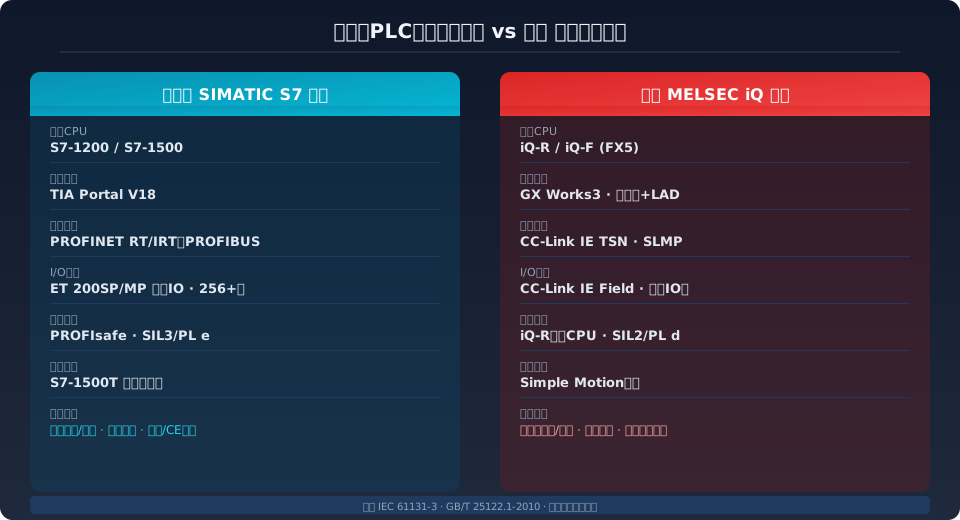
Siemens builds its communication architecture around PROFINET. PROFINET RT (Real-Time) achieves cycle times as low as 1 ms, while IRT (Isochronous Real-Time) reaches 31.25 μs—making it well-suited for multi-crane synchronized operation where multiple VFDs must work in precise harmony. The PROFIsafe safety communication protocol carries both standard data and safety signals over a single network, and is TÜV-certified to SIL3/PL e safety level, satisfying the safety circuit requirements of TSG 51-2023 Crane Safety Technical Supervision Regulation.
Mitsubishi centers its architecture on CC-Link IE TSN, which leverages Time-Sensitive Networking technology to deliver a 31.25 μs communication cycle with ±1 μs synchronization accuracy. CC-Link IE Field supports star, line, and ring topologies with up to 254 stations. The SLMP (Seamless Message Protocol) enables straightforward TCP/IP communication with host computers, vision systems, and SCADA systems. However, Mitsubishi's safety functions require a dedicated safety CPU module, achieving up to SIL2/PL d—meaning high-risk crane applications demanding SIL3 will need additional safety relays in the architecture.
| Comparison Item | Siemens PROFINET Architecture | Mitsubishi CC-Link IE TSN Architecture |
|---|---|---|
| Communication Protocol | PROFINET RT/IRT | CC-Link IE TSN |
| Real-Time Cycle | 1ms(RT)/31.25μs(IRT) | 31.25μs |
| safety level | PROFIsafe SIL3/PL e | i Q-RSafety CPU SIL2/PL d |
| Topology Support | Star/Tree/Ring Network MRP | Star/Line/Ring |
| Max Stations | 512Units PROFINETDevice | 254Station |
| Host Integration | OPC UA Server Built-in | SLMP + OPC UA adapter |
| Frequency Inverter / VFD Matching | SINAMICS G120/S120 | FREQROL A800/E800 |
| Recommended Application | CE Certification Export·Multi-Crane Synchronization | Japanese OEM·Cost-Performance Optimization |
Crane PLC Selection Matrix: A Decision Guide
Based on the five criteria discussed above, the following recommendations address common crane types and applications. When choosing a PLC brand, weigh four key factors: compatibility with existing equipment, the owner's technical specification, export certification needs, and the availability of local technical support.
Single-Girder & Suspension Cranes under 20t — Opt for the Mitsubishi FX5U or Siemens S7-1200. If the site already uses Japanese VFDs (e.g., Mitsubishi FREQROL, Yaskawa), the FX5U minimizes communication setup costs. For exports to the EU requiring CE Certification, the Siemens S7-1200 with PROFIsafe is mandatory, as Mitsubishi's SIL2 safety level does not meet the PL e requirement for crane safety circuits under EN ISO 13849-1.
Double-Girder Bridge Cranes (32~100t) — Recommended: Siemens S7-1500. This class typically demands redundant CPU configurations (S7-1500R/H) for uninterrupted production. While the Mitsubishi iQ-R supports redundancy, it has fewer proven field applications. The S7-1500T technology CPU can replace a separate motion controller, directly handling anti-sway algorithms and collaborative scheduling for multiple cranes.
Gantry & Shipbuilding Gantry Cranes — Recommended: Siemens S7-1500 with ET 200SP distributed I/O. For large-span gantry cranes where I/O stations are spread over 100m apart, PROFINET's MRP ring network redundancy ensures system operation continues even with a single point of failure. Mitsubishi's CC-Link IE Field also supports ring topologies but may require fiber optic repeaters for distances exceeding 200m.
Cost-Effective Domestic Retrofit Projects — Recommended: Mitsubishi iQ-F/FX5U. In purely domestic projects without CE requirements, where the owner is familiar with Mitsubishi ladder diagram programming, the total cost (including PLC, I/O modules, communication cable, and programming time) is roughly 60%~75% of a comparable Siemens solution, with better spare parts supply. Kelude can supply, program, and support both brands, recommending the optimal PLC choice based on your project's specific needs.
Further Reading: Crane Electrical Control Standards
For more details on crane electrical control system standards and component selection, refer to these resources:
• Understanding IEC 60204-32: Safety of Machinery – Electrical Equipment — A comprehensive guide to control cabinet electrical safety.
• IEC 60204-32: General Requirements for Lifting Appliances Electrical Equipment — The foundational design standard for crane electrical systems.
• Is PLC Retrofit for Bridge Cranes Worth It? A 5-Step Comparison and Cost Recovery Analysis — A case study on upgrading older cranes from relay logic to PLCs.
FAQ: PLC Selection for Cranes
Q: Should I choose a Siemens S7-1200 or Mitsubishi FX5U for my crane? What are their ideal use cases?
A: For single-girder, suspension cranes, and electric hoist systems under 20t without CE export requirements, the Mitsubishi FX5U offers superior value, with total costs around 60%~75% of a comparable Siemens setup. If you need to export to the EU and obtain CE Certification, the Siemens S7-1200 with PROFIsafe is required, as Mitsubishi's SIL2 safety level doesn't meet the PL e standard for crane safety circuits. For existing systems with Japanese VFDs, choosing Mitsubishi avoids extra costs associated with protocol conversion.
Q: What's the difference between Siemens PROFINET and Mitsubishi CC-Link IE TSN for multi-crane coordination?
A: PROFINET IRT offers an isochronous cycle time of 31.25μs and, combined with PROFIsafe, can transmit safety and standard data on the same network, achieving TÜV Certification for SIL3/PL e – ideal for high-safety collaborative scheduling. CC-Link IE TSN also provides a 31.25μs cycle and ±1μs synchronization accuracy, integrating seamlessly into Japanese equipment ecosystems. Performance for multi-crane communication within 100m is comparable, but PROFINET is more mature for distances exceeding 200m.
Q: Can a Mitsubishi PLC meet the safety requirements of IEC 60204-32 for crane applications?
A: The Mitsubishi iQ-R series with a safety CPU module can achieve SIL2/PL d, meeting the safety circuit requirements for most domestic bridge and gantry cranes. However, for high-risk applications needing SIL3/PL e (e.g., metallurgical bridge cranes, shipbuilding gantries), additional safety relays or a dedicated safety controller are necessary. Always verify compliance against the quantified safety integrity levels in IEC 60204-32 and TSG 51-2023 Crane Safety Technical Supervision Regulation during design.
Q: How does the learning curve for Siemens TIA Portal compare to Mitsubishi GX Works3?
A: TIA Portal V18 integrates PLC programming, HMI configuration, VFD setup, and safety programming, resulting in a steeper learning curve – expect 2~3 weeks for a beginner to grasp basic crane control programming. GX Works3, centered on ladder diagram, is more intuitive for engineers with traditional electrical backgrounds, typically requiring 1~2 weeks to learn. For long-term career growth and handling complex projects, TIA Portal's integrated approach aligns better with Industry 4.0 trends. The electrical team at Kelude is proficient in both platforms and can provide the most suitable electrical solution based on your existing equipment infrastructure.
Kelude Heavy Industry: Overhead Crane & Hoist Manufacturer
Kelude Heavy Industry is a professional manufacturer of overhead cranes, gantry cranes, and electric hoists. With years of engineering experience and a commitment to quality, we deliver reliable material handling solutions for workshops, warehouses, and industrial production lines.
Frequently Asked Questions
Q: What is the maximum span for your double-girder overhead cranes?
A: Our double-girder overhead cranes can be manufactured with spans up to 34.5 meters (113 ft). For larger spans, we recommend a gantry crane configuration.
Q: Do you provide installation services overseas?
A: Yes, we offer on-site installation supervision and commissioning services. Our engineers can travel to your site, or we can provide detailed installation manuals and video guidance for self-installation.
Q: What is the warranty period for your cranes?
A: We provide a 12-month warranty covering all crane components. The warranty covers manufacturing defects and premature failures under normal operating conditions.
Q: Can you customize the crane controls for our existing facility?
A: Absolutely. We offer various control options including pendant control, wireless remote control, and cabin operation. We can also integrate with your existing PLC or automation system.
