

Crane Electrical Cabinet IP Dust & Moisture Ratings
The dustproof and moisture-proof rating of a crane electrical cabinet directly impacts equipment lifespan and safety—IP54 suits indoor workshops (splash-proof plus limited dust protection), IP55 covers semi-outdoor canopy environments (water jet proof), IP65 is for high-dust conditions like foundries and metallurgy (fully dustproof plus water jet proof), and explosion-proof Ex environments require IP65 as a baseline plus an Explosion Proof Certificate. Choose the wrong rating, and you'll face contactor burnout, PLC controller malfunctions, and grounding faults in quick succession.
Kelude Heavy Industry has accumulated extensive engineering experience in the design & manufacturing of crane electrical systems. The electrical cabinet serves as the core carrier of the entire electrical system, housing critical components such as frequency inverters (VFD), PLC controllers, contactors, relays, and terminal blocks. The three major threats to electrical cabinets in industrial environments are dust (metal shavings, coal powder, cement dust), moisture (rainwater, washdown water, condensation), and corrosive gases (hydrogen sulfide, chlorine). Selecting the correct IP protection rating and performing routine maintenance are fundamental to ensuring reliable operation of the crane's electrical system.
Electrical cabinet protection ratings are classified according to IEC 60529 (International Electrotechnical Commission standard for enclosure protection) and GB/T 4208-2017 (Chinese national standard for enclosure protection IP codes). The IP code consists of two digits: the first digit indicates the level of protection against solid foreign objects (dust) on a scale of 0 to 6, while the second digit indicates the level of protection against water on a scale of 0 to 9. For crane electrical cabinets, the common protection rating range is IP44 to IP66, and special explosion-proof applications must comply with the GB 3836 series of explosion-proof standards for electrical equipment in explosive atmospheres.
This design calculation follows the core requirements of ISO 4301 (Crane Design Standard) and TSG 51-2023 Crane Safety Technical Supervision Regulation, with targeted protection configurations tailored to different operating environments.
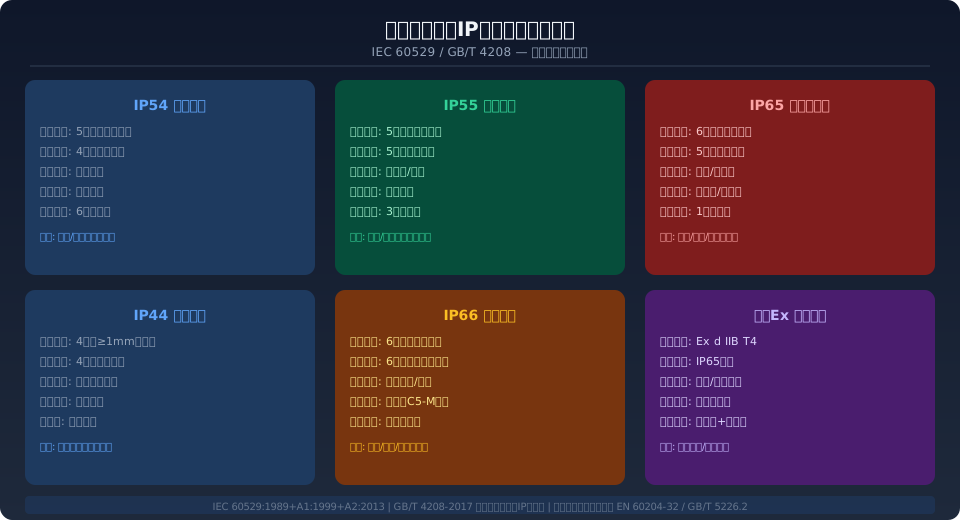
IP Protection Ratings Explained: Definitions & Selection Criteria
The first digit of an IP protection rating indicates the level of protection against solid foreign objects: Level 0 means no protection; Level 1 protects against solid objects ≥50mm in diameter; Level 2 against objects ≥12.5mm; Level 3 against objects ≥2.5mm; Level 4 against objects ≥1.0mm; Level 5 is dustproof (limited ingress permitted without affecting equipment operation); and Level 6 is dust-tight (complete protection against dust ingress). Crane workshop environments typically require Level 4 or higher dust protection, while metal-cutting shops with conductive metal dust should start at Level 5.
The second digit indicates the level of protection against water: Level 0 means no protection; Level 1 protects against vertically dripping water; Level 2 against dripping water at a 15° tilt; Level 3 against spraying water (at a 60° angle); Level 4 against splashing water (from any direction); Level 5 against water jets (12.5mm nozzle); Level 6 against powerful water jets (12.5mm nozzle at increased pressure); Level 7 against temporary immersion (1m depth for 30 minutes); Level 8 against continuous immersion (as specified by the manufacturer); and Level 9 against high-temperature, high-pressure water jets (80°C, 80–100 bar). Crane electrical cabinets typically only require Levels 4 through 6; immersion ratings (Levels 7–8) apply exclusively to specialized underwater equipment.
When selecting a rating, consider the following factors: first, the concentration and type of dust in the working environment (metal dust, coal powder, cement dust, fiber dust); second, waterproofing requirements (indoor splashing, outdoor rain, water washdown cleaning); third, temperature and humidity ranges with condensation risk; fourth, the presence of corrosive gases; and fifth, special requirements for explosion-proof zones. After evaluating these factors, determine the minimum protection rating by referencing the test methods outlined in IEC 60529 and GB/T 4208.
Six Common IP Ratings: Application Scenarios Quick Reference
| IPGrade | Dustproof Capacity | Waterproof Capacity | Applicable Working Conditions | Dust Type | Typical Model |
|---|---|---|---|---|---|
| IP44 | ≥1mm Foreign Object | Splash-Proof | cleanroom Indoor Workshop | Light Dust | Assembly Line LD Type Single Girder |
| IP54 | Limited Dustproof | Splash-Proof | Standard Industrial Workshop | General Dust | Overhead/LH Type Hoistdouble girder |
| IP55 | Limited Dustproof | Water Jet Proof | Semi-Outdoor/Canopy | Moderate Dust+Rainwater | Gantry Crane |
| IP65 | Fully Dustproof | Water Jet Proof | Heavy Dust/Semi-Outdoor | Metal Chips/Coal Powder/Cement | QDCasting/Metallurgical Crane |
| IP66 | Fully Dustproof | Heavy-Duty Hose-Down Protection | Offshore Platform/Dock | Salt Spray+Severe Wind and Wave Splash | Marine/Ship Crane |
| Ex d IP65 | Fully Dustproof+Flameproof | Water Jet Proof | Chemical/Petrochemical Explosion-proof Zone | Combustible Dust+Gas | LB/LXBExplosion-Proof Crane |
Electrical Cabinet Sealing & Installation Best Practices
The IP Protection Rating of an electrical cabinet is only as good as its on-site installation quality. The cabinet sealing system typically consists of the enclosure panels, door gaskets, cable entry sealing glands, and ventilation filter assemblies. Below is a step-by-step guide to the critical installation points.
Kelude recommends the following sealing and installation practices, which have been proven over years of field service to maintain the rated IP Protection Rating. Door Gaskets — Use continuous EPDM or silicone rubber foam gaskets with a compression ratio of 25%–35%. Gasket joints must be cut at a 45° angle and bonded or heat-fused, never butt-cut at 90° (which leaves gaps). After 3–5 years of service, gaskets lose elasticity and develop permanent compression set; replace them when compressed thickness falls below 60% of the original.
Cable Entry Points — All cable entry holes must be fitted with waterproof cable glands (nickel-plated brass or nylon PA66). The seal ring inner diameter must match the cable outer diameter within a tolerance of ±1 mm. Unused knockouts must be sealed with metal plugs — never tape or plastic bags. When multiple cables pass through a single opening, use a multi-hole sealing module rather than enlarging the hole.
Ventilation Openings — For cabinets rated IP54 and Above that require ventilation, install IP54-rated waterproof louvered vents or filter fan assemblies. Replace the filter media every 3–6 months. In high-dust environments (cement, coal powder), Kelude recommends using an enclosure air conditioner or Heat Exchanger instead of ventilation openings to achieve fully sealed cooling.
Grounding & Equipotential Bonding — Bond the cabinet door to the enclosure with a copper braid of at least 4 mm² cross-section to ensure Grounding continuity. Provide no fewer than two M8 bolted Grounding connection points between the mounting plate and the enclosure frame, with a Grounding Resistance of no more than 0.1 Ω.
Common Failure Modes & Protection Rating Degradation
| Fault Symptom | Root Cause Analysis | Involved IPGrade | Solution | Preventive Maintenance Interval |
|---|---|---|---|---|
| Contactor Contact Oxidation | Sealing Pieces Aging, Moisture Ingress | IP54IP55 | Replacement Sealing Pieces+Installation Anti-Condensation Heating Device | Sealing Strip Replacement Every 3 Years |
| PLCInput Signal Drift | Dust Ingress Terminal Block Formation of Leakage Path | IP44IP54 | Upgrade Enclosure Sealing+Adding Terminals Protective Cover | Monthly Blow-Down Cleaning |
| Frequency Inverter / VFDOverheat Trip | Filter Pad Clogging+Metal Dust Accumulation | IP54IP65 | Replacement IP65Enclosure+Cabinet Air Conditioner Heat Dissipation | Filter Pad Replacement Every 1 Month |
| Terminal Block Corrosion Fracture | Salt Spray+High Humidity Environment, Stainless Steel Unused Terminal | IP55IP66 | stainless steel cabinet + terminals + desiccant bag | Quarterly Inspection |
| Electrical Cabinet Bottom Water Accumulation | Cable Entry Hole Sealing Defective, Rainwater Backflow | IP54IP55 | Change Bottom Cable Entry to Side Cable Entry+Waterproof Joint | Pre-Rainy Season Inspection |
| Explosion-proof Enclosure Loss of Flameproof Integrity | Flameproof Joint Corrosion+gasket Hardening | Ex d IP65 | Apply Anti-Rust Oil on Flameproof Joint + Replace Gasket | Quarterly Maintenance |
Electrical Cabinet Maintenance Checklist
Kelude recommends following the maintenance schedule below to keep your crane's electrical cabinet in optimal condition. Maintaining the cabinet's IP Protection Rating depends on regular inspection and servicing. Key checks are organized by interval below.
Daily Inspection — Visually confirm the cabinet door is fully closed and the sealing strip is intact. Check the enclosure for signs of impact deformation and ensure no standing water or liquid leaks nearby. Listen for abnormal sounds inside the cabinet (e.g., contactor hum, fan noise) and watch for unusual odors such as burning or ozone.
Weekly Checks — Open the cabinet door and inspect for visible dust buildup or condensation traces. Use dry compressed air (max pressure 0.2 MPa) to blow dust off PLC modules, VFD heatsinks, and terminal blocks. Verify filter fans are operating properly; replace filter media if discolored or clogged.
Monthly Maintenance — Thoroughly check cable waterproof glands and joints for tightness, and inspect seal rings for aging or cracks. Measure the internal cabinet temperature and compare it with the ambient temperature to confirm adequate heat dissipation (internal temperature should not exceed ambient by more than 15°C). Use a 500V megohmmeter (insulation tester) to measure the insulation resistance of the main circuit to ground; it must be no less than 1 MΩ.
Quarterly Servicing — Remove sealing strips and check for loss of elasticity or permanent deformation; replace if necessary. For explosion-proof cabinets, verify the integrity of the anti-rust oil film on flameproof joints. Tighten all terminal blocks (with power disconnected) to address any loosening caused by vibration. Test the auto start/stop function of the anti-condensation heater inside the cabinet.
Related reading: For more on crane electrical systems, refer to the technical requirements on electric shock protection and equipotential bonding in IEC 60204-32 (the international equivalent of IEC 60204-32, Machinery Electrical Safety Standard), and the European standard EN 60204-32:2008 (Safety Requirements for Electrical Equipment of Cranes) for environmental adaptability of electrical cabinets. For troubleshooting guidance, see our article 6 Root Causes of Frequent Contactor Burnout in Cranes, where 55% of failure root causes are directly linked to electrical cabinet protection failure.
Frequently Asked Questions
Q: How significant is the real-world difference between IP54 and IP55 for crane electrical cabinets? Is the upgrade to IP55 worth the extra cost?
A: The core difference between IP54 and IP55 lies in the water protection rating — IP54 (degree 4) protects against splashing water from any direction, while IP55 (degree 5) protects against water jets (12.5mm nozzle delivering 12.5 L/min from any direction). For semi-outdoor installations under canopies or workshops that require regular water washing, the incremental cost of IP55 is roughly 15–20% above IP54, but it can effectively prevent downtime losses caused by moisture-related electrical failures during rainy seasons. For standard indoor workshops, IP54 is generally sufficient.
Q: What are the differences between GB/T 4208-2017 and IEC 60529 test methods? Are domestic certifications mutually recognized internationally?
A: GB/T 4208-2017 is identical to IEC 60529:2013 — the test methods and acceptance criteria are exactly the same. Reports issued by accredited third-party inspection bodies in China (such as CQC or Shanghai Electrical Apparatus Research Institute) are internationally recognized. Key tests include: dust test (talcum powder concentration 2kg/m³ for 8 hours) and water tests (varying nozzle diameters and flow rates for 3–10 minutes). For cranes exported to the EU, note that CE Certification may also require supplementary electrical safety tests per EN 60204-32.
Q: Can an existing IP54 electrical cabinet be upgraded to IP55 or IP65 by adding sealing strips?
A: Upgrading from IP54 to IP55 is achievable through targeted retrofits such as replacing the sealing strips with high-grade silicone rubber (instead of EPDM), swapping cable glands for IP55-rated waterproof fittings, and adding rain hoods over cable entries. However, reaching IP65 typically requires replacing the enclosure itself—IP65 demands continuously sealed weld seams on the cabinet body, gapless door sealing, and uniform waterproofing across all openings, which is difficult to guarantee with piecemeal modifications. The decision to retrofit versus replace should be based on the target protection rating; retrofitting generally costs about 30%–50% of a full replacement.
Q: Beyond Ex d flameproof protection, what IP Protection Rating is mandatory for explosion-proof crane electrical cabinets?
A: Per GB 3836.2, explosion-proof electrical cabinets (Ex d IIB/IIC T4–T6) must have an enclosure Protection Rating of at least IP54, though industry practice typically specifies IP65 as the minimum. Corrosion protection on the flameproof joints (applying 204-1 anti-rust oil or equivalent) is critical—once the flameproof surfaces corrode, the flame path (with a gap width not exceeding 0.2–0.4 mm) is compromised, and the explosion-proof integrity fails even if the IP rating remains compliant. We recommend inspecting the flameproof joint surfaces quarterly and reapplying anti-rust oil as needed.
Kelude Heavy Industry manufactures a full range of overhead, gantry, and explosion-proof cranes, with all electrical cabinets designed and manufactured in strict compliance with GB/T 4208-2017 and IEC 60529 standards. IP54 is the default Protection Rating, with customizable IP55/IP65/IP66 solutions available based on operating conditions. Explosion-proof models come with Ex d IIC T4 flameproof electrical cabinets, accompanied by an Explosion Proof Certificate and an IP65 test report at the time of delivery. For selection assistance or a tailored Technical Solution, please contact our engineering team.
