

Bridge Crane PLC Retrofit: 5-Step Relay vs PLC Comparison & Payback
Is PLC Retrofit Worth It for Bridge Cranes? 5-Step Relay-to-PLC Comparison and Payback Calculation
Upgrading a bridge crane's relay control system to a programmable logic controller (PLC) cuts fault response time from 30 minutes to under 60 seconds, reduces wiring nodes by 70%–80%, and lowers annual maintenance costs from approximately $5,300 to $1,200. For a 32t bridge crane, a full S7-1500 retrofit typically costs between $5,900 and $11,800, with a payback period of 1.5 to 3 years. The upgraded system supports PROFINET communication, remote diagnostics, and SIL3 safety integrity level.
Bridge cranes are the backbone of material handling in factory workshops. Many overhead cranes commissioned before 2010 still rely on relay-contactor control systems — control cabinets packed with dozens of intermediate relays, time delay relays, and contactors, all interconnected through hard wiring for logic interlocking. Every time production processes change or new safety interlocks are added, electricians must rewire the cabinet and swap relays — a time-consuming process that leaves room for hidden faults.
This article, grounded in the ISO 4301 Crane Design Standard and the IEC 61131-3 PLC programming standard, systematically compares relay control versus PLC control across five dimensions: fault diagnosis, wiring complexity, logic modification, safety functions, and maintenance costs. It also provides PLC selection recommendations and retrofit cost estimates for various crane capacities.
Why Legacy Relay Control Cabinets Need Retrofitting
Traditional bridge crane relay control cabinets implement logic through hard wiring and electromagnetic relays. Hoisting mechanism up/down interlocks, crane bridge left/right limit interlocks, and emergency stop circuits all rely on series/parallel relay contact connections. This approach was the industry standard two decades ago, but as equipment ages, the following problems become increasingly pronounced.
The first issue is difficult fault localization. Relay control systems have no diagnostic capability. When the crane suddenly stops, electricians must trace the fault point by point — Which relay contact has burned? Which wire has loosened? Which limit switch is stuck? Average troubleshooting time exceeds 30 minutes. If a fault occurs during the night shift with an inexperienced electrician on duty, half a day of downtime is not uncommon.
The second issue is rigid, non-adaptable logic. When production line adjustments require modifying the hoisting height limiter or adding new safety interlocks, physical rewiring is mandatory. Every additional interlock condition means another intermediate relay and a dozen more wires — the control cabinet grows increasingly bulky.
The third issue is accumulating safety hazards. Relay contacts gradually burn and oxidize through frequent open-close cycles, increasing contact resistance and leading to overheating or even contact welding. Per the TSG 51 Safety Technical Specification for Special Equipment, safety protection devices on cranes must undergo periodic inspection. However, latent faults in relay systems — such as contact resistance degrading from a normal value below 50 mΩ to over 500 mΩ — are extremely difficult to detect during routine inspections.
Relay vs. PLC: A Five-Dimension Head-to-Head Comparison
A PLC is not simply a "replacement" for relays — it fundamentally changes the architecture of crane electrical control. Below is a dimension-by-dimension breakdown of the technical differences.
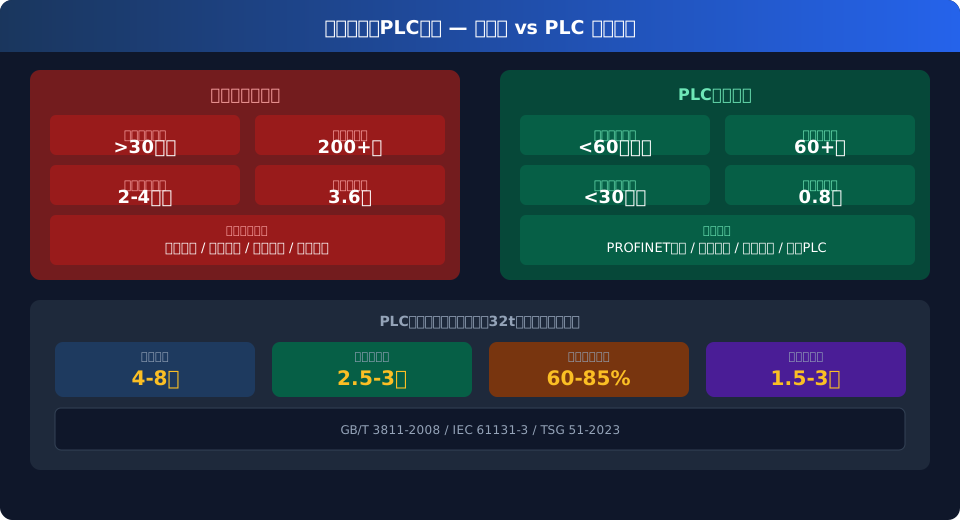
Fault Diagnosis Capability — When a relay control cabinet fails, electricians must use a multimeter to measure voltage and continuity point by point, averaging over 30 minutes per fault. PLC systems, by contrast, feature a built-in diagnostic buffer that automatically records every I/O signal change, communication interruption, and program anomaly. Technicians can read fault codes and pinpoint the exact module or channel within 60 seconds using TIA Portal software.
Wiring Complexity — Take a 32t double-girder bridge crane as an example: the relay approach requires approximately 50 intermediate relays and 200+ wiring nodes. The PLC approach deploys remote I/O stations near the crane via PROFINET bus, requiring only 60+ I/O points and a single network cable for all signal acquisition and control output.
Logic Modification Flexibility — Each interlock logic change in a relay system takes 2–4 hours (power-down, rewiring, relay replacement, testing). With a PLC, modifying ladder logic or SCL programs in TIA Portal takes effect immediately after compilation and download — typically under 30 minutes.
Safety Integrity Level — Relays can only implement simple limit-plus-emergency-stop interlocks and cannot meet SIL safety integrity requirements. The S7-1500F safety PLC achieves SIL3 via PROFIsafe protocol, supporting STO (Safe Torque Off) and SBC (Safety Brake Control) — meeting the safety redundancy requirements of TSG 51 for metallurgical cranes.
Maintenance Data Accumulation — Relay systems record no operational data whatsoever. PLCs automatically log each mechanism's cycle count, cumulative operating hours, fault types, and timestamps — providing the data foundation for full life cycle management and preventive maintenance.
| Comparison Parameter | relay control | PLC Control | Retrofit Gain |
|---|---|---|---|
| Fault Diagnosis | Manual Point-by-Point Inspection, Average30Minutes or More | PLCDiagnosis Automatic Buffer Zone Recording,60Second-Level Precision Positioning | Fault Response Acceleration30Times |
| Wiring Complexity | 200+Wiring Nodes,50+Units Intermediate Relay | 60+Pieces IOWiring Nodes, PROFINETBWCommunication | Wiring Reduction70-80% |
| Logic Modification | Rewiring+Replacement Relay,2-4Hours/Cycles | TIA Portal Software Modification, Less Than30Minutes | Modification Efficiency Improvement4-8Times |
| Safety Functions | Limit switch+Emergency Stop Button Simple Interlock | S7-1500FSafety PLC, SIL3Grade STO/SBC | safety level Upgraded To SIL3 |
| Operation & Maintenance Data | No Operational Data Logging, Experience-Based Judgment | Automatic Cycle Counting, Fault Logs | Data-Driven O& M, Preventive Maintenance |
| Annual Maintenance Cost | Approximately36,000 CNY(Including Labor+Spare parts) | Approximately8,000 CNY(IOModule Maintenance-Free) | Annual Savings28,000 CNY |
How to Calculate I/O Points for a PLC Retrofit
Before starting a retrofit, accurately counting the I/O points is the most critical step—it directly determines the PLC CPU model and module configuration. The calculation follows the principle of "enumerate each mechanism + 20% spare capacity."
Digital Input (DI) count—using a typical three-mechanism overhead crane (hoisting + bridge travel + trolley) as an example: the hoisting mechanism requires 8 DIs (upper limit switch, lower limit switch, overspeed switch, brake-open confirmation ×2); the crane travel mechanism requires 6 DIs (left limit, right limit, left deceleration, right deceleration, travel brake confirmation ×2); the trolley mechanism requires 6 DIs (forward limit, reverse limit, forward deceleration, reverse deceleration, trolley brake confirmation ×2).
The safety system needs 8 DIs (emergency stop buttons ×3, safety gate switches ×2, load moment limiter contacts ×2, overload contact ×1); miscellaneous signals account for about 10 DIs (pushbuttons, selector switches, etc.). That brings the total to 38 DIs, and with the 20% spare allowance, the final count is 46 points.
Digital Output (DO) count—the hoisting mechanism needs 4 DOs (hoist contactor, lower contactor, brake release, fault indicator light); the crane travel mechanism needs 4 DOs (travel left, travel right, brake release, fault light); the trolley mechanism needs 4 DOs (travel forward, travel reverse, brake release, fault light); the safety system requires 4 DOs (audible and visual alarm, safety relay reset); miscellaneous outputs total about 6 DOs. That adds up to 22 DOs, and with the 20% spare allowance, the final count is 27 points.
Analog Input (AI) and High-Speed Counter (HSC)—the load cell/weighing sensor occupies 1–2 AI channels (4–20 mA), the laser distance measurement takes 1 AI channel, and encoders use 1–3 HSC channels (one each for hoisting, bridge travel, and trolley). After applying the 20% spare allowance, the AI count is about 6 points and HSC about 4 points. Combining all of the above, the PLC system for a 32t three-mechanism overhead crane requires at least 46 DI, 27 DO, 6 AI, and 4 HSC points. A recommended configuration is an S7-1513 CPU with 3 DI16 modules, 2 DO16 modules, and 1 AI8 module.
Retrofit Cost Breakdown and Payback Period Analysis
The cost of a PLC retrofit is primarily made up of three components: hardware procurement, programming licenses, and commissioning labor. Costs vary significantly depending on the crane's rated capacity.
For electric single-girder or small bridge cranes up to 16t, an S7-1215C CPU is sufficient (150 KB working memory, max 100 DI/DO points). The full hardware package (CPU + DI/DO modules + power supply + network switch) costs approximately $900, the TIA Portal Basic programming software about $370, and commissioning over 3 days around $740—bringing the total budget to roughly $2,200.
For medium-sized bridge cranes in the 16–100t range, an S7-1513 or S7-1516 CPU is recommended (1 MB working memory, supports motion control TO). Hardware costs about $2,200, programming licenses around $1,200, and commissioning over 7 days approximately $2,200, for a total of about $5,900.
For heavy metallurgical cranes above 100t, or applications requiring a safety PLC, an S7-1516F safety-rated CPU is required, along with additional F-DI/F-DQ safety I/O modules. Hardware comes to roughly $6,700, programming licenses about $2,200, and commissioning over 10 days around $3,700—totaling approximately $13,000. These figures are estimates for hardware and labor; final pricing depends on the actual project quotation.
| Retrofit Items | S7-1200(Not Exceeding16t) | S7-1500(16-100t) | S7-1500FSafety-Certified(Not Exceeding100t) |
|---|---|---|---|
| CPUModule | S7-1215C 3,500 CNY | S7-1513 7,000 CNY | S7-1516F 28,000 CNY |
| IOModule | DIx32+DOx16 3,000 CNY | DIx64+DOx32 8,000 CNY | DIx64+DOx32+F-DI/F-DQ 18,000 CNY |
| Power Supply Module | SITOP 24V/10A 800 CNY | SITOP 24V/20A 1,500 CNY | SITOP 24V/20A 1,500 CNY |
| Programming License | TIA Portal Basic 2,500 CNY | TIA Portal Pro 8,000 CNY | TIA Pro+Safety 15,000 CNY |
| Installation & Commissioning | 3Days 5,000 CNY | 7Days 15,000 CNY | 10Days 25,000 CNY |
| Total Budget | Approximately15,000 CNY | Approximately40,000 CNY | Approximately88,000 CNY |
Payback period calculation: Taking a 32t double-girder bridge crane as an example, the total investment for an S7-1500 retrofit is approximately CNY 40,000 (about $5,900). After the retrofit, annual maintenance costs drop from CNY 36,000 to CNY 8,000 (saving CNY 28,000 per year), and fault downtime is reduced by 70% (based on 40 hours of downtime per year and CNY 500 per hour of lost production value, the annual recovered production loss is about CNY 14,000). Total annual savings amount to approximately CNY 42,000, putting the payback period at roughly one year.
Even with a conservative estimate of CNY 30,000 in annual savings, the payback period is only 1.5–2 years.
PLC Retrofit in 5 Steps: A Structured Implementation Guide
Retrofitting an overhead crane with PLC control is far more involved than simply swapping out the control box—it's a comprehensive upgrade of the entire electrical system. The work follows a standardized five-step process.
- Step 1: Site Survey and I/O Point Schedule — Begin with a complete mapping of the existing relay control cabinet: document the coil voltage and contact function of every relay, trace and label the start and end points of every wire, and then compile a full I/O point schedule and electrical schematic. This step takes 1–2 days and lays the groundwork for everything that follows.
- Step 2: PLC Hardware Selection and Procurement — Based on the I/O point count, multiply the DI/DO points by 1.2 (a 20% spare allowance) to determine module configuration. The recommended approach is a Siemens S7-1500 series CPU paired with ET200SP remote I/O modules. The procurement list should include the CPU, I/O modules, power supply module, PROFINET network switch, terminal blocks, and other accessories.
- Step 3: Control Cabinet Fabrication and Programming — In the workshop, complete the backplate mounting, module installation, and wiring for the new PLC control cabinet. In parallel, develop the ladder logic/SCL program in TIA Portal in accordance with IEC 61131-3. The program must include: state machines for the hoist, trolley, and crane bridge drives; safety interlock logic; fault diagnosis and alarms; and an HMI interface. Run full functional testing in the PLCSIM simulation environment.
- Step 4: On-Site Installation and Wiring — During a scheduled downtime window (holidays or maintenance shutdown), remove the old relay control cabinet and install the new PLC cabinet along with the ET200SP remote I/O station mounted on the crane. Wire each point according to the I/O schedule: use 0.75 mm² shielded cable for DI signal lines and 1.5 mm² cable for DO control lines. Verify every I/O point after wiring is complete.
- Step 5: Commissioning and Acceptance — After downloading the PLC program, run progressive commissioning in three stages: no-load, light-load, and full-load. Test each function systematically: hoist limit switches, crane travel limits, emergency stop, overload protection, and brake interlock. Upon completion, issue a commissioning report and arrange for a third-party inspection body to conduct supervision and inspection in accordance with TSG 51-2023 Crane Safety Technical Supervision Regulation. Hand over the crane for service only after acceptance is passed.
Frequently Asked Questions
Q: How long does a PLC retrofit take for an older overhead crane, and what's the production impact?
A: The on-site installation and commissioning phase for a single overhead crane typically takes 5–10 days, including removal of the old control cabinet, installation of the new one, wiring, and joint commissioning. We recommend scheduling the work during a major overhaul or the off-season. The main installation and wiring can be completed in a 48-hour weekend window, with commissioning carried out on weekdays. Production gaps during the retrofit can be managed by reallocating work schedules across other overhead cranes in the workshop.
Q: How do I choose between the S7-1200 and S7-1500 for a crane PLC retrofit?
A: Use 16t as the dividing line. For electric single-girder cranes or small bridge cranes up to 16t, the S7-1215C (150 KB working memory, up to 100 DI/DO points) keeps costs within CNY 15,000 (about $2,200). For medium double-girder bridge cranes in the 16–100t range, we recommend the S7-1513 or S7-1516 (supporting three-axis motion control TO and PROFINET IRT), with costs around CNY 40,000–80,000 (about $5,900–$11,800). For metallurgical or explosion-proof cranes requiring a safety PLC (SIL3 rating), choose the S7-1516F.
Q: Can I keep the existing cam controllers and master switches after the PLC retrofit?
A: Yes. The contact signals from the cam controllers are wired into the PLC as digital inputs, and the PLC executes control outputs based on the master switch signals and the current state machine logic. Operators will find the handling unchanged, but all interlocking and sequence control inside the electrical cabinet is now handled by the PLC program. If you want to take automation a step further, anti-sway control, positioning control, and remote monitoring can be added on top of the PLC program.
Q: How is the payback period for a PLC retrofit calculated? Are there real-world examples?
A: The payback period equals the total retrofit investment divided by (annual maintenance savings + annual production loss recovered from reduced downtime). For a 32t crane, the retrofit costs about CNY 40,000 (about $5,900), annual maintenance savings are CNY 28,000 (about $4,100), and the annual production value recovered from fewer fault shutdowns is about CNY 14,000 (about $2,100)—a combined annual benefit of CNY 42,000 (about $6,200), giving a payback period of roughly one year. In one steel plant, a project retrofitting three 50t overhead cranes with PLC control (total investment of CNY 250,000, about $37,000) showed the following results after two years of operation: annual fault downtime dropped from 127 hours to 18 hours (an 86% reduction), annual maintenance costs fell from CNY 128,000 to CNY 32,000 (a 75% reduction), and the full investment was recovered in 18 months.
Kelude Heavy Industry provides turnkey PLC retrofit services—from I/O point schedule development and PLC control cabinet fabrication to on-site installation and commissioning—supporting the full Siemens S7-1200/S7-1500 series. We have completed PLC retrofit projects for more than 120 overhead cranes across the steel, port, power, and automotive industries, with an average fault rate reduction of over 80%.
