

Electric Hoist Selection: CD to Metallurgical VFD
📋 Key Summary
Choosing an electric hoist doesn't start with the price tag — it starts with nailing down the operating conditions. For standard-temperature workshops, a general-purpose wire rope hoist will do. For high-temperature melting areas and continuous heavy loads, you need a metallurgical hoist. And for assembly lines that demand soft starts, stops, and precise positioning, a VFD hoist is the right call. The real differences among these three come down to insulation class, work duty, and speed control method. Pick the wrong one and you're not just sacrificing performance — you're looking at premature insulation aging, unreliable braking, and repeated downtime. This article breaks down the application boundaries and parameter thresholds for each type, turning "which one should I buy?" into "which one do I actually need?"
Selecting an electric hoist isn't a standalone product decision — it sits on two dedicated hoist standards. EN 14492-1:2019 (Wire Rope Electric Hoists) lays out the technical specifications for European Standard wire rope hoists, while ISO 23775:2020 (Technical Specifications for Wire Rope Electric Hoists) defines the internationally accepted performance and acceptance criteria. Drilling down, selection really comes down to three questions: What operating conditions will this hoist face? What parameters will it be accepted against? And which work duty classification does it fall under?
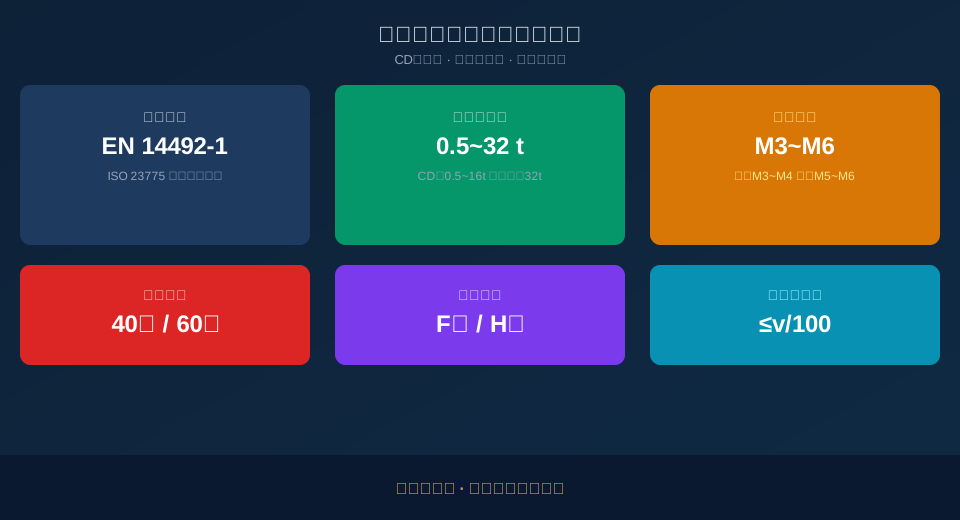
CD Type vs. Metallurgical vs. VFD: Which Standard Applies to Each
Electric hoists fall into three broad categories by operating condition — standard, metallurgical, and VFD — and each has completely different standard bases and application boundaries. The first step in selection is placing your equipment in the right framework.
Start with the standard type. The CD Type wire rope electric hoist is the most common hoist in workshops, designed for light-to-medium duty at normal temperatures. Its work duty typically falls between M3 and M4, with an ambient temperature range of -20°C to +40°C. These hoists are built to be "capable and affordable" — handling everyday lifting in warehousing, assembly, and general machining workshops, with lifting capacities usually ranging from 0.5t to 16t.
Now the metallurgical type. Any hoist operating near melting furnaces, pouring bays, or ladle hot-repair areas must be configured as a metallurgical hoist. The key difference isn't the housing — it's the motor insulation class and brake temperature resistance. Motor insulation must step up from Class F (155°C) to Class H (180°C), and work duty must rise from M3–M4 to M5–M6. Without these upgrades, running continuously at 60°C ambient temperature will cut insulation service life dramatically. For metallurgical hoist selection, refer to the high-temperature environment and continuous operation requirements in JB/T 7688 (Technical Specifications for Metallurgical Cranes).
Finally, the VFD type. This isn't about solving a temperature problem — it's about solving a speed problem. For assembly and transport scenarios that require soft starts and stops, slow-speed precise positioning, and anti-sway control, a standard hoist offers only a single speed. A VFD hoist uses a frequency inverter to achieve roughly a 1:10 speed control range, continuously adjustable from 0.8 m/min creep speed up to rated speed. A true VFD hoist needs a variable frequency motor — not a standard motor with a VFD bolted on.
Reading Core Parameters: Work Duty, Insulation Class, and Speed Range
In the comparison table for these three hoist types, what really sets them apart isn't lifting capacity — it's work duty, insulation class, and speed control range.
On lifting capacity, the CD Type covers 0.5t to 16t, while the metallurgical type can reach up to 32t because it handles heavy tasks like ladle lifting and scrap transfer. But a 10t CD hoist and a 10t metallurgical hoist may look similar in overall dimensions, yet their internal motor and brake configurations are completely different. The comparison table below lays out the differences:
| selection parameters | CD TypeGeneralHoist | metallurgicalHigh-Temperature TypeHoist |
|---|---|---|
| lifting capacity range | 0.5~16 t | 1~32 t |
| Work Duty / Classification | M3~M4 | M5~M6 |
| ApplicableAmbient Temperature | -20℃~+40℃ | -25℃~+60℃ |
| motor insulation class | FGrade(155℃) | HGrade(180℃) |
| TypicalLifting Speed | 8 m/min Single-Speed | 7~10 m/min Two-Speed |
There is an engineering principle that most buyers overlook: thermal aging of insulation follows the Arrhenius relationship, and for every 8°C–10°C rise in operating temperature, insulation life is cut in half. The 25°C rated temperature gap between Class F (155°C) and Class H (180°C) translates into a multiple-fold difference in long-term service life—this is precisely why metallurgical operating conditions demand Class H insulation, and the underlying logic behind why a general-purpose hoist sent into a high-temperature workshop "burns out its motor within two years."
When Kelude Heavy Industry performs matching selection for European Standard (EN) hoist packages, the practice is to first align the temperature resistance grade of this component with the crane classification group, then work backward to determine the motor configuration—because JB/T 5315 "Conical Rotor Motors for Electric Hoists" sets explicit requirements for motor starting, braking, and temperature rise limits. Choose the wrong motor, and the brake and gearbox will be wrong along with it.
Electric Hoist Acceptance: Insulation Resistance, Brake Slip Distance & Noise
Whether a hoist selection actually holds up must ultimately be judged by inspection data. Insulation resistance, brake slip distance, and noise are three hard requirements that cannot be sidestepped.
Each of these three indicators rests on its own rationale: insulation resistance measures the integrity of the winding-to-ground insulation, brake slip distance verifies whether the suspended load drops during a full-load emergency stop, and noise exposes early abnormalities in gears and bearings. Locking down these three items during acceptance inspection can block the vast majority of hoists that are "shipped defective." Below is the complete acceptance table covering these three hard requirements plus the static and dynamic load tests and temperature rise:
| inspection items | DeterminationIndicator | inspection method | Consequences of Non-Conformance |
|---|---|---|---|
| Insulation Resistance | Cold State Not Less Than0.5 MΩ | 500VMegohmmeter (Insulation Tester)Winding Measurementtack-upGround | insulation breakdown、Leakage |
| brake slip distance | Not ExceedingLifting Speedof1/100 | Full loadLoweringemergency stopDownward Drift Measurementdistance | Load slipping、load drop |
| No-loadnoise | Not Higher Than85 dB(A) | no-load operationDistance1mMeasurement at | GearorBearingAbnormal |
| Static load test | 1.25multiples of rated loadNonepermanent deformation | Suspension10minAfterinspection | structural strengthInsufficient |
| Dynamic Load Test | 1.1multiples of rated loadRepeated Raising and Lowering | Lifting and Lowering andBrakingEach3Times | BrakingortransmissionFailure |
| Motortemperature rise | winding temperature riseNot ExceedingInsulation ClassLimit Value | Measurement After Continuous Operationtemperature rise | insulationAccelerationAging |
| Grounding Resistance | Not Greater Than4 Ω | GroundingContinuity Measurement | Electric Shock Risk |
When Kelude's acceptance team receives a European-standard hoist as a complete unit, they run through this checklist item by item — and they are especially unforgiving about brake slip distance, which maps directly to the hoisting safety requirements in FEM 1.001 Crane Design Standard. Once the crane is put into operation, it also falls under the periodic inspection framework of TSG 51-2023 Crane Safety Technical Supervision Regulation. Thinking through acceptance criteria at the selection stage saves you from repeated rectification headaches down the road.
Three Common Hoist Selection Mistakes: Metallurgical Isn't Just a Shell, VFD Isn't Just an Inverter
The most damaging selection pitfalls come from three assumptions that sound reasonable but actually push equipment toward its failure limits. Each one deserves a closer look.
The most common mistake is treating a metallurgical hoist as simply "a standard hoist with a heat-resistant shell." Painting the enclosure with heat-resistant coating does not make the motor heat-resistant. The real dividing line is a complete package: Class H insulation motor, high-temperature-resistant brake, and the corresponding work duty. A so-called metallurgical unit that only swaps the shell will burn out its motor first after a few months of continuous operation at 60°C.
Another frequent misconception is treating Variable Frequency Speed Control as just "adding a VFD." Connecting a standard Conical Rotor Motor directly to a frequency inverter causes insufficient heat dissipation at low speeds and a mismatched torque curve — which actually accelerates damage. A true VFD Hoist requires a dedicated variable frequency motor and matched brake control to achieve stable, continuous speed control from 0.8 m/min up to rated speed.
A more subtle mistake is thinking "sizing up the lifting capacity can't hurt." A larger lifting capacity means the hoist dead weight, crane rail load, and procurement cost all go up together — but the work duty doesn't automatically increase just because you picked a bigger number. What you need to match is the actual lifting frequency and load spectrum, not an ever-higher capacity rating.
The technical manager at Kelude Heavy Industry pointed out: "Nine out of ten hoist selection failures come from fixating on lifting capacity alone while ignoring work duty and insulation class — the two far more critical dimensions. Submit your full operating condition parameters first, then discuss which model to choose. It saves far more than trying to fix things after the fact."
📚 Related reading: Metallurgical and Explosion-proof Conditions: Can Imported or Domestic European-Standard Cranes Handle Them Better? | How Do FEM and GB Work Duty Classifications Convert? The Actual Gap Between European-Standard and Chinese National Standard Cranes
FAQ
Q: What exactly is the difference between a CD Type Electric Hoist and a metallurgical electric hoist?
A: The difference comes down to insulation class and work duty. The CD Type general-purpose hoist uses a Class F insulation motor (155°C) with a work duty of M3~M4, suitable for workshops at -20°C to 40°C. The metallurgical version uses a Class H insulation motor (180°C) with work duty raised to M5~M6, capable of continuous operation at 60°C ambient temperature. Based on insulation thermal aging principles, every ~8°C rise in temperature halves service life — using Class F insulation in high-temperature environments is essentially scrapping the motor ahead of schedule.
Q: Which standards matter most for electric hoist selection?
A: For the hoist itself, refer to EN 14492-1 and ISO 23775 — the former sets technical specifications for European-standard wire rope hoists, the latter defines general acceptance criteria. For overall crane design, FEM 1.001 governs work duty and load combination, while TSG 51-2023 covers safety supervision. Each standard handles a different segment; skip any one and you risk getting stuck at the acceptance stage.
Q: What motor power does a 5-ton electric hoist typically use with a conical rotor motor?
A: A 5-ton CD Type hoist typically uses a conical rotor motor around 7.5 kW with a lifting speed of 7–8 m/min. Exact power depends on lifting height and work duty — for M4 and above, it's advisable to leave a power safety margin. Final parameters are subject to the manufacturer's nameplate and the actual contract.
Q: How much more does a metallurgical VFD electric hoist cost compared to a CD Type?
A: At the same capacity, the metallurgical version commands a noticeably higher purchase price due to two key configurations — the Class H insulation motor and the high-temperature-resistant brake. The VFD version adds the cost of a frequency inverter and variable frequency motor on top. Kelude Heavy Industry's complete quotations are calculated individually based on lifting capacity, work duty, and supporting components — subject to the actual contract.
Kelude Heavy Industry specializes in custom manufacturing of 50t to 300t European Standard Double-Girder Bridge Cranes. Electric hoist and complete crane selection and matching can be evaluated together — define your operating conditions first, then discuss configuration. Get the selection decision right from the start.
