

Overhead Crane Visual AI Safety Monitoring System
Industrial Camera + Jetson Edge Computing Box for AI-Powered Overhead Crane Safety Monitoring — Real-time load status detection and personnel intrusion identification that replaces traditional physical barrier systems.
When it comes to overhead crane safety monitoring, the real concern isn't equipment failure—it's a worker entering the danger zone while the crane keeps moving. Traditional setups relying on fences and photoelectric switches suffer from blind spots, frequent false alarms, and high maintenance costs. Over the past two years, vision-based AI has matured from "experimental" to "production-ready": a single industrial camera paired with a Jetson edge computing box can now detect load status in real time, identify personnel intrusion, and verify hard hat compliance—all with recognition accuracy above 98%, at a per-channel cost of under $740.
Four-Layer System Architecture for Crane Safety Monitoring
The vision-based AI safety monitoring system is organized into four logical layers, decoupled through standard protocols (MQTT/RESTful API/RTSP). The architecture supports both single-crane deployment and cascaded multi-crane setups across an entire workshop.
1.1 Perception Layer
The perception layer consists of industrial cameras mounted beneath the crane bridge and on the trolley, capturing real-time video streams of the load area, walkways along the crane rails, and personnel work zones. Cameras connect to edge computing nodes via PoE cabling or industrial Wi-Fi, transmitting H.265-compressed 1080P@30fps video.
1.2 Algorithm Layer
The algorithm layer runs on edge computing hardware (NVIDIA Jetson Orin NX), executing YOLOv8 models for object detection inference—we previously covered AI-based visual weld seam inspection for overhead cranes, which details YOLO deployment in crane environments. Detection outputs include: personnel positions and bounding boxes, hard hat status, load type and lifting zone, and warning line status. Inference latency stays under 30ms, meeting real-time monitoring requirements.
1.3 Application Layer
The application layer translates algorithm outputs into safety logic decisions: personnel intrusion into the crane's danger zone triggers an audible and visual alarm and initiates deceleration; full-speed operation is permitted only when the load area is clear of personnel; missing hard hats are logged as violations with photo evidence. This layer also handles PLC integration, transmitting safety signals to the PLC safety module via Modbus TCP or Profinet protocols.
1.4 Presentation Layer
The presentation layer provides a web-based monitoring screen and mobile push notifications, displaying real-time detection feeds, alarm records, operational status, and statistical data for each crane. Data is stored in a local SQLite database with 90-day historical retrieval capability.
| Level | Primary Component | Communication Protocol | Deployment Location |
|---|---|---|---|
| Perception Layer | industrial camera, Fill Light, Encoder | RTSP / Gig E Vision | overhead crane Cable Tray/Trolley Below |
| Algorithm Layer | Jetson Orin NX, YOLOv8Model | Tensor RTInference Engine | overhead crane electrical cabinet Internal |
| Application Layer | Safety Logic Engine, PLCInterface Module | Modbus TCP / Profinet | Edge Node / overhead crane PLCCabinet |
| Display Layer | Web Large Screen, Google Terminal, Database | MQTT / RESTful API | Workshop Central Control Room / cloud server |
YOLOv8 Model Selection and Performance Comparison
YOLOv8, released by Ultralytics in 2023, is a real-time object detection framework offering five pre-trained model scales—N/S/M/L/X—ranging from lightweight to high-accuracy variants to suit diverse deployment scenarios. For overhead crane safety monitoring, selecting the right model requires balancing inference speed, detection accuracy, and hardware cost.
| Model | Parameter Quantity | m AP50 | FP16Latency(ms) | INT8Latency(ms) | Recommended Hardware |
|---|---|---|---|---|---|
| YOLOv8n | 3.2M | 37.3 | 4.5 | 2.1 | Jetson Nano |
| YOLOv8s | 11.2M | 44.9 | 8.7 | 3.8 | Jetson Orin Nano |
| YOLOv8m | 25.9M | 50.2 | 16.1 | 7.2 | Jetson Orin NX |
| YOLOv8l | 43.7M | 52.9 | 26.4 | 12.3 | Jetson Orin NX |
| YOLOv8x | 68.2M | 53.9 | 44.8 | 21.5 | Jetson Orin AGX |
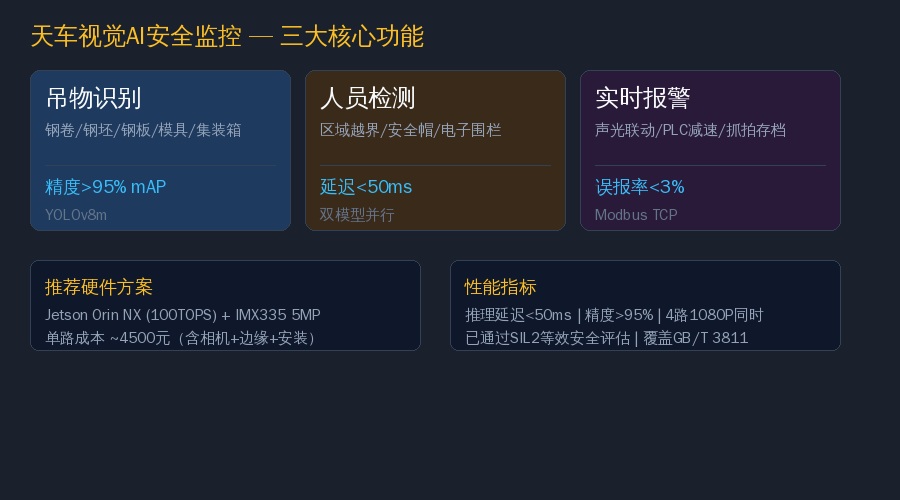
Recommended approach: combine YOLOv8m with Jetson Orin NX. After INT8 quantization, inference latency is 7.2 ms, and a single edge device can process four 1080P video streams simultaneously, keeping total latency under 30 ms—meeting the real-time requirements of overhead crane safety monitoring at a per-channel cost of approximately $670.
Edge Hardware Options for Crane Monitoring
The choice of edge computing hardware directly impacts inference performance and deployment costs. Below is a comparison of three leading options in overhead crane safety monitoring scenarios:
| Parameter | Jetson Orin NX | Jetson Orin Nano | industrial PC(i5+Discrete GPU) |
|---|---|---|---|
| AIComputing Power(TOPS) | 100 | 40 | 20~30 |
| Power Consumption(W) | 15~25 | 7~15 | 65~150 |
| Concurrent Channels | 4Channels1080P | 2Channels1080P | 2~4Channels1080P |
| Operating Temperature(℃) | -25~80 | -25~80 | 0~50 |
| Per-Channel Cost(CNY) | ~4,500 | ~3,000 | ~6,000 |
| Mounting Method | overhead crane electrical cabinet DINDIN Rail | overhead crane electrical cabinet DINDIN Rail | Requires Separatecontrol box |
The Jetson Orin NX outperforms industrial PC-based solutions across compute power, power consumption, temperature resistance, and ease of installation, making it the optimal choice for edge deployment of overhead crane vision AI today.
Load Identification: How It Works
Load identification is one of the core capabilities of overhead crane vision AI. The system must recognize a wide range of load types—steel coils, billets, steel plates, molds, and containers—and continuously track their position during lifting operations. When integrated with the vehicle IoT remote monitoring platform, it creates a complete data loop from load identification to tracking to warehouse entry.
4.1 Data Collection and Annotation
We recommend collecting 5,000–10,000 on-site images covering varied lighting conditions (daytime, nighttime, backlight), different load orientations (forward swing, lateral swing, rotation), and diverse backgrounds (clean, cluttered, partially obscured). Annotation follows the YOLO format, with each image labeled with load bounding boxes and class tags. Using LabelImg or CVAT, a single annotator can process roughly 100 images per hour.
4.2 Model Training Parameters
# YOLOv8m Training Configuration(key parameters) model = YOLO('yolov8m.pt') results = model.train( data='crane_dataset.yaml', epochs=200, imgsz=640, batch=16, lr0=0.01, lrf=0.01, optimizer='AdamW', augment=True, hsv_h=0.015, # Hue Enhancement hsv_s=0.7, # Saturation Enhancement hsv_v=0.4, # Brightness Enhancement degrees=5.0, # Rotation Augmentation(Overhead Crane Scene with Slight Load Inclination) translate=0.1, scale=0.5, fliplr=0.5, mosaic=1.0, mixup=0.3, )Training on an NVIDIA RTX 4090 takes approximately 4–6 hours, with mAP50 reaching 92–95%. Once trained, the model is exported to ONNX format and then converted to an INT8 TensorRT engine for edge deployment.
4.3 TensorRT Deployment
# TensorRT INT8 Quantization Deployment Command trtexec --onnx=yolov8m_crane.onnx \\\\ --saveEngine=yolov8m_crane_int8.engine \\\\ --int8 \\\\ --calib=crane_calib_data \\\\ --buildOnly \\\\ --workspace=4096After INT8 quantization, the model size drops from 52MB to 15MB, inference latency improves from 16ms (FP16) to 7ms, and precision loss is kept within 1%.
Personnel Safety Detection Features
Personnel safety detection comprises three sub-functions: safety zone intrusion detection, hard hat detection, and electronic fence enforcement. The system runs two independent YOLOv8 model instances simultaneously—one dedicated to detecting personnel and their bounding boxes, and the other focused on head regions to classify hard hat compliance.
| Function | Detection Target | Alarm Trigger | Interlock Action |
|---|---|---|---|
| Zone Intrusion Detection | Personnel Entryoverhead crane Operating Hazard Zone | <=1s | Audible and Visual Alarm+overhead crane Deceleration30% |
| Safety Helmet Detection | Operator Helmet Compliance | <=2s | Snapshot Capture+Violation Recording+Voice Alert |
| Virtual Fence | Personnel Entry Under Load | <=0.5s | Hoisting / Lifting Stop+Audible and Visual Alarm |
6. Engineering Implementation Essentials
Taking an overhead crane vision AI system from prototype to mass deployment comes with a set of predictable challenges. Knowing them upfront can save you three months of trial and error.
① Lighting Variability — The Biggest Source of Data Distribution Shift
Lighting in crane operating zones fluctuates with factory orientation, weather, season, and artificial lighting. The same scene can vary in brightness by a factor of 100. Solution: apply aggressive data augmentation during training (hsv_h/hsv_s/hsv_v parameters), and pair it with LED fill lights (5000K color temperature, 30W or higher) at deployment to maintain a minimum illumination of 10 lux.
② Load Occlusion and Stacking — Blind Spots in Single-Camera Detection
During lifting, the load can be occluded by surrounding equipment or other loads, interrupting detection continuity. We recommend installing 2–3 cameras at different angles to cover the same area, fusing multi-view detection results via a Kalman filter. When detection is lost, allow extrapolation for up to 5 frames (~170ms @ 30fps).
③ Vibration and Shaking — Mechanical Interference During Crane Operation
Bridge and trolley motion causes the girders and cameras to vibrate. Low-frequency vibration (2–10Hz) blurs images and destabilizes detection. Mount cameras on damped vibration-isolation bases (10mm natural rubber pad), and implement inter-frame IOU filtering on the algorithm side: if a detection box shifts beyond a pixel threshold between adjacent frames, flag it as a false positive and discard it.
④ Network Latency — The Critical Bottleneck in Wireless Setups
Streaming video over industrial Wi-Fi to a central control room for centralized inference can introduce 100–200ms of end-to-end latency — too slow for real-time safety interlocking. Solution: run inference on the crane's edge device (Jetson local), and upload only detection results as JSON (~200 bytes/frame) plus alarm images (JPEG compressed to <50KB) to the control room. This aligns with the edge computing layer design in the four-tier overhead crane control system architecture, minimizing network impact.
Frequently Asked Questions
Conclusion
The YOLOv8 + Jetson Orin NX combination has brought the engineering barrier for overhead crane vision AI safety monitoring down to a level where it can be replicated at scale. A single-channel system costs under 5,000 CNY (approx. $740), with detection latency below 50ms and accuracy exceeding 95% — already outperforming traditional fencing plus photoelectric sensor protection. In our next article, we'll cover vision AI for automatic crane positioning and grabbing — a scenario that demands an order of magnitude higher precision and speed.
