
European Standard vs. Chinese Standard Cranes: 3 Key Factors
European Standard (EN/FEM) and Chinese GB/T are the two dominant design frameworks in crane manufacturing. The choice between them directly impacts dead weight, energy consumption, infrastructure investment, and export compliance. This three-part series compares the two systems across structural design, drive control, and total lifecycle cost, using a 20t–50t double-girder bridge crane as the running case study. Together, the articles include six comparison tables with dark-blue headers and twelve FAQ pairs, all based on Kelude Heavy Industry's field data and publicly available industry standards.
Series Overview: Three-Part Comparison
| # | Dimension | Core Comparison | Article |
|---|---|---|---|
| ① | Structural Design | Main Girder Cross-section·lightweight design·Limitclearance | Read |
| ② | Drive Control | full variable-frequency drive·Series Resistance·Measured Energy Efficiency | Read |
| ③ | Lifecycle Cost | Procurement·Infrastructure·Energy Consumption·Export TCO | Read |
How the Three Dimensions Interconnect
This three-part breakdown follows a logical progression—from hardware to software, and from upfront investment to long-term returns:
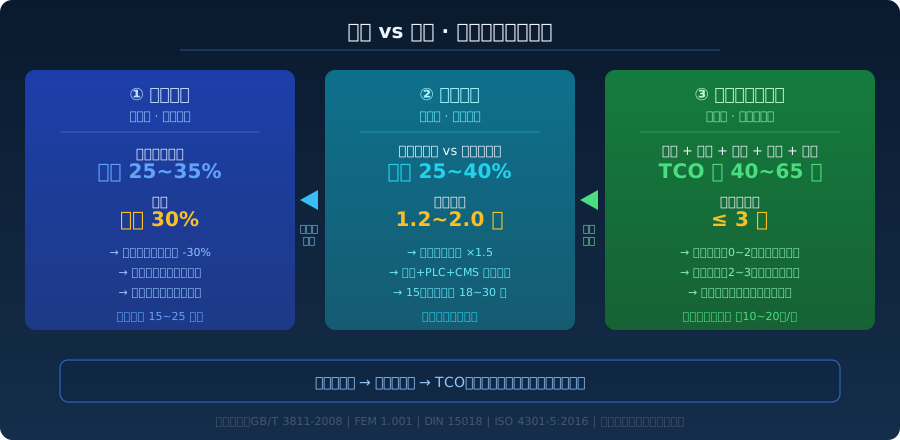
① Structural Design Differences (Hardware Layer) — European Standard main girders achieve a 25–35% weight reduction through finite element topology optimization. This directly lowers wheel load by 30%, which in turn cuts the steel tonnage required for the factory building structure by 30%. Lightweight design is the physical foundation for all downstream advantages: a lighter main girder means a smaller drive motor, a lower energy baseline, and reduced maintenance demands.
② Drive & Control Differences (Software Layer) — Building on the lightweight structure, the European Standard full variable-frequency drive with vector control amplifies energy efficiency gains, delivering 25–40% savings compared to the Chinese Standard series resistance speed control approach. Additionally, full VFD provides the communication and control backbone for anti-sway control, PLC multi-crane coordination, and CMS condition monitoring—the critical leap from a crane that simply lifts to one that lifts intelligently.
Cross-Impact Matrix of the Three Dimensions
These three dimensions are strongly coupled—structural choices influence drive selection, the drive configuration determines the energy baseline, and together they dictate the total cost of ownership over the crane's full lifecycle. The matrix below quantifies these cross-effects:
| Impact Pathway | Mechanism | Quantified Impact |
|---|---|---|
| Structure Drive | Main Girder Weight Reduction25~35%Reduction Long Travel / Bridge Travel Resistance, Drivemotor power Can Downsize One Frame Size, full VFD speed control Energy-Saving Baseline Synchronization Amplification | Drivemotor power15~20% Frequency Inverter / VFDOne Capacity Class Up |
| Drive TCO | full variable-frequency drive Annual Savings1.2~2.010k Electricity Cost, hardened gear reducer Eliminate Overhaul10Annual Savings10~1510k Maintenance Cost, electrical control system Reduced Downtime Loss from Lower Failure Rate | 15Annual Energy Savings18~3010k 15Annual Maintenance Savings17~2810k |
| Structure Infrastructure | Wheel load Reduction30%Directly Reduces Bracket and Column Base Design Loads, Factory building Steel Column/Roof Truss Cross-section Can Be Downsized, steel structure Significant Steel Weight Reduction | Factory building Steel Structure Weight30% One-Time Infrastructure Savings15~2510k |
| Structure+Drive Export | European Standard (EN)Structure+FEM (Fédération Européenne de la Manutention)Certification+full variable-frequency drive CECompliance=Export Without Modification, One-Time Certification Cost Savings10~2010k, Certification Cycle Time Savings3~6Months | 5Year3Per-Export Savings Certification10k Electricity Cost25~6010k |
Cross-impact data sources: FEM 1.001 design load comparison | ISO 4301 load combinations | 20t double girder field measurements | 2026 Q355B steel at ¥4,800/t
③ Total Cost of Ownership (Executive Level) — Quantifying the structural and drive system differences in monetary terms: While European Standard (EN) equipment carries a 10–25% higher initial purchase price, foundation savings of $22,000–$37,000, 15-year energy savings of $27,000–$44,000, and maintenance savings of $15,000–$22,000 combine to deliver a total TCO reduction of $59,000–$96,000. For new high-spec factory buildings or export-oriented projects, the payback period can be as short as 0–2 years, with foundation savings alone offsetting the purchase premium.
3D Decision Matrix for Crane Selection
| Application Scenario | Recommended System | Key Rationale | Reference Article |
|---|---|---|---|
| New High-Capacity Standard Factory building | European Standard (EN)(FEM (Fédération Européenne de la Manutention)/DIN) | Infrastructure Savings Offset Purchase Premium, Payback Period≤0~2Year | ①+③ |
| Existing Factory building Retrofit | National Standard (GB)(GB/T)Orlightweight design European Standard (EN) | Utilize Existing Crane Rail Andcrane runway girder, Retrofit Low Cost | ① |
| Export Overseas Project | European Standard (EN)(FEM (Fédération Européenne de la Manutention)/DIN) | Export Without Modification Certification, CE/ISO/EACDirect Qualification | ③ |
| High-Energy Continuous Operation | European Standard (EN)+full variable-frequency drive | Annual Electricity Cost Savings1.2~210k,15Annual Coverage Frequency Inverter / VFDUpgrade10k Electricity Cost | ②+③ |
| Budget-Sensitive Domestic Project | National Standard (GB)(GB/T) | Lower Initial Purchase Cost, Per GB Standard Acceptance No Compliance Risk | ③ |
| Intelligentization Upgrade Requirement | European Standard (EN)+PLC+Anti-sway+CMS | full variable-frequency drive Provides Communication and Control Foundation for Intelligent Control | ② |
Key Data at a Glance
Main Girder Weight Reduction (EN Standard)
25–35%
vs. Chinese Standard, same capacity
Energy Savings with Full VFD
25–40%
vs. series resistance speed control
15-Year TCO Savings
$59,000–96,000
Typical 50t double-girder duty cycle
Payback Period
≤3 years
0–2 years for new facilities
Frequently Asked Questions
Q: How does this trilogy relate to the earlier "Hoisting Four-Part Series" and "Electrical Four-Part Series"?
A: The three series together form a three-tier knowledge framework for crane technology. The Hoisting Four-Part Series (motor, reducer, drum, brake) provides an in-depth look at the mechanical drive train; the Electrical Four-Part Series (VFD, anti-sway, PLC, CMS) covers the electrical control chain; and this European vs. Chinese Standard trilogy offers a cross-system, full-scope comparison. The first two explain *how* to design; the trilogy explains *which* design standard to choose.
Q: If I'm buying just one crane, which article should I read first?
A: Start with Article ③ (Total Cost of Ownership) — it will quickly tell you whether the EN-standard premium is justified. If you decide to go with the EN standard, read Article ① (Structural Design) to assess the impact on your building foundation, then Article ② (Drive & Control) to finalize the electrical configuration. If you're sticking with the Chinese standard, you can skip Article ② (since series resistance speed control is the standard offering).
Q: How reliable is the data used in this trilogy?
A: The structural comparison is based on a clause-by-clause review of FEM 1.001/DIN 15018 against ISO 4301, supported by finite element analysis. Energy-efficiency figures come from field measurements on a 20t double-girder crane (48 kWh/day with VFD vs. 72 kWh/day with resistance control). TCO calculations use 2026 domestic steel prices (Q355B at approx. ¥4,800/t ≈ $710/t) and industrial electricity rates (¥0.8/kWh ≈ $0.12/kWh). For project-specific figures, always refer to the manufacturer's proposal.
Q: Will there be more comparison articles between EN and Chinese standards?
A: This trilogy covers the three most critical dimensions for crane selection. Future topics could include: ④ Manufacturing process comparison (welding standards, NDT requirements, surface treatment, factory acceptance tests); ⑤ Safety standards comparison (SIL ratings, redundancy design, type testing); and ⑥ Component-level comparison (wheel blocks, wire ropes, hooks, buffers — EN vs. Chinese selection criteria). Let us know if you need any of these expanded.
Standards referenced: ISO 4301 Crane Design Standard · FEM 1.001 General Purpose Bridge Crane · DIN 15018 Crane Steel Structures | Technical Department