

GB/T 45163.1 Crane Intelligence Levels
The intelligent transformation of lifting appliances is accelerating, with over 65% of new projects in the industry now requiring an automated control system. In complex operating conditions, scientifically evaluating the level of intelligence has become critical. This article provides an in-depth analysis of the grading standards and terminology system for intelligent systems, helping you clarify the application logic of AI technology in lifting equipment—from basic data acquisition to advanced autonomous decision-making—and thoroughly examining the technical characteristics and implementation points at each level.
When evaluating a retrofit solution for lifting equipment, we must align with the specific requirements for electric control equipment outlined in GB/T 28264 Safety Monitoring and Management System, while also referencing the special specifications for petrochemical applications in SH/T 3415 to ensure system reliability across different operating conditions. Furthermore, for specialized cranes used in power generation and wind energy sectors, it is essential to comply with relevant technical clauses in DL/T 5450 and DL/T 1419, thereby constructing a complete and compliant intelligent evaluation framework.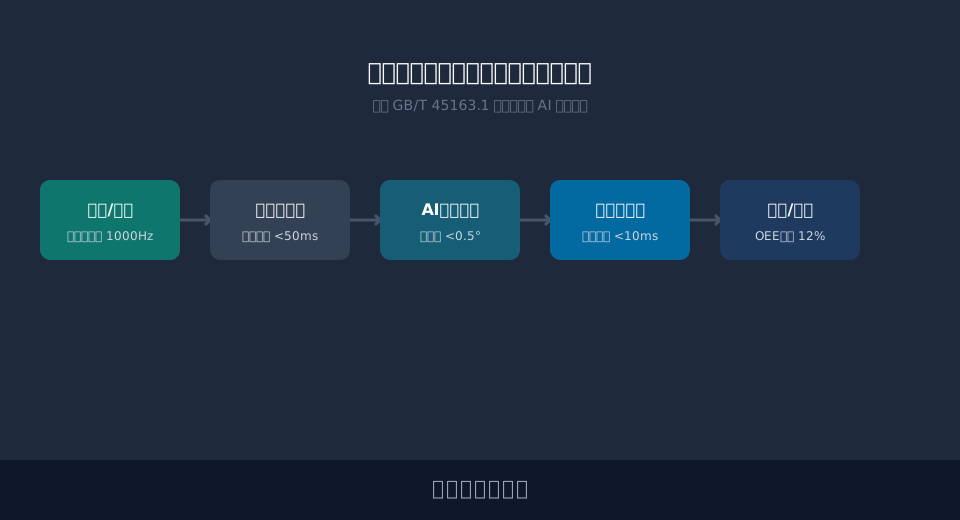
This article begins with the foundational concepts of intelligent grading, progressively delving into the specific application of AI algorithms in anti-sway and anti-collision scenarios. It then analyzes the data flow logic of system architecture, discusses engineering case studies and selection costs, and finally addresses common misconceptions in routine maintenance. Through this five-dimensional breakdown, we present a comprehensive technical guide for intelligent transformation.
Core Definitions and Terminology in Intelligent System Grading Standards
When undertaking an automation upgrade for lifting equipment, clarifying basic terminology is the prerequisite for all work. According to relevant specifications, intelligent systems are typically divided into three main levels, each with significantly different requirements for hardware configuration and software algorithms.
Level-1 systems primarily rely on basic sensor data acquisition, with signal response times strictly controlled within 50 milliseconds to ensure immediate transmission of control commands. Level-2 systems introduce preliminary logical judgment modules on this basis, requiring the integration of at least three AI algorithm sub-modules, such as automatic positioning and load spectrum assessment. Level-3 systems achieve full autonomous decision-making, capable of completing complex lifting and transport tasks without human intervention.
Understanding the precise definitions of these terms helps avoid disputes during acceptance testing. For instance, there is an essential difference between "automatic positioning" and "automatic addressing" regarding accuracy requirements: the former focuses on the absolute precision of coordinate points, while the latter emphasizes the rationality of path planning.
"In intelligent grading assessments, the system's autonomous decision-making capability is the core indicator distinguishing Level-2 from Level-3 systems. A Level-3 system must possess the ability to automatically adjust operating parameters under sudden conditions, with an adjustment latency not exceeding 200 milliseconds."
⚠️ Note
When consulting technical manuals, do not confuse "semi-automatic" with "intelligent." Semi-automatic refers only to the electrification of execution mechanisms, whereas intelligence must include data processing and feedback closed loops; the two have fundamental differences in system architecture.
Application of AI Algorithms in Crane Anti-Sway and Anti-Collision
As working environments become increasingly complex, traditional mechanical anti-sway devices can no longer meet the demands of high-precision lifting. Introducing mature AI algorithms has thus become inevitable. In anti-sway control, deep learning models via AI anti-sway algorithm enable the system to predict the motion trajectory of the lifting spreader in real-time, strictly controlling the sway angle within 0.5 degrees.
This algorithm considers not only current wind speed and load mass but also integrates historical operational data to continuously optimize control parameters. In the field of anti-collision, intelligent systems also perform exceptionally well. By fusing LiDAR and vision sensors, the system constructs a 3D model of the surrounding environment. When obstacles are detected, the early warning mechanism for the anti-collision safety distance is triggered, typically setting the buffer distance at 2.5 meters (approx. 8.2 ft).
Kelude Heavy Industry deeply coupled anti-sway and anti-collision algorithms when developing large overhead cranes. This design ensures extremely high operational smoothness even under full-load high-speed operation, effectively reducing the risk of cargo damage.
"In anti-collision testing, when an obstacle approaches at 0.5 m/s, the system must complete identification and output braking signals within 0.2 seconds. This is the baseline requirement for ensuring safety in complex workshop operations."
💡 Tip
The installation position of anti-collision sensors is crucial. It is recommended to arrange them at the four corner nodes of the trolley frame to ensure detection blind spots remain below 5 degrees, thereby enhancing environment perception capabilities under complex operating conditions.
Data Acquisition Levels and Network Architecture Design for Intelligent Control Systems
The stable operation of intelligent systems relies on efficient data acquisition and transmission networks. At the data acquisition level, underlying devices must capture operating status at high frequencies. Typically, the sampling frequency for key nodes needs to reach 1000 Hz to capture minute vibrations and current fluctuations during motor operation.
After initial filtering by the edge computing gateway, these raw data streams are uploaded to the central server. In network architecture design, the combination of industrial Ethernet and 5G technology has become the mainstream trend. This hybrid network architecture not only ensures low-latency transmission of control commands—with network latency strictly controlled within 10 milliseconds—but also enables cloud storage of massive amounts of historical data.
📊 Comparison of Data Acquisition Parameters and Network Requirements Across Hierarchy Levels
| Data Hierarchy | sampling frequency | Networklatencyrequirements | Primary Data Types |
|---|---|---|---|
| Device Layer / Bottom-level Equipment Layer | 1000Hz | <5ms | Current、vibration、EncoderPulse |
| Edge ComputingLayer | 100Hz | <10ms | Eigenvalue、Status Flag、Alarm code |
| Cloud Management Layer | 1Hz | <500ms | Operation Report、energy consumptionStatistics、Health Trend |
The table above highlights the distinct parameter requirements for data acquisition versus analysis layers. We will now evaluate the transmission performance of mainstream industrial network protocols in real-world engineering applications.
📊 Performance Comparison and Application Scenarios of Industrial Network Protocols
| Network Protocol | bandwidthCapability | Anti-interferenceGrade | TypicalApplication Scenarios |
|---|---|---|---|
| PROFINET | 100Mbps | High | WorkshopReal-time Levelcontrol systemandPLCCommunication |
| EtherCAT | 100Mbps | Extremely High | Multi-axisServodrive systemand High-speedSynchronization Control |
| 5G Private Network | 1Gbps+ | Medium | Massive Video Data Uploading and Cloud Collaboration |
"Industry field data shows that intelligent cranes using a hybrid architecture of EtherCAT and 5G can maintain packet loss rates below 0.01%, fully meeting the stringent requirements of Level-3 intelligent systems."
⚠️ Note
When laying industrial Ethernet cables, maintain a minimum distance of 30 cm from power cables and ensure proper shield grounding to prevent high-frequency harmonic interference from frequency inverters (VFDs) from disrupting stable data signal transmission.
Engineering Case Studies and Cost Assessment for Intelligent Retrofit Projects
Scientific engineering calculations and cost assessments are critical to the success of intelligent retrofit projects. Taking an overhead crane with a span of 28.5 m and a lifting capacity of 50 t as an example, we must recalculate the braking parameters for long travel.
Assuming a rated operating speed of 60 m/min (equivalent to 1 m/s), and a set deceleration of 0.5 m/s², the braking distance is calculated using the kinematic formula s = v²/(2a): 1²/(2 × 0.5) = 1 m. This means the intelligent system must initiate braking logic at least 1 meter before the target position to ensure precise stopping.
Regarding cost assessment, a complete Level-2 intelligent retrofit solution typically costs approximately $22,350 for hardware procurement and software licensing, subject to the actual contract. Considering that automation retrofitting reduces the need for two operators and lowers energy consumption by about 15%, the return on investment period is usually around 18 months.
"According to industry statistics, implementing intelligent upgrades on bridge cranes has increased overall equipment efficiency (OEE) by an average of 12% while reducing manual intervention frequency by over 60%, demonstrating a significantly better return on investment compared to traditional retrofit models."
💡 Tip
When evaluating retrofit costs, do not overlook hidden costs. For instance, excessive mechanical clearance in aging equipment can prevent AI algorithms from executing control commands precisely. In such cases, mechanical repairs must be performed first, adding to the budget.
Kelude Heavy Industry provides detailed return on investment analysis reports when offering intelligent retrofit solutions. Through precise calculation simulations, we help clients clearly understand the actual output of every investment, ensuring scientific decision-making for their projects.
Daily Operation, Maintenance, and Common Fault Troubleshooting Guide for Intelligent Equipment
The introduction of intelligent equipment has transformed traditional maintenance models. For the daily maintenance of intelligent devices, Kelude's technical team recommends shifting from routine mechanical lubrication to data-driven predictive maintenance. During daily operation, the system continuously monitors the health status of critical components.
For example, regarding vibration monitoring of gearboxes, it is recommended to set the data acquisition cycle to 90 days to detect potential gear wear through spectrum analysis in advance. Meanwhile, sensor calibration cannot be ignored; measurement errors must always be kept below 0.1%.
When system alarms occur, troubleshooting logic must also be upgraded. Beyond checking traditional electrical circuits, focus must be placed on the stability of the communication link. If abnormal data jumps are detected from the weld crack detection module, the primary cause to rule out is loose sensors or damaged cables, rather than directly assuming structural failure.
"A field measurement case from a large steel plant showed that after introducing a predictive maintenance system, unplanned downtime decreased by 42%, and spare parts inventory costs dropped by 28%. This fully demonstrates the superiority of data-driven maintenance models."
⚠️ Note
During sensor calibration,Must use standard instruments certified by metrology authorities. Any uncalibrated sensor data will cause deviations in AI algorithm outputs, thereby affecting overall control accuracy.
FAQ
Q: Does the intelligent system have special requirements for the crane's mechanical structure?
A: The intelligent system relies primarily on electrical and control-level upgrades and has no special requirements for the mechanical structure. However, to ensure control accuracy, it is recommended to keep mechanical clearances within a reasonable range to avoid delays in AI command execution caused by excessive play.
Q: What are the specific response speed indicators for the motor required by the anti-sway algorithm?
A: The anti-sway algorithm requires the motor to have fast dynamic response capabilities. Typically, the VFD control cycle must be less than 1 ms, and the motor's torque response time must be controlled within 5 ms to ensure that compensation commands output by the algorithm are executed precisely.
Q: What is the estimated budget for retrofitting a vision anti-collision system?
A: The cost of a vision anti-collision system depends on the number of cameras, computing power configuration, and software licensing. Typically, a basic setup for a single Trolley ranges from approximately $4,500 to $7,500 USD. Final Quotation is subject to actual operating conditions and custom requirements, and is subject to the actual contract.
Q: How long is the data storage period for intelligent systems?
A: Per industry standards, local data storage for critical operational data and alarm logs is typically set to 6 months. For traceability requiring longer retention periods, cloud server configuration can extend data preservation to over 3 years.
In summary, the intelligent transformation of lifting appliances is not merely hardware stacking but a systematic engineering process involving terms and definitions, algorithm application, network architecture, cost accounting, and Predictive Maintenance. Only by deeply understanding the technical connotations of various Standard Levels can scientific decisions be made in practical projects. Kelude Heavy Industry leverages its deep expertise in Heavy load customization to provide full-process intelligent solutions—from conceptual design to implementation—helping manufacturing enterprises achieve efficient and safe modernized production.
