Crane Export Certifications: CE, EAC, GSO, ASME Guide
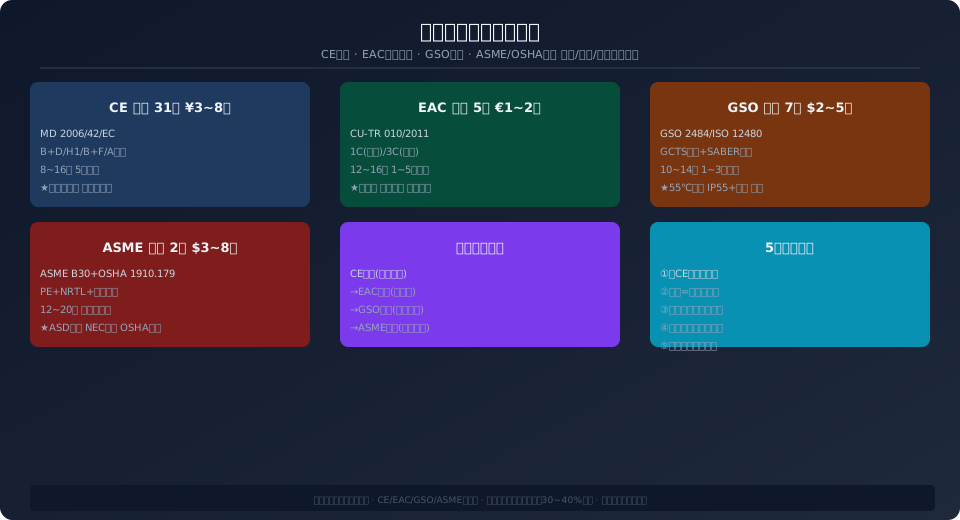
Four major export markets for cranes correspond to four certification systems: EU CE (MD Directive 2006/42/EC, approx. $4,400–$11,800, 8–16 weeks), Eurasian Economic Union EAC (CU-TR 010/2011, approx. $14,800–$29,600, 12–16 weeks), Gulf GSO (GSO 2484/ISO 12480, approx. $2,960–$7,400, 10–14 weeks), and North American ASME/OSHA (ASME B30 series + OSHA 1910.179, approx. $4,400–$11,800, 12–20 weeks). The right choice depends on your target market, product positioning, and budget.
The biggest challenge Chinese crane manufacturers face when expanding overseas isn't building a quality product—it's figuring out which certification each market actually requires. The same 50t European Standard double-girder overhead crane needs CE for Germany, EAC for Russia, GCTS for Saudi Arabia, and PE-stamped calculations plus NRTL certification for the United States. Each system has different requirements, costs that vary by multiples, and timelines that range from weeks to months. This article provides a quick-reference comparison table to help you lock down the certification path and budget range for your target market.
One lesson that holds true time and again: certification isn't something you scramble for after winning an order—it's a capability you build before you can even bid. Many overseas buyers, especially EPC contractors and multinational procurement teams, require bidders to hold the relevant certifications at the tender stage. If you wait until you receive an RFP to start approaching a notified body, the two months it takes to get the certificate will be two months too long—the tender will already be closed. Companies that prepare their certification strategy in advance gain a natural 2–3 month head start in bidding. By designing to ISO 4301 from the outset and building in flexibility for different certification regimes—such as multilingual nameplates and headroom in the electrical cabinet for Protection Rating (IP) upgrades—you can cover multiple markets with minimal incremental cost.
Crane Export Certification Comparison Chart
How to Choose the Right Export Certification
Export certification decisions can be approached from three angles:
①Target Market — CE for Europe, EAC for the Russian-speaking market, GSO for the Middle East, and ASME for North America. This is the most straightforward logic, but watch out for "composite markets": Kazakhstan, for instance, is an EAEU member (requiring EAC), yet the owner may also reference GOST standards (already covered by EAC). If a European investor is involved, CE may be requested on top of that.
②Product Positioning — For a premium brand competing with Demag or Konecranes, a CE + GSO dual certification covers both Europe/Eurasia and the Middle East. For a mid-range product aimed at Belt and Road Initiative markets, EAC + GSO is the practical choice. For a low-cost, price-driven product, skipping certification initially and relying on an overseas agent's certificate under an OEM arrangement is possible — but carries legal risk.
③Budget & Timeline — With a limited budget (under ¥50,000), start with CE (best cost-to-coverage ratio). With a mid-range budget (¥50,000–150,000), go for CE + EAC. With a larger budget (over ¥150,000), pursue all four — CE, EAC, GSO, and ASME — in one go to cover all major global markets from day one.
From a practical standpoint, running multiple certifications in parallel is the most effective way to save both time and money. The type test for the same overhead crane — load test, safety device verification, and electrical safety checks — only needs to be performed once, but you'll need to arrange for representatives from each notified body to witness it simultaneously. Each body may require its own inspection record forms, but the physical test itself is done only once. For example, when a 50t European Standard double-girder overhead crane undergoes its load test at the factory, you can invite the CE notified body (e.g., TÜV), the EAC certification body, and a GSO notified body to witness the same test together — one test, one fee, three certificates. However, you'll need to coordinate schedules at least 6 weeks in advance; getting three auditors' calendars to align is no small feat, and nearly impossible during peak seasons. A more pragmatic approach: run CE and EAC simultaneously (these two rarely conflict), and phase in GSO and ASME as orders come in.
5 Common Certification Mistakes to Avoid
①"CE certification means I can sell anywhere" — CE is only valid within the EU/EFTA. EAC, GSO, and ASME do not recognize it. Treating a CE certificate as a "universal passport" is the most widespread misconception in export certification.
②"Certification is just getting a piece of paper" — Certification is an ongoing compliance system, not a one-time event. Annual surveillance audits, standard revisions, and supplementary assessments after design changes are all ongoing costs. EAC's unannounced audits are even less predictable than CE's annual reviews, so your factory's QA system must always be "audit-ready."
③"If the components are certified, the whole crane doesn't need it" — As mentioned earlier, a VFD or motor with CE/UL certification does not mean the complete crane complies with the Machinery Directive or OSHA regulations. The entire machine must undergo a system-level risk assessment and compliance integration.
④"The bigger the certification body, the better" — TÜV's certificate certainly carries weight, but their audits take longer (senior auditors are heavily booked), cost more, and their understanding of design adaptations for Chinese operating conditions can be limited. For Belt and Road Initiative markets (Central Asia, the Middle East), working with a locally recognized body is often more efficient.
⑤"Build the product first, worry about certification later" — Certification is about proving a product meets standards, not retrofitting a product to meet them. If you wait until the crane is built to approach a notified body, you may find design changes are required (missing safety devices, insufficient electrical IP rating, non-compliant nameplates). The cost and time to fix these issues far exceed the effort of embedding certification requirements into the design input from the start.
In short, crane export certification is a systematic engineering effort, not a paperwork exercise — from standards research at the design stage, to compliance control during manufacturing, to documentation for the application, and finally to annual maintenance and market surveillance after certification. Every step is interconnected. We recommend setting up a "Certification Calendar" to centrally manage application windows, audit schedules, annual surveillance, and standard revision cycles for all four certification schemes — this prevents lapses like "forgot to renew" or "missed the standard update window" that can invalidate your certificates. A practical sequence to follow is CE → EAC → GSO → ASME: CE has the lowest barrier, broadest coverage, and shortest lead time, and its technical documentation serves as a foundation for subsequent certifications. EAC then covers the Russian-speaking markets, GSO taps into the Gulf infrastructure boom, and ASME provides a competitive edge in North America. This builds a complete certification portfolio covering all major global markets.
Frequently Asked Questions
Q: Is there any possibility of a "one-certificate-for-all" approach across the four certification systems? Will a unified standard emerge in the future?
A: Not at this stage. While the ISO/IEC conformity assessment framework provides a common technical foundation for national certifications, every country or region retains the right to impose additional technical barriers based on its own legal requirements and acceptable risk levels. A globally unified crane certification standard is unlikely within the next 5–10 years. That said, manufacturers can adopt a "design once, certify in parallel" strategy—embedding the divergent requirements of CE, EAC, GSO, and ASME at the product design stage (e.g., multilingual nameplates, steel structures engineered to the most stringent criteria, electrical cabinets rated to the highest protection class). This way, market-specific certification only requires supplementary documentation rather than a full redesign. In practice, parallel certification typically saves 30%–40% of total time and cost compared with sequential certification.
Q: For a small company just starting to export, which certification should we pursue first?
A: Start with CE certification. Here's why: ① CE is the most market-driven of the four—there are dozens of notified bodies worldwide, competition keeps pricing transparent (roughly ¥30,000–¥80,000); ② CE covers the largest market footprint (EU + EFTA's 31 countries, plus CE-recognizing nations such as Türkiye, Serbia, and Morocco); ③ The CE Technical File (TCF) provides a 70%–80% reusable foundation for subsequent EAC and GSO applications; ④ The CE process itself acts as a comprehensive product compliance "health check"—an invaluable learning curve for teams with less mature process capabilities. After securing your first CE certificate, decide on EAC (only when you have Russian-speaking market orders) and GSO (only when you have Middle East orders) based on actual export demand. For the ASME North American market, we recommend waiting until annual sales exceed $1 million USD—the return on investment cycle is considerably longer.
Q: Can export certification costs be recovered through tax rebates or government subsidies?
A: Yes, in certain regions. ① At the national level—the "SME International Market Development Fund" reimburses 50%–70% of certification expenses (capped at ¥100,000–¥300,000 per year, subject to local bureau of commerce policies); ② At the provincial level—major trading provinces like Jiangsu, Zhejiang, and Guangdong operate dedicated "Export Product International Certification Funds" with subsidy rates of 30%–50%; ③ Certification fees themselves can be booked under "technical service fees" for export tax rebate purposes. We recommend contacting your local bureau of commerce or SME service center to check the application windows for this year's certification subsidies—typically two intake periods (March–April and September–October), and missing a deadline means waiting another six months.
Q: What should we budget for translation services during certification—Chinese-to-English, Chinese-to-Russian, and Chinese-to-Arabic?
A: Translation typically accounts for 5%–10% of total certification costs, yet it has the single biggest impact on approval rates—a poorly translated TCF can trigger repeated rejections from the notified body. Current market rates: Chinese-to-English (TCF technical documentation, roughly 200–300 pages) ¥10,000–¥15,000; Chinese-to-Russian ¥15,000–¥25,000 (Russian technical translators are scarce); Chinese-to-Arabic (nameplates plus safety sections, roughly 30–50 pages) ¥3,000–¥5,000. We strongly recommend hiring translators with an engineering background (e.g., retired engineers or technical translation specialists) rather than pure language translators—the latter often render "main girder web plate" as "web plate" (correct: "web of main girder") or "Weld reinforcement" as "weld remaining height" (correct: "weld reinforcement"), leaving reviewers confused and triggering endless rounds of clarification.
Looking at the global landscape for crane export certification, Chinese manufacturers are sitting in a rare strategic window. On one hand, infrastructure demand across Belt and Road Initiative countries continues to grow, and recognition of cost-effective Chinese cranes improves year after year. On the other, established European and American crane manufacturers are losing responsiveness in emerging markets due to rising certification pass-through costs and extended lead times. The company that completes its multi-market certification footprint first—building a certification matrix across major economies—will hold the "compliance moat" as a first-mover advantage in the global crane market over the next decade. What it takes to get there goes beyond technical capability and capital: it demands clear recognition at the executive level of certification's strategic value, and the resolve to push it through.
Kelude specializes in the design and manufacture of European Standard high-end cranes, with products covering 50t–300t European Standard Double-Girder cranes. We strictly adhere to ISO 4301 Crane Design Standard—Core Provisions and the FEM/DIN/EN international standard framework, and have assisted numerous clients in completing full-machine compliance and technical documentation for CE, EAC, and GSO export certifications.
For export certification technical solutions or certification consulting, contact the Kelude technical team: 13903802779.