

Crane Reducer Selection: Gear, Planetary & Cycloidal Types
📋 Quick Guide: Selecting a crane gearbox requires determining the duty classification (M3~M8), equivalent torque and speed ratio, and mounting configuration (horizontal/vertical/flange) in sequence. Then verify the thermal power rating Pt≥Pn×f, and finally match the coupling interface dimensions. This article compares four gearbox types—helical gear reducers, planetary reducers, cycloidal reducers, and three-in-one gear reducers—covering transmission efficiency (90%~98%), speed ratio range (1.25~10000), rated torque (≤1200kN·m), application conditions, and maintenance costs, along with a side-by-side comparison of GB/T 23201 and JB/T 6391 inspection and acceptance clauses to streamline your selection decision.
5 Key Parameters for Crane Gearbox Selection: Speed Ratio, Torque, Power & Mounting Explained
Selecting a crane gearbox essentially converts the motor's high-speed, low-torque output into the low-speed, high-torque required at the drum or wheel. Based on years of project experience, the Kelude engineering team has identified five critical parameters that must be verified during selection:
① Duty Classification (M3~M8): Per the ISO 4301 Crane Design Standard, the duty classification of a hoisting mechanism is determined by the load spectrum factor Kp and total operating time. M3~M4 applies to light-duty cranes (e.g., service hoists), M5~M6 for medium duty (e.g., general purpose bridge crane hoisting), and M7~M8 for heavy/extra-heavy duty (e.g., metallurgical cranes, ladle cranes). The gearbox duty classification must be equal to or higher than the mechanism classification—this is the first hard constraint in selection.
② Equivalent Torque (Meq): Calculate the equivalent torque from the actual load spectrum using Meq=km×Mn, where km is the load coefficient (M5 = 0.8, M6 = 0.9, M7 = 1.0). The gearbox rated torque MB must satisfy MB≥Meq, with a typical safety factor of 1.2~2.0.
③ Speed Ratio (i): Speed ratio = motor rated speed ÷ operating speed. Hoisting mechanisms typically require ratios of 50~200, while travel mechanisms range from 10~80. Pay attention to stage distribution in multi-stage drives—two-stage helical gear reducers typically offer ratios of 6.3~22.4, three-stage units reach 22.4~100, and four-stage designs cover 100~500.
④ Thermal Power Verification: For continuous duty applications, the gearbox thermal power rating Pt must be checked. The requirement is Pt≥Pn×f1×f2, where f1 is the ambient temperature coefficient (1.0 at 40°C, 1.4 at 50°C) and f2 is the duty cycle coefficient (1.0 for continuous S1 duty, 0.7~0.9 for intermittent S3 duty). Insufficient thermal capacity leads to oil overheating, seal failure, and gear scuffing.
⑤ Mounting Configuration & Interface Dimensions: Horizontal base mounting (over 80% of applications), vertical flange mounting, or shaft-mounted (hollow shaft directly over the wheel axle). Verify input/output shaft diameters, keyway dimensions, flange pilot diameters, and anchor bolt hole spacing to ensure compatibility with the motor and coupling.
Helical vs. Planetary Gear Reducers: Structural Differences & Application Boundaries
Helical gear reducers (cylindrical/bevel gear types) are the most widely used conventional gearbox in the crane industry. The core principle involves multiple gear meshing stages to reduce speed and increase torque. Kelude's standard QJ series crane gearboxes feature carburized and quenched hardened tooth flanks (HRC58~62) with ground gears (accuracy grade 6 or higher), delivering 2~3 times the load capacity of medium-hardened tooth designs. Cylindrical gear reducers achieve 94%~98% transmission efficiency, handle torque up to ≤580kN·m, and cover the full duty classification range of M3~M8.
Planetary reducers employ a sun gear–planet gear–internal ring gear configuration, with multiple planet gears sharing the load simultaneously. This design delivers 3~5 times the power density of equivalent helical gear reducers, reducing volume and weight by approximately 60%—though at a manufacturing cost premium of 40%~80%. Planetary reducers offer an extremely wide speed ratio range (3~10 per stage, up to 10,000 in multi-stage combinations) and rated torque exceeding 1200kN·m, making them ideal for space- and weight-sensitive heavy-load applications such as tower crane slewing mechanisms and shipbuilding gantry crane hoisting mechanisms.
Selection boundary between the two types: Using a 50t bridge crane hoisting mechanism as an example, if space is not constrained and budget is a priority, the QJ series cylindrical gear reducer is preferred (30% lower cost). However, for tower crane slewing mechanisms requiring compact dimensions, a planetary reducer is mandatory—its radial footprint is only 1/3 that of an equivalent-torque helical gear reducer.
Cycloidal vs. Three-in-One Reducers: Which Suits Your Lifting Equipment Better?
Cycloidal reducers use a cycloidal disc and ring pins as the core meshing elements, operating on the principle of small tooth-difference planetary transmission. Their standout advantages include high single-stage speed ratios (6~87), exceptional shock and overload resistance (instantaneous overload capacity up to 2.5 times rated torque), and smooth, quiet operation (≤75dB(A)). Kelude's CD/MD type reducers standard on electric hoists feature this cycloidal design. However, their rated torque is generally limited to ≤30kN·m with a duty classification of ≤M5, making them unsuitable for medium-to-heavy hoisting mechanisms.
Three-in-one reducers (integrated motor + gearbox + brake) are the standard solution for travel mechanisms, designed and manufactured to JB/T 9003. Their key advantage lies in eliminating the intermediate coupling, simplifying installation and commissioning, and achieving compact axial dimensions. Common models include the DLR series (per German DIN Standard) and domestic QS series, offering speed ratios of 5~200, torque up to ≤200kN·m, and duty classifications from M3~M7. Kelude equips all travel mechanisms with three-in-one reducers, improving installation efficiency by over 50%.
The division of labor between these two types in lifting equipment is clear: cycloidal reducers dominate electric hoist hoisting applications (≤16t), while three-in-one reducers handle crane bridge and trolley travel mechanisms (≤300t). For single-girder cranes under 16t, Kelude employs a combined solution—CD electric hoist (cycloidal hoisting) paired with a three-in-one travel mechanism—balancing hoisting reliability with travel convenience.
GB/T 23201 vs. JB/T 6391: Inspection & Acceptance Requirements for Crane Gearboxes
The design, manufacturing, and acceptance of crane gearboxes are governed by multiple standards, with GB/T 23201 "Technical Conditions for Bridge Crane Gearboxes" and JB/T 6391 "Gearboxes for Cranes" being the two most critical. Below is a clause-by-clause comparison of their inspection requirements:
GB/T 23201-2008 primarily specifies technical requirements for bridge crane-specific gearboxes, covering four core inspections: material and heat treatment (gear shaft 42CrMo quenched and tempered to HB240~280, tooth flank carburized and quenched with effective hardened layer depth of 0.3~0.5mm), geometric accuracy (bearing bore cylindricity to IT6 grade, center distance deviation per GB/T 10095), no-load test (forward and reverse rotation each ≥1h, bearing temperature rise ≤40K), and load test (rated load operation ≥2h, oil temperature ≤85°C).
JB/T 6391 has broader applicability, covering gearboxes for bridge, gantry, and portal cranes. It adds supplementary clauses including noise inspection (≤85dB(A) measured 1m from the housing), sealing integrity inspection (no leakage at housing joints or shaft extensions after 2h operation), and tooth contact pattern inspection (≥50% along tooth height, ≥70% along tooth length). Kelude's factory acceptance test simultaneously enforces the strictest criteria from both standards—noise limited to the tighter 85dB(A) and oil temperature capped at 85°C per GB/T 23201.
| Comparison Item | GB/T 23201-2008 | JB/T 6391 |
|---|---|---|
| Application Scope | Bridge Crane / Overhead Crane Reducer / Gearbox | Bridge/Gantry/Portal crane Reducer / Gearbox |
| Tooth surface hardness | HRC58~62(Carburizing and Quenching) | HRC56~62(hardened tooth flank) |
| No-Load Test Duration | Each Direction (Fwd/Rev)≥1h | ≥2hContinuous |
| Max Oil Temperature | ≤85°C | ≤85°C(Mineral oil) |
| noise limit | Not Separately Specified | ≤85dB(A)(1mLocation) |
| Sealing Inspection | No Visible Leakage | Operation2hNo Leakage at Joint Faces |
5 Common Gearbox Installation & Commissioning Issues and Fixes for Cranes
The quality of gearbox installation and commissioning directly affects service life and operational reliability. Kelude Heavy Industry's after-sales team has compiled the five most frequent issues encountered during on-site installation:
① Coupling shaft alignment out of tolerance: Radial misalignment between the two coupling halves should be ≤0.05mm (at rotational speeds ≤1500rpm), with angular misalignment ≤0.1°/100mm. Excessive misalignment subjects the gearbox input shaft to additional radial forces, which initially manifests as oil seal leakage and, in severe cases, fatigue fracture of the input shaft. Use a dial indicator to check alignment in at least four directions—top, bottom, left, and right.
② Uneven base mounting surface: Base flatness should be ≤0.1mm/m. An uneven base forces the gearbox housing to deform, causing uneven gear mesh loading that leads to pitting and spalling on tooth flanks. Corrective measures include using bow shackle shims (maximum 3 per stack) or hand-scraping the mounting surface on site.
③ Incorrect lubricating oil fill: New gearboxes are shipped with only a rust-preventive coating. Upon delivery, the specified grade of lubricating oil must be added up to the midpoint of the oil sight glass. For hoisting mechanism gearboxes, L-CKC220~320 medium-duty industrial gear oil is recommended; for travel mechanism gearboxes, use L-CKC150~220. Insufficient oil causes gear and bearing damage from starvation, while overfilling leads to oil churning, overheating, and blown oil seals.
④ Breather installation overlooked: The transport sealing plug must be replaced with a breather before operation. If overlooked, internal pressure rises as temperature increases, forcing the oil seal out or squeezing lubricant through the joint faces. A common field case: after a 2-hour test run, a puddle of oil appears beneath the gearbox—inspection reveals the transport plug was never swapped for the breather.
⑤ First oil change interval ignored: The break-in period for a new gearbox (first 200 operating hours or 1 month, whichever comes first) requires a mandatory oil change to flush out metal wear particles generated during run-in. Kelude Heavy Industry's warranty terms are explicit: gear or bearing damage resulting from failure to perform the first scheduled oil change is not covered under warranty. Subsequent regular oil changes are due every 2,000 operating hours or 6 months.
| Common Issues | Root Cause | Standard Requirement & Solution |
|---|---|---|
| Couplingshaft alignment Out of Tolerance | Shaft Alignment Not Dial-Indicated | Radial≤0.05mm, Angle≤0.1°/100mm |
| Uneven Base Mounting Surface | Foundation Not Leveled | Flatness≤0.1mm/m |
| Lubricating Oil Insufficient Lubricant Fill | Rust Preventive Oil Not Replaced | L-CKC220~320To Centerline of Oil Sight Glass |
| breather Rust Preventive Oil Not Replaced | Transport Plug Not Replaced | Must Be Installed Before Operationbreather |
| Delayed First Oil Change | Maintenance Procedure Not Performed | 200hOr1Mandatory Oil Change (Months) |
| Tightening Bolt Torque Insufficient | Tightened Without Specified Torque | M16:210N·m M20:410N·m |
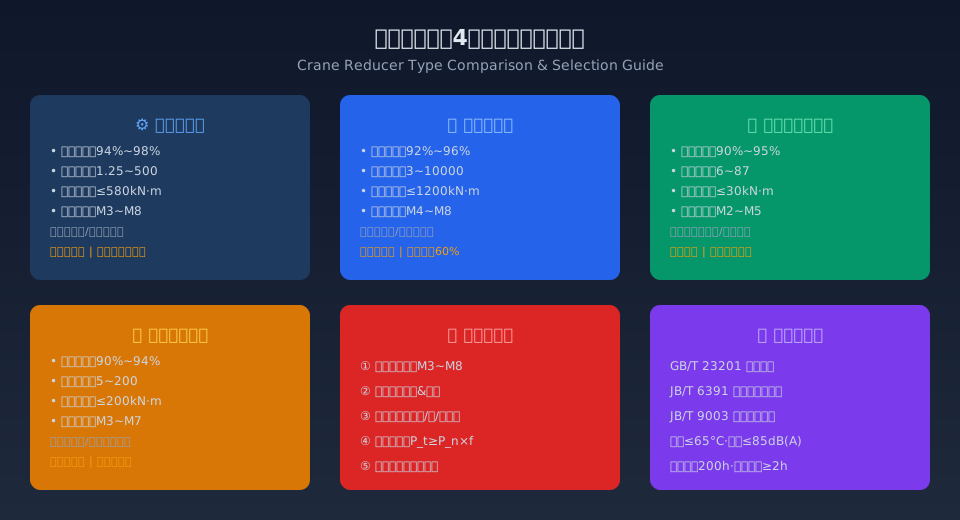
6 Key Performance Parameters: 4 Crane Reducer Types Compared
The six data cards below compare the core specifications of four crane reducer types across transmission efficiency, speed ratio range, rated torque, work duty classification, application scenarios, and maintenance cost — giving you a quick way to shortlist the right type for your crane.
⚙ Transmission Efficiency
Gear Reducer: 94%–98% (highest)
Planetary Reducer: 92%–96%
Three-in-One: 90%–94%
Cycloidal: 90%–95%
📐 Speed Ratio Range
Planetary Reducer: 3–10,000 (widest)
Gear Reducer: 1.25–500
Three-in-One: 5–200
Cycloidal: 6–87 (narrowest)
💪 Rated Torque
Planetary Reducer: ≤1,200 kN·m (highest)
Gear Reducer: ≤580 kN·m
Three-in-One: ≤200 kN·m
Cycloidal: ≤30 kN·m (lowest)
📊 Work Duty Coverage
Gear Reducer: M3–M8 (broadest)
Planetary Reducer: M4–M8
Three-in-One: M3–M7
Cycloidal: M2–M5 (limited)
🏗️ Application Scenarios
Cycloidal → Electric hoist lifting
Gear Reducer → Bridge/gantry hoisting
Planetary → Tower/shipbuilding heavy-duty
Three-in-One → Crane bridge & trolley travel
💰 Maintenance Cost
Cycloidal: Lowest
Gear Reducer: Moderate (frequent oil changes)
Three-in-One: Moderate (integrated, easy to service)
Planetary Reducer: Highest (many precision parts)
📖 Related Reading
8 Common Questions About Crane Reducer Selection & Use
Q: What is the design life and cost comparison between gear reducers and planetary reducers for cranes?
A: Gear reducers typically have a design life of 20,000–30,000 hours, while planetary reducers under the same operating conditions can reach 30,000–50,000 hours (multiple planet gears share the load, reducing stress on individual gear teeth). In terms of cost, a planetary reducer with the same torque rating costs approximately 1.4–1.8 times more than a gear reducer. Taking the Kelude 50t bridge crane as an example, the QJ series gear reducer costs roughly $3,700–$4,400, while a planetary reducer with equivalent torque is about $5,900–$7,400. If your budget allows and you are sensitive to size and weight (e.g., for tower cranes), a planetary reducer is the preferred choice. For standard bridge and gantry cranes, the QJ series gear reducer offers the best cost-performance ratio.
Q: What are the gear accuracy requirements for reducers per ISO 1328?
A: Per GB/T 23201-2008, hardened tooth flanks must achieve a minimum accuracy of Grade 6 per GB/T 10095 (ground gear process), while medium-hardened tooth flanks must meet Grade 7. Specific indicators include: cumulative pitch deviation Fp ≤ 0.032 mm (for pitch circle diameters ≤ 125 mm), total profile deviation Fα ≤ 0.010 mm, and total helix deviation Fβ ≤ 0.012 mm. During the Factory Acceptance Test, the contact pattern must show at least 50% contact along the tooth height and 70% along the tooth length (under no-load, light braking conditions). Kelude Heavy Industry uses NILES gear grinding machines, consistently achieving DIN Grade 5 accuracy (equivalent to Grade 5 per GB/T 10095), which exceeds the minimum standard requirement.
Q: What should I do if the reducer oil temperature exceeds 85°C?
A: If the reducer oil temperature exceeds 85°C, follow these troubleshooting steps: ① Check the oil level — it should be between 1/2 and 2/3 on the sight glass. Too much oil causes churning and heat generation; too little leads to insufficient lubrication and friction heat. ② Check the lubricating oil grade — verify that the viscosity is appropriate; hoisting mechanisms should use L-CKC220~320. ③ Check the load — determine whether the unit has been running under sustained overload. Use a clamp meter to measure motor current and compare it with the rated value. ④ Check cooling conditions — inspect whether dust or oil contamination on the housing is impeding heat dissipation, and confirm the ambient temperature does not exceed 40°C. ⑤ Check gear and bearing wear — take an oil sample for laboratory analysis (ferrography) to detect abnormal wear particles. If all checks come back normal but the temperature remains high, install a cooling fan or cooling coils for forced cooling. Kelude Heavy Industry recommends keeping the continuous operating oil temperature of the reducer below 70°C for optimal performance.
Q: What motor power and reducer type are recommended for a 16t electric hoist?
A: For a 16t electric hoist hoisting mechanism, the recommended reducer parameters are: motor power 13–18.5 kW (4-pole or 6-pole), speed ratio 120–180 (calculated based on a lifting speed of 3.5–5 m/min), and output torque ≥ 8,000 N·m. A cycloidal reducer is the first choice for three reasons: ① A single-stage reduction ratio is sufficient (gear reducers require 2–3 stages and are over 50% larger); ② Impact overload capacity of 2.5 times the rated torque, ideal for the frequent start-stop duty cycle of electric hoists; ③ Cost is only 60%–70% of a gear reducer with equivalent specifications. The Kelude 16t CD Type electric hoist comes standard with a BWY series cycloidal reducer (speed ratio 121, rated torque 12 kN·m), with operating noise ≤ 72 dB(A). If a lifting speed greater than 7 m/min is required (high-speed ratio demand), a three-stage gear reducer is recommended instead.
