

GB/T 14406 Gantry Crane Acceptance Criteria
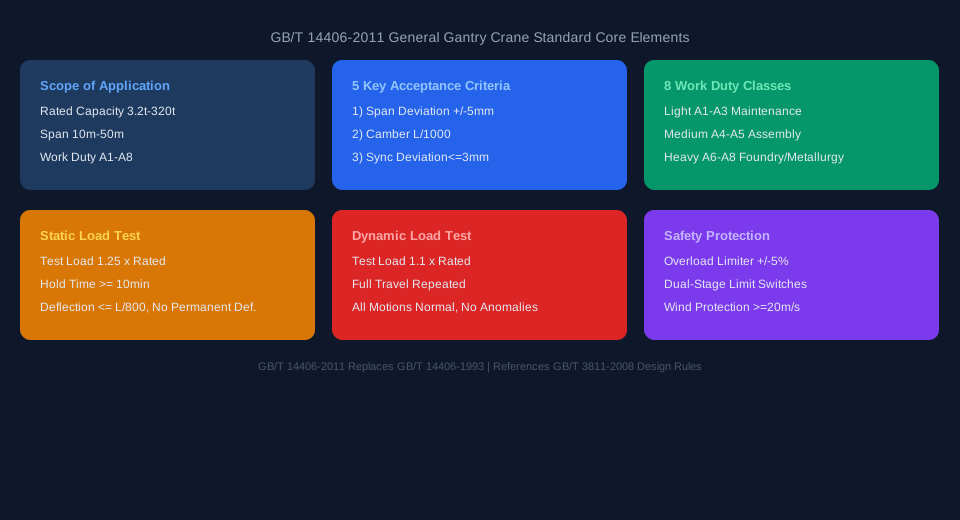
Per GB/T 14406-2011 "General-Purpose Gantry Cranes," gantry cranes are classified by main girder configuration into single-girder and twin-girder types, with rated lifting capacities from 3.2t to 320t and spans from 10m to 50m. The standard defines five core acceptance criteria: span deviation ≤±5mm, main girder camber of L/1000, crane bridge travel synchronization deviation ≤3mm, static load test at 1.25 times rated load held for ≥10 minutes, and dynamic load test at 1.1 times rated load over the full travel range. Eight service classifications A1~A8 cover applications from maintenance hoists to metallurgical foundry cranes; selection must consider the load spectrum and utilization class together. The standard also mandates safety devices including a lifting capacity limiter (accuracy ±5%), dual-stage travel limit switches, and an anti-wind anti-slip device (activated at wind speeds ≥20m/s).
GB/T 14406 Scope and Gantry Crane Classification Requirements
GB/T 14406-2011 "General-Purpose Gantry Cranes" is the core product standard for gantry cranes in China, administered by the National Technical Committee for Standardization of Lifting Appliances and superseding the 1993 edition. It applies to general-purpose gantry cranes used indoors or outdoors, covering rated lifting capacities from 3.2t to 320t, spans from 10m to 50m, and service classifications A1 through A8.
By main girder configuration, gantry cranes fall into two types:
① Single-girder gantry cranes: A single main girder carries the load, with the trolley running along one side of the girder. This design offers a compact structure and low dead weight, making it suitable for medium-to-small spans with lifting capacities up to 50t.
② Twin-girder gantry cranes: Two main girders are arranged symmetrically, with the trolley traveling on rails between them. This configuration provides higher load capacity and greater stiffness, making it ideal for large-span, heavy-duty applications from 50t to 320t.
By cantilever configuration, gantry cranes are available without cantilevers, with a single cantilever, or with double cantilevers; cantilever length is typically 0.25 to 0.35 times the main span. By lifting attachment, they are classified as hook-type, grab-type, lifting magnet-type, and combination (dual/triple-purpose) types. The standard requires that design and manufacture comply with the fundamental requirements of GB/T 3811-2008 "Crane Design Standard", which serves as the baseline design framework for all gantry crane types.
Kelude Heavy Industry's MDG series general-purpose gantry cranes strictly follow GB/T 14406-2011, covering the full range of 5t to 200t lifting capacities and 18m to 45m spans. Each unit undergoes static and dynamic load testing before shipment, with inspection reports provided.
5 Key Gantry Crane Acceptance Criteria and Test Methods
Chapter 7 of GB/T 14406-2011 specifies the inspection items and acceptance criteria for both factory and installation acceptance of gantry cranes. The five most critical acceptance criteria are as follows:
Criterion 1: Span deviation. The gantry crane span S is defined as the horizontal distance between the centerlines of the crane bridge wheel rails on both sides. The standard requires a span deviation of ΔS ≤±5mm (for S ≤26m) or ΔS ≤±8mm (for S >26m). Measurement is performed using a steel measuring tape with a spring scale applying a 150N tension, taken above the centerline of the wheel tread.
Criterion 2: Main girder camber. The mid-span camber F of the main girder is a key stiffness indicator for gantry cranes. The standard specifies F = (0.9~1.4)L/1000, where L is the span. Under no-load conditions, measurements are taken at seven points — mid-span and both ends — using a level instrument or total station to plot the deflection curve. Kelude Heavy Industry gantry crane main girders use a box-type welded structure, with factory camber controlled at 1.1L/1000 ±5%.
Criterion 3: Crane bridge travel synchronization deviation. Both drive sides of the crane bridge travel mechanism on dual-rail gantry cranes must remain synchronized. The standard requires a wheel travel difference of ≤3mm/m (based on travel distance) between the two sides, or the use of an electrical synchronization correction system to maintain deviation at ≤0.2% of the span. During inspection, reference marks are made on the rail side, and the deviation between both sides is measured after 30m of travel.
Criterion 4: Static load test. Per the test procedures in GB/T 5905-2011 "Cranes — Test Code and Procedures", the static load test for gantry cranes uses 1.25 times the rated lifting capacity. The trolley is positioned at mid-span, and load is applied incrementally to the rated load to verify normal operation, then increased to 1.25Gn. The load is held for ≥10 minutes. After unloading, the main girder must show no permanent deformation, and mid-span deflection must not exceed L/800.
Criterion 5: Dynamic load test. The dynamic load test uses 1.1 times the rated lifting capacity and requires combined operations of hoisting, trolley travel, and crane bridge travel. Each motion is repeated ≥3 times over the full travel range. After the test, all mechanisms must operate normally with reliable braking, no abnormal vibration or noise, and no cracks or permanent deformation in structural components.
Gantry Crane Service Classifications A1~A8: Selection and Duty Matching
Gantry crane service classification is determined per the grading system in GB/T 3811-2008 "Crane Design Standard", combining the utilization class (U0~U9) and load spectrum (Q1~Q4) to yield eight service classifications from A1 to A8. The service classification directly affects the fatigue design of the steel structure, mechanism selection, and safety factor values.
The selection decision process is as follows:
Step 1: Determine the utilization class. Based on the total number of duty cycles Ct expected over the crane's design life:
Ct ≤1.6×10⁴ corresponds to U0~U1.
Ct = (1.6~3.2)×10⁵ corresponds to U4~U5.
Ct ≥1.25×10⁶ corresponds to U8~U9.
A typical workshop assembly crane with a 15-year design life operating 4 hours per day corresponds to utilization class U4.
Step 2: Determine the load spectrum. Based on the proportion of rated load in the lifting load spectrum, classify as Q1 through Q4:
Q1 (light): Rated load is rarely lifted;
Q2 (medium): Rated load is occasionally lifted;
Q3 (heavy): Rated load is frequently lifted;
Q4 (very heavy): Rated load is regularly lifted.
Step 3: Combine to determine the service classification A1~A8. For example, U4+Q2 → A4 (medium duty), U6+Q3 → A6 (heavy duty), and U7+Q3 → A7 (very heavy duty).
For practical selection, Kelude Heavy Industry recommends the following duty matching: maintenance and installation cranes → A1~A3; machine shop assembly cranes → A4~A5; warehouse and logistics grab cranes → A5~A6; metallurgical foundry cranes → A6~A7; scrap handling electromagnetic cranes → A7~A8. Incorrect selection — for instance, using a A3 crane for a A6 duty — can drastically shorten structural fatigue life and even lead to safety incidents.
Gantry Crane Technical Parameters Comparison Table and Selection Workflow
The following table summarizes the key technical parameters for gantry cranes as specified in GB/T 14406-2011, covering typical configurations across different lifting capacities and spans:
Kelude Heavy Industry: 35-Ton Double-Girder Overhead Crane for a U.S. Steel Service Center
Kelude Heavy Industry recently delivered a 35-ton double-girder overhead crane to a steel service center in the United States. The crane was designed and manufactured to meet the customer's specific material handling requirements, providing a reliable and efficient solution for their daily operations.
Frequently Asked Questions
Q: What is the lead time for a custom overhead crane?
A: Lead time varies depending on the crane's specifications and customization level. A standard crane typically ships within 45-60 days, while a fully customized unit may take 90-120 days. Contact us for a specific timeline based on your requirements.
Q: Can you provide cranes that meet specific international standards?
A: Yes, our cranes are designed and manufactured in accordance with international standards, including ISO 4301 for crane classification and IEC 60204-32 for electrical equipment. We can also adapt designs to meet local codes and regulations.
Q: What kind of after-sales support do you offer?
A: We provide comprehensive after-sales support, including installation guidance, commissioning, operator training, and spare parts supply. Our global service network ensures prompt assistance whenever you need it.
| Parameter Item | Light Duty Gantry Crane | Heavy Duty Gantry Crane |
|---|---|---|
| Rated Lifting Capacity Gn | 3.2t / 5t / 10t / 16t / 20t | 50t / 80t / 100t / 160t / 320t |
| Span S | 10m / 14m / 18m / 22m / 26m | 26m / 30m / 35m / 40m / 50m |
| Lifting Height H | 6m / 8m / 10m / 12m | 10m / 12m / 16m / 20m |
| Lifting Speed Vn | 8m/min / 5m/min / 3.2m/min | 5m/min / 3.2m/min / 2m/min |
| Long Travel Speed Vk | 40m/min / 32m/min / 25m/min | 32m/min / 25m/min / 20m/min |
| Work Duty / Classification | A3~A5(Assembly/Warehouse) | A5~A7(Heavy Lift/Metallurgical) |
A: Selection Process:
Step 1: Determine the main girder configuration based on lifting capacity and span (single main girder for capacities ≤50t; twin main girders for capacities >50t or extra-wide spans).
Step 2: Establish the work duty classification according to the intended operating conditions A1~A8.
Step 3: Specify the lifting height and travel speed parameters.
Step 4: Define the cantilever arrangement and power supply method (conductor rail or cable reel) based on site conditions.
Kelude offers fully customizable solutions across all parameters. Our engineers conduct a site survey and deliver a technical proposal with quotation within 48 hours.
Gantry Crane Installation Acceptance: Common Issues and Standard Compliance
The following outlines six frequently encountered issues during gantry crane installation acceptance, along with the corresponding ISO 4306 standard clauses and recommended solutions:
| Acceptance Common Issues | Corresponding Standard Clause | Determination Standardand Solutions |
|---|---|---|
| Main Girder Deflection Out-of-Tolerance | Article7.3.2Clause camber | Deflection≤L/800; Out-of-tolerance requires factory recalibration or addition of prestressing cables |
| Long Travel / Bridge Travel Wheel rail gnawing / flange rubbing | Article7.4.1Clause Crane Travel Mechanism | Span Deviation≤±5mm; Diagonal Difference≤5mm |
| Hoisting / Lifting Braking Excessive Sag | Article7.5.2Clause Brake Test | Sag≤Vn/100; Air Compressor Brake Springor Replacement Brake Lining |
| Limit switch Failureor Malfunction | Article6.3Clause Safety Guard | Hoisting / Lifting Limit Switch+Lowering Two-Stage Limit; Accuracy±50mm |
| Electrical Control System Grounding Defective | Article6.5Clause Electrical Equipment | Grounding Resistance≤4Ω; Insulation Resistance≥1MΩ |
| anti-wind anti-slip device Failure | Article6.4.3Clause Wind Protection Device / Rail Clamp | Rail clamp/Anchor device, Wind Speed≥20m/s Automatic Trigger |
All Kelude gantry cranes undergo full pre-assembly and no-load commissioning at our factory before shipment. After on-site installation, certified inspectors perform item-by-item acceptance testing in accordance with GB/T 14406-2011 and issue a signed report, ensuring the crane is ready for immediate operation upon delivery.
6 Core Technical Parameters of General-Purpose Gantry Cranes
Span Range
10m~50m
Standard spans: 10/14/18/22/26/30/35/40/50m
Rated Lifting Capacity
3.2t~320t
Standard series: 3.2/5/10/16/20/32/50/80/100/160/320t
Work Duty Classification
A1~A8
Light duty A1~A3 / Medium duty A4~A5 / Heavy duty A6~A8
Span Deviation
≤±5mm
S≤26m: ±5mm; S>26m: ±8mm
Static Load Test Load
1.25×Gn
Holding time ≥10min, deflection ≤L/800, no permanent deformation
Wind Speed Threshold
≥20m/s
Rail clamp + anchor dual protection, wind-resistant up to ≥12 levels
Related Reading: Crane Standards & Technical Resources
For more on crane standards and technical documentation, we recommend the following articles:
• GB/T 3811 Crane Design Standard: 9 Load Combinations and Work Duty Selection from A1 to A8
• GB/T 5905 Crane Test Specification: 3 Load Test Procedures and 6 Acceptance Criteria
• GB/T 30023 Crane Structure Test Methods: 6 Load Tests and 4-Level Evaluation Criteria
Gantry Crane Selection & Acceptance: Common Questions Answered
Q: What is the difference between GB/T 14406 for general-purpose gantry cranes and GB/T 3811 Crane Design Standard?
A: GB/T 14406-2011 is the product standard for gantry cranes, specifying complete machine technical requirements, test methods, and acceptance criteria — it serves as the direct basis for factory acceptance testing. GB/T 3811-2008, the Crane Design Standard, is the overarching design code covering all crane types, including load calculations (9 load combinations), structural design, and mechanism design principles. In short, GB/T 3811 guides "how to design," while GB/T 14406 defines "what qualifies as acceptable." Gantry crane designs must comply with both standards simultaneously.
Q: What is the standard camber value at mid-span of the main girder during gantry crane acceptance?
A: Per clause 7.3.2 of GB/T 14406-2011, the mid-span camber of the main girder on a gantry crane shall be F=(0.9~1.4)L/1000, where L is the span, with a maximum of 1.4L/1000. The inspection is performed under no-load conditions using a level instrument to measure elevations at 7 points — mid-span, both end supports, and cantilever ends — to plot the actual camber curve against the theoretical curve. The deviation must not exceed ±10%. For a 32m-span gantry crane, the standard camber should be 28.8mm~44.8mm. Kelude factory products come standard with a camber inspection report.
Q: How do I troubleshoot and resolve wheel rail gnawing on the crane bridge during long travel?
A: Wheel rail gnawing (abnormal friction between the wheel flange and the rail side) is one of the most common faults in gantry cranes. Troubleshoot in the following order: ① Measure span deviation to verify it does not exceed ±5mm (for spans S≤26m);
② Measure the diagonal difference on both sides to ensure it is ≤5mm;
③ Check that the horizontal skew of the crane bridge wheels is ≤L/1000 and the vertical skew is ≤1/400;
④ Check the rail joint height difference (≤1mm) and lateral misalignment (≤1mm). Common causes include accumulated rail installation deviation, rotational speed mismatch between the two drive motors, and uneven foundation settlement. Solutions: realign the rails → correct with electrical synchronization → reinforce the foundation; in severe cases, replace the wheel block. Kelude offers on-site wheel rail gnawing diagnosis and rail alignment services.
Q: How much does a 10-ton general-purpose gantry crane cost?
A: The price of a 10-ton gantry crane depends on span, lifting height, work duty, and configuration. A standard configuration (A4 duty, 18m span, 8m lifting height, pendant control + remote dual control) typically costs between $12,000 and $22,000 (including rail and installation). A A6 heavy-duty configuration ranges from $18,000 to $30,000. The standard quotation includes: main girder + outrigger steel structure, hoisting mechanism, crane bridge/trolley travel mechanisms, electrical control system, safety devices (overload limiter + dual-level limit switches + wind rail clamp), factory static/dynamic load tests, on-site installation & commissioning, and third-party acceptance. Kelude offers free site surveys and technical solutions — call our 400 hotline for an exact quotation.
