

GB/T 30023 Crane Structure Load Test Methods
GB/T 30023 "Cranes — Structural Test Methods" is the core standard for structural design verification and type testing of crane steel structures. It covers six categories of test methods — static load, dynamic load, stiffness, stability, fatigue, and non-destructive testing — and classifies results into four assessment grades: qualified, conditionally qualified, corrective action required, and unqualified. The standard applies to the steel structural components and complete machines of bridge cranes, gantry cranes, tower cranes, and other crane types, providing full-lifecycle structural reliability assurance for safe crane operation.
The structural safety of a crane is directly tied to personnel safety and property protection. During the crane design phase, GB/T 3811 Crane Design Standard defines the nine load combinations and eight work classifications (from A1 to A8) that steel structures must account for, while structural test methods serve as the physical verification of these design criteria. Together, GB/T 30023 and GB/T 3811 form a closed-loop system that spans theoretical design through test validation, ensuring that every crane produced by Kelude passes rigorous structural testing before leaving the factory. In parallel, GB/T 28264 Safety Monitoring and Management System provides data traceability and early-warning mechanisms from a monitoring perspective, with all three standards working in concert to safeguard crane operations.
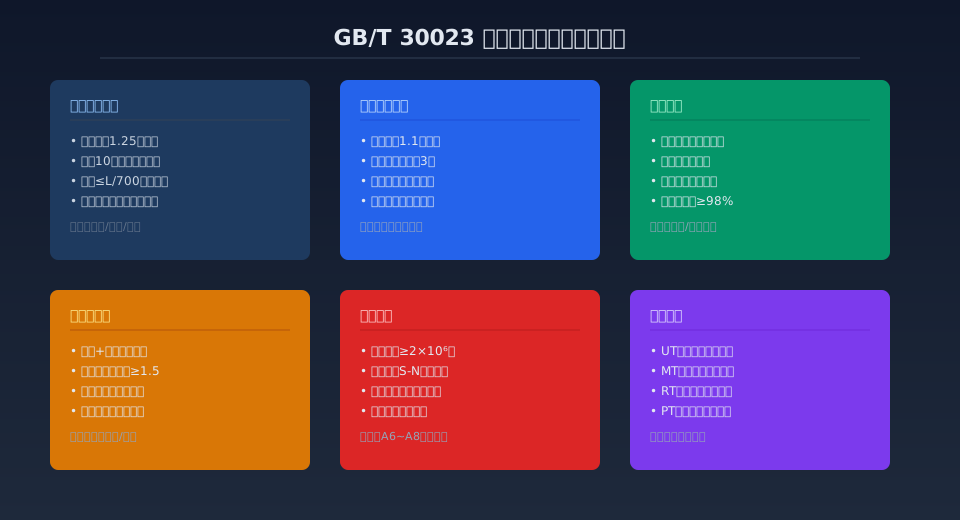
Scope of Application and Test Classification
GB/T 30023 applies to structural testing of steel structural components and complete machines for bridge cranes, gantry cranes, tower cranes, and portal cranes with a rated lifting capacity of 0.5t and above. The standard divides testing into two main categories: type tests and factory tests. Type tests are required for newly designed or significantly modified products and must cover all six test categories. Factory tests apply to every mass-produced unit and focus on the two core tests — static load and dynamic load.
Test classification is further organized into three levels by load nature: static tests, dynamic tests, and special tests. Static tests primarily verify load-bearing capacity and stiffness indicators; dynamic tests evaluate structural response under motion; and special tests cover fatigue life validation and wind stability testing. Kelude strictly follows the graded test requirements of this standard during the factory acceptance testing of every crane it manufactures.
Static and Dynamic Load Test Requirements
The static load test is the foundational item in structural testing. The standard specifies a static test load of 1.25 times the rated lifting capacity, applied smoothly and maintained for at least 10 minutes. After testing, the mid-span deflection of the main girder is measured: for bridge cranes, deflection must not exceed 1/700 of the span; for the cantilever end of gantry cranes, deflection must not exceed 1/350 of the cantilever length. After load removal, the structure must show no permanent deformation or cracks.
The dynamic load test uses a load factor of 1.1 times the rated lifting capacity. The crane must complete full-travel cycles of hoisting, lowering, long travel, and cross travel, with each motion repeated no fewer than three times. During testing, braking distance, operational smoothness of each mechanism, and any abnormal structural vibration are monitored simultaneously. The acceptance criteria for the dynamic load test are: all mechanisms operate normally, braking is reliable, no abnormal noise is present, and no visible damage occurs after testing.
Stiffness and Stability Test Methods
The stiffness test is a critical evaluation of the elastic deformation capability of the crane steel structure. Under rated load, vertical and horizontal deflections at the mid-span of the main girder are measured in accordance with GB/T 30023, and the elastic recovery rate must not be lower than 98%. Measurement points are positioned at key sections including mid-span, quarter-span, and cantilever ends, using dial indicators or laser displacement sensors with a measurement accuracy of 0.1mm.
The stability test applies to outdoor cranes, particularly gantry cranes and tower cranes. The test requires a full-load condition combined with an equivalent wind load (at a wind speed of no less than 20m/s) to verify that the anti-overturning safety factor of the complete machine is no less than 1.5. In accordance with load combination B of GB/T 3811-2008, loading is applied at the most unfavorable position while the effectiveness of rail clamps, anchor devices, and windproof cables is checked. Kelude performs enhanced stability testing on all crane products destined for high-wind coastal regions.
Fatigue Testing and Non-Destructive Testing Evaluation
Fatigue testing applies to heavy-duty cranes with a work classification of A6 and above. The standard specifies a stress cycle count of no less than 2×10⁶ cycles, with the test load set at 0.5 to 0.7 times the rated load. S-N curves are used to evaluate the fatigue life of weld joints and stress concentration areas, and for critical welded nodes, separate specimens must be prepared to verify the fatigue limit. Kelude requires that ladle cranes and metallurgical cranes pass 2 million fatigue cycles before design finalization.
Non-destructive testing is an essential supplementary tool for evaluating structural test results. GB/T 30023 recommends four conventional NDT methods: Ultrasonic Testing (UT) for scanning internal defects across the full weld seam, Magnetic Particle Testing (MT) for surface and near-surface cracks, Radiographic Testing (RT) for flaw detection at critical load-bearing areas, and Penetrant Testing (PT) for surface-opening defects. The inspection ratio requires 100% coverage of critical load-bearing welds and no less than 20% spot checking of secondary welds.
Test Reports and Acceptance Criteria
A formal test report must be issued upon completion of each structural test. The report must include: the governing test standard, basic parameters of the crane under test, the test instrument list with calibration certificate numbers, the test load calculation sheet, raw data records from all measurement points, deflection curves and stress distribution diagrams, and the test conclusion. Sign-off and approval of the report must be performed by qualified inspection and testing personnel.
The acceptance evaluation uses a four-level grading system as follows:
① Qualified (Grade I): All test items fully meet requirements with no abnormalities — approved for delivery and use.
② Conditionally Qualified (Grade II): Minor deviations exist in non-critical items that do not affect safe use — approved for use with restrictive conditions issued by the inspection body.
③ Corrective Action Required (Grade III): Repairable structural defects exist — retesting is required after rectification.
④ Unqualified (Grade IV): Major irreparable structural defects exist — the unit is condemned and scrapped.
Kelude's quality policy is to ensure that all products shipped from the factory meet the Grade I qualified standard.
Comparison of Six Structural Test Methods
| Test Type | Critical Parameter | Acceptance Criteria |
|---|---|---|
| Static Load test | 1.25multiples of rated load, Sustained10min | No Permanent Deformation, Deflection≤L/700 |
| Dynamic Load test | 1.1multiples of rated load, Each Motion3Cycle | Mechanism Normal, Braking Reliable, None Abnormal noise |
| Stiffness Test | rated load, Elastic recovery rate | Recovery Rate≥98%, Accuracy0.1mm |
| stability test | Full Load+Wind Load Combination Cases | Anti-overturning Coefficient≥1.5 |
| Fatigue test | Stress Cycles≥2×10⁶Cycle | S-NCurve Without Fatigue Fracture |
| Non-destructive testing | UT/MT/RT/PTFour Methods | Critical Weld Seam100%Detection Qualified |
7. Grade 4 Rating Standard Comparison Table
| Assessment Grade | Assessment Criteria | Corrective Measures |
|---|---|---|
| ⅠGrade(Qualified) | All Items Compliant, No Abnormalities | Approved for Delivery and Use |
| ⅡGrade(Conditionally Qualified) | Minor Non-Critical Items Deviation | Approved for Use with Restrictions |
| ⅢGrade(Rectification within a Time Limit) | Repairable Structural Issues Defect | Re-inspection after Rectification Test |
| ⅣGrade(Unqualified) | Major Irreparable Defect | Judged Scrapped |
| Re-inspection Requirements | Full Re-test Required after Rectification | Original Detection Agency Re-inspection Stamp |
| Dispute Resolution | In Case of Dispute over Results | Third-Party Arbitration May Be Requested Inspection |
8 Key Test Data Cards: 6 Essential Crane Test Parameters
1.25×
Static Load Test Multiplier
L/700
Bridge Crane Main Girder Deflection Limit
98%
Minimum Elastic Recovery Rate
≥1.5
Anti-Overturning Safety Factor
2×10⁶
Fatigue Test Stress Cycles
100%
Critical Weld Seam NDT Inspection Coverage
Related Reading: Crane Design & Inspection Standards
Beyond structural test methods, the following standard articles offer a comprehensive overview of crane design, manufacturing, and inspection requirements: DL/T 5450 Technical Specification for Bridge Crane Selection in Turbine Halls, EN 13001-3-4 Crane Bearing Limit States and Life Verification, YB/T 4275 General Technical Conditions for Metallurgical Cranes, ISO 16625 Wire Rope Drums and Pulleys — Selection, Use, and Maintenance Guide, and GB/T 20863 Crane Classification Standard.
Frequently Asked Questions
Q: What is the difference between the static load test and dynamic load test under GB/T 30023?
A: The static load test applies 1.25 times the rated load and holds it for 10 minutes, primarily verifying structural load-bearing capacity and stiffness. Deflection must not exceed L/700 (bridge crane) or L/350 (cantilever end). The dynamic load test applies 1.1 times the rated load and requires three full hoisting and lowering cycles with complete travel, primarily verifying mechanism coordination and braking reliability. Static load testing focuses on deformation indicators, while dynamic load testing emphasizes functional verification.
Q: What stress cycle requirements does GB/T 30023 specify for fatigue testing?
A: The standard requires a minimum of 2×10⁶ stress cycles (2 million cycles) for fatigue testing, applicable to heavy-duty cranes with work classification A6 and above. The test load is set at 0.5 to 0.7 times the rated load, and S-N curves must be plotted for welded joints and stress concentration areas. If fatigue cracks or fractures occur within the 2 million cycles, the structural design is deemed non-compliant with fatigue strength requirements, and the structure must be redesigned and retested.
Q: What should be done when residual deformation exceeds allowable limits during crane structural testing?
A: Immediately halt the test and determine whether the deformation occurs in a critical load-bearing area. If deformation is found in the heat-affected zone of the main girder weld seam, hardness testing and metallographic analysis of the welded joint are required to identify potential welding process defects. Per Chapter 8 of GB/T 30023, excessive residual deformation is classified as Level III (correction required within a specified timeframe). The structure must undergo flame straightening or localized rework, followed by a complete re-run of the static load test before proceeding to subsequent test phases.
Q: How much does a full structural test suite cost for a 50-ton overhead crane?
A: The cost of completing the full 6-test structural suite per GB/T 30023 for a 50t bridge crane typically ranges from $3,700 to $5,900, depending on the inspection body's accreditation level and regional pricing. Static and dynamic load tests each cost approximately $740 to $1,190. The fatigue test is the most expensive, accounting for 40%–50% of the total, due to its extended duration (2 million cycles requiring 48–72 hours of continuous operation). If commissioned through Kelude's in-house CNAS-accredited laboratory, the quotation is approximately $4,450 including the test report.
