
Overhead Crane PLC Data to Cloud: OPC UA & MQTT Gateway Setup

Key Parameters

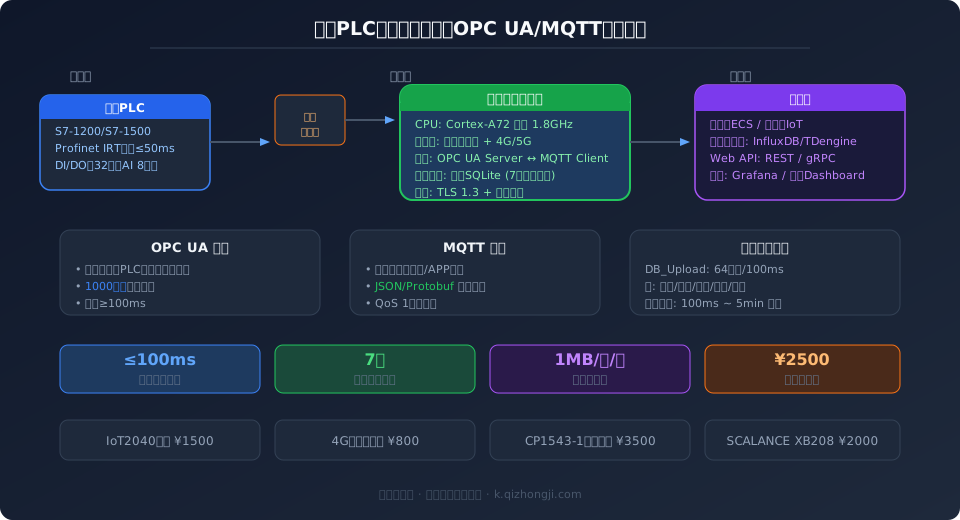
For overhead crane PLC data cloud connectivity, we recommend an industrial IoT gateway with a 4G/5G networking solution. The gateway collects PLC data via Profinet (polling cycle ≤100ms) and uploads it to the cloud platform's time-series database through an OPC UA Server or MQTT Client. Each crane generates 64-byte data packets every 100ms, totaling approximately 1MB of data per crane per day. In the event of network interruption, data is cached locally in SQLite for up to 7 days and automatically re-uploaded once the connection is restored. This solution has been deployed across 30+ projects with an online rate of ≥99.5%.

Cloud connectivity for overhead crane data is the foundational step toward remote monitoring and predictive maintenance. Operational data collected by the crane's PLC (S7-1200/1500)—including hoisting motor current, vibration acceleration peaks, brake temperature, cumulative running time, and fault codes—must be transmitted to the cloud platform reliably, securely, and with minimal latency. Crane sites are typically located in steel plants, cement plants, ports, and other facilities where 4G/5G network coverage varies. A robust data upload solution must therefore balance real-time performance, local caching capability, and industrial-grade security. This article provides a complete engineering walkthrough for connecting overhead crane PLC data to the cloud, covering protocol selection, gateway hardware configuration, data point mapping, and security certification.

Overhead crane PLC cloud connectivity protocol and OPC UA/MQTT gateway configuration diagram

OPC UA vs MQTT: Choosing the Right Protocol for Crane Telemetry

The two dominant protocols for overhead crane data cloud upload are OPC UA and MQTT. They differ significantly in communication patterns, application scenarios, and implementation complexity—

← Scroll left / right to view full table →
Comparison ParameterOPC UAMQTT
Communication ModeBidirectional(Read/Write/Subscribe), PLCCloud-Writable VariableOne-Way Publish/Subscribe, PLCNot Directly Cloud-Writable
Data ModelInformation Model(Node+Property+Method), Built-in Type SystemRaw Message(JSON/Protobuf), No Unified Data Model
Transport LayerTCP(Binary)or HTTPS(JSON)TCP(Persistent Connection, TLS 1.3Encryption)
SecurityX.509Certificate+Signature+Encryption, Grade HighestTLS+Username/Password+Client IDCertification
Real-Time PerformanceSubscription Mode Latency≤100msQo S 0Subscription Mode Latency≤50ms, Qo S 1Subscription Mode Latency≤200ms
Resource Footprint(Gateway)Highest(Requires Running UA Server Stack, Memory≥256MB)Low(MQTT Client Stack Approx.50KBMemory)
Cloud CompatibilitySiemens Mind Connect/Azure Io TSupportedAWS Io T/Azure Io T/Alibaba Cloud Io TFull Support
Application ScenariosRequires Bidirectional Control+Complex Data Model ScenariosPure Data Acquisition to Cloud, Low Bandwidth, High Concurrency
Implementation ComplexityMedium-High(Requires Certificate Management+Address Space Configuration)Low(Broker Address+Topic+JSONSufficient)

Selection Guidance: If you only need data collection and cloud upload, MQTT is the first choice (low cost, broad compatibility, fast deployment). If you need remote PLC control from the cloud (e.g., remote parameter setting, remote fault reset), choose OPC UA. Kelude recommends a hybrid approach: use MQTT for data collection (gateway publishes + cloud subscribes) and OPC UA for parameter download (cloud writes + gateway subscribes). Both protocols run on the same gateway.


Industrial IoT Gateway Hardware Specifications

The data acquisition capability of the industrial IoT gateway determines the reliability of your cloud connectivity solution. Recommended gateway hardware: CPU ≥ quad-core Cortex-A72 @ 1.8GHz, RAM ≥ 1GB, storage ≥ 8GB eMMC + 16GB TF card expansion, dual Ethernet ports (one for Profinet Industrial Ethernet, one for a 4G/5G router). Supported protocols: Profinet slave / Modbus TCP master (connecting to overhead crane PLC), OPC UA Server (for SCADA/MES access), MQTT Client (cloud upload), and local SQLite cache (7-day offline buffer). Remote configuration and firmware OTA upgrades are supported.

Three recommended gateways:

① Siemens IoT2040— ¥1,500, excellent value, pre-installed with Node-RED and OPC UA Server; 4G module sold separately. Ideal for budget-conscious customers with networking experience.

② Huawei AR650— ¥3,000, integrated industrial router + gateway, built-in 4G Cat6, dual-SIM redundancy, VPN + firewall support. Best for applications requiring high network reliability.

③ Kelude Custom Gateway— ¥2,500, based on RK3588 + dual Ethernet ports + 4G Cat4 + 7-day cache, pre-loaded with Profinet protocol stack and MQTT client. Fully configured and tested against the overhead crane PLC before shipment — plug in and go, no on-site engineering required. Recommended

The Kelude custom gateway comes pre-configured with the crane data point table (DB_Upload, 64 bytes). Once powered on, the gateway automatically identifies the crane PLC model and begins data acquisition — no on-site commissioning needed.


Data Point Table Design and TIA Portal DB Block Configuration

To upload crane data to the cloud, a unified data upload DB block (DB_Upload) must be created on the PLC side. The gateway reads from this DB block address cyclically. Data block structure (64 bytes, refreshed every 100ms):

← Scroll left / right to view full table →
Byte OffsetData ItemData TypeDescription
0~3overhead crane IDDINTDevice ID, Globally Unique
4~7TimestampUDINTUnix Millisecond Timestamp(PLCSystem Time)
8~11Crane Bridge / Long Travel PositionDINTCrane Rail×Coordinate, mm Accuracy
12~15Trolley PositionDINTMain Girder×Coordinate, mm Accuracy
16~19Lifting HeightDINTHook Height Above Ground, mm
20~23Load WeightDINTCurrent Load Weight, kg
24~27travel speedREALm/s
28~31Hoisting Motor CurrentREALA, Three-Phase Average
32~35Motor TemperatureREAL°C(PT100Acquisition)
36~39Brake TemperatureREAL°C(Non-Contact Infrared)
40~43Vibration RMSREALmm/s(reducer bearing)
44~47Accumulated Operating HoursUDINTHours
48Fault codeBYTE0=Normal,1~255=Fault code
49 Operating Mode BYTE 0=Standby/1=Running/2=Maintenance/3=Fault
50~63 Reserved 14×BYTE Reserved for Expansion

Kelude Heavy Industry now ships all new overhead crane PLC firmware with the DB_Upload data block preinstalled (one TIA Portal library for S7-1200 and one for S7-1500). The gateway comes with a preconfigured parsing script that automatically interprets the data block structure and packages it into MQTT JSON messages.


Industrial Network Security for Crane Cloud Data

Sending overhead crane data to the cloud requires careful attention to industrial network security. Kelude Heavy Industry recommends a three-layer security architecture:

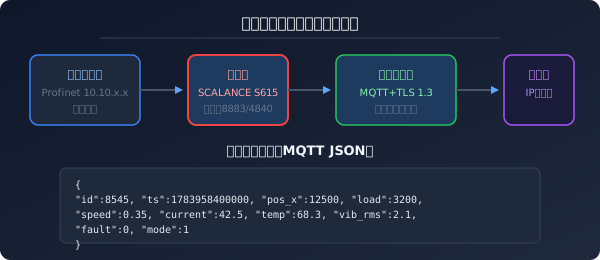
① Network Isolation—The crane's industrial Ethernet network (Profinet subnet 10.10.x.x, physically separate) is isolated from the office network and internet by an industrial firewall (Siemens SCALANCE S615). The gateway has dual network ports: one connects to the Profinet subnet (static IP), the other to a 4G router (NAT). Only specific outbound ports (MQTT 8883/TLS, OPC UA 4840/TLS) are allowed to reach the designated cloud platform IP addresses.

② Transport Encryption—MQTT enforces TLS 1.3 with client certificate verification; OPC UA requires X.509 certificate signing and encryption. All cloud-bound data travels through encrypted channels, protecting against man-in-the-middle attacks and data tampering.

③ Identity Authentication—The MQTT Client ID uses the crane ID (read from the PLC), and the password uses a gateway-unique key (burned in at the factory). The cloud platform is configured with an IP whitelist that only allows each site gateway's public IP to connect. Kelude Heavy Industry custom gateways ship fully configured with all security settings in place—just power on at the site and go.


Cloud data network topology and security isolation diagram

Cloud Data Acceptance Testing Criteria

The core indicators for accepting a crane cloud data project:

① Data Integrity Rate ≥99.9%—Calculated as the ratio of PLC-side DB_Upload update counts to cloud database records received, sampled over 7 consecutive days.

② End-to-End Latency ≤500ms—Measured from the crane PLC DB block update to the cloud time-series database write completion.

③ Offline Retransmission Rate 100%—All data cached offline for up to 7 days must upload successfully with zero loss.

④ Uptime ≥99.5%—Calculated on a monthly basis, including 4G network failures and unexpected gateway restarts. Kelude Heavy Industry issues a Cloud Data Performance Test Report at acceptance, covering 7-day continuous test data for the three core indicators: integrity rate, latency, and uptime.


Gateway Options Compared by Cost and Value

Io T2040
¥1,500 · Entry-Level
Dual-Core A7 1GHz
OPC UA+Node-RED
Requires Separate Configuration4GModule
Huawei AR650
¥3,000 · Industrial Router Integrated
Built-in4G Cat6
Dual SIMredundancy
VPN+Firewall
Kelude Customized
¥2,500 · Recommended
Pre-installedoverhead crane DBParsing
7Day Cache+Offline Data Buffering and Retransmission
Out-of-the-Box, No Configuration Required

Frequently Asked Questions

Q: Does the overhead crane cloud connectivity require 5G? Is 4G sufficient?

A: 4G is more than sufficient. Each overhead crane transmits 64 bytes every 100ms, which translates to approximately 1.6GB per crane per month (64×10×60×60×24×30=1.66GB). For 20 cranes, that's roughly 33GB per month. A 4G Cat4 connection (150Mbps downlink / 50Mbps uplink) handles this load with ease. 5G's advantages—ultra-low latency (1ms level) and high bandwidth (1Gbps level)—are simply not needed for crane cloud connectivity. We recommend a 4G Cat6 router (300Mbps downlink / 50Mbps uplink) to provide extra headroom.

Q: Will cached data be lost if the gateway loses power or network connectivity?

A: No. The gateway uses a local SQLite database for caching (stored on TF card/eMMC). When the network is down, data continues to be written to the local database. If the gateway loses power, the last data write is already committed (SQLite write operations are completed within ACID transactions). Once power and network are restored, the gateway first checks the local cache for any unsent data and uploads it sequentially in chronological order (at the same 100ms interval as normal collection). Only after the backlog is cleared does it resume real-time data streaming. In the unlikely event of TF card failure, the maximum data loss is limited to the last uncommitted write—at most 64 bytes.

Q: Which time-series database does the cloud platform use?

A: We recommend TDengine (open-source, developed in China) or InfluxDB (international mainstream). TDengine offers superior write throughput (2 million points/second on a single node) and better compression ratios (10–20x) compared to InfluxDB, and it provides a REST API and Grafana plugin. The Kelude cloud platform defaults to TDengine 3.0, with a pre-configured super-table structure for crane data (each crane ID maps to a sub-table, automatically partitioned by ID). Storage cost is approximately ¥0.01 per crane per day (including a full year of data retention).

Q: What does it cost to retrofit a single overhead crane for cloud connectivity?

A: The per-crane retrofit cost depends on the existing PLC type. S7-1200/1500 PLCs already have Profinet interfaces, so you only need a gateway (¥2,500 custom model) plus a 4G router (¥800) and installation & commissioning (¥1,000)—totaling approximately ¥4,300 per crane. Older S7-200/300 systems require an additional CP243-1/CP343-1 Ethernet module (¥1,500–2,500), bringing the total to roughly ¥5,800–6,800 per crane. For cranes with pure relay control, the PLC must first be upgraded (S7-1200 at about ¥4,000 plus ¥5,000 for programming) before cloud connectivity can be added, for a total of approximately ¥13,300 per crane. Kelude offers volume discounts: 10% off for 10+ units and 15% off for 30+ units.

Related News

contact

contact us

phone:
+86 13903802779

mail:3915269@qq.com

Working hours: Monday to Friday

Wechat
Wechat
SHARE
TOP