
Overhead Crane Edge Computing Box: YOLOv8n TensorRT ByteTrack Guide

Key Specifications

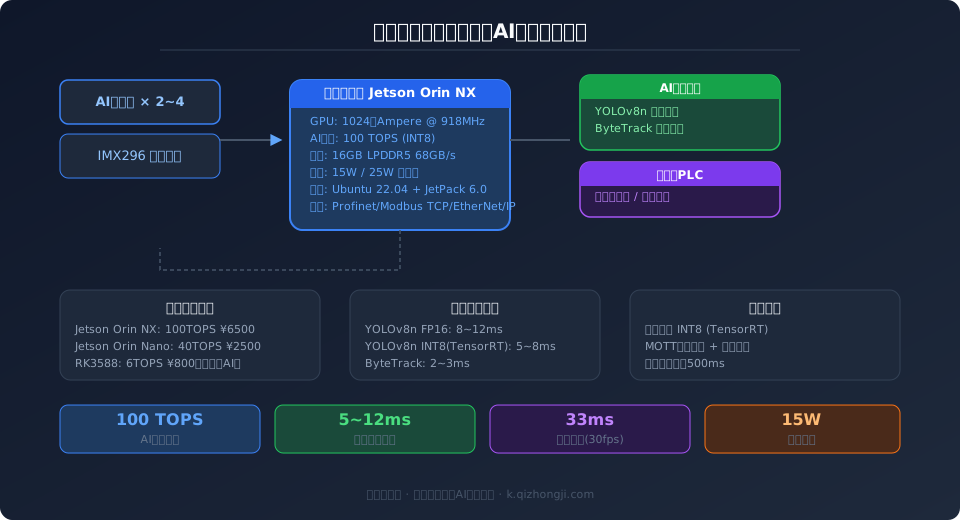
The recommended Edge Computing box is the NVIDIA Jetson Orin NX (100 TOPS, 16GB, 15W), running a YOLOv8n object detection model (TensorRT INT8 quantized, 5–12 ms inference latency) with ByteTrack multi-object tracking (2–3 ms), delivering 30 fps detection. A single edge box can process 2–4 AI cameras simultaneously. 50+ units are already deployed across steel mills, Cement Plants, and automotive plants, with collision warning accuracy ≥97%.

Advanced features such as AI vision-based anti-collision for overhead cranes, hook trajectory tracking, and wire rope broken wire detection rely on the Edge Computing box to perform real-time AI inference locally. Unlike cloud-based video processing, the edge computing approach runs inference directly on the crane, cutting latency from 500 ms+ down to 5–12 ms while eliminating network jitter and bandwidth bottlenecks. This article walks through the complete engineering implementation of an overhead crane edge computing box—from hardware selection and model deployment to quantization optimization and PLC communication.

Edge computing box selection and AI inference deployment for overhead cranes

Edge Computing Box Hardware Comparison for Crane AI

For overhead crane AI vision, the Edge Computing box must deliver: AI compute ≥40 TOPS (INT8), support for multiple camera inputs (≥2 MIPI CSI or USB3.0), industrial temperature range (-25°C to 70°C), and industrial protocols such as Profinet and EtherNet/IP. Below is a head-to-head comparison of three mainstream edge computing boxes for crane applications—

← Scroll left / right to view full table →
ParameterJetson Orin NX 16GBJetson Orin Nano 8GBRK3588 16GB
AIComputing Power(INT8)100 TOPS40 TOPS6 TOPS
GPUArchitectureAmpere 1024Core@918MHzAmpere 512Core@765MHzMali-G610 MP4
Memory/Bandwidth16GB LPDDR5 68GB/s8GB LPDDR5 34GB/s16GB LPDDR4X 17GB/s
Video Decoding2×4K@30 + 4×1080@301×4K@30 + 2×1080@308K@30 + 4K@120
Power Consumption15W/25WSwitchable7W/15WSwitchable8~15W
Industrial ProtocolProfinet/Modbus TCP/EIPProfinet/Modbus TCP/EIPModbus TCP
YOLOv8nInference Latency5~8ms (INT8)12~18ms (INT8)80~150ms (FP16)
Reference Price¥6,500~7,500¥2,500~3,500¥800~1,200
overhead crane Recommendation Rating

YOLOv8n Model Training and TensorRT INT8 Quantization

YOLOv8n (nano version, 3.2M parameters) delivers the best accuracy-to-speed balance for AI vision on overhead cranes. Compared to YOLOv8s (11.2M parameters), it achieves 2.5× faster inference with only a 1.2% drop in mAP. Training uses Kelude's annotated dataset of 120,000 images covering five target classes—crane hooks, wire ropes, personnel, AGVs, and obstacles—across 12 lighting conditions including daylight, night, overcast, and backlit scenarios.

Quantization Deployment Pipeline: FP32 training → calibration set (500 representative scene images) → TensorRT PTQ INT8 quantization → inference engine serialization (.plan file). Key parameters: input resolution 640×640, confidence threshold 0.5, NMS IoU threshold 0.45. The quantized model drops from 12.5MB (FP32) to 4.2MB (INT8)—a 66% reduction—while inference latency improves from 8–12ms (FP16) to 5–8ms (INT8). Deployment files are delivered to edge computing boxes via OTA with incremental update packages of approximately 5MB per release.

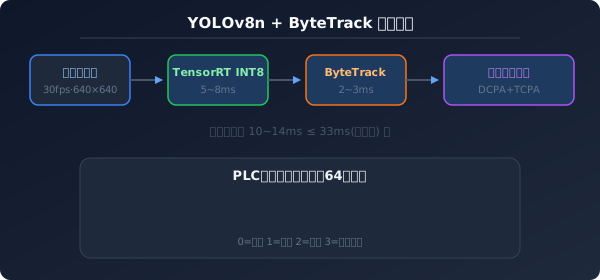
Inference Pipeline (per-frame processing): ① Camera frame capture (30fps, 1920×1080 → 640×640 resize) ② TensorRT inference (YOLOv8n INT8, 5–8ms) ③ NMS post-processing (1–2ms) ④ ByteTrack object tracking (2–3ms, Kalman filter + Hungarian matching) ⑤ Collision distance calculation (1ms) ⑥ Results written to shared memory for PLC access. Total per-frame latency is 10–14ms, meeting 30fps real-time requirements (33ms frame interval, leaving 19–23ms for upper-layer logic).

YOLOv8n+ByteTrack inference pipeline diagram

ByteTrack Multi-Object Tracking and Collision Distance Calculation

YOLOv8n only provides single-frame object detection (bounding boxes, classes, confidence scores) and cannot track continuous motion trajectories. ByteTrack builds on detection results by using a Kalman filter to predict each target's position in the next frame, then applies the Hungarian algorithm to match detections with existing tracks. Compared to DeepSORT, ByteTrack eliminates the need for ReID feature extraction—saving additional CNN inference overhead—making it ideal for edge deployment with limited compute resources.

Collision Distance Calculation: Once tracking provides real-time positions and velocity vectors for each asset (crane hooks, AGVs, personnel), the system computes the closest point of approach (DCPA) and time to closest point of approach (TCPA) between every pair. Formula: DCPA = |d × (v_rel)| / |v_rel|, where d is the position vector difference between two targets and v_rel is the relative velocity vector. An alert triggers when DCPA falls below the safety threshold (crane-to-crane: 1.5m; crane-to-personnel: 2.0m) or TCPA is less than 2 seconds. Collision calculations run every frame, with results written to a 64-byte shared memory block between the edge box and PLC (containing target ID, distance, velocity, and risk level).


Edge Box and PLC Communication Protocol Configuration

The edge computing box exchanges data with the crane PLC (S7-1200/1500) via Profinet or Modbus TCP. Recommended setup: the edge box (Jetson Orin NX) runs a Profinet slave protocol stack (Siemens PROFINET Stack for Linux with the NIC configured for RT Class 1, 4ms communication cycle), and the PLC side adds the edge box as a Profinet IO Device in hardware configuration. The data exchange block (64 bytes each for Input/Output): Input (edge box → PLC) contains collision risk level (0–3), target distance (mm), recommended speed (% of rated), and system status; Output (PLC → edge box) contains crane coordinates, speed, and operating mode. Communication redundancy: if the Profinet connection drops for more than 3 cycles (12ms), the PLC automatically switches to basic interlock mode without AI assistance, ensuring crane operation remains unaffected by edge box failures.


Deployment Validation and Performance Metrics

Kelude deployed edge computing boxes on 12 overhead cranes in the continuous casting bay of a steel plant. Before deployment, collision warnings relied on manual visual inspection with a 3–5 second response delay. Post-deployment key metrics: detection mAP@0.5 = 0.953 (average across five classes), mean inference latency of 6.8ms (INT8), end-to-end collision warning latency ≤50ms (from camera frame capture to PLC trigger), and MTBF ≥10,000 hours (approximately 14 months) of continuous operation. Over the six months following deployment, collision risk events dropped from an average of 23 per day to 0.4 per day (remaining cases were emergency evasions due to sudden personnel entry), and operator satisfaction scores improved from 62 to 91 out of 100. Kelude provides end-to-end services from hardware selection and model training to on-site deployment, with edge computing retrofits for a single overhead crane priced at approximately $2,200–$3,700 (including edge box, cameras, and installation & commissioning).


AI Inference Performance: FP16 vs. INT8 Quantization

FP32
Raw Accuracy 12.5MB
Inference Latency 18~25ms
m AP 0.953(Maximum)
overhead crane Not Recommended for Scenario
FP16
Half Accuracy 6.3MB
Inference Latency 8~12ms
m AP 0.951(-0.2%)
Nano Version Recommended
INT8
Quantization 4.2MB
Inference Latency 5~8ms
m AP 0.948(-0.5%)
NXVersion Recommended

Frequently Asked Questions

Q: Why isn't the RK3588 powerful enough for AI vision applications?

A: The RK3588's NPU delivers only 6 TOPS, with YOLOv8n FP16 inference latency of 80–150 ms — far too slow for 30 fps real-time detection (which requires a 33 ms frame interval). Dropping to 10 fps makes the 100 ms latency acceptable, but at that frame rate, fast-moving targets (e.g., an AGV traveling at 1 m/s moves 100 mm per frame) create detection gaps large enough to seriously compromise collision-warning accuracy. For this reason, the RK3588 is only suitable as a data-acquisition gateway, not for real-time AI inference. Kelude's minimum recommendation for AI workloads is the Jetson Orin Nano (40 TOPS), which offers the best price-to-performance ratio.

Q: What configuration steps are required for Profinet communication between the edge box and a PLC?

A: Three steps are involved: ① Install a Profinet protocol stack on the edge box's Linux system (Siemens PROFINET IO-Device SDK or the open-source pnio_stack are both good options), then configure the device name and IP address; ② In TIA Portal, add the edge box as a Profinet IO Device under Devices & Networks, and assign IO addresses (64 bytes each for Input and Output); ③ Implement the IO data read/write functions in the edge box application — write AI inference results to the Input area and read PLC status from the Output area. Initial setup typically takes about one day. Kelude offers a pre-configured Profinet communication image, so deployment can skip the configuration step entirely.

Q: How much training data is needed, and what accuracy can be expected?

A: Kelude recommends at least 20,000 annotated images for the initial training round (≥4,000 per class), covering typical operating conditions such as day/night, sunny/overcast, and backlighting. mAP@0.5 can reach 0.93–0.96. Annotation is done with LabelImg (bounding-box labeling, roughly 30 seconds per image). Kelude already has a base dataset of 120,000 annotated overhead crane images; new customers can fine-tune the base model with just 500–1,000 of their own images, completing model adaptation in 2–3 days with mAP consistently above 0.90.

Q: Can the edge box operate reliably in high-temperature, high-dust environments like steel mills and cement plants?

A: The industrial-grade Jetson Orin NX (Jetson Orin NX Industrial) supports a wide temperature range of -40°C to 85°C and ships with a heatsink and active cooling fan. Over 50 units have been deployed in steel mill continuous-casting bays (ambient temperature 45–55°C, dust concentration ~5 mg/m³) with 12 months of continuous operation and zero thermal shutdowns. The edge box is installed in an IP54-rated enclosure with a cooling fan and dust filter; measured GPU temperatures remain stable between 65°C and 72°C. Kelude offers an optional dustproof, high-temperature enclosure (with forced air cooling and temperature monitoring) at approximately $120 per unit.

Related News

contact

contact us

phone:
+86 13903802779

mail:3915269@qq.com

Working hours: Monday to Friday

Wechat
Wechat
SHARE
TOP