

Electromagnetic Brake Rectifier: Working Principle & Replacement
📋 Key Summary
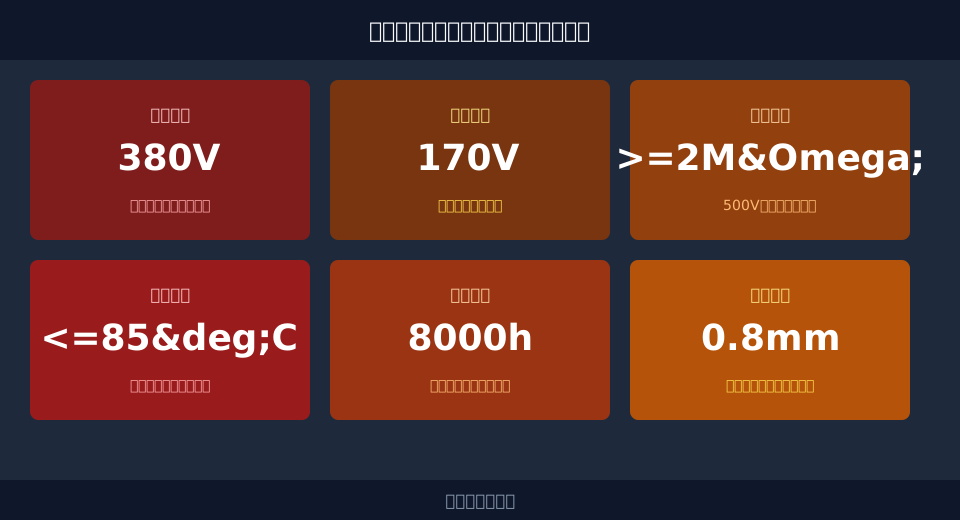
The rectifier block in a crane’s electromagnetic brake converts AC power to DC, providing stable voltage for the brake coil. In 50t–300t European Standard Double-Girder Cranes, input is typically 380V AC, with output regulated at 170V–190V DC. Degraded or broken blocks can cause failure to release or incomplete braking. We recommend insulation resistance testing every 8,000 operating hours or two years; replace immediately if resistance drops below 2MΩ to ensure safe operation.
Crane Electromagnetic Brake Rectifier: Working Principle & Parameters
The electromagnetic brake is a critical safety component for hoisting and travel mechanisms, while the rectifier block serves as its “heart” power module. Its core function is to convert three-phase AC from conductor rails or cables into smooth DC via an internal bridge rectifier, generating stable magnetic attraction for the brake coil. For high-end customization projects by Kelude Heavy Industry (50t–300t European Standard Double-Girder Cranes), the standard input is 380V AC. After full-wave rectification and filtering, the output stabilizes between 170V and 190V DC, with a rated output power of approximately 200W.
Internally, the rectifier comprises diodes, filter capacitors, and freewheeling diodes. When the control system triggers braking, the contactor closes, allowing AC to enter the rectifier. Diodes convert AC to pulsating DC, which filter capacitors smooth into a steady waveform to prevent coil fluctuation. The freewheeling diode, connected in parallel across the coil, provides a discharge path for self-induced electromotive force when the contactor opens, preventing high-voltage damage to control components. Understanding this principle helps technicians appreciate the importance of anti-collision safety distance settings and brake response time.
Per FEM 1.001 Crane Design Specification, electrical designs must guarantee reliable operation under all conditions. Output voltage fluctuations must stay within ±10% of the rated value (153V–209V). Low voltage causes insufficient holding force and brake shoe friction, while high voltage accelerates insulation aging. Kelude’s technical team strictly calculates the matching relationship between load inertia and braking torque during selection to meet rigorous European Standard requirements.
Fault Diagnosis & Insulation Testing for Double Girder Crane Rectifiers
Under long-term heavy loads, rectifiers are susceptible to grid fluctuations, ambient temperature, and dust, leading to electrical faults. Common symptoms include failure to open, slow release, incomplete closing, or abnormal humming noises. These often indicate broken diodes, failed capacitors, or oxidized terminal blocks. Accurate diagnosis requires a standardized testing procedure.
- Isolate Power: Disconnect the main power supply. Use a voltage tester to confirm zero voltage on the main circuit and hang a “Do Not Operate” sign. Wait at least 5 minutes for internal capacitors to fully discharge.
- Check Input Voltage: Set a multimeter to AC voltage mode. Measure the three-phase input; normal readings should be around 380V. Missing phases require inspection of the upstream power supply line.
- Verify Output Voltage: Switch to DC voltage mode. If output drops below 150V or fluctuates significantly under load, internal components are degrading and require disassembly.
Beyond voltage checks, insulation resistance is key to assessing health. Using a 500V Megohmmeter, measure the resistance between the output and ground; it must exceed 2MΩ. Simultaneously, check the brake coil’s DC resistance (typically ~50Ω). Infinite resistance indicates an open circuit; values below 2MΩ suggest moisture ingress or insulation breakdown. Combine these electrical tests with weld crack detection on the Main Girder for a comprehensive condition assessment. Regular dual inspections align with TSG 51-2023 Crane Safety Technical Supervision Regulation to prevent accidents.
Replacement Procedure & Precautions for Large Tonnage European Standard Cranes
If the rectifier is irreparable,Specification replacement is mandatory. On Kelude’s European Standard Double-Girder Cranes, this involves both electrical wiring and mechanical brake clearance adjustment. Prepare a compatible replacement unit along with insulated gloves and a torque wrench. During removal, label every wire to prevent short circuits from incorrect reconnection.
When installing the new unit, tighten mounting bracket bolts to 45N·m to ensure proper heat dissipation. After wiring, adjust the gap between the Brake shoe and Brake wheel. For large tonnage cranes, the standard single-side gap is 0.8mm; gaps must be uniform. Excessive gaps increase braking distance and reduce Braking torque; too small a gap causes dragging and overheating.
Braking distance directly reflects performance. Consider a 50t European Standard Double-Girder Crane with a rated operating speed of 60m/min (1m/s linear speed). With emergency braking deceleration set at 0.5m/s², the theoretical braking distance is calculated as s=v²/(2a) = 1²/(2×0.5) = 1m. Post-replacement, conduct empty-load and rated load brake tests; actual distance should approximate 1m. If significantly longer, check output voltage or spring tension.
Precautions: Never plug/unplug terminals while live. Clean oil and dust after wiring to prevent tracking. Perform an Inching / Jog Mode test upon first power-up to verify smooth operation before continuous running.
Maintenance Cycle & Operating Status Assessment
To extend service life, establish a scientific routine maintenance schedule. Under normal environmental conditions, inspect and maintain the rectifier every 8,000 hours or two years. Tasks include cleaning dust, checking terminal tightness, measuring insulation/output voltage, and logging data for health records.
In harsh environments (high temp, dust, corrosive gases), shorten the maintenance cycle to every six months. High temperatures dry out electrolytic capacitors and risk thermal breakdown. Monitor surface temperature closely; it should not exceed 85℃. Use infrared temperature measurement to detect hot spots indicating aging or poor heat dissipation, requiring immediate shutdown.
Vibration also impacts longevity. Mechanical shock from travel can fatigue welds or loosen connections. Standards require vibration velocity effective values at the mounting bracket to remain under 4.5mm/s. Excessive vibration necessitates checking bracket stiffness and vibration damping pads. Modern systems integrating anti-sway algorithm technology improve operating stability, reducing mechanical shock on the braking system and enhancing overall reliability.
| fault symptom | possible causeAnalysis | Processingrecommendationand Measures |
|---|---|---|
| BrakeUnable to Open | Rectifier Block AbsentDC (Direct Current)Output,Internal Diode Breakdown or Fuse Blown | Measure Input and Output Terminals,replacementSameModelRectifier Block or Internal Fuse |
| BrakeSlow Opening | FilteringCapacitanceCapacityattenuation,OutputVoltageExcessive Ripple Causing Insufficient Holding Force | DetectionOutputVoltageWaveform,replacementRectifier Block or IndividualreplacementFilteringCapacitance |
| Burning Smell During Operation | Rectifier BlockoverloadOverheating,Terminal BlockLoose Connection Causing Localized High Temperature | TighteningTerminal Block,Clean Dust,inspectioncoilPresence Checkturn-to-turn short circuit |
| cranecapacity | Input ACVoltage | OutputDC (Direct Current)Voltage | Rated OutputPower |
|---|---|---|---|
| 50t European Standard Double-Girder | 380V (AC) | 170V (DC) | 200W |
| 100t European Standard Double-Girder | 380V (AC) | 180V (DC) | 350W |
| 200t European Standard Double-Girder | 380V (AC) | 190V (DC) | 500W |
| 300t European Standard Double-Girder | 380V (AC) | 190V (DC) | 650W |
FAQ
Q: What are the consequences of low output voltage from the rectifier block?
A: Insufficient output voltage reduces the magnetic attraction in the brake coil, preventing the Brake shoe from fully opening and causing friction heat. Prolonged operation accelerates Brake Lining wear and may lead to Motor overload. Check if the input voltage is stable or measure for diode attenuation; replace the unit if necessary.
Q: What electrical safety precautions should be taken when replacing a rectifier block?
A: Cut off the crane's main power supply and hang warning signs before replacement. Wait at least 5 minutes for Capacitance discharge. Use a multimeter to confirm DC Voltage has dropped to a safe range. Mark wire phases during disassembly and ensure Terminal Block torque meets specifications during installation to prevent loose connections and overheating.
Q: How can I determine if a rectifier block is damaged and needs replacement?
A: Measure input and output Resistance. Infinite AC Resistance at the input indicates an open internal fuse or coil; abnormally low DC Resistance at the output suggests a shorted diode. Additionally, if the surface temperature exceeds 85°C or a burning smell is detected during operation, the unit is damaged and must be replaced.
Q: What is the recommended routine maintenance cycle for rectifier blocks?
A: In standard environments, perform a comprehensive inspection every 8,000 operating hours or two years. In high-temperature, dusty, or Corrosive environments, shorten the maintenance cycle to every six months. Record Insulation Resistance and output Voltage data during each inspection to track equipment health and predict remaining life.
