

Crane Maintenance Cost
📋 Key Summary
Annual crane maintenance costs are significantly influenced by lifting capacity and working conditions. For European-standard double-girder cranes ranging from 50 to 300 tons, the standard maintenance interval is strictly set at 12 months. Basic lubrication and wear part replacements account for approximately 35% of the annual budget, while in-depth electrical system inspections and non-destructive testing (NDT) comprise about 45%. By strategically planning maintenance checklists and strictly adhering to technical specifications, enterprises can effectively control overall operational costs, extend equipment service life, and ensure production safety.
In the full lifecycle management of cranes, scientific maintenance is the foundation for ensuring stable operation. According to the requirements of FEM 1.001 Crane Design Specification, structural components and mechanisms must be designed with fatigue life and wear margins fully considered. Simultaneously, daily maintenance operations must strictly comply with the safety technical supervision regulations outlined in TSG 51-2023 Safety Technical Supervision Regulation for Lifting Appliances. Kelude Heavy Industry leverages its extensive experience in manufacturing European-standard double-girder cranes to provide a detailed breakdown of annual maintenance cost lists and technical highlights.
Cost Structure and Detailed Analysis of Annual Maintenance for European Standard Double-Girder Cranes
First, mechanical structure lubrication represents the core expenditure in routine maintenance. For European-standard double-girder cranes in the 50t to 300t range, gearboxes, bearing housings, and open gears require regular oil replacement or replenishment. Taking a double-girder crane with a 100t lifting capacity and a 28.5m span as an example, a comprehensive lubrication session consumes approximately 200 liters of industrial gear oil and 40 kg of grease. These material and labor costs form the baseline of basic maintenance.
Second, the costs associated with inspecting and replacing wire ropes and pulley blocks fluctuate significantly. As critical wear parts, the service life of wire ropes is heavily influenced by Work Duty classification and load spectrum. Under A5 work duty, the average replacement interval for wire ropes is approximately 18 months. Additionally, seal components in pulley block bearings require preventive replacement every 12 months to prevent dust ingress that could cause bearing seizure. These consumable costs must be included in the annual routine budget.
<pFurthermore, inspecting wear on wheel tread surfaces and crane rails is another significant component of routine maintenance. After reaching specific operating cycles, calipers must be used to measure diameter deviations on the wheel tread. When deviations exceed 2mm, turning repair or complete replacement is required. Machining and installation costs for these repairs should be planned in advance. The Kelude Heavy Industry technical team recommends specifying wear part models during the procurement phase to facilitate rapid matching later, thereby reducing downtime waiting costs.Cost Accounting for In-Depth Inspection and Non-Destructive Testing of Large Tonnage Crane Core Components
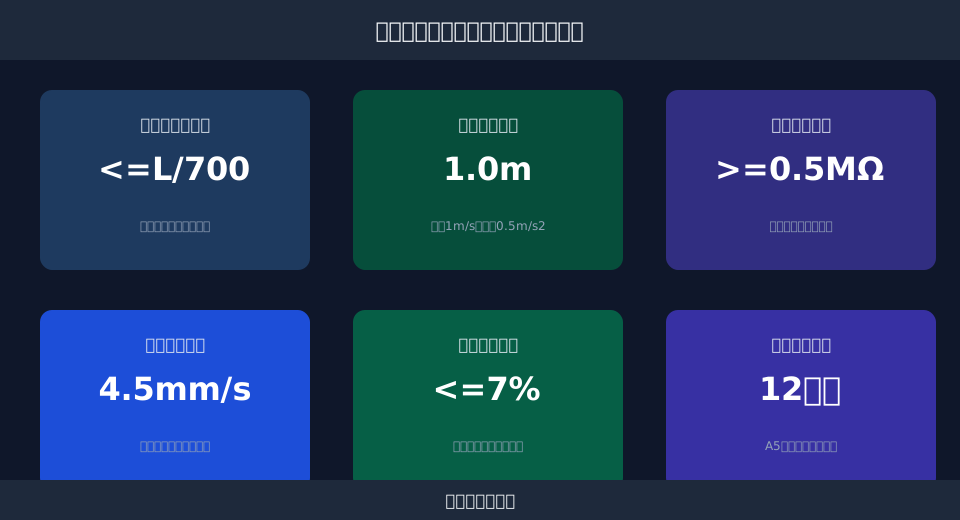
The metal structures and core transmission components of large tonnage cranes are prone to fatigue damage under long-term alternating stress. Measuring main girder deflection is a key indicator during annual in-depth inspections. According to technical specifications, the mid-span deflection of the main girder under full load should not exceed 1/700 of the span. If inspection data approaches this threshold, an assessment for prestressed repair is necessary, which incurs high specialized maintenance costs.
Regarding non-destructive testing (NDT), ultrasonic and magnetic particle inspection (MPI) fees for main girder weld crack detection constitute a substantial portion of the deep inspection budget. Typically, a 20% sampling rate is required for critical welds at the connection between the main girder and end carriage. Furthermore, quantitative evaluation of brake performance is essential. Using a crane travel mechanism as an example, if the Long Travel Speed is set at 60 m/min (equivalent to 1 m/s) and braking deceleration is set at 0.5 m/s², the braking distance $s$ is calculated using the kinematic formula $s = v^2 / (2a) = 1^2 / (2 \times 0.5) = 1$ meter. If the measured braking distance exceeds 1.2 meters, it indicates severe wear of the brake lining or attenuation of spring force, necessitating immediate replacement of the brake lining. These adjustment and replacement costs must be included in the deep maintenance list.
In the gearbox inspection process, beyond routine oil analysis, vibration analysis technology should be introduced. By measuring the RMS vibration velocity of the gearbox housing in X, Y, and Z directions, values exceeding 4.5 mm/s indicate abnormal wear of internal gears or bearings. Although this data-driven deep inspection costs several thousand dollars per instance, it effectively prevents massive losses caused by sudden shaft breakage accidents.
Evaluation of Maintenance Costs for Crane Electrical Control Systems and Safety Protection Devices
First, internal cleaning of electrical cabinets and component inspection form the basis of electrical maintenance. Frequency inverters and contactors generate heat and accumulate dust during operation. It is recommended to replace frequency inverter cooling fans every 24 months and clean filters simultaneously. Additionally, use a megohmmeter to measure insulation resistance for motors and cables, ensuring values remain ≥0.5 MΩ. If standards are not met, locate points of insulation aging and perform local replacements to avoid short-circuit faults.
Second, calibration costs for safety protection devices cannot be overlooked. Limit switches, buffers, and sensors for anti-collision safety distance monitoring systems require regular calibration. Lens cleaning and optical path calibration for laser anti-collision sensors must be performed every six months to ensure accurate signal transmission. While individual maintenance costs for these safety devices are low, their high frequency results in them accounting for approximately 30% of total electrical maintenance expenses.
For cranes utilizing PLC control, testing input/output points of logic control modules requires significant labor. Technicians must simulate limit signals and operation commands one by one to verify the response time of the PLC program and the action consistency of execution mechanisms. This commissioning fee accounts for about 15% of electrical maintenance but is crucial for ensuring the reliability of automated operation.
Discussion on Maintenance Intervals and Budget Optimization Strategies for Cranes Under Different Working Conditions
Actual working conditions directly determine maintenance intervals and costs. In severe working conditions such as high-temperature metallurgy or dusty environments, equipment work duty typically reaches A6 or A7, with ambient temperatures fluctuating drastically between -20°C and 50°C. Under such harsh conditions, the oxidation speed of lubricating oil accelerates, and filter clogging cycles shorten. Routine maintenance intervals must be compressed from 12 months to 6 months or even shorter, increasing annual consumable costs by approximately 40%.
To optimize budgets, enterprises can rely on customized maintenance solutions provided by Kelude Heavy Industry. By introducing condition monitoring systems to acquire real-time motor current and vibration data, traditional "periodic maintenance" can be transformed into "predictive maintenance." This not only enables precise positioning of potential failures but also avoids spare parts waste caused by over-maintenance. Note that specific maintenance item details and final settlement amounts are subject to the actual contract; it is advisable for enterprises to clarify post-warranty maintenance service terms when signing procurement contracts.
Regarding budget optimization, reasonable spare parts inventory management can significantly reduce capital occupation costs. An ABC classification method is recommended for critical spare parts: Class A items, such as main hoist gearboxes and large frequency inverters, should maintain a reasonable safety stock, while Class C items, such as standard fasteners, can be procured on demand via the supply chain. Through this refined management, enterprises can reduce spare parts inventory capital occupation rates by more than 20%.
| MaintenanceItem | Scope of Work | Estimated Cost Share |
|---|---|---|
| MachineryLubrication | Gearbox / Reducer、bearing housingOil Change,open gearLubricationGrease | 25% |
| Wear Partsreplacement | Brake Lining、Sheave BearingSeal、Filterfilter elementreplacement | 35% |
| Tightening&adjustment | High-Strength BoltRe-torque,Brakestrokeand Clearanceadjustment | 15% |
| Work Duty / Classification | Lubrication Interval | Wear PartsReplacement Interval | Annual OverhaulDetectionFrequency |
|---|---|---|---|
| A5 | 12Months | 18Months | 1Times |
| A6 | 6Months | 12Months | 2Times |
| A7 | 3Months | 6Months | 4Times |
FAQ
Q: How many days of downtime are required for the annual maintenance of a 50t Double Girder Crane?
A: For a European Standard Double-Girder crane with a 50t capacity, routine annual maintenance typically requires 2 to 3 days of downtime. This includes comprehensive lubrication of the mechanical structure, brake gap adjustment, and basic cleaning and testing of the electrical system. If major Wear Parts, such as the complete replacement of the Wire Rope, are involved, an additional day is needed. Specific schedules depend on the actual contract and operating conditions.
Q: Under what conditions must a crane's wire rope be scrapped and replaced?
A: Mandatory scrapping and replacement of the wire rope are required when any of the following occur: the Number of broken wires exceeds the limits specified in the Specification; the wear or Corrosion of the nominal diameter reaches 7% or more; or there is severe structural damage such as Cage distortion, Core protrusion, or kink. Regular measurement and recording are key to determining the replacement timing.
Q: Does the maintenance of a European standard crane's electrical system include deep inspection of the Frequency Inverter?
A: Yes. Deep maintenance of the electrical system involves not only checking Contactors and Relays but also conducting thorough inspections of the Frequency Inverter / VFD. Technicians will read internal fault logs from the inverter, check for capacitance attenuation in the DC bus capacitors, and clean heat dissipation air ducts. For equipment operating in harsh environments, thermal imaging cameras are used to monitor the temperature distribution of power modules.
Q: How should maintenance budgets be adjusted for cranes under severe working conditions?
A: In severe working conditions such as high temperatures, heavy dust, or high Corrosion, it is recommended to halve the regular Maintenance interval and increase the budget for repairing special protective coatings. Additionally, inventory levels for Wear Parts like filter elements and Seals should be increased. By introducing Condition Monitoring technology to accurately track equipment degradation trends, you can avoid blindly shortening all project cycles, thereby optimizing the overall budget.
