

Wire Rope Inspection: 6 Discard Criteria & Daily Checks
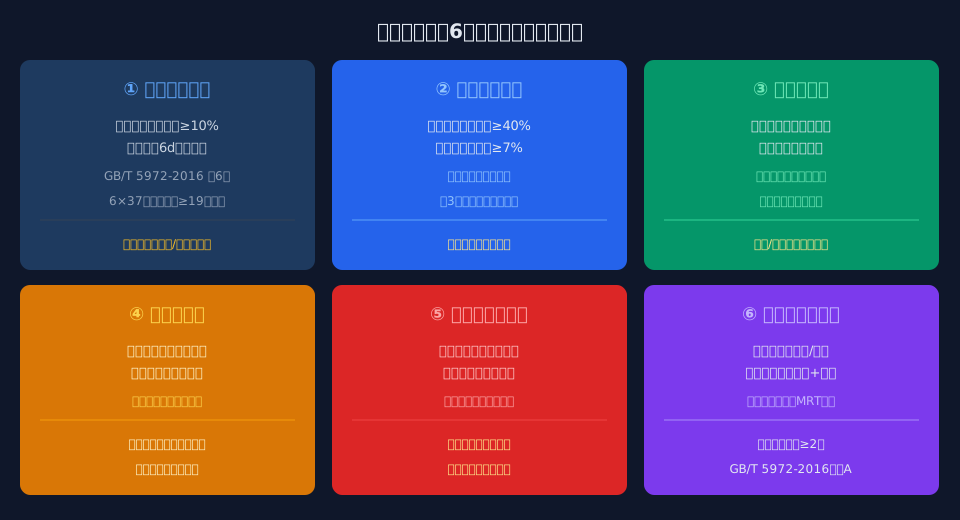
📌 Key Takeaways: A crane wire rope in service must be immediately removed from service and replaced when any of the following six conditions is detected: ① The number of visible broken wires within one rope lay length reaches 10% of the total wire count (approximately 19 wires for a 6×37 construction); ② Outer wire wear reaches 40% or more, or the nominal rope diameter is reduced by 7% or more; ③ Plastic deformation such as waviness, cage distortion, or core protrusion is present; ④ External corrosion shows visible pitting, or internal corrosion is indicated by rust powder seeping out; ⑤ The rope has been damaged by electric arc or tempering heat that has discolored the wires; ⑥ Broken wires or severe damage are found in the rope end termination zone. Daily inspections should include a visual check for broken wires and deformation on every shift, diameter measurement with an optical flat every two weeks, and an annual MRT magnetic particle inspection. Reference Chapter 6 of GB/T 5972-2016 for discard criteria and Appendix A for the inspection record form.
In industrial lifting operations, the condition of the wire rope is directly linked to personnel safety and equipment reliability. Statistics indicate that approximately 30% of crane-related accidents are attributed to wire rope failure. Yet many frontline maintenance personnel lack a clear, practical threshold for when a rope should be taken out of service—resulting in either premature replacement and unnecessary cost, or continued operation with a compromised rope and hidden risk. This article consolidates the six categories of wire rope discard criteria and daily inspection practices based on the GB/T 5972-2016 standard for cranes—covering maintenance, inspection, and discard—alongside the ISO 4309:2017 international standard, providing a practical framework for wire rope safety management.
How Many Broken Wires Require Crane Wire Rope Replacement?
Broken wires are the most common mode of wire rope failure. When the number of visible broken wires within one rope lay length—typically 6 times the nominal diameter (6d) for regular lay wire rope—reaches 10% of the total wire count, the rope must be immediately removed from service.
Taking the widely used 6×37+FC construction as an example, the total wire count is 222. Applying the 10% threshold, a rope with 19 to 22 broken wires within a 6d lay length is considered due for discard. The discard threshold varies by rope construction:
6×19+FC construction (114 total wires): discard when broken wires reach 12 or more
6×37+FC construction (222 total wires): discard when broken wires reach 19 or more
8×19+FC construction (152 total wires): discard when broken wires reach 16 or more
35W×7 rotation-resistant construction: discard when broken wires reach 14 or more (stricter threshold due to hidden inner wires)
It is important to note that broken wires tend to concentrate in the bending zones where the rope passes over sheaves and drums. This is because the outer wires experience maximum tensile stress during bending, and repeated flexing leads to fatigue fractures. During inspection, mark a 6d lay length segment at the point of maximum curvature where the rope bends around a sheave, and count all visible broken wires within that segment. For rotation-resistant ropes, internal wire breaks are more concealed—if localized diameter enlargement or debris extrusion between outer strands is observed, the rope should be opened for internal examination.
Applicable standard: GB/T 5972-2016 Clause 6.2 specifies the discard criteria for broken wires, providing detailed threshold tables based on rope construction and work duty classification. For ropes used in hoisting and luffing mechanisms, the discard threshold is reduced to half of the standard value—for a 6×37 construction, replacement should be considered when broken wires reach 10 or more.
Wire Rope Diameter Wear Limits for Safe Crane Operation
Diameter reduction is another common discard indicator. GB/T 5972-2016 requires discard when the nominal rope diameter is reduced by more than 7%, or when outer wire wear reaches 40% or more of the original wire diameter.
Diameter measurements should be taken with an optical flat (0.02 mm accuracy) at a minimum of three positions along a straight section of the rope. At each position, measure two diameters in perpendicular directions and average all six readings to obtain the actual measured diameter. Measurement points should avoid rope joints, clamps, and similar fittings, prioritizing the sections that most frequently pass over sheaves and drums.
Based on field experience, the Kelude technical team recommends a three-level warning system for diameter wear:
① Diameter reduction less than 3%: Normal operation—continue monitoring trends per the daily inspection schedule.
② Diameter reduction of 3% to 5%: Increase monitoring frequency (shorten inspection intervals to weekly), analyze the cause of wear, and prepare a replacement rope.
③ Diameter reduction of 5% to 7%: Critical level—schedule replacement and operate under reduced load until the rope is changed.
Outer wire wear typically manifests as a flattened "flat spot" on the wire surface, resulting from prolonged sliding friction between the wire and the sheave or drum groove. Worn sheave rope grooves or undersized groove radii accelerate outer wire wear. Therefore, when wear is detected, the condition of both sheave and drum grooves should be inspected simultaneously.
Additionally, a "false increase" in rope diameter warrants attention. If measurements show the diameter increasing rather than decreasing (exceeding 3% above nominal), it may indicate internal core deterioration from moisture or internal wire breaks compressing the core. In such cases, the rope should be opened for internal inspection.
Crane Wire Rope Discard Criteria: Six Conditions Reference Table
| scrap type | determination Standard(GB/T 5972-2016) | inspection method and Frequency |
|---|---|---|
| excessive broken wires | 6dbroken wires within one lay length≥10%total number of wires | visual check per shift+count every half month |
| diameter Wear | nominal Diameter reduction≥7% | every half monthoptical flatmeasurement |
| Corrosion | depth of surface pitting≥0.5mmor Strandslackness | visual check every half month+auxiliary lighting |
| plastic Deformation | Waviness/Cage distortion/Core protrusion/flattening | full-length visual inspection per shift |
| heat damage | Temperingcolor/mill scale/arc burn Quenching | visual check per shift+post-weld special inspection |
| rope end damage | Fixingend2dbroken wires or severe crushing within | dismantle and inspect rope clips every half month |
Wire Rope Corrosion and Plastic Deformation: How to Identify and Assess
Corrosion is the "silent killer" of wire ropes, especially in humid or acidic environments such as chemical plants, port terminals, and pickling workshops, where the corrosion rate can accelerate exponentially. ISO 4309 classifies corrosion into two categories—external and internal—each assessed separately.
External corrosion is relatively straightforward to identify:
① Visible oxidation pitting on the wire surface, with pit depth ≥ 0.5 mm
② Wire surface becomes rough and friable due to corrosion, with rust powder easily scraped off by a fingernail
③ Strand gaps narrow as corrosion byproducts accumulate, causing the rope diameter to appear "enlarged"
Internal corrosion is more critical to detect and far more insidious. When the rope is bent, if reddish-brown rust powder is squeezed out from between the strands, or if the rope diameter increases noticeably in localized areas, the internal wires have already undergone severe corrosion. At this stage, the rope's breaking force may have dropped by more than 30%, and immediate replacement is mandatory.
Plastic deformation, by contrast, is a "one-strike" discard criterion—if any of the following deformation patterns is present, the rope must be condemned regardless of other indicators:
① Waviness: the rope axis exhibits a regular wave-like bend, with the peak-to-valley difference exceeding one-third of the rope diameter
② Cage distortion: outer strands separate from the core, forming a cage-like bulge with a localized diameter increase of ≥ 5%
③ Core or strand protrusion: the rope core becomes visible between strands, or outer strands stand out and separate from the rope body
④ Local flattening: the rope cross-section becomes oval, with a major-to-minor axis ratio of ≥ 1.2
⑤ Kinking: permanent, irrecoverable structural damage caused by excessive twisting
Kelude's After-Sales Service team has observed during routine inspections that cage distortion frequently occurs after the rope is subjected to impact loads—such as when a heavy load is suddenly lifted off the ground or during emergency braking. We recommend scheduling a dedicated inspection after every impact event.
Wire Rope End Fixing Inspection Standards vs. Daily Inspection Checklist
| inspection item | Standard/method | scrap criteria |
|---|---|---|
| Cable clip fastening(≥3pcs) | rope clip spacing6~7d, Utype clip on short end | loose rope clip≥1pcs or broken wires within2dwithin |
| Wedge socket Fixing | fit clearance between wedge and socket≤0.5mm | loose wedge or broken wires at tail |
| alloy socketing Fixing | Jointouter surface free of Crack, taper match | occurrence of Crackor wire slippage from conical socket |
| routine visual inspection per shift | ≤0.3m/sfull rope inspection at slow speed | broken wire found, Deformationmark immediately |
| precision measurement every half month | optical flat≥3location6average of directions | Diameter reduction≥5%warning,≥7%scrap |
| annually Non-destructive testing | MRTMagnetic Particle Inspection (MPI)or Electromagneticdetector | cross-sectional metal loss LMA≥6%scrap |
How to Identify Arc Burns and Heat Damage on Crane Wire Ropes
Heat damage to wire ropes is often overlooked by site personnel, yet it poses an extremely high risk. The wires in a wire rope achieve their high strength (typically 1570–1960 MPa) through controlled cooling and heat treatment. Once exposed to external high temperatures, the wire's microstructure undergoes irreversible changes, leading to a significant drop in strength. Both GB/T 5972-2016 and ISO 4309:2017 classify heat damage as an independent criterion for rope replacement.
Arc burns are the most common form of heat damage encountered in the field. When welding operations are carried out with improper grounding of the welding cable, the welding current can pass through the wire rope and create arc spots on its surface. These spots can reach local temperatures exceeding 3,000°C, causing the wire to momentarily austenitize and then rapidly cool into a brittle martensitic structure, potentially reducing tensile strength by more than 50%.
Three key characteristics indicate whether a wire rope has suffered arc burns:
① Circular or oval burn pits 1–3 mm in diameter appear on the wire surface, with edges showing signs of melting and re-solidification
② A blue-purple tempering color ring forms around the burn pits (temperatures as low as 300–400°C are sufficient to degrade wire performance)
③ Under magnification, the wire surface in the burned area appears rough with a network of fine cracks
Tempering heat damage is identified by color changes on the wire surface: straw yellow (approx. 230°C), brown (approx. 270°C), blue (approx. 300°C), and gray-black (above approx. 400°C). If any visible tempering discoloration appears on the wire, the rope must be immediately taken out of service and replaced, regardless of whether the number of broken wires exceeds the limit.
Kelude Heavy Industry explicitly requires in its crane manufacturing and maintenance procedures that before any welding work is performed on the crane steel structure, the wire rope must be reliably insulated and isolated from the steel structure (using insulating rubber wrapping or temporarily moving the rope aside). The path between the welding ground clamp and the welding point must never pass through the wire rope.
Crane Wire Rope Inspection Intervals and Record-Keeping Requirements
Beyond understanding the replacement criteria, establishing a systematic daily inspection routine is equally critical. Based on Annex A of GB/T 5972-2016 and the operation and maintenance requirements of the ISO 4301 Crane Design Standard, wire rope inspection is carried out at three levels:
Level 1: Daily visual inspection before each shift
Before each shift, the operator runs the hoisting mechanism at a slow speed not exceeding 0.3 m/s and visually inspects the full length of the wire rope. Key focus areas: visible broken wires, whether the rope has slipped out of the sheave rope groove, and whether the rope end fixing is loose. Any abnormality must be recorded and reported immediately — the crane must not be operated with a suspected fault.
Level 2: Semi-monthly scheduled measurement inspection
Performed by dedicated maintenance personnel. This includes:
① Measuring the wire rope diameter with an optical flat (average of ≥3 locations × 2 directions)
② Marking a 6d lay length on sections suspected of severe wear and counting broken wires one by one
③ Checking the wear condition of sheave and drum grooves
④ Verifying the tightness of rope end fixing devices
Results are recorded in the Wire Rope Inspection Log.
Level 3: Annual non-destructive testing
Using MRT (Magnetic Particle Inspection) or electromagnetic detectors, a full-length non-destructive test is performed on the wire rope to obtain the LMA (Loss of Metallic cross-sectional Area) curve. When LMA ≥ 6%, the rope must be scrapped even if no obvious broken wires or wear are visible on the surface, as internal wires may have already fractured.
Kelude Heavy Industry recommends that for cranes with A6~A8 work duty classifications (heavy/very heavy service), the non-destructive testing interval for wire ropes should be shortened to every six months. For wire ropes used in high-temperature environments such as metallurgical cranes, a comprehensive inspection should be performed quarterly.
📖 Related Reading:
ISO 4309:2017 Wire Rope Inspection Standard — Maintenance, Inspection and Discard Criteria Explained — International standard perspective on wire rope inspection and replacement criteria
GB/T 5972 Crane Wire Rope — Care, Maintenance, Inspection and Discard Standard — Full interpretation of the domestic core standard
GB/T 29086-2012 Crane Wire Rope End Fixings Standard Explained — Design and inspection requirements for 3 fixing methods
Crane Hoisting Mechanism Installation & Commissioning Technical Specification — Drum parameter standards and deflection angle acceptance guide
GB/T 30220 Crane Brake Standard — Coordinated safety design of brakes and wire ropes
Frequently Asked Questions on Crane Wire Rope Inspection
Q: What is the difference in discard criteria between outer-layer and inner-layer broken wires on a crane wire rope?
A: Outer-layer broken wires can be directly counted by visual inspection — the rope must be discarded when the number of broken wires within a 6d lay length reaches ≥10% of the total wire count. Inner-layer broken wires (common in rotation-resistant ropes such as 35W×7 construction) cannot be seen directly and are identified through indirect signals: local rope diameter increase ≥3%, debris or rust powder extruded between strands, or the rope suddenly becoming stiff and difficult to bend during operation. If any of these signals appear, the rope should be opened strand-by-strand for inspection, and the inner-layer broken wire count is subject to the same criteria as the outer layer. Reference standards: GB/T 5972-2016, clause 6.3.3, and ISO 4309:2017, clause 5.4.
Q: After a crane wire rope reaches its discard criteria, how much longer can it be used with a reduced load?
A: It cannot. Wire rope failure is often sudden, and there is no safety basis for "extended service with reduced load." When the number of broken wires exceeds the limit, the rope's overall load-carrying capacity is no longer reliable, and continued use risks sudden fracture. GB/T 5972-2016, clause 4.1, explicitly requires that once a wire rope is judged to be due for discard, it must be immediately taken out of service and replaced with a new rope. From an economic standpoint, the purchase cost of a wire rope is typically 1%–3% of the total crane value — the loss from an accident caused by deferred replacement far exceeds the cost of the rope itself. Kelude Heavy Industry recommends initiating the procurement process when the 5% warning threshold is reached, ensuring the new rope is on site before the old one is scrapped.
Q: How much does it cost to replace the wire rope on a 5-ton electric hoist, and what criteria determine when it should be scrapped?
A: A 5t electric hoist typically uses a 13–15 mm diameter 6×37+FC wire rope. The discard criteria are the same: ≥19 broken wires within a 6d lay length, or a diameter reduction of ≥7% (i.e., a reduction of approximately 0.9–1.0 mm). In terms of price, a wire rope for a CD1-type electric hoist with a 5t × 6m lifting height is approximately RMB 180–300 per rope (mainstream domestic brands), including end fitting processing (rope clips or wedge socket). Kelude Heavy Industry's original-equipment wire ropes use 1960 MPa high-strength galvanized steel wire and undergo pre-stretching treatment before delivery to eliminate structural elongation, extending service life by more than 30% compared to ordinary wire ropes.
Q: Why does excessive wear on the crane sheave rope groove cause premature wire rope discard?
A: The sheave rope groove and the wire rope have a mating relationship. When the groove bottom radius R wears down to less than 1.05 times the wire rope radius r (i.e., R < 1.05r), the contact condition between the rope and the groove changes from "surface contact" to "point contact," causing a sharp increase in contact stress and accelerated wear on the outer wires. Additionally, uneven groove wear causes the rope to twist and wear eccentrically during operation. ISO 4301 specifies that the sheave rope groove radius R = (0.53–0.56) × nominal rope diameter d, and the sheave should be replaced when groove wall wear reaches 20% of the original thickness. Kelude Heavy Industry's After-Sales Service recommends: when replacing the wire rope, inspect the sheave rope groove at the same time — if groove wear reaches ≥5% of the rope diameter, replace the sheave as well.
