

Electric Hoist Motor Burnout: 7 Causes & Fixes
Frequent motor burnout in KBK electric hoists is a common and costly workshop failure. Each incident not only incurs $300–$1,200 in repair costs but also halts production lines for 4 to 48 hours. This article systematically examines the root causes across seven dimensions—overload operation, brake drag, power supply phase loss, poor cooling, excessive inching, insulation aging, and improper selection—and provides temperature rise limits, insulation resistance testing methods, and daily protection strategies to help shift equipment management from "fix after failure" to "prevent before burnout."
In industrial lifting, motor burnout is the second highest-risk failure mode after wire rope fracture. According to ISO 4301 Crane Design Standard, the work duty of the hoisting mechanism motor directly affects its heat generation and service life calculations. For each increase in duty classification (e.g., M5 → M6), the allowable number of motor starts per hour decreases by approximately 40%. The duty cycle (JC value) calculation directly determines whether the motor operates in a prolonged overload and overheating state.
The underlying mechanism of motor burnout is thermal breakdown of winding insulation. Per GB/T 755-2019 Rotating Electrical Machines—Rating and Performance, the temperature rise limit for Class F insulated motor windings is 80 K (measured by resistance method). When winding temperature exceeds 155°C for more than 30 minutes, the insulating varnish begins to carbonize and decompose, sharply increasing the risk of turn-to-turn short circuits. Kelude's after-sales statistics show that in approximately 68% of electric hoist motor burnout cases, users never measured operating current or winding temperature, relying entirely on a passive "shut down only after smelling burning" response.
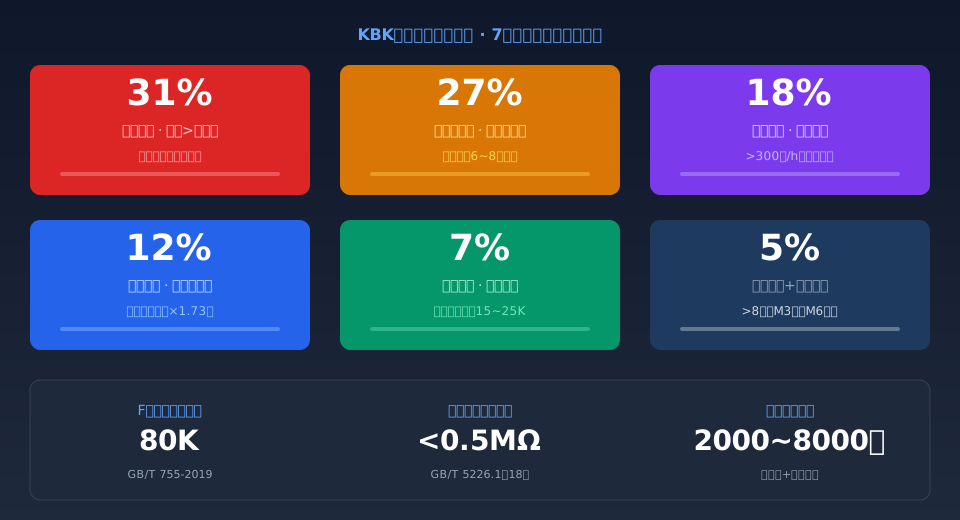
7 Common Causes of Frequent Hoisting Motor Burnout in KBK Electric Hoists
Based on teardown analysis of 132 burned-out motors returned over the past three years, Kelude's technical team has categorized the root causes into the following seven types, ranked by occurrence rate from highest to lowest:
① Overload Operation (31% occurrence rate): Actual lifted load exceeds the rated lifting capacity of the electric hoist, causing motor current to continuously run at 1.2–1.5 times the rated value. Typical case: an automotive parts plant used a 2 t KBK hoist to routinely lift 2.3 t molds—the motor burned out twice within three months.
② Brake Drag (27% occurrence rate): Improper brake clearance adjustment or stuck brake pads force the motor to start while the brake is not fully released. Starting current can reach 6–8 times the rated value, with each start generating heat equivalent to 10 minutes of full-load operation. The standard brake clearance for conical rotor motors is 0.5–1.5 mm; too small a gap causes brake pad wear from dragging, while too large a gap leads to brake failure.
③ Excessive Inching/Jog Operation (18% occurrence rate): Operators repeatedly jog the hoist for precise positioning, subjecting the motor to 6–8 times rated current during each start surge. Per ISO 4301, a motor at M4 duty allows no more than 150 equivalent starts per hour, yet on-site measurements under frequent inching conditions show 300–500 starts per hour—a temperature rise rate more than three times that of normal operation.
④ Power Supply Phase Loss or Voltage Imbalance (12% occurrence rate): When one phase of a three-phase supply is lost, the motor is forced to start in single-phase mode, and current in the two remaining phases increases by 1.73 times. When three-phase voltage imbalance exceeds 5%, negative-sequence current causes additional rotor heating, increasing the probability of burnout by four times over extended operation.
⑤ Poor Cooling (7% occurrence rate): Blocked motor wind covers, oil-contaminated cooling fins, or ambient temperatures above 40°C degrade the motor's heat dissipation capability. Most electric hoist motors use IC411 self-ventilated cooling. When the fan cover is more than 50% blocked by dust, cooling airflow drops by approximately 60%, adding 15–25 K to the temperature rise.
⑥ Natural Insulation Aging (3% occurrence rate): After 5–8 years of operation, winding insulation gradually deteriorates under combined thermal, electrical, and mechanical vibration stress. When insulation resistance drops from an initial value of >100 MΩ to <0.5 MΩ, the risk of turn-to-turn short circuits increases sharply.e rate): After 5–8 years of operation, winding insulation gradually deteriorates under combined thermal, electrical, and mechanical vibration stress. When insulation resistance drops from an initial value of >100 MΩ to <0.5 MΩ, the risk of turn-to-turn short circuits increases sharply.
⑦ Improper Hoist Selection (2% occurrence rate): Using a hoist rated for M3/M4 duty in M5/M6 operating conditions results in insufficient motor power margin. For example, using a CD1-type hoist (M3 duty) for steel mill continuous caster maintenance (which actually requires M6 duty) reduces motor service life from a designed 8 years to less than 1 year.e rate): Using a hoist rated for M3/M4 duty in M5/M6 operating conditions results in insufficient motor power margin. For example, using a CD1-type hoist (M3 duty) for steel mill continuous caster maintenance (which actually requires M6 duty) reduces motor service life from a designed 8 years to less than 1 year.
Early Warning Signs and Diagnostic Methods Before Motor Burnout
Motor burnout does not happen instantaneously—there is typically a warning window of 30 minutes to several hours between overheating and failure. Here are five key early warning signals:
Warning Signal 1: Abnormally High Motor Housing Temperature. Under normal operation, the motor housing temperature should not exceed 80°C (Class F insulation). You should be able to hold the back of your hand against the housing for at least 3 seconds. When you cannot hold contact for more than 1 second (approximately 90°C or above), the internal winding temperature has already exceeded 130°C, approaching the thermal breakdown threshold. We recommend using an infrared thermometer (accuracy ±2°C) to record housing temperature during each shift inspection.
Warning Signal 2: Persistently High Operating Current. Use a clamp meter to measure the three-phase operating current. Normal values should be within ±10% of the rated current. When any phase current continuously exceeds 15% above the rated value, or three-phase current imbalance exceeds 10%, the motor is already in an overload or abnormal winding state. Kelude recommends installing a smart ammeter with data logging capability that automatically records current values every 15 minutes.
Warning Signal 3: Declining Insulation Resistance. Use a 500 V megohmmeter (insulation tester) to measure winding-to-ground insulation resistance (hoist motor rated voltage: 380 V). New motors should read ≥100 MΩ; motors in service are acceptable at ≥5 MΩ; readings below 1 MΩ are dangerous and require immediate shutdown for maintenance; below 0.5 MΩ indicates partial short-circuiting in the windings. Measurements should be taken after the motor has stopped and cooled, to eliminate humidity effects.
Warning Signal 4: Burning Smell or Smoke During Operation. This is a direct manifestation of insulating varnish decomposing at high temperature. When a burning odor appears, winding temperature has typically exceeded 180°C, and turn-to-turn short circuits are actively occurring. The motor must be immediately powered off—do not continue operation.
Warning Signal 5: Severe Three-Phase Current Imbalance. If three-phase current imbalance suddenly increases beyond 15% (with power supply phase loss ruled out), it usually indicates turn-to-turn short circuits in one phase winding. In this case, use a digital multimeter to measure the DC resistance of all three-phase windings. A resistance deviation exceeding 5% between any two phases confirms a winding fault.
What Are the Temperature Rise Limits for Crane Motors? Class F vs. Class H Insulation
The insulation class of an electric hoist motor determines its maximum allowable operating temperature and temperature rise limit. Currently, KBK electric hoists on the market predominantly use Class F insulation (approximately 85%) and Class H insulation (approximately 15%, for high-temperature or high-frequency duty applications).
Class F insulation materials (such as polyester-imide magnet wire and NMN composite paper) have a heat resistance rating of 155°C. Per GB/T 755-2019, the winding temperature rise limit measured by the resistance method is 80 K (based on a 40°C ambient temperature). This means a Class F motor operating at standard ambient temperature (40°C) has a maximum allowable winding temperature of 155°C (40 + 80 + 35 K margin). For every 10°C increase above this temperature, insulation service life is reduced by approximately 50%.
Class H insulation materials (such as polyamide-imide magnet wire and Nomex paper) have a heat resistance rating of 180°C, with a winding temperature rise limit of 125 K. Class H insulated motors cost approximately 1.5–2 times more than Class F, but under frequent inching conditions, their service life can be extended by 2–3 times. For applications operating more than 16 hours per day or in ambient temperatures above 45°C, Class H insulation is strongly recommended.
Key points for temperature rise testing: Do not use an infrared thermometer to measure housing temperature immediately after motor shutdown to estimate winding temperature—the housing is 15–30°C cooler than the internal windings. The accurate method is to measure winding DC resistance using the resistance method within 30 seconds of power-off, then calculate the average winding temperature using the resistance-temperature formula: T₂ = (R₂/R₁) × (K + T₁) − K, where K = 235 (for copper windings), R₁ and T₁ are the initial (cold) resistance and temperature, and R₂ is the hot-state resistance.
According to FEM 1.001 Crane Test Specifications and Procedures, during the dynamic load test at 1.1 times rated load, the hoisting motor winding temperature rise must not exceed the limit corresponding to its insulation class, and insulation resistance after the test must not fall below 70% of its initial value.
31%
Overload Operation
#1 Cause of Burnout
80K
Class F Insulation
Winding Temperature Rise Limit
27%
Brake Drag
2nd Leading Cause of Burnout
6~8x
Starting Current
as a Multiple of Rated Value
0.5MΩ
Insulation Resistance
Dangerous Scrap Threshold
$520
Average Motor Burnout
Repair Cost
KBK Electric Hoist Motor Parameters by Common Model
| Model | Lifting Capacity(t) | motor power(k W) | rated current(A) | Insulation Class | Work Duty / Classification | number of starts/hour |
|---|---|---|---|---|---|---|
| KBK-0.5t | 0.5 | 0.8 | 2.1 | F | M4 | ≤150 |
| KBK-1t | 1.0 | 1.5 | 3.7 | F | M4 | ≤150 |
| KBK-2t | 2.0 | 3.0 | 6.8 | F | M4 | ≤150 |
| KBK-3t | 3.0 | 4.5 | 10.0 | F | M5 | ≤120 |
| KBK-5t | 5.0 | 7.5 | 15.5 | F | M5 | ≤120 |
| KBK-5t(H) | 5.0 | 7.5 | 15.5 | H | M6 | ≤300 |
Electric Hoist Motor Burnout Causes and Inspection Standards Reference Table
| burnout cause | determination Standard | Detectionmethod | Standardclause reference | acceptance threshold | inspection interval |
|---|---|---|---|---|---|
| overloadoperation | Current> rated value | clamp meter | ISO 4301 Crane Design Standard-4.2 | ≤1.0In | daily |
| Brakebrake drag | clearance out of tolerance | feeler gauge measurement | ISO 4301 Crane Design Standard-5.8 | 0.5~1.5mm | weekly |
| frequent Inching / Jog Mode | count exceeding limit | counter tally | ISO 4301 Crane Design Standard-6.3 | ≤150times/h(M4) | continuous Monitoring |
| phase loss in power supply | Voltageunbalance | multimetermeasure three-phase | IEC 60204-32 | ≤5% | monthly |
| poor heat dissipation | air duct blockage | visual inspection+anemometer | GB/T 755-9.2 | temperature rise≤80K(F) | semi-monthly |
| insulation Aging | Insulation Resistancelow | 500VMegohmmeter (Insulation Tester) | IEC 60204-32 | ≥5MΩ | quarterly |
KBK Electric Hoist Motor Burnout: Emergency Response and Replacement Guide
When an electric hoist motor burns out, follow this three-step protocol: cut power first, then verify, then take corrective action.
Step 1: Immediately press the Emergency Stop Button and disconnect the main power supply to the motor. If a load is suspended in mid-air, do not release the brake hastily — use the manual release device (Manual Brake Release lever) to slowly lower the load to the ground. The Conical Rotor Motor's brake engages automatically upon power loss, so manual release requires two people: one operates the release lever while the other monitors the lowering speed of the load.
Step 2: Use a 500V Megohmmeter (Insulation Tester) to measure the insulation resistance of the three-phase windings to ground. A reading of 0 or below 0.1MΩ confirms burnout. Also measure the DC resistance of each phase winding to determine the failure mode: an inter-turn short circuit shows a resistance deviation greater than 5% between two phases, while a ground fault shows any phase-to-ground resistance below 0.1MΩ.
Step 3: Remove the burned-out motor and record all nameplate data (Model, Power, Voltage, Current, Insulation Class, Duty Classification). Order a replacement with identical specifications. Kelude recommends keeping one spare motor of the same model on hand to ensure replacement is completed within 4 hours. After installation, run a no-load test for 30 minutes, monitoring the no-load current (should be 25%–40% of rated current) and motor housing temperature rise (≤40K). Only proceed to production once these readings are within acceptable limits.
After motor replacement, the following checks are also required: readjust the Brake gap to 0.5–1.5mm, verify that the three-phase voltage unbalance of the power supply line is below 3%, and confirm the overload limiter is set to 105%–110% of the rated load and functioning correctly. Skipping any of these three checks before returning to service puts the new motor at risk of another burnout.
How to Prevent Electric Hoist Motor Burnout Through Proper Selection and Installation
Prevention is far more cost-effective than repair. Establishing the correct Technical Parameters baseline at the selection stage is the most economical way to avoid motor burnout. Here are five preventive measures to implement at the source:
1. Correctly calculate the Work Duty and Duty Cycle (JC value). Per ISO 4301 Crane Design Standard Appendix A, determine the actual work duty based on daily operating hours, starts per hour, and the Load spectrum. If your actual operating conditions require a M5/M6 classification, do not select a hoist rated at M3/M4. Each step down in work duty reduces motor service life by approximately 60%. For heavy-duty, high-frequency applications such as steel mills, foundries, and ports, select an Electric Hoist rated M5 and Above.
2. Specify motor thermal protection. All Kelude KBK Electric Hoists come standard with PTC thermistors embedded in the stator windings. These trigger an alarm at 135°C (Class F insulation) and automatically cut the main circuit at 150°C. For older hoists without built-in PTC protection, retrofit an external infrared Temperature Sensor and a current monitoring Relay (set at 105% of rated current) to provide automatic shutdown protection against over-temperature and over-current conditions.
3. Install phase sequence and Phase Loss Protection on the three-phase supply. Add a phase sequence Relay (e.g., Schneider RM17TG20) at the incoming power supply line. This device cuts the control circuit within 0.5 seconds in the event of phase loss, incorrect phase sequence, or voltage unbalance beyond the set threshold — eliminating phase-loss operation, a leading cause of motor burnout. At approximately $30–$60 per unit, this is an extremely cost-effective safeguard.
4. Establish a daily Inspection routine for motor operating parameters. Kelude recommends maintaining a motor health log that records: three-phase running current (A), motor housing temperature (°C), cumulative running hours (h), daily start count, and insulation resistance (MΩ, measured quarterly). If the current trend rises more than 10% over three consecutive days, stop the hoist and investigate even if the values remain below the rated limit.
5. Keep the motor cooling path clean. Every two weeks, blow out the Wind Cover and cooling fins with compressed air (pressure ≤0.3MPa) to remove dust and oil buildup. For motors operating in High-Temperature Environments (above 40°C), install an auxiliary cooling fan or position an industrial fan nearby to improve ventilation.
📖 Related Reading
Electric Hoist Motor Overheating? 5 Common Causes and Step-by-Step Fixes
ISO 4301 Crane Design Standard: 9 Load Combinations and Work Duty Selection from A1 to A8
Frequently Asked Questions
Q: What is the difference between motor overheating and motor burnout?
A: Overheating is a reversible temperature anomaly — after power-off cooling, the insulation remains intact and the motor can return to normal service, with winding temperatures typically between 130–155°C. Burnout, by contrast, is irreversible insulation failure where a permanent short circuit has formed between turns or phases, with insulation resistance below 0.5MΩ that cannot be restored. To distinguish between the two: after 2 hours of cooling with power disconnected, measure with a 500V Megohmmeter. If insulation resistance recovers to above 5MΩ, the motor was overheated and is recoverable; if it remains below 0.5MΩ, the motor is burned out and requires replacement. Kelude after-sales statistics show that approximately 40% of motors diagnosed as "burned out" actually only require cooling and drying to be restored to full functionality.
Q: What specific requirements does ISO 4301 place on electric hoist motor work duty?
A: Section 5.2.3 of ISO 4301 (equivalent to ISO 4301) specifies that Hoisting mechanism motors must be selected according to the actual Load spectrum and operating frequency, with work duty classifications ranging from M3 to M8. A M4 motor suits moderate-duty applications (up to 150 starts per hour, up to 4 hours of daily operation); M5 is for more frequent duty (up to 300 starts per hour, up to 8 hours daily); and M6 is for heavy-duty, high-frequency applications. The critical Duty Cycle (JC) values are: M4 = 25% JC, M5 = 40% JC, and M6 = 60% JC. Selecting a work duty below what the actual operating conditions require is a leading cause of motor burnout — motors operating under an underspecified duty classification have an average service life of only 20%–30% of their design life.
Q: How much does it cost to repair or replace a burned-out electric hoist motor?
A: Repair costs vary significantly by hoist capacity and brand. For small hoists (0.5t–2t), rewinding the motor windings costs approximately $120–$220, while a complete replacement motor runs $220–$520. Medium hoists (3t–5t) require $520–$890 for a new motor. Imported brands (DEMAG/KITO/STAHL) cost 2–3 times more than domestic equivalents. Beyond the motor itself, factor in labor for removal and installation (approximately $75–$150 per unit) and production downtime (calculated by hourly output value). Kelude offers a trade-in program that credits approximately 10%–15% of the old motor's value toward a replacement. Overall, installing a PTC thermal protector (around $30) can prevent over 90% of burnout incidents — an investment-to-return ratio exceeding 1:20.
Q: Why does my electric hoist motor trip the circuit breaker immediately on startup?
A: Three common causes explain immediate tripping on startup: ① Inter-turn or phase-to-phase short circuit already present in the windings — confirm with a Megohmmeter reading below 0.5MΩ; the motor must be replaced. ② The Brake is completely seized — the locked-rotor current can reach 6–8 times the rated current, causing the circuit breaker to trip instantly. Check the brake gap and whether the electromagnet is operating correctly. ③ The circuit breaker's rated current is undersized — electric hoist motors draw 6–8 times rated current during startup, so the breaker must have a Type D trip curve (instantaneous trip at 10–14×In). If a Type C breaker (5–10×In) is mistakenly installed, it will trip spuriously during the startup surge. Troubleshoot in this order: first swap in a Type D breaker and test → then inspect the Brake → finally, dismantle and test the motor windings.
This article was originally written by the Kelude Heavy Industry Technical Center, based on teardown data from 132 burned-out motors and national standards including ISO 4301, GB/T 755, and FEM 1.001. Kelude Heavy Industry offers full-series KBK Electric Hoist motor selection, Fault Diagnosis, and trade-in services. For Technical consultation, please call the consultation hotline listed on our website.
