

Crane Inspection & Maintenance Intervals: Annual, Full & Wear Parts
Crane Periodic Inspection and Maintenance Intervals: Annual Inspection, Thorough Examination, and Wear Parts Replacement Guide. Full life cycle management after a crane is put into service is essential to ensuring safe operation and extending its service life.
Full life cycle management after a crane is put into service is the key to ensuring safe operation and maximizing service life. Periodic inspection and maintenance are legal obligations for the user, carried out in accordance with TSG Q7015 Rules for Installation, Retrofit, and Major Repair Supervision Inspection of Lifting Appliances, the Special Equipment Safety Supervision Regulations, and TSG Q7016 Rules for Periodic Inspection of Lifting Appliances. Kelude has compiled this complete technical guide covering periodic inspection, routine maintenance, and wear parts replacement intervals for overhead cranes.
Annual Inspection vs. Thorough Examination
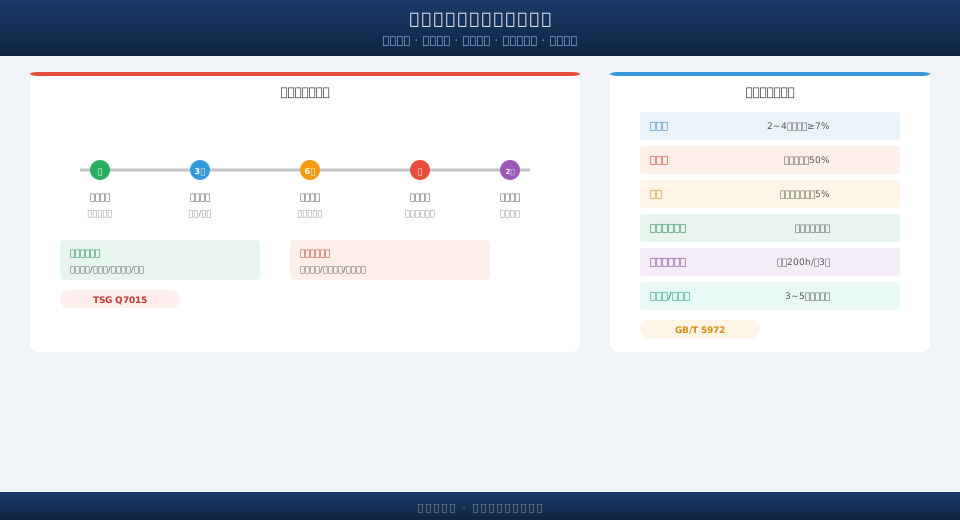
Statutory crane inspections fall into two categories: annual inspection and thorough examination. Kelude offers annual maintenance contracts that follow TSG Q7015 requirements. The annual inspection may be performed by the user's own team or by a qualified maintenance contractor, and covers: 1) functional testing of safety devices (limit switches, overload limiter, door interlock, emergency stop button, and brake); 2) visual inspection of the wire rope (number of broken wires, wear, corrosion, and deformation); 3) flaw detection on the hook and lifting spreader (magnetic particle or penetrant testing, at least once per year); 4) insulation resistance test of the electrical system (≥1MΩ); and 5) documentation of crane rail and wheel wear.
A thorough examination is performed every two years by an approved special equipment inspection body. In addition to all annual inspection items, it includes: 1) static load test of the main girder (deflection measured at 125% of rated load); 2) calibration of the lifting capacity limiter (verified with standard test weights); 3) non-destructive flaw detection sampling of load-bearing weld seams (ultrasonic or magnetic particle, with a sampling rate of no less than 10%); 4) brake torque testing; and 5) grounding resistance and lightning protection checks. The thorough examination concludes with one of three ratings: "Passed," "Conditionally Passed" (requiring corrective action before license renewal), or "Failed" (crane taken out of service until rectified).
Daily Checks and Periodic Maintenance
Daily checks are performed by the operator before startup each day and cover: 1) brake release status; 2) wire rope for broken wires, kinking, or flattening; 3) condition of all limit switches; 4) operation panel indicator lights and gauge readings; and 5) crane rail for obstructions. Results must be recorded and signed on the daily crane inspection checklist. Any abnormality should be reported immediately — never operate a crane with a known fault.
Periodic maintenance is scheduled by operating hours or calendar intervals. Every 3 months: replace reducer lubricating oil (initial oil change after 200 hours of operation, then every 3 months or 500 hours thereafter). Every 6 months: inspect and adjust brake clearance and push rod travel, check gear coupling elastomer wear, and verify tightness of all electrical wiring terminal blocks. Every 12 months: replace grease in gear couplings, check wheel bearing clearance, measure main girder camber, and perform a full inspection of components inside the electrical cabinet.
Wear Parts Replacement Intervals
| Wear Parts | Replacement Interval | Replacement Criteria Standard |
|---|---|---|
| Wire Rope | Subject to Wear Condition or2~4Years | GB/T 5972-2016 |
| Brake Lining | Wear Thickness Exceeds Original 50% | JB/T 6406 |
| Wheel | Tread surface Wear Diameter Exceeds Original5% | GB/T 10183-2005 |
| Coupling Elastomer | Annually or Upon Occurrence of Cracks | JB/T 10163-2014 |
| reducer lubrication Oil | Initial200h, Thereafter Every3Months | GB/T 5903-2015 |
| Contactor/Relay | 3~5Years or Duty Cycles Exceeding Service Life | GB/T 14048.1-2019.4 |
Crane Safety Assessment & Service Life Management
Once a crane reaches its designed service life (typically 20 years), it must be submitted to an accredited inspection body for a comprehensive safety assessment. This evaluation covers: remaining fatigue life calculation of primary structural components (based on the load spectrum and stress cycle counts), full non-destructive flaw detection of weld seams, wear and corrosion degree assessment of critical components, and integrated safety function testing of the complete crane. The assessment outcome falls into one of three categories: "fit for continued service" (with a specified re-inspection interval, generally 1–2 years), "serviceable after repair" (accompanied by a detailed repair plan), or "out of service / to be scrapped." Cranes that have exceeded their design life without undergoing this safety assessment must not remain in operation.
