

Overhead Crane Group Scheduling: Multi-Crane Collision Avoidance
Crane Group Scheduling Algorithm: Engineering Implementation of Multi-Crane Collision Avoidance and Task Allocation. In large-scale steel smelting, port logistics, and heavy equipment manufacturing, material handling tasks typically require multiple overhead cranes to operate collaboratively within the same bay or adjacent bays.
In industrial environments such as large steel smelting plants, port logistics hubs, and heavy equipment manufacturing facilities, material handling operations typically require multiple overhead cranes to work together within a single bay or across adjacent bays. The core technical challenge lies in how to allocate tasks among these cranes, plan travel paths, and prevent collisions — all of which directly impact material handling efficiency, energy consumption, and operational safety. Drawing on years of experience in industrial overhead crane control systems, Kelude Heavy Industry has developed a comprehensive crane group scheduling algorithm suite that covers task priority assignment, path planning with collision avoidance, load balancing and energy optimization, MES integration, and simulation-based validation. The system has been deployed at multiple steel enterprises (including Baowu Group and Ansteel Group) and heavy manufacturing plants, delivering a 25%–40% improvement in average crane utilization, a 30%–50% reduction in task response time, and zero collision incidents. This article provides a systematic technical overview of Kelude's crane group scheduling algorithm from three perspectives: system architecture, algorithm principles, and engineering practice.
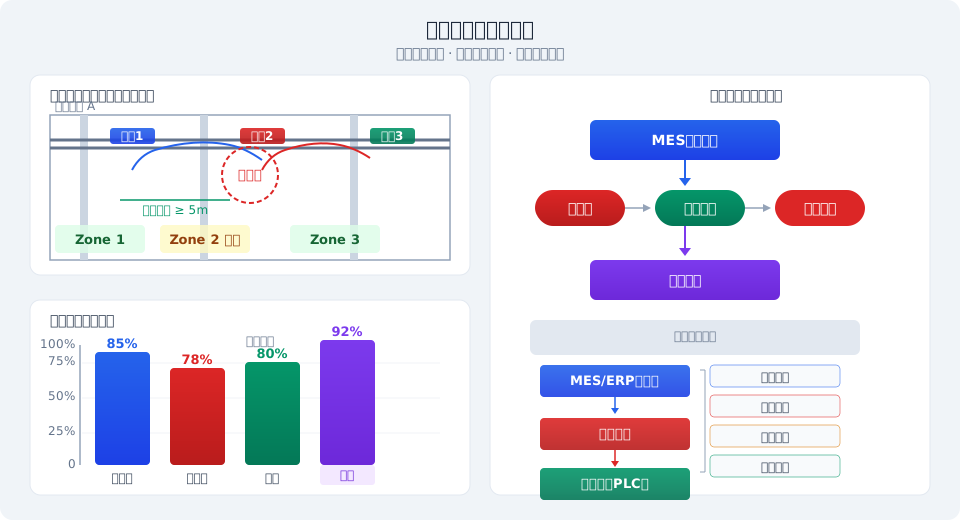
Crane Group Scheduling System Architecture
Kelude Heavy Industry's crane group scheduling system adopts a layered, distributed architecture consisting of three tiers: the decision layer, the scheduling layer, and the execution layer. The decision layer (MES/ERP interface) receives material handling task commands from upper-level management systems (MES, WMS, ERP, etc.), including task type (e.g., ladle lifting, slab transfer, finished product warehousing), task priority, start and end positions, and expected completion time. The decision layer then forwards these task commands to the scheduling layer. The scheduling layer (group scheduling server) is the core of the crane group scheduling system. It runs Kelude's proprietary crane group scheduling algorithm software, responsible for real-time task allocation, path planning, and collision avoidance computation across multiple cranes. The scheduling layer communicates with the onboard terminal (PLC or industrial PC) on each crane via industrial Ethernet (Profinet or EtherNet/IP), with a communication cycle kept within 100 ms. The execution layer (overhead crane control system) executes the control commands issued by the scheduling layer, including hoisting and cross-travel speed and direction control, lifting spreader positioning, and load handover. The execution layer is equipped with Absolute encoders (position detection accuracy ±5 mm), Laser Distance Sensors, and an anti-sway control system to ensure precise execution of scheduling commands. The crane group scheduling system employs a redundant server architecture (active-standby hot standby), where the standby server automatically takes over scheduling tasks within 500 ms in the event of a primary server failure, ensuring continuous system availability. The overall architecture is designed to meet the high reliability, real-time performance, and safety requirements of industrial automated control systems.
Task Priority Allocation Strategy
Task priority allocation forms the decision-making foundation of the crane group scheduling system. Kelude Heavy Industry employs a Multi-factor Weighted Priority Model (MWPM) that evaluates four dimensions: task urgency, task value, waiting time, and resource constraints. The Urgency Factor is calculated based on the difference between the task's expected completion time and the current time — the smaller the difference, the higher the urgency, mapped to a score of 0–100 using an exponential decay function. The Value Factor is calculated based on the task's impact coefficient on production efficiency; for example, ladle lifting tasks at the blast furnace taphole receive the highest value score (100), while finished product warehousing tasks receive a lower score (40). The Waiting Factor is calculated based on how long a task has been waiting in the queue, using a logarithmic growth function — the longer the wait, the higher the score, preventing low-priority tasks from being indefinitely starved. The Resource Constraint Factor is calculated based on the availability and exclusivity of the equipment resources required for the task (specific cranes, specific lifting spreader models) — the more intense the resource competition, the higher the score. The weighting coefficients of the four factors are adaptively adjusted by the scheduling system based on production conditions: under normal operating conditions, the Value Factor carries the highest weight (40%), followed by Urgency Factor at 30%, Waiting Factor at 20%, and Resource Constraint Factor at 10%. Under emergency repair conditions, the Urgency Factor weight is raised to 60% to ensure repair tasks are executed first. Task priority is recalculated every 200 ms, supporting dynamic preemptive scheduling — when a high-priority task enters the queue, the currently executing low-priority task can be interrupted (paused at the next turnaround point), and resources are released to the high-priority task.
Path Planning and Collision Avoidance
Path planning and collision avoidance represent the core technical challenge of the crane group scheduling system. Kelude Heavy Industry employs a hybrid algorithm architecture that combines the A* algorithm for global path planning, the Velocity Obstacle (VO) method for local collision avoidance, and the Time Window method for multi-crane coordination. For A* global path planning, the system uses an improved A* algorithm on a grid map of the crane runway rails, calculating the shortest collision-free path from the crane's current position to the target position. The heuristic function combines Manhattan distance with a turning penalty factor, ensuring the planned path is not only the shortest but also minimizes unnecessary crane turning and rail-switching operations. For VO-based local collision avoidance, when the planned paths of two or more cranes intersect or merge, the scheduling system calculates the Velocity Obstacle Cone based on each crane's current velocity vector and position, automatically adjusting the speed of conflicting cranes (deceleration or pause) to ensure that safe distances (longitudinal ≥ 5 m, lateral ≥ 1.5 m) are never breached. For multi-crane coordination using the Time Window method, the system assigns each crane an exclusive time window for same-rail operation, ensuring that only one crane can operate within a given rail section at any time. When the scheduling system predicts that two cranes are about to share the same rail section, it automatically computes an interleaved time window scheme to avoid excessive waiting or scheduling deadlock. Kelude's path planning and collision avoidance algorithms have undergone more than 10,000 hours of virtual testing in simulation environments. Under conditions with six cranes operating simultaneously in a single bay, the collision avoidance success rate reaches 100%, and the average path planning computation time is below 50 ms.
Load Balancing and Energy Optimization
In a multi-crane group system, load balancing and energy optimization are key to improving overall operational efficiency and economic performance. Kelude Heavy Industry's crane group scheduling algorithm incorporates a load balancing and energy optimization module that considers two objective functions simultaneously in the constrained task allocation problem: crane utilization balance and per-task energy consumption. The Load Balancing Function takes each crane's cumulative operating hours and current task queue length as inputs to calculate the load rate (current task queue length / rated task capacity). By minimizing the variance of load rates across all cranes, the system achieves load balancing, preventing the "some cranes overworked, others idle" phenomenon. The Energy Optimization Function calculates the estimated energy consumption for each crane to complete a handling task from its current position to the task target position, based on the crane's operating power curve and task travel trajectory. Tasks are then preferentially assigned to the crane with the lowest per-task energy consumption. The scheduling system employs Pareto Optimization to find the optimal trade-off solution between load balancing and energy optimization. The table below compares the engineering application results of different scheduling strategies.
| Scheduling Strategy | Basic Principle | Advantages | Disadvantages | Application Scenarios |
|---|---|---|---|---|
| Priority-Based Scheduling | Tasks Sorted by Priority, High-Priority Tasks Assigned Firstreemption | Simple Implementation, Fast Emergency Response | Low-Priority Tasks May Be "Starved", Imbalanced Crane Utilization | Emergency Repair, Time-Critical Scenarios (e.g., Blast Furnace Tapping) |
| Shortest-Distance Scheduling | Nearest-Idle-Crane Assignmentoverhead crane | Minimized Deadhead Travel, Low Energy Consumption | Localized Crane Overload, Suboptimal Global Efficiency | overhead crane Small Fleet Size, Low Task Density Scenarios |
| Load-Balanced Scheduling | Based onoverhead crane Load Varianceminimum Variance Minimization Task Allocation | All Cranesoverhead crane Balanced Utilization, High Overall Throughput | Task Response Time May Increaseme Potential Increase, High Computational Complexity | overhead crane Large Fleet Size, High Task Densitymption Density High-Density Busy Scenarios |
| Hybrid Scheduling (Kelude Solution) Approach) | Priority+Shortest-Distance+Pareto-Optimal Combination | Comprehensive Optimization, Adaptability to Operating Conditions | Parameter Complex Tuning, Extended Commissioning Period | Large-Scale Steel Mill, Port Complex Scenarios |
Kelude Heavy Industry's hybrid dispatching strategy has been deployed at a hot rolling line of Baowu Group. Actual operating results show that overhead crane utilization increased from an average of 45% to 72%, energy consumption per ton decreased by 18%, average task response time was reduced from 8.5 minutes to 4.2 minutes, and overall system dispatching efficiency improved by approximately 49%.
MES Integration for Crane Dispatching Systems
Seamless integration between the crane group scheduling system and MES (Manufacturing Execution System) is a critical enabler for Smart Manufacturing. Kelude Heavy Industry's crane group scheduling system provides standardized RESTful API and OPC UA communication interfaces, supporting real-time bidirectional data exchange with mainstream MES platforms such as Siemens Opcenter, Rockwell FactoryTalk, and SAP MES. Data received from MES includes material handling task instructions (task type, priority, start/end locations, material codes), material information (weight, dimensions, lifting spreader requirements), production plan change notifications, and urgent order insertion commands. Data transmitted to MES includes crane operating status (online/offline, current position, current task progress, cumulative operating hours), task execution results (completed/failed, completion time, actual energy consumption), equipment fault alarms, and crane utilization reports. The default data exchange interval is 1 second, adjustable from 100 ms to 5 s depending on operating conditions. Kelude Heavy Industry also offers a visual Digital Twin Dashboard for the crane group scheduling system, presenting real-time 3D visualization of crane movements, task execution progress, and system performance indicators, with Remote Monitoring and dispatching intervention capabilities. MES integration projects typically require joint commissioning between Kelude Heavy Industry and the customer's MES vendor, with a standard integration timeline of 4 to 8 weeks covering interface development, joint testing, and acceptance testing.
Simulation Validation of Dispatching Algorithms
Simulation-based validation of crane group dispatching algorithms is essential to ensure stable and reliable system performance after deployment. Kelude Heavy Industry has developed a digital simulation platform using MATLAB/Simulink and Unity 3D that supports the following functions: virtual scene modeling — creating a virtual environment that accurately replicates the actual crane rail layout, restricted zones, and material storage areas; crane kinematics and dynamics simulation — modeling the motion characteristics and dynamic responses of the hoisting, crane bridge, and trolley mechanisms, including acceleration/deceleration curves, anti-sway control, and Positioning Accuracy; dispatching algorithm execution — loading the actual scheduling algorithm software into the simulation platform and validating its performance under various operating conditions using virtual task flows; and abnormal condition simulation — simulating sensor failures, communication interruptions, and crane malfunctions to verify the system's exception-handling capability. Kelude Heavy Industry requires every new dispatching algorithm to undergo at least 2,000 hours of virtual simulation testing and more than 200 abnormal condition simulations before deployment, with a 100% pass rate required. After simulation validation, the system enters on-site no-load trial operation (typically 1 to 2 weeks), followed by loaded trial operation (typically 2 to 4 weeks), and finally passes a 72-hour continuous fault-free acceptance test before formal commissioning. Kelude Heavy Industry has completed simulation validation and on-site commissioning for more than 50 crane group scheduling systems, achieving a 100% successful deployment rate.
