

Crane Installation & Commissioning: Testing, Inspection Guide
The Complete Guide to Crane Installation, Commissioning & Handover: 9 Key Topics from Hoisting to Maintenance. Installation, commissioning, and acceptance are the critical bridge between a crane leaving the factory and entering service—directly impacting operational safety and service life.
Crane installation, commissioning, and handover mark the crucial transition from factory floor to active duty, with direct consequences for operational safety and equipment longevity. Drawing on hundreds of on-site installations and commissioning projects for bridge and gantry cranes, Kelude Heavy Industry has organized nine technical deep-dives covering the full lifecycle—from runway beam and civil foundation work to routine maintenance. The series spans civil foundations, whole-crane hoisting, structural inspection, dimensional alignment, electrical commissioning, safety device verification, integrated load testing, project acceptance, and long-term servicing. This article serves as the series overview, providing a technical roadmap and at-a-glance navigation for each topic. Applicable standards include GB/T 10183 (Tolerances for wheel diameters and track gauge of crane wheel blocks), ISO 4301 (Crane Design Standard), GB 5226.2 (Electrical safety of machinery), GB/T 28264-2017 (Safety Monitoring and Management System for cranes), FEM 1.001 (Cranes — Test code and procedures), and TSG Q7015 (Supervision inspection rules for installation, retrofit, and major overhaul of lifting appliances).
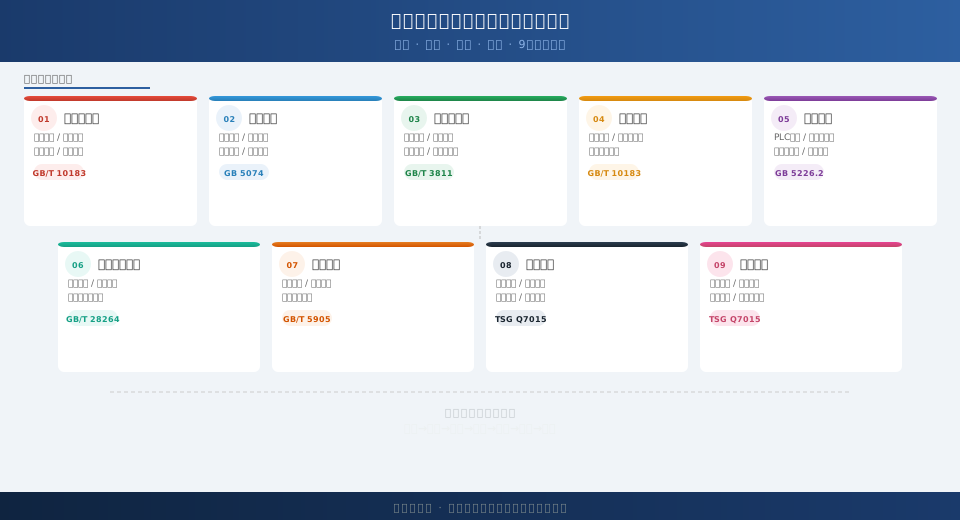
9 Key Topics at a Glance
The table below summarizes the core scope and reference standards for each of the nine topics. Jump straight to the section relevant to your current project phase:
| # | Special Topic Name | Phase | Core Standard |
|---|---|---|---|
| 1 | Crane Rail Girder Foundation Design and Construction Specification | Civil Construction | GB/T 10183-2005 |
| 2 | crane Complete Machine Hoisting: Main Girder Lifting/End Carriage Assembly/Elevated Connection Safety Control | Installation Phase | GB 5074 |
| 3 | How to measure main girder camber? Complete inspection methods and adjustment techniques | Structure Inspection | ISO 4301 Crane Design Standard-2008 |
| 4 | Crane rail gauge and span adjustment: tolerance standards, diagonal alignment, and wheel skew correction | Installation Air Compressor | GB/T 10183-2005 |
| 5 | craneelectrical system Site Commissioning from Basics to Mastery | Commissioning Phase | GB 5226.2 |
| 6 | Limit Switchand Safety Device Adjustment: Hoisting / Lifting Limit Switch/Travel Limit Switch/Overload Limiter Verification Procedure | Commissioning Phase | GB/T 28264 Safety Monitoring and Management System-2017 |
| 7 | crane No-Load and Interlocked Test Run, These Detection Essential Items | Test Run Phase | FEM 1.001 |
| 8 | crane Acceptance & Handover Preparation Requirements?As-Built Documentation/Quality Inspection Report/Training Handover Complete Checklist | Handover Phase | TSG (Special Equipment Safety Technical Regulation) Q7015-2016 |
| 9 | craneperiodic inspectionand Maintenance Cycle: Annual Inspection/Comprehensive Inspection/Wear Parts Replacement Guide | Operation Phase | TSG (Special Equipment Safety Technical Regulation) Q7015-2016 |
Crane Runway Beam Foundation: Design & Construction Standards
Crane runway beam foundation design and construction standards is a complete technical guide covering everything from foundation design through site construction. The article details positioning accuracy requirements for corbel embedded parts (center deviation ±5mm, elevation deviation ±3mm), rail clamp installation spacing and bolt preload torque specifications, secondary grouting material selection and curing cycles, plus the three critical tolerance indicators for rail installation: straightness, elevation, and span. It also breaks down the typical fixing methods and structural connection details for runway beams across different factory building types (concrete columns, steel columns, and braced frame columns).
Crane Whole-Machine Lifting Plan & Safety Control
Crane whole-machine lifting: main girder hoisting, end carriage assembly, and high-altitude connection safety control is the go-to reference for developing a lifting plan. The article systematically explains lifting point calculations for dual-crane main girder hoisting, shaft alignment methods for high-altitude end carriage assembly, bolt tightening sequences and torque values for structural connections, and high-altitude work safety measures (safety rope anchor points, basket usage, and wind speed limits). It also includes a crane selection table for typical capacities (20t/32t/50t/100t) and a wire rope diameter verification method.
Main Girder Camber Inspection & Adjustment
How to measure main girder camber? Complete inspection methods and adjustment techniques covers the full spectrum from measurement principles to adjustment procedures. The article explains camber design value calculations (L/1000~L/700), laser level measurement methods and data processing formulas, camber variation acceptance criteria before and after static load tests, and engineering remedial measures for out-of-tolerance camber, including spring plate adjustment and prestressed tie rod compensation. It also reviews the revised camber requirements introduced in the updated ISO 4301 standard.
Crane Rail Gauge & Span Adjustment
Crane rail gauge and span adjustment: tolerance standards, diagonal alignment, and wheel skew correction provides a complete measurement and adjustment methodology. The article covers span limit deviations per GB/T 10183 (±5mm to ±10mm graded by span), the ≤5mm diagonal difference acceptance standard, measurement methods for horizontal and vertical wheel skew (laser theodolite with magnetic reference blocks), and the applicable conditions for two correction techniques: bearing housing shim adjustment and wheel tread turning.
Electrical System On-Site Commissioning
Electrical commissioning is the final step in the installation sequence, covering PLC control program download and logic verification, VFD parameter tuning for each of the three mechanisms (hoisting, crane bridge, and trolley) including acceleration time, braking delay, and PID parameters, zero-point calibration of the load limiter and encoder, and communication bus (PROFINET/PROFIBUS) slave station configuration and signal testing. This section provides a complete electrical commissioning record template and a common fault diagnosis table.
Limit Switch & Safety Device Calibration
Limit switch and safety device calibration: hoisting limit, travel limit, and overload limiter verification procedures is the operational reference for safety device commissioning. The article focuses on hoisting height limit switch trip point settings (minimum 200mm clearance between the highest lifting spreader position and the upper limit), travel limit switch trigger position calibration for both crane bridge and trolley, overload limiter trip point verification (alarm at 110% of rated load, hoisting power cutoff at 125%), and integrated acceptance testing for auxiliary safety devices including door interlocks, rail clamps, and anemometers.
No-Load & Integrated Test Run
Crane no-load and integrated test runs: essential inspection items you can't skip provides a complete test run protocol. Following the FEM 1.001 test procedure, the article specifies minimum operating cycles for each mechanism during no-load testing (crane bridge full travel ≥3 times, trolley full travel ≥3 times, hoisting full cycle ≥6 times), a step-by-step verification checklist for interlock functions (overload cutoff and limit stop trigger logic), and acceptance indicators including noise limits (operator cabin ≤85dB(A)), vibration velocity (≤4.5mm/s), and temperature monitoring. A test record template is also included.
As-Built Documentation & Acceptance Handover
What to prepare for crane acceptance and handover? Complete checklist for as-built documents, quality inspection reports, and training transfer is a full operational guide for the delivery and acceptance process. The article details the required documentation package per TSG Q7015 and special equipment safety technical regulations, including installation/retrofit/major repair supervision inspection reports, certificates of conformity and material certificates for key components, electrical test records (insulation resistance, withstand voltage, grounding), load test reports, as-built drawings (including change orders), and sign-in records and assessment results from operator and maintenance training sessions. Recommended templates for the equipment handover form and warranty period service statement are also provided.
Periodic Inspection & Preventive Maintenance
Crane periodic inspection and maintenance intervals: annual inspection, comprehensive inspection, and wear parts replacement guide is the core reference for full lifecycle equipment management. The article outlines the cycle requirements and inspection items for annual inspections (conducted by the user unit, covering safety devices, wire ropes, brakes, and other critical components), comprehensive inspections (performed by an inspection body every 2 years, including load testing), and safety assessments (required after reaching the design service life). It also provides a wear parts replacement interval reference table (wire rope, brake pads, wheels, coupling elastomers) and a daily inspection checklist.
Series Reading Recommendations
This series follows the natural sequence of crane installation and delivery. For best results, we recommend reading the topics in order from Topic 1 through Topic 9. Design firms should focus on runway beam foundation design and main girder camber inspection; installation contractors should master the lifting plan, rail gauge adjustment, and electrical commissioning sections; and end users can combine the integrated test run, acceptance handover, and periodic maintenance topics for comprehensive equipment lifecycle management. The topics are technically interconnected (for example, runway beam foundation accuracy directly affects rail gauge adjustment), so understanding them together will help you build a complete knowledge framework for installation, commissioning, acceptance, and handover.
