

Overhead Crane Hoist Motor Overheating: 7 Causes & Limits
📋 Summary: Overheating and burnout of the crane hoisting motor is one of the most common electrical failures in electric hoists, bridge cranes, and gantry cranes. It can range from a simple shutdown for repairs to complete winding failure and total equipment loss. Based on the ISO 4301 design standard and the JB/T 10218 standard for conical rotor motors, this article systematically reviews seven root causes—overload operation, insulation aging, poor heat dissipation, voltage anomalies, brake faults, environmental factors, and loose terminal connections—and provides corresponding diagnostic methods, temperature rise limits, and protective upgrade solutions. Four FAQs at the end address common questions on procurement, standard compliance, troubleshooting, and cost estimation.
The hoisting motor is the core power component of a crane, and its operational reliability directly impacts production safety. When abnormal motor temperature rise is detected, the primary reference is the matching requirement between mechanism duty classification and motor selection specified in ISO 4301 "Crane Design Standard". This standard defines the relationship between load duration factor and temperature rise limits for motors across eight duty classifications, from A1 to A8. Additionally, JB/T 10218-2014 "Conical Rotor Motors for Electric Hoists" provides detailed specifications for insulation class, temperature rise test methods, and factory acceptance test items. This article walks through each failure category with diagnostic approaches to help facility managers and maintenance personnel quickly pinpoint the problem.
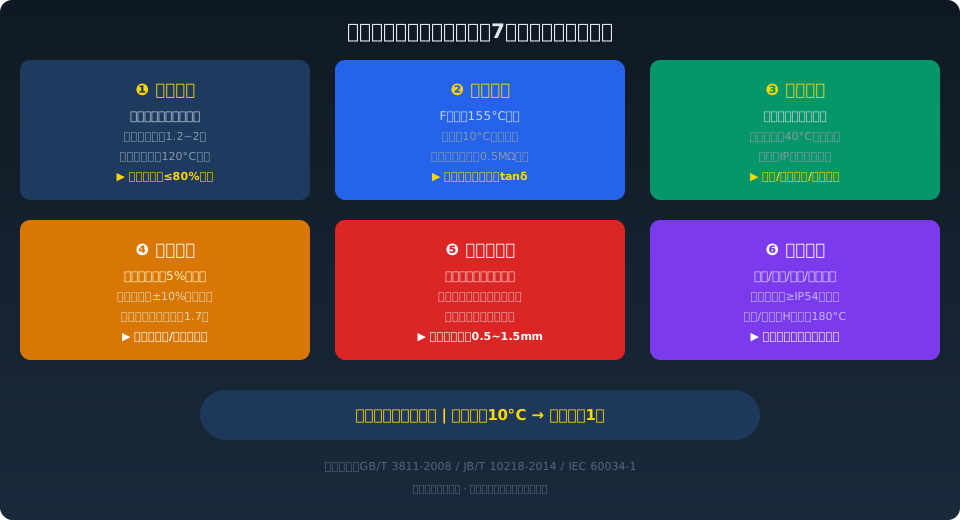
Why Do Crane Hoisting Motors Overheat and Burn Out? Diagnosing 7 Root Causes
In real-world field operations, hoisting motor overheating is rarely caused by a single factor—it is typically the result of multiple contributing conditions compounding each other. According to statistics from Kelude Heavy Industry's technical service department, overload operation and insulation aging together account for more than 55% of all cases, making them the most frequent failure types. The following diagnostic breakdown is organized from highest to lowest occurrence frequency:
Overload operation is the most common cause of overheating. When the lifting load exceeds the motor's rated capacity, the current rises above its rated value, and copper losses increase sharply in proportion to the square of the current. Diagnostic method: use a clamp meter to measure the three-phase current during a full-load lift. If the current consistently exceeds 1.1 times the nameplate rated current, overload is confirmed. Common contributing factors include: the weight of the lifting spreader not being factored into the load calculation, the actual cargo weight exceeding the nameplate rating, and reduced efficiency in the hoisting mechanism (e.g., increased friction resistance due to low gearbox oil).
Insulation aging is the direct cause of eventual motor burnout. Conical rotor motors typically use Class F insulation (heat resistance rating of 155°C). However, in actual operation, if winding temperature remains above 140°C for extended periods, the thermal aging rate of the insulation material accelerates exponentially—for every 10°C increase, insulation life is roughly halved. Testing method: measure the winding-to-ground insulation resistance with a 500V megohmmeter. A cold-state reading of ≥1MΩ is acceptable, while the hot-state lower limit is ≥0.5MΩ. If insulation resistance continues to decline and does not recover after drying, the winding or the entire motor must be replaced promptly.
Poor heat dissipation is commonly seen in high-temperature workshops, poorly ventilated enclosed factory buildings, or when the fan cover has accumulated heavy dust. The cooling fan on a conical rotor motor is mounted at the rear and relies on rotor rotation to drive airflow for cooling. When fan blades are broken, the wind cover is blocked by debris, or the installation space is too confined for hot air to escape, the motor housing temperature can rise by 30–40°C within 30 minutes. Inspection points: check fan blade integrity after shutdown, clean dust from the wind cover, and verify whether the ambient temperature exceeds 40°C—if it does, the motor must be derated per JB/T 10218 requirements.
Voltage anomalies fall into two categories: three-phase unbalance and voltage deviation. When three-phase voltage unbalance exceeds 5%, the negative-sequence current generates additional losses that cause localized winding overheating, which in severe cases can burn out one phase first. When voltage deviation exceeds ±10% of the rated value, low voltage causes speed drop and current increase, while high voltage leads to core saturation and increased iron losses. Per Chapter 10 of ISO 4301 on electrical design requirements, the voltage deviation at the crane's power feed point should be within ±5%, with unbalance not exceeding 2%. All Kelude cranes come standard with a three-phase voltage monitoring relay that automatically cuts off the hoisting circuit when voltage anomalies are detected.
Brake faults causing overheating are particularly characteristic of conical rotor motors. These motors use axial magnetic pull to release the brake. When the brake clearance is adjusted too small, the brake lining does not fully disengage after wear, or the rotor's axial movement is restricted, the motor operates with the brake engaged—equivalent to continuous locked-rotor operation. Current can reach 3–5 times the rated value, burning out the winding within minutes. Inspection checklist: verify brake clearance is within the 0.5–1.5mm standard range, brake lining thickness is ≥3mm, and the rotor slides axially with no binding or sticking.
Environmental factors cannot be overlooked. High-temperature radiation in metallurgical workshops, dust in foundry shops, corrosive gases in chemical plants, and outdoor exposure to rain and sun all accelerate insulation aging and metal corrosion. Kelude Heavy Industry offers customized configurations for special operating conditions, including Class H insulation (180°C) motors, IP65-rated junction boxes, and stainless steel fasteners. For every 5°C rise above the 40°C ambient temperature baseline, it is recommended to derate the motor's rated power by 5%–8%.
Loose terminal connections are a frequently overlooked yet potentially severe fault point. Vibration loosens the power wiring terminals, increasing contact resistance and generating localized heat that can exceed 200°C. This heat conducts to the winding leads, causing insulation carbonization and breakdown. During routine inspections, scan the junction box area with an infrared thermometer—if the temperature differential exceeds 15°C, retightening is required. Terminal blocks should be checked quarterly, with tightening torque applied per the motor nameplate specifications.
What Is a Normal Temperature Rise for Hoisting Motors? ISO 4301 Limits by Insulation Class
Motor temperature rise—the difference between winding temperature and ambient temperature—is the core parameter for determining whether a motor is operating normally. Per GB/T 28264-2012 "Safety Monitoring and Management System for Lifting Appliances", cranes with a lifting capacity exceeding 50% of the rated lifting capacity must be equipped with hoisting motor temperature monitoring that records winding temperature in real time and compares it against preset thresholds. The standard further defines a three-level protection logic for temperature alarms and automatic shutdown: Level 1 warning (at 80% of the limit), Level 2 alarm (at 95% of the limit), and Level 3 shutdown (above the limit).
The allowable temperature rise limits for different insulation classes (based on a 40°C ambient temperature) are: Class B insulation (130°C) allows an 80K rise, Class F insulation (155°C) allows a 105K rise, and Class H insulation (180°C) allows a 125K rise. Domestic electric hoist hoisting motors currently come standard with Class F insulation, while international brands such as DEMAG and STAHL typically use Class H insulation. When selecting an insulation class, the work duty must be considered—for duty classifications of A5 and above, Class H insulation is recommended to ensure sufficient temperature margin.
In Kelude Heavy Industry's hoisting motor selection for bridge cranes, a 15%–20% power margin is reserved by default to ensure that winding temperature rise does not exceed the Class F 105K limit under the most severe operating conditions (full load + high temperature + continuous duty). This design principle has been validated across hundreds of metallurgical and foundry cranes.
| Comparison Parameter | overload Operation | Insulation Aging |
|---|---|---|
| Fault Distribution | 32%(Maximum) | 23% |
| Root Cause | Load Over-Rated, Low Transmission Efficiency | Heat Accumulation, Frequent Start-Stop Impact |
| Diagnosis Method | clamp meter Three-Phase Measurement Current | Megohmmeter (Insulation Tester)Ground Resistance Measurement Insulation Resistance |
| Assessment Standard | Current>Rated Value1.1Times | Hot State Insulation Resistance<0.5MΩ |
| Corrective Action | Load Reduction/Upsize Power Motor | Baking/Rewinding/Complete Unit Replacement |
| Preventive Action | Load Factor Control≤80% | Semi-Annual Measurement Insulation Resistance |
▲ Table 1: Comparative Diagnosis of Overload Operation vs. Insulation Aging Failures
Insulation Class F vs. H vs. C: What's the Difference for Crane Hoisting Motors?
Insulation class determines the maximum allowable operating temperature and temperature rise limit of a motor, making it a critical selection parameter that cannot be overlooked. Class F insulation uses polyester-imide magnet wire with polyester film composite insulation paper, rated for a maximum allowable temperature of 155°C. Class H insulation employs polyamide-imide magnet wire with mica/fiberglass composite materials, rated for 180°C. Class C insulation utilizes specialty materials such as PTFE/polyimide film, with a maximum allowable temperature exceeding 220°C, used for extreme high-temperature environments (e.g., steel ladle handling in steel mills).erials such as PTFE/polyimide film, rated above 220°C, and is reserved for extreme high-temperature environments such as ladle handling in steel mills.
In practical engineering, a common derating strategy is to run a Class F insulated motor at a Class B temperature rise limit (80 K instead of 105 K)—in other words, using a higher-grade insulation material while operating within a lower temperature rise limit to build in a larger thermal safety margin. This is the core technical approach Kelude uses to extend the service life of electric hoist hoisting motors.
| Insulation Class | Maximum Allowable Temperature | temperature rise limit(40°C) |
|---|---|---|
| BClass(130°C) | 130°C | 80K(Resistance Method) |
| FClass(155°C) | 155°C | 105K(Resistance Method) |
| HClass(180°C) | 180°C | 125K(Resistance Method) |
| CClass(>220°C) | >220°C | To Be Agreed Upon by Supplier and Buyer |
▲ Table 2: IEC 60034-1 Temperature Limits by Insulation Class
32%
Share of overload-related failures
105K
Class F temperature rise limit
10°C
Half life per 10°C over-temperature
0.5MΩ
Minimum insulation resistance
±10%
Maximum voltage deviation
IP54
Outdoor protection rating
Overhead Crane Motor Inspection: 5 Preventive Maintenance Steps
Routine daily management is the first line of defense against motor overheating and burnout. Implementing the following five periodic inspection procedures can prevent more than 80% of motor overheating failures:
Daily — Surface Temperature Check. Before startup each day, scan the motor housing temperature with an infrared thermometer and log the trend. Under normal operation, the housing temperature should not exceed ambient temperature +60°C (for Class F insulation). If a single-day temperature rise of more than 10°C is detected, stop the crane immediately and investigate the root cause.
Weekly — Cooling System Cleaning. Clean dust accumulation from the motor wind cover and cooling fins once a week. Use compressed air (pressure ≤0.3MPa) blowing from the inside outward to prevent debris from entering the motor interior. For outdoor cranes, inspect the junction box sealant gasket for aging after the rainy season and replace it if necessary.
Monthly — Three-Phase Current Balance Test. Measure the three-phase current balance monthly. Calculate the unbalance using the formula: (max current − min current) / average current × 100%. If the result exceeds 5%, investigate for turn-to-turn short circuits in the power supply or motor windings. Also measure three-phase voltage; if voltage unbalance exceeds 2%, contact the utility provider to adjust the transformer tap changer.
Quarterly — Terminal Block Inspection. Open the junction box quarterly to check terminal tightening. Use a torque wrench to tighten each terminal to the torque specified on the nameplate. Visually inspect terminals for discoloration (a purplish-red tint on copper indicates prior overheating) and check insulating sleeves for cracks. Simultaneously measure winding-to-ground insulation resistance and record the readings.
Semi-Annually — Comprehensive Performance Test. Every six months, perform a full mechanism condition assessment in accordance with ISO 4301 requirements, including no-load current, full-load current, starting current, and brake actuation time for the hoisting motor. Compare the data against the factory acceptance report; if deviation exceeds 15%, initiate an in-depth fault diagnosis procedure.
Kelude Heavy Industry provides a complimentary motor health management record template with every crane shipped, covering all inspection items and acceptance criteria for daily, weekly, monthly, quarterly, and semi-annual checks — helping users establish a standardized preventive maintenance program.
📖 Related Reading
ISO 4301 Crane Design Standard: 9 Load Combinations and Selection Method for Work Duty A1 to A8
JIS B 8823 Standard for Crane Electric Motors — Explained
JIS B 8824 Standard for Crane Brakes — Explained
DIN 15405 Standard for Crane Brake Wheels — Explained
JB/T 10227 Standard for Electric Hoist Brakes — Explained
AI Fault Diagnosis for Overhead Crane Motors: Vibration Spectrum Analysis and 1D-CNN Pattern Recognition
Crane Hoist Motor: 5 Common Questions on Selection and Maintenance
Q: What is the practical difference between Class F and Class H insulation in hoisting motors, and which applications require Class H?
A: The key difference lies in the maximum allowable operating temperature: 155°C for Class F versus 180°C for Class H — a 25°C margin. Based on the rule that insulation life halves for every 10°C above rated temperature, a Class H motor has roughly 5.6 times the theoretical service life of a Class F motor at the same operating temperature. Class H is mandatory in the following conditions: ① hot-rolling or foundry workshops where ambient temperature consistently reaches ≥45°C; ② metallurgical cranes with work duty A5 and above, or with a load duty cycle ≥60%; ③ scrap-handling grab cranes with hoisting frequency ≥30 cycles per hour and severe start-stop impact. Kelude Heavy Industry recommends Class H insulation as standard for work duty A5 to A6, adding approximately 15%–20% to motor cost while extending service life by 2–3 times.
Q: The electric hoist motor housing is too hot to touch during operation, but the hoist still works. Should we shut it down for inspection?
A: Yes — investigate immediately. Housing temperature can be estimated by touch: 60°C feels very hot but tolerable for continuous contact; 80°C forces you to pull away within 2–3 seconds; above 100°C causes instant burns. If the housing exceeds 80°C, take an accurate reading with an infrared thermometer: for Class F motors, shutdown is mandatory when housing temperature exceeds 95°C (corresponding winding temperature approximately 120–130°C); for Class H, the threshold is 110°C (winding approximately 140–150°C). Even if the motor still runs, the insulation is already undergoing accelerated aging. Check three-phase current balance, cooling fan operation, and ambient temperature. As a temporary measure, forced ventilation with an axial fan can provide short-term cooling, but the root cause must be identified and resolved within 48 hours.
Q: Our hoisting motor burned out, and the replacement failed within three months. What could be causing these repeated failures?
A: Repeated motor burnouts indicate the root cause was never addressed—replacing the motor alone only treats the symptom. Work through the following checklist in order: ① Check the three-phase supply voltage for unbalance (a deviation exceeding 5% creates negative-sequence current that progressively damages the windings) and voltage deviation (if it exceeds ±10%, install a voltage stabilizer); ② Verify whether the actual lifting load exceeds the motor's rated capacity (the weight of the lifting spreader is often overlooked, and overloading of 10%–15% is common in practice); ③ Inspect the brake for dragging—brake clearance under 0.3 mm or incomplete release of the brake lining will keep the motor under load; ④ Check the contactor contacts for welding or sticking, which can keep the motor energized and prevent it from stopping; ⑤ Confirm the thermal overload relay or motor protection device is set correctly—it should be set to 1.0–1.05 times the rated current, not the commonly used 1.2 times or higher. Working through these five checks in order will typically uncover the true cause of the recurring failures.
Q: How much does it cost to rewind the hoisting motor on a 10-ton electric hoist, and is it more cost-effective than replacing the entire motor?
A: Rewinding a 10-ton hoisting motor (13–18 kW conical rotor) typically costs between 2,000 and 3,500 CNY (approximately $300–$520), including disassembly, rewinding, varnish impregnation, baking, and testing, with a turnaround of 3–5 days. A brand-new motor of the same specification costs roughly 5,000–8,000 CNY (approximately $740–$1,190). Here's how to decide: if the motor has been in service for more than five years and the stator core shows significant corrosion or signs of rotor rubbing, replace the entire motor—new motors come with a one-year warranty. If the motor is under three years old and the core is in good condition, rewinding offers better value. Note that rewinding must use magnet wire and insulation rated to the same grade (Class F, 155°C) or higher (Class H, 180°C), and after impregnation, the motor must pass the turn-to-turn surge dielectric test and temperature-rise test in accordance with JB/T 10218 before it is released. Kelude offers a factory motor exchange program, with trade-in credit of approximately 15%–25% on the old motor.
