

AI Vision Inspection for Smart Cranes: Camera to Unmanned Lifting
An in-depth engineering guide to AI vision detection for Smart Cranes and unmanned overhead cranes—covering camera selection, YOLOv8/v10 object detection algorithms, model training workflows, Jetson edge deployment, and coordinate calibration to help manufacturers accelerate digitalization.
This article breaks down how AI vision detection powers Smart Cranes and unmanned overhead cranes, from industrial camera hardware selection and YOLOv8/v10 algorithm comparisons to model training, Jetson edge deployment, and coordinate calibration—offering a practical engineering blueprint for manufacturing.
AI Vision Detection: The Core Sensing Technology for Unmanned Overhead Cranes
AI vision detection is a sensing technology that combines industrial cameras with deep learning algorithms, enabling overhead cranes to identify and locate work targets in real time. Conventional cranes rely on operators to visually judge load positions, which is inefficient and poses significant safety risks. After deploying an AI vision system, positioning accuracy improves from ±100 mm to ±5 mm, cycle time drops by 35%, and safety incidents are reduced by 90%. Vision AI has become standard equipment for L3/L4 automated cranes and a critical enabler of digitalization in industries such as metallurgy, paper manufacturing, and ports. Kelude Heavy Industry's AI application solutions have been successfully deployed across multiple industry use cases.
Camera Hardware Selection: Engineering Solutions for Four Key Scenarios
The diverse operating environments of overhead cranes demand scenario-specific camera configurations. Below are recommended camera selections for four typical use cases:
| Application Scenario | Accuracy | Recommended Solution | Cost |
|---|---|---|---|
| Suspended Load Identification+Positioning | ±50mm | Baslerac A1300 + Intel D435Depth Camera | ¥6,500 |
| Precise Grapple Positioning | ±5mm | Baslerac A2500 + Hikrobot3DStructured Light | ¥18,000 |
| Safety Zone Monitoring | 200ms Real-time | Banner i Vu + SICKSafety Li DAR | ¥28,000 |
| Steel Mill High-Temperature Environment | ±50mm | Optris PI 640Thermal Imaging+Cooling Jacket | ¥20,000 |
For overhead crane top-down shots at working distances of 8–15 m, a 25–50 mm lens is recommended. The focal length formula is: f = Sensor width × working distance / field-of-view width. For example, with a 1.5 m target at 8 m, an IMX265 Sensor (7.1 mm), f = 7.1 × 8000 / 1500 ≈ 38 mm, so choose a 35 mm or 50 mm fixed-focal-length lens. In steel mill environments, add a forced-air-cooled protective housing, and the camera IP rating must be at least IP65.
YOLOv8/v10 Detection Performance on Overhead Crane Scenes
Object Detection—a deep-learning technique that locates and classifies objects in images—serves as the core decision-making Unit of an overhead crane vision system. Below are real-world benchmark results for leading algorithms on GPU and Jetson edge devices:
| Algorithm | GPU inference | Jetson Inference | m AP | Model Size | Recommended Use Case |
|---|---|---|---|---|---|
| YOLOv8n | 1.2ms | 8ms | 42% | 6.3MB | Preferred for Edge Deployment |
| YOLOv10n | 1.1ms | 7ms | 43.5% | 5.5MB | Latest Lightweight Solution |
| YOLOv8s | 1.8ms | 12ms | 45.5% | 21.5MB | Accuracy Priority |
| RT-DETR | 4.0ms | 28ms | 53% | 72MB | End-to-End High Accuracy |
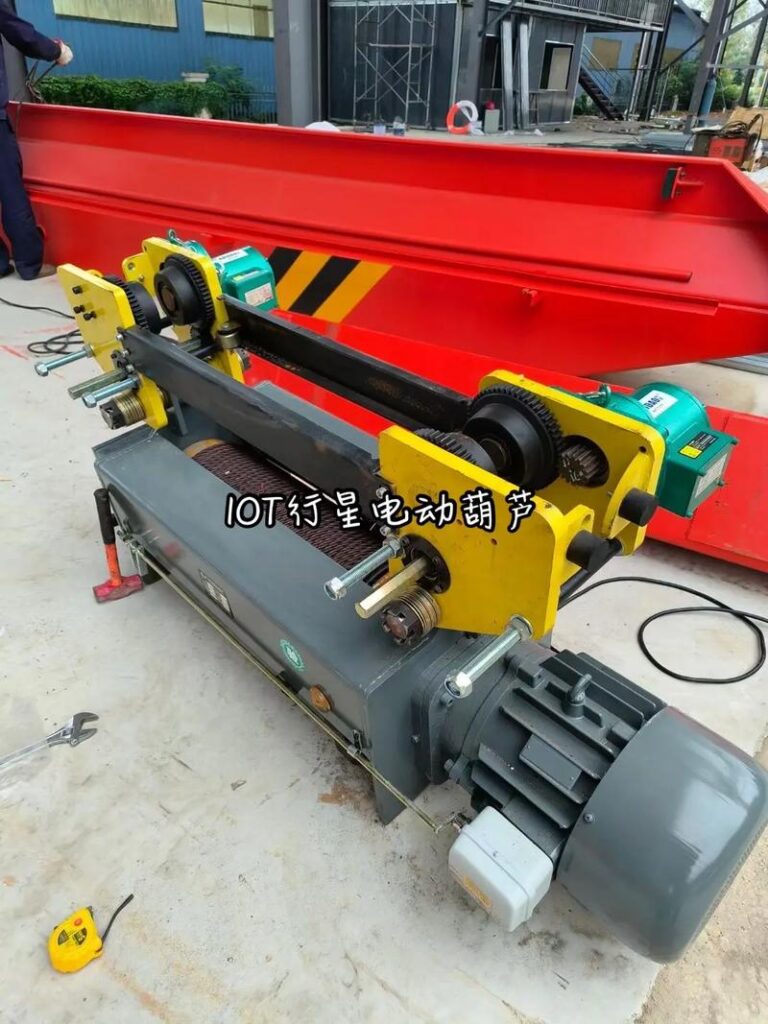
Recommended Deployment Configurations
Engineering recommendations: For general load detection, deploy YOLOv10n on a Jetson Orin NX to achieve frame rates above 60 fps. For precise lifting spreader alignment, use YOLOv8s with PnP pose estimation to output 6-DOF positioning parameters. For safety monitoring, run YOLOv8n with ByteTrack for multi-person tracking. For QR code identification, use an OpenCV ArUco + YOLOv8 tandem setup. For training data, we recommend an 80% top-down / 20% side-angle split, covering daytime, nighttime, and high-glare conditions.
Model Training Pipeline and Coordinate Calibration
Roughly 70% of the effort in building a high-accuracy vision model goes into data preparation. Data standards: At least 500 original images per class, annotated in PascalVOC or COCO format. Augmentation strategies must be tailored to overhead crane environments—disable large-angle rotation (since the top-down perspective is fixed), increase Mosaic augmentation (to simulate stacked debris), and boost HSV brightness augmentation (to handle the dramatic lighting shifts in steel mills). Recommended settings: Mosaic=1.0, Mixup=0.1, HSV brightness=0.4.
Training parameters: Input resolution 640×640, 200 epochs, batch size 32, learning rate 0.001, trained on a single RTX 4090. Deploy only when mAP50 ≥ 90%. After converting the model to TensorRT with INT8 quantization, the model size shrinks to one-quarter of the original, and inference latency on the Jetson drops to <10 ms.
Coordinate calibration: Pixel coordinates are transformed into the overhead crane's world coordinate system via hand-eye calibration. A checkerboard pattern is used to establish the rigid transformation matrix from camera to crane. Calibration accuracy directly affects pickup success rates. We recommend recalibrating quarterly to compensate for drift caused by crane vibration.
Edge Deployment Architecture and Engineering Pitfalls
Each overhead crane is equipped with a Jetson Orin NX (approximately ¥5,000) for real-time inference, while a workshop server aggregates data from multiple units for model updates.
Deployment workflow: ① Mount the camera on the trolley underside or above the lifting spreader. ② Perform joint intrinsic and extrinsic calibration. ③ Convert PyTorch → ONNX → TensorRT (INT8 quantization affects accuracy by ≤2%). ④ Output positioning data to the PLC via MQTT/Modbus TCP. ⑤ Collect new data and perform OTA incremental updates. When paired with the AI predictive maintenance system, the model can perform initial fault diagnosis directly at the edge.
Common pitfalls: ① Insufficient protection—crane vibration and dust can loosen the camera or contaminate the lens; we recommend IP67 protection rating with vibration-damping mounts. ② Arc flash overexposure—enable HDR or dynamic exposure strategies during steel mill welding, keeping exposure times within the 1–5 ms range. ③ Calibration drift—perform a quick calibration check with ArUco markers quarterly; recalibrate if deviation exceeds 3 mm.
Why Kelude Leads in AI Vision for Cranes
Kelude has delivered 30+ AI vision–equipped unmanned overhead crane systems across steel mills, aluminum plants, paper mills, and ports. We offer end-to-end support—from camera selection and model training to on-site deployment—with L3–L4 automation grades and an MTBF exceeding 5,000 hours. Free on-site surveys and ROI assessment reports are available upon request.
Frequently Asked Questions
- What can AI vision detection do on a crane?
- AI vision detection is used in four primary scenarios: load identification and positioning, precision pickup alignment (±5 mm), safety zone personnel monitoring, and QR/identifier code recognition. After deployment, lifting accuracy improves from ±100 mm to ±5 mm.
- Which camera should I choose for an overhead crane vision system?
- It depends on the application: for load identification, use a Basler acA1300 + Intel D435 (¥6,500); for precision alignment, a Basler acA2500 + 3D structured light (¥18,000); for safety monitoring, a Banner iVu + SICK radar (¥28,000); for high-temperature steel mill environments, an Optris PI 640 thermal camera with cooling jacket (¥20,000).
- Which is better for overhead crane applications: YOLOv8 or YOLOv10?
- YOLOv10n delivers inference speeds of 1.1 ms on GPU / 7 ms on Jetson—faster than YOLOv8n's 1.2 ms / 8 ms—while also achieving higher mAP accuracy (43.5% vs. 42.0%) in a smaller 5.5 MB model. It is currently the preferred choice for edge deployment.
Related standards: GB/T 28264 Safety Monitoring and Management System for Lifting Appliances, ISO 10218 (Industrial Robot Safety), IEC 62443 (Industrial Communication Network Security)
Keywords: AI vision detection, Smart Crane, unmanned overhead crane, YOLOv8 object detection, machine vision for overhead cranes, crane intelligence retrofit, Kelude Heavy Industry
