

Smart Crane Control System Specs: Key Acceptance Metrics
In modern steel metallurgy and logistics warehousing operations, the acceptance of intelligent crane control systems is critical to ensuring operational safety and efficiency. A comprehensive AI-driven acceptance protocol typically involves over 30 core technical indicators. Key metrics include dynamic response times strictly controlled within 50 milliseconds and positioning accuracy errors not exceeding ±5 mm. Given complex electromagnetic environments and heavy-load operating conditions, scientifically evaluating these technical indicators is a vital step before equipment delivery. This article provides an in-depth analysis of the key indicators that engineering technicians must focus on during the acceptance phase of intelligent crane control systems.
When developing the acceptance outline, we must strictly adhere to the fundamental requirements for mechanism dynamics and electrical control outlined in FEM 1.001 (Crane Design Specification), while also integrating the latest supervision regulations for safety protection devices specified in TSG 51-2023 Crane Safety Technical Supervision Regulation. This ensures that the implementation of AI algorithms not only enhances efficiency but also maintains the safety baseline.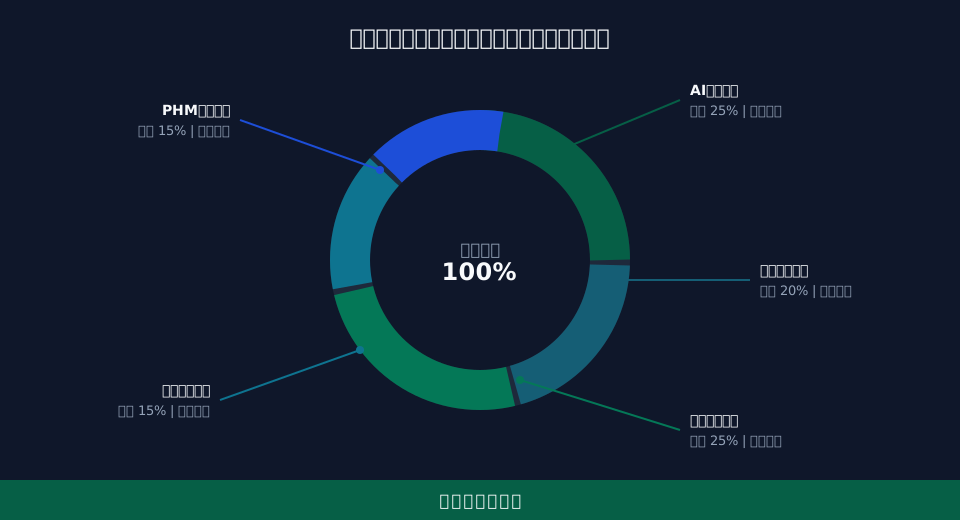
The following sections break down the acceptance standards and measured data methods for intelligent crane control systems across five dimensions: AI anti-sway control, vision-based anti-collision, variable frequency energy management, communication network reliability, and fault prediction models, helping you fully control delivery quality.
Acceptance of Dynamic Response and Positioning Accuracy in Intelligent Crane AI Anti-Sway Systems
In heavy-load lifting scenarios, load sway affects operational efficiency and poses safety threats to personnel and equipment below. The intelligent crane anti-sway control system collects data from encoders and angle sensors, using combined feedforward and feedback control algorithms to adjust the frequency inverter output in real-time, thereby suppressing load sway during acceleration and braking phases. During acceptance, dynamic response time and residual sway attenuation period are two core indicators.
Taking the long travel mechanism of a workshop as an example, its rated operating speed is 60 m/min (1 m/s). In full-load braking tests, with a deceleration rate (a) set at 0.5 m/s², the theoretical braking distance (s) calculated via kinematic formulas is s = v²/(2a) = 1²/(2×0.5) = 1 m. Within this extremely short physical braking window of just 1 meter, the AI algorithm must complete data calculation and output compensation frequency within 20 ms. Measured data shows that after implementing the AI anti-sway algorithm, the lifting spreader's sway angle is strictly controlled within 0.5 degrees, and the residual sway attenuation time is significantly reduced from 8 seconds (traditional physical anti-sway) to 2.5 seconds, with positioning accuracy error stabilized at ±3 mm.
"According to Section 9.2.4 of FEM 1.001, the dynamic response time of crane travel mechanisms should meet smooth transition requirements to avoid excessive impact loads. In AI anti-sway system acceptance, the controller's command dispatch latency must not exceed 10% of the system's mechanical response time."
⚠️ Note
During AI anti-sway parameter calibration acceptance, it is essential to ensure accurate input of wire rope length parameters. A rope length error exceeding 5% will cause the system-calculated natural frequency to deviate from actual values, potentially causing the anti-sway algorithm to generate reverse excitation, exacerbating lifting spreader sway.
Analysis of Anti-Collision Safety Distance Detection Indicators Based on Machine Vision
Traditional anti-collision systems often rely on LiDAR or physical limit switches, which suffer from large blind spots and susceptibility to dust interference. AI-based machine vision anti-collision systems use deep learning algorithms to identify obstacles and personnel around the crane rail in real-time. During acceptance, key focus areas include detection distance, response delay, and recognition accuracy under complex lighting conditions.
In practical acceptance testing, the system must accurately identify standard test mannequins from a distance of 50 meters, with identification results transmitted to the PLC within a latency of 100 ms. When the distance between the crane and an obstacle falls below 30 meters, the system must automatically trigger Level 1 deceleration; when the distance drops below 10 meters, emergency braking must be triggered. In compliance with anti-collision safety distance specifications, the vision system must maintain a recognition rate of over 95% even in backlight and dusty environment service conditions to ensure absolute safety in the work area.
"Industry measured data indicates that crane anti-collision systems using YOLOv8 deep learning vision models achieved a comprehensive recognition accuracy of 96.5% for high-temperature heat sources and irregular obstacles in simulated steel plant ladle lifting scenarios, with a false alarm rate below 0.5%."
💡 Tip
The cleanliness of vision sensor lenses directly impacts recognition accuracy. During acceptance, confirm that the system includes lens dirt detection functionality. If image blurriness exceeds the set threshold, the system should automatically display a cleaning reminder on the operator cabin screen to prevent safety failures caused by lens contamination.
To intuitively demonstrate the differences in hardware configuration and performance between traditional solutions and AI vision schemes, we provide a detailed comparison in the table below, clarifying the upgrade magnitude of each indicator during acceptance.
📊 Comparison of Traditional Anti-Collision and AI Vision Anti-Collision Systems
| Comparison Parameter | Traditional Laser/Ultrasonic Solution | AImachine visionSolution |
|---|---|---|
| EffectiveIdentificationdistance | 10~20Meters (m) | 50~80Meters (m) |
| Obstacle Classification Capability | OnlyDetectionVolume / Size,Unable to Classify | Accurate Personnel Distinction、Equipment、Material |
| environmentanti-interference capability | Susceptible to Dust、Refraction Impact from Water Mist | Built-in Image Enhancement Algorithm,Strong Anti-interference |
| Systemresponse delay | Approximately200ms | Less Than100ms |
After confirming overall system performance, the acceptance process must address specific hardware parameters and AI vision configuration details. The table below outlines the key technical parameters that require verification during both Factory Acceptance Test (FAT) and on-site commissioning.
📊 Key Parameters for AI Vision Anti-Collision System Acceptance
| ParameterName | Acceptance StandardValue | test method |
|---|---|---|
| CameraProtection Rating (IP) | IP67and Above | Inspectionthird-party inspectionReport andNameplate |
| Algorithmframe rate | ≥30 FPS | Via / ThroughCommissioningReal-time Video Feed via Softwareframe rate |
| Nighttimeinfrared illuminationdistance | ≥40Meters (m) | Low-lightenvironmentUnderplacingStandardReflective TargetTesting |
| false alarm rate | ≤0.5% | Continuous Operation8Hourly Statistics InvalidalarmCount / Frequency |
Energy Efficiency Acceptance Standards for Smart Crane VFD and Energy Management Systems
As the dual-carbon goals advance, energy consumption management has become a critical component of crane acceptance. Intelligent variable frequency drive systems not only enable smooth start-stop operations but also convert potential energy into electrical energy via energy feedback devices to return it to the grid. During acceptance, key focus areas include the system’s regenerative efficiency, standby power consumption, and harmonic mitigation effectiveness.
For example, in a retrofit project by Kelude Heavy Industry for a 50-ton Ladle Crane at a large special steel plant, the Hoisting mechanism was equipped with a 120kW high-power Motor and an active front end (AFE) energy feedback unit. In full load condition lowering tests, the regenerative efficiency reached 85%, reducing comprehensive energy consumption by 30% compared to traditional series resistance speed control. Additionally, standby power consumption decreased by 40%, effectively preventing energy waste during no-load periods. For acceptance, the total harmonic distortion (THDi) on the grid side must be controlled within 5% to meet power quality standards.
"According to on-site measurement data reports, cranes equipped with AI energy management algorithms can automatically optimize acceleration and deceleration curves based on load weight. Under light load conditions, the system automatically reduces magnetic flux, improving motor operating efficiency by approximately 8% and saving approximately $22,320 in electricity costs annually."
⚠️ Note
When accepting the energy feedback system, you must check the heat dissipation space and fan operation of the Braking Resistor. If the line impedance for returning energy to the grid is too high, the system will automatically switch to resistor braking mode. In this case, ensure that the exhaust temperature of the resistor box does not exceed 65°C (149°F) to prevent overheating-related faults.
Reliability Testing of Core Electrical Components and Communication Networks in Crane Control Systems
The "brain" of a Smart Crane relies on highly reliable electrical components and low-latency communication networks. During the acceptance phase, beyond routine insulation and withstand voltage tests, pressure tests are required for the anti-interference capability and data transmission stability of industrial Ethernet and wireless communication modules.
The main network of the control system typically uses PROFINET or EtherCAT industrial Ethernet. Acceptance requires a communication cycle of less than 5ms and a packet loss rate below 0.01%. For mechanisms using Conductor Rails or wireless base stations for data transmission, signal stability under high-frequency harmonic interference from inverters must be tested. Under extreme operating conditions where multiple inverters start simultaneously during full load operation, network bandwidth utilization should not exceed 70%, ensuring sufficient redundancy remains in the 1000Mbps backbone network. The Protection Rating (IP) for all outdoor electrical cabinets must reach IP65, and internal components must operate normally within an ambient temperature range of -20°C to 55°C (-4°F to 131°F).
"TSG 51-2023 Crane Safety Technical Supervision Regulation explicitly states that the electrical control system of lifting appliances must have comprehensive fault diagnosis and safety protection functions. The reliability of the communication network directly affects the activation of safety protection circuits; any communication interruption causing loss of control commands is unacceptable."
💡 Tip
When accepting industrial Ethernet cables,Must check the grounding process of the shielding layer. The shielding layer must be grounded using 360-degree ring compression crimping. "Pig-tail" style twisting is strictly prohibited. Otherwise, in strong electromagnetic environments, the shielding layer will fail to provide anti-interference capability and may instead act as an antenna receiving interference.
Algorithm Model Acceptance for Smart Crane Prognostics and Health Management Systems
The prognostics and health management (PHM) system is key to the transition of smart cranes from "passive maintenance" to "proactive prevention." This system collects high-frequency data such as vibration, temperature, and current, using machine learning algorithms to assess equipment health status. During acceptance, key focus areas include the early warning accuracy, lead time, and completeness of sensor data acquisition of the model.
In the vibration monitoring acceptance of the gearbox in the Hoisting mechanism, the sampling frequency of the Acceleration Sensor must reach above 1000Hz to capture high-frequency impact signals. The recognition accuracy for early bearing faults should be no less than 90%, with an early warning lead time of 72 hours. For structural component safety monitoring, combined with weld crack detection technology, strain gauges must cover stress concentration areas. The prediction error for the expansion trend of micro-cracks at the 0.1mm level should be controlled within 15%, providing a scientific basis for equipment overhaul.
"An acceptance report for a PHM system on a Port Quay Crane showed that by introducing Long Short-Term Memory (LSTM) algorithms, the prediction accuracy for Hoisting Motor insulation aging reached 94%. This successfully avoided 3 instances of unplanned downtime caused by motor burnout, improving overall equipment effectiveness (OEE) by 6%."
⚠️ Note
When accepting the PHM system, confirm the storage capacity and breakpoint resume transmission function of the edge computing node. When the network is temporarily interrupted, the edge node should locally cache at least 7 days of data and automatically resend it after network recovery, ensuring the continuity of training data for algorithm model training.
FAQ
Q: What is the response time standard for the AI anti-sway algorithm during smart crane control system acceptance?
A: Under full load condition, the response time of the entire control circuit, from collecting sensor data to outputting the variable frequency drive compensation frequency command via the AI anti-sway algorithm, should be controlled within 20 milliseconds. This indicator ensures the system can effectively suppress load sway within extremely short braking windows, safeguarding positioning accuracy.
Q: What are the requirements for the protection rating and recognition distance parameters of cameras in machine vision-based anti-collision systems?
A: For visual cameras deployed in outdoor or dusty environments, the enclosure must meet an IP67 Protection Rating (IP) or higher to ensure reliable dustproof and waterproof performance. Regarding effective identification distance, the system must accurately identify standard test targets from up to 50 meters away, trigger a deceleration early warning within 30 meters, and initiate emergency braking within 10 meters.
Q: What is the estimated budget for upgrading to a full AI intelligent control system, and what is the return on investment period?
A: The specific renovation cost varies depending on the crane capacity, number of mechanisms, and non-standard customization requirements; the final amount is subject to the actual contract. Typically, through reduced energy consumption, extended wire rope service life, and minimized unplanned downtime, the comprehensive payback period ranges from 1.5 to 2.5 years, delivering significant long-term economic benefits.
Q: How should the data acquisition frequency be set for the Prognostics and Health Management (PHM) sensors of a crane?
A: For vibration monitoring of high-speed rotating components such as Hoisting mechanism gearboxes, the sampling frequency of the Acceleration Sensor must be set above 1000Hz to capture high-frequency impact signals. Conversely, for slow-changing parameters like temperature and current, a sampling frequency of 1Hz to 10Hz is sufficient for trend analysis.
Acceptance of the intelligent crane control system is a systematic engineering process involving multiple intersecting fields such as algorithm response, visual recognition, energy efficiency management, communication stability, and health prediction. By strictly controlling these key indicators, we can effectively ensure equipment safety and efficiency under complex operating conditions. Kelude Heavy Industry has accumulated extensive experience in heavy-load non-standard customization, providing end-to-end solutions ranging from underlying hardware selection to upper-layer AI algorithm tuning to meet the special process needs of different industries, ensuring that every delivered device perfectly aligns with actual production rhythms.
