
Crane Spreader Beam Selection Guide: Types, Models & Uses
Crane lifting spreaders fall into seven categories based on the load's shape and handling process: spreader beams (for long items / multi-layer plate stacking), C-hooks (for coils / pipes), lifting magnets (for steel plates / scrap), clamps (for structural steel / billets), rotating spreaders (for loads requiring orientation adjustment), telescopic spreaders (for containers of varying sizes), and vacuum lifters (for smooth-surfaced sheets). The core selection principle is matching the gripper type and safety factor (≥5 for hazardous loads) to the material's physical properties—shape, temperature, surface condition, and magnetic response.
The lifting spreader is the "interface" between the crane and the load—it determines what an overhead crane can lift, how it lifts it, and how fast. Most companies focus on lifting capacity and span when specifying an overhead crane, only to discover once the equipment arrives that "the hook can't reach" or "the load isn't stable." By then, they're already three to six months behind schedule hunting for a spreader solution. A lifting spreader is not a crane "accessory"—it's a core piece of process equipment that must be designed in tandem with the overhead crane from day one. A 50t crane fitted with the right dedicated spreader can handle loads three to five times faster than a bare hook; choose the wrong spreader type, and you're looking at damaged or rejected material at best, and at worst, a dropped load and a serious safety incident.
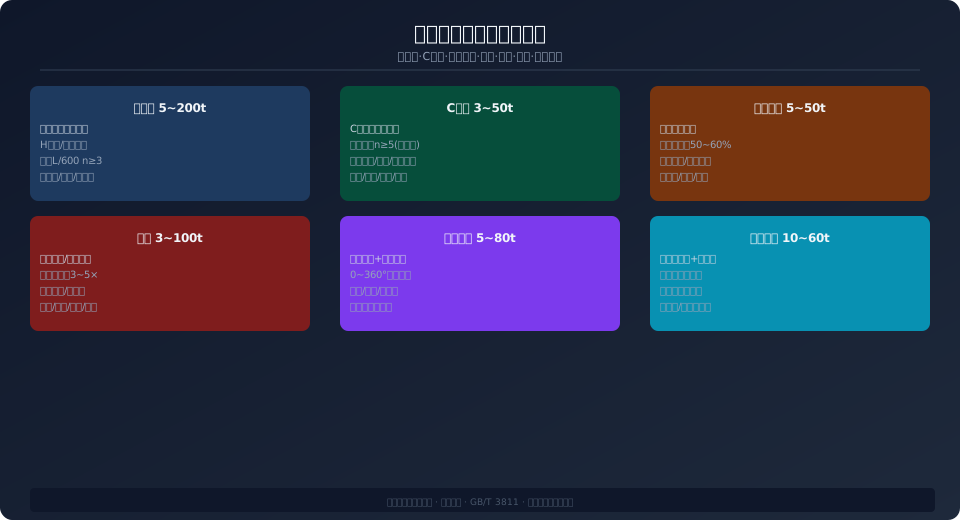
Based on the physical form of the load and the handling process requirements, crane lifting spreaders can be grouped into seven main categories. Each type differs fundamentally in load-bearing structure, gripping principle, and safety protection—the matrix below provides a quick overview, followed by a detailed breakdown of design considerations for each category.
Spreader Beam: The Load Balancer for Long Cargo
The spreader beam is the most widely used type of crane lifting spreader. For any component longer than 3 m — such as a 20 m steel plate, a 12 m pipe pile, or a precast concrete beam — a single-point hook cannot guarantee a level lift. A "distribution beam" must be placed above the load, with multiple lifting lugs spreading the load evenly. The core design consideration is lug positioning, which determines the bending moment distribution and deformation of the load during lifting. For uniform cross-section members (e.g., a full-length steel plate), lugs should be symmetrically placed at 0.207L from each end — the theoretical point of minimum bending moment. For variable cross-section members (e.g., stepped precast beams), finite element analysis is required to determine the optimal lug positions that minimize the overall bending moment envelope.
Spreader beams typically use an H-beam or box-section profile, made from Q355B or Q460C steel. Strength verification follows a simply supported or continuous beam model (depending on the number of lifting points), with deflection limited to L/600 (referencing the deformation limits for crane runway girders in GB 50017). Excessive deflection causes visible elastic sagging of the load, compromising installation accuracy and creating a safety concern on site. The weld seam connecting the lifting lugs to the main girder is the most critical weak point. Fatigue assessment of these welds must follow the hot-spot stress method in GB 50017 — especially in high-frequency applications exceeding 20 lifts per day, where the weld details at the lug root (full penetration butt weld with fillet weld reinforcement) directly determine the service life of the beam.
C-Hook: The Dedicated Tool for Coil Handling
A C-hook resembles a horizontally oriented letter "C" — with a short upper arm (lifting eye end) and a long lower arm (load-bearing end). During lifting, the lower arm is inserted into the bore of the coil, and the friction generated by the coil's dead weight keeps the load stable. Section design is the most critical engineering challenge: the section height h is determined by the opening size (opening = maximum coil outer diameter + 50–100 mm safety clearance), the section width b is governed by bending stress (checked using a cantilever beam model, M = P × opening/2), and the web plate thickness tw must satisfy shear strength requirements (τ ≤ 0.6 × [σ]). C-hooks fall under the category of critical components as defined in ISO 4301 Crane Design Standard — failure results in direct load drop — so the safety factor must not be less than 5. In practice, n = 5–6 is commonly used, verified against yield strength rather than tensile strength.
Lifting Magnet: The Invisible Grip for Ferrous Materials
Lifting magnets use the magnetic field generated by a DC electromagnetic coil to lift ferromagnetic materials (steel plates, scrap steel, billets). Their key advantage is "no mechanical clamping and no surface damage to the material." The MW1 series round lifting magnet is the most common specification, with diameters from φ800 to φ2100 and lifting forces from 10 t to 60 t. One critical concept to remember when selecting a magnet: the rated lifting force is the maximum value under ideal conditions — flat, thick plates, full surface contact, and ambient temperature. In real-world conditions, lifting force degrades significantly due to: uneven material surfaces (force reduced by 30%–50%), material temperatures above 200°C (magnetic permeability drops, reducing force by 15%–20% per 100°C rise), and air gaps greater than 0.5 mm (force decreases with the square of the gap). For this reason, the safe working load of a lifting magnet is typically taken as 50%–60% of the rated force — meaning a magnet rated at 20 t should not be used to lift more than 10–12 t safely.
Clamps, Rotating Spreaders, Telescopic Spreaders & Other Specialized Lifting Gear
Clamp (gripper) spreaders grip the sides of structural steel or billets through mechanical levers or hydraulic actuation, relying on friction or mechanical interlock to prevent slippage. Mechanical clamps utilize the friction angle between the jaws and the material (the jaw angle must typically be less than 14° to ensure self-locking), while hydraulic clamps apply constant clamping force via hydraulic cylinders and are equipped with accumulators to prevent sudden pressure loss. The key safety indicator for clamps is the clamping force redundancy factor — the jaw clamping force should be at least 3–5 times the dead weight of the load to compensate for uncertainty in the friction coefficient of the contact surfaces. Rotating spreaders incorporate a slewing bearing and motor-driven rotation unit between the spreader and the overhead crane hook, enabling 360° horizontal rotation of the load. These are ideal for precise orientation during installation (e.g., aligning steel structure beams and columns). Telescopic spreaders use a multi-section telescopic boom to adjust the distance between lifting points, accommodating different container or box sizes. The telescoping mechanism must be equipped with a synchronization system (mechanical linkage or hydraulic synchronized motors) to prevent unequal extension of the two arms, which could cause eccentric loading and tipping.
Lifting Spreader Selection Guide: 7 Types Compared
From a return-on-investment perspective, pairing a lifting magnet with a steel plate lifting beam is the most cost-effective configuration for most steel fabrication shops. The magnet handles roughly 80% of routine medium-thickness plate handling at ambient temperature, maximizing throughput, while the lifting beam covers hot plates, thin plates, and non-magnetic materials where safety takes priority. The combined investment for both systems runs approximately $30,000 to $52,000. For a shop moving steel plates more than 200 times per day, with a 30-second saving per lift, and combined labor and equipment costs of $115 to $175 per hour, the annual savings in labor and efficiency gains come to roughly $15,000 to $22,000—putting the payback period at about two to three years.
Take a typical mid-sized steel fabrication facility as an example: 250 plate lifts per day, an average load of 8 tons per lift, and a switch from conventional wire-rope slinging to a magnet-plus-lifting-beam combo. In one year, the savings on edge damage alone—wire-rope slinging routinely leaves indentations deeper than 2 mm on plate edges, which classifies the plate as non-conforming—amount to roughly $4,500 to $7,500 in rework and scrap costs. Add the labor efficiency gain (20–30 seconds saved per lift, 250 lifts per day, totaling about two hours of labor saved daily), and the combined annual benefit exceeds $22,000. Factor in the avoided risk of a load drop from a power failure—an incident that could cost tens of thousands of dollars in material loss and production downtime—and the payback period shortens further. The recommendation: budget the lifting spreader as a dedicated line item in the overhead crane procurement plan from the start, rather than treating it as an afterthought once the crane is already installed.
Frequently Asked Questions
Q: Which of the seven lifting spreader types are used most often, and in what industries?
A: Spreader beams and C-hooks see the widest use—spreader beams cover nearly all long-load lifting scenarios (steel fabrication, precast concrete, pipe pile manufacturing), while C-hooks are the standard choice for steel and non-ferrous coil handling. Lifting magnets dominate scrap processing and medium-to-heavy plate fabrication. Clamps (grippers) are indispensable in structural steel mills and rail manufacturing shops. Rotating spreaders are seeing the fastest adoption growth in applications requiring precise orientation, such as wind power tower sections and large castings.
Q: How much dead weight do lifting spreaders typically add, and does it eat into usable capacity?
A: Dead weight varies by type and capacity: small C-hooks (3–10 t) typically weigh 15%–25% of rated load, while large spreader beams (100 t and up) can be held to 8%–12%. This must be factored into crane selection from day one—for example, if you need to lift a 40 t component and the spreader weighs 8 t, the crane's rated lifting capacity needs to be at least 50 t. Many projects calculate only the payload weight and forget the spreader, only to find the crane comes up short and requires an upgrade—this is the #1 hidden cost in lifting spreader selection.
Q: Can one overhead crane run multiple spreader types? How fast can you switch between them?
A: Yes—and it should. Most overhead cranes come with a quick-change interface below the hook. The most common setup is hook + shackle + spreader lifting eye: to swap spreaders, you simply open the shackle, and the change takes about 3–5 minutes with one crane operator and one ground assistant. For production lines that switch frequently (five or more times per day), upgrading to an automatic release mechanism or a hydraulic quick coupler is the better route—the crane operator triggers the release/attach remotely from the control pendant, no ground personnel needed, and changeover time drops to under 30 seconds. The trade-off: automated quick-change systems cost roughly 5–8 times more than a standard shackle arrangement.
Q: What inspection standards apply to lifting spreaders, and how often should they be checked?
A: Lifting spreaders fall under the rigging category governed by ISO 4301 and TSG Q0002 (Special Equipment Safety Technical Regulation for Lifting Appliances). The inspection schedule breaks down as follows: daily pre-use visual checks by the operator (weld seam cracks, loose bolts, deformation); monthly detailed inspections by the designated equipment manager (ultrasonic thickness measurement, MPI of weld seams, and a 10% sampled load test); and an annual comprehensive inspection by a third-party inspection body (100% rated load test plus full weld seam non-destructive testing). Each spreader must have a permanently riveted nameplate stating rated load, dead weight, manufacturing date, and inspection interval. The lifting eye weld seams on C-hooks and spreader beams demand the closest attention—fatigue cracks propagate fastest in these areas, and any crack, regardless of size, means immediate removal from service and replacement.
Kelude Heavy Industry specializes in the design and manufacturing of European-standard overhead cranes, with a product range covering 50 t to 300 t European Standard Double-Girder cranes, strictly in line with ISO 4301 Crane Design Standard and the FEM/DIN international standard system. For specialized lifting requirements, we offer full custom design and manufacturing services for spreader beams, C-hooks, lifting magnets, clamps (grippers), rotating spreaders, and telescoping spreaders.
For lifting spreader design proposals or technical consultation, contact the Kelude Heavy Industry engineering team: 13903802779.