

Smart Crane Features: 6 Must-Haves vs Gimmicks
📌 Standards referenced in this article
GB/T 28264-2017 Safety Monitoring and Management System for Lifting Appliances is the hard benchmark for judging how much "intelligence" a crane actually delivers. It mandates the installation of safety monitoring systems on large-tonnage machines — bridge cranes above 200 t and gantry cranes above 100 t — with real-time acquisition and recording of parameters such as lifting capacity, lifting height, travel, and mechanism working condition.
FEM 1.001 Crane Design Standard is the governing document for the design of all crane types. Its clauses on work duty classification A1–A8, load combinations, and brake configuration determine which "smart features" are merely repackaged versions of existing safety equipment.
ISO 24617 Intelligent Control Systems for Cranes, along with ISO 23811 for remote monitoring and ISO 23812 for intelligent anti-collision, provides the international reference framework for assessing whether a given feature truly delivers what it promises. The evaluations below all trace back to these clauses.
Many factories have spent hundreds of thousands of yuan equipping their workshops with "smart cranes," only to find three years later that only two of the intelligent features are actually used on a daily basis. The other four are either decorative or were never activated in the first place. The money wasn't wasted on the equipment — it went into marketing hype.
The word "smart" has been thoroughly overused in the crane industry. Anti-sway, precise positioning, remote monitoring, AI vision, digital twins, unattended operation — every one of them sounds impressively high-tech. But when you strip away the buzzwords, only two or three features are actually required by standards or genuinely indispensable in real-world operating conditions.
This article doesn't take sides with any manufacturer. It does one thing only: maps each of these six features against the relevant standard clauses and real operating conditions, so you can see which ones are non-negotiable, which are nice-to-have, and which are pure tax on the uninformed.
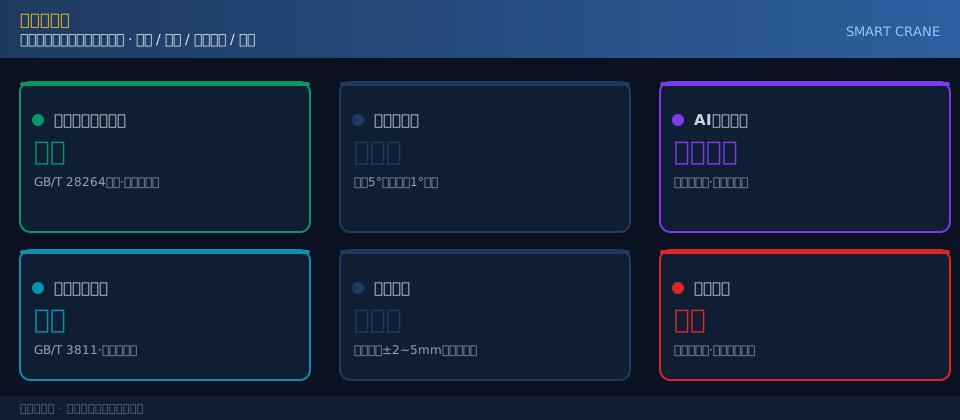
Only Two of Six Smart Crane Features Are Mandatory by Standard
Let's state the conclusion up front: of the six commonly marketed "smart features," only two are backed by mandatory standards — the Safety Monitoring and Management System and overload limiting protection. Without them, the crane won't pass inspection.
The Safety Monitoring and Management System, governed by GB/T 28264-2017, has a clearly defined scope: it is mandatory for large-tonnage machines, including bridge cranes above 200 t and gantry cranes above 100 t. The system collects and records parameters such as lifting capacity, torque, lifting height, travel, and work duty classification, functioning as a data-recording configuration that inspection bodies are required to verify.
The Overload Limiter, governed by FEM 1.001 and TSG 51-2023 Crane Safety Technical Supervision Regulation, is a fundamental safety device on all electric cranes. It triggers an alarm when the load reaches a certain percentage of rated capacity and cuts the hoisting circuit in the event of overload. This was standard equipment long before the "smart" concept gained traction — today, many manufacturers simply rebrand it as "intelligent overload protection." Same substance, different label.
The remaining four features — anti-sway, precise positioning, AI visual inspection, and digital twins — are not mandated by any standard. Whether they're worth the investment or a waste of money depends entirely on your specific operating conditions, not on the manufacturer's pitch. When Kelude takes on custom orders built to European standards, it quotes mandatory standard items and optional value-added features separately, letting the customer judge what's worth paying for.
Why Anti-Sway and Precise Positioning Justify the Cost: Real Differences in Handling Efficiency and Incident Rates
If two of the six features qualify as "non-mandatory but genuinely useful," they are anti-sway and precise positioning. Both directly impact handling efficiency and safety, with returns that are visible and quantifiable.
Anti-sway control uses frequency inverters and sensors to detect the load's swing angle in real time and compensates by adjusting trolley and hoist speeds. On older cranes without anti-sway, the load can easily swing 5° or more by the time it reaches its target position. The operator has to wait for the swing to settle before lowering the hook, wasting ten-plus seconds per lifting cycle just on "waiting for the sway to stop." With variable-frequency anti-sway, the swing angle can be held to within 1°, allowing the hook to be lowered essentially on the first attempt.
Precise positioning is the prerequisite for automation. Traditional manual positioning by the operator's eye carries errors on the order of tens of millimeters. With encoders, laser distance measurement, or gray-code bus positioning systems retrofitted, repeat positioning accuracy can reach ±5 mm or even ±2 mm. For production lines requiring automatic loading and unloading, or scenarios that need automatic docking with AGV/RGV systems, none of the downstream automation is possible without precise positioning.
The return on investment for these two features follows a clear path: anti-sway eliminates waiting time in every cycle, and precise positioning eliminates collisions and rework caused by manual alignment errors. When Kelude configures intelligent systems for custom European-standard machines, it lists anti-sway and precise positioning as "default required" — precisely because their value in real operating conditions stands up to scrutiny.
AI Vision and Digital Twins: Where They're Genuinely Needed vs. Where They're Overkill
The remaining two features are the most controversial and the most prone to being oversold. The value of AI visual inspection is highly dependent on the application scenario. In high-frequency risk situations such as wire rope broken wire detection, load shape recognition, and personnel intrusion alerts in the working area, AI vision genuinely fills gaps that manual inspection cannot cover. Standards such as ISO 24621 for fault diagnosis and ISO 23812 for anti-collision provide the technical framework for these applications.
But if your workshop is running a small-capacity overhead crane in the tens-of-tons range, handling a single material type across three shifts, everything AI vision can detect is already covered by two cameras and an audible and visual alarm. Paying extra for AI in that context doesn't add up.
Digital twins have been the most aggressively hyped feature in recent years. ISO 24619 Technical Requirements for Crane Digital Twins does provide a framework, but its real value lies in large-scale system scenarios: full life cycle management, predictive maintenance, and coordinated scheduling across complex production lines. For a single, independently operating mid-to-small-tonnage overhead crane, a digital twin essentially renders a 3D model of the equipment on a big screen — limited operational value, mostly for show.
The judgment criterion is simple: if a feature's value only materializes "someday when we implement MES or plant-wide digitalization," it's a gimmick for today. If it saves a minute or prevents a collision today, it's a genuine need. When Kelude conducts technical exchanges with customers, it starts by asking about tonnage, operating conditions, and whether automation integration is planned — and only then recommends which intelligent features make sense.
Four Compliance Pitfalls That Trip Up Smart Crane Buyers
Work through these four pitfalls and you won't be led astray by sales talk.
Pitfall one: treating "smart" as a reason to reduce safety devices. No matter how advanced the intelligent system, the dual-brake configuration at A6 or above required by FEM 1.001 and the various limit protections required by TSG 51-2023 are non-negotiable. Intelligence is additive, not substitutive.
Pitfall two: assuming that installing a safety monitoring system is all it takes. GB/T 28264-2017 requires a closed loop of "monitoring + recording + early warning" — not just putting a display screen on the wall. Many manufacturers deliver monitoring systems that collect data but don't trigger alarms, or alarm but don't interlock. They still fail inspection.
Pitfall three: confusing "having the feature" with "the feature meeting spec." Take anti-sway: suppressing the swing angle to 3° versus 1° are two entirely different propositions, requiring different frequency inverter configurations and commissioning expertise. Acceptance should be based on measured data, not marketing brochures.
Pitfall four: paying upfront for features you'll never use. Before purchasing, clarify your tonnage, operating conditions, and whether automation integration is planned — then decide which intelligent features are worth adding, rather than letting a salesperson bundle the full package. In Kelude's contracts, indicators such as anti-sway swing angle and positioning accuracy are written as measurable acceptance values, not marketing claims.
Quick Reference Table: Real vs. Hype in Six Smart Crane Features
Kelude Heavy Industry: Overhead & Gantry Crane Solutions
Kelude Heavy Industry is a professional manufacturer of industrial overhead cranes, gantry cranes, and electric hoists. We provide comprehensive material handling solutions for workshops, warehouses, and production lines, backed by a full engineering team and a modern manufacturing facility.
Complete Crane Engineering & Manufacturing Capabilities
Our in-house engineering department handles every stage of your project—from structural design and finite element analysis to fabrication, assembly, and on-site commissioning. We deliver cranes built to your exact specifications, ensuring reliable performance and long service life.
We offer a wide range of crane types, including single-girder and double-girder overhead cranes, gantry cranes, and specialized explosion-proof or low-headroom configurations. Every crane is designed and manufactured in compliance with international standards such as FEM 1.001, ISO 12480-1, and IEC 60204-32.
Key Crane Components & Hoist Technology
We manufacture all critical crane components in-house: end carriages, crane runways, trolleys, and wire rope hoists. Our electric hoists feature a compact design, high efficiency, and low noise operation. Optional features include variable frequency drives (VFD), anti-sway control, and remote radio control.
For demanding applications, we provide explosion-proof hoists and cranes certified for hazardous environments. Our engineering team can also integrate smart monitoring systems for load monitoring, overload protection, and predictive maintenance.
Customized Gantry & Special-Purpose Cranes
Our gantry cranes are available in full-gantry, semi-gantry, and portable configurations, with capacities ranging from light-duty workshop models to heavy-duty steel mill units. We also design special-purpose cranes for specific industries, including foundries, precast concrete plants, and shipyards.
All gantry cranes are engineered with a rigid structure, precise travel mechanisms, and reliable safety devices. We can supply cranes with either a single girder or double girder design, depending on your span and lifting capacity requirements.
Global Installation, Commissioning & After-Sales Support
Our service team provides professional installation and commissioning services worldwide. We offer operator training, preventive maintenance programs, and a global spare parts supply network to minimize downtime and extend the lifespan of your equipment.
With decades of experience and hundreds of successful installations across the United States and Europe, Kelude is a trusted partner for safe, efficient, and cost-effective material handling solutions.
| Smart Function | CorrespondenceStandard | Mandatory (Yes/No) | applicable working conditions | Actual Value | Determination |
|---|---|---|---|---|---|
| safety monitoringManagement | GB/T 28264 Safety Monitoring and Management System-2017 | large tonnageMandatory (Yes/No) | 200toverhead type/100tgantry typeand Above | Data Traceability、Inspection Compliance Requirement | Inspection Compliance Requirement |
| overload limitingProtection | FEM 1.001 Crane Design Standard、TSG (Special Equipment Safety Technical Regulation) 51 Safety Technical Specification for Special Equipment | Mandatory for All Models | Allelectric crane | Basic Safety Baseline | Inspection Compliance Requirement |
| Anti-Sway Control | Variable Frequency Speed Control GB/T 12668 | No | Frequent Handling、Long Sling | sway angle5°Overlap Above1°Within | High-Value |
| Precise Positioning | Non-Mandatory | No | automationloading and unloading、AGV (Automated Guided Vehicle)Docking/Interface | ±2~5mmRepetitivePositioning | High-Value |
| AI visual inspection | ISO 24621/23812Framework | No | Wire Rope Inspection、Human-Machineanti-collision | Manual AssistanceInspectionBlind Zone | Application-Dependent |
| Digital Twin | ISO 24619Framework | No | lifecycle、Multi-Crane Dispatching | System-Level Value | Majorityoperating conditionsGimmick |
| Unattended Operation | safety interlockRelevant | No | High-Risk/Harsh Environment/Continuous operation | Labor Saving、Risk Reduction | Conditional Value |
Balancing Smart Features with Compliance Requirements
| Conflict Scenario | StandardArequirements | StandardBrequirements | Engineering Recommendation |
|---|---|---|---|
| Intelligent System vs safety device | FEM 1.001 Crane Design StandardrequirementsDouble Brake | intelligent controlElectronic Speed Limiting Capability | Intelligent Enhancement,safety deviceNo Reduction |
| MonitoringClosed-Loop System | GB/T 28264 Safety Monitoring and Management Systemrequirementsearly warninginterlock | Some Solutions Only Display, Not...interlock | According to28264Closed-Loop SystemAcceptance |
| Anti-swayAccuracy | No Mandatory Value | Manufacturer1° | AcceptanceMeasured Valuesway angleContractual Commitment |
| Data Interface | ISO 24619requirementsOpen Interface | Proprietary Protocol by Some Manufacturers | ExplicitrequirementsOpenOPC UA/API |
Six Compliance Checks Before You Buy
📋
Check Standard Coverage
Confirm whether your tonnage falls under the mandatory GB/T 28264 scope.
🛑
Verify Dual Brakes
Does the A6 or higher configuration include dual brakes per FEM 1.001?
🔒
Confirm Limit Switches
Are all required limit protections per TSG 51 in place?
📡
Check Monitoring Loop
Are alarms interlocked and operational data fully logged?
🎯
Demand Measured Anti-Sway Data
Base acceptance on measured sway angle data, not brochure claims.
🔌
Check Open Interfaces
Does the smart system support OPC UA/API integration?
Smart Crane Feature Options: FAQ
Q: What are the real advantages of a smart crane over a conventional one?
A: The core differences come down to three areas: safety monitoring with data logging, anti-sway control, and precise positioning. Safety monitoring helps large-tonnage models meet the mandatory GB/T 28264 requirements and keeps a record of operational data. Anti-sway control reduces load swing from over 5° to under 1°, cutting loading and unloading wait times. Precise positioning enables repeatable alignment within ±2–5 mm, supporting automated docking. Other features like AI vision and Digital Twin are scenario-dependent—their value varies with the operating conditions.
Q: Which cranes are legally required to have a Safety Monitoring and Management System?
A: Under GB/T 28264-2017, large-tonnage models—such as bridge cranes above 200 t and gantry cranes above 100 t—fall within the mandatory scope. Additionally, TSG 51-2023 sets out clear inspection requirements for safety protection functions like safety monitoring and overload limiting. While smaller-tonnage cranes are not legally required to have these systems, retrofitting safety monitoring helps with operational data traceability and device management.
Q: With a limited budget for a smart crane, which features should I prioritize?
A: Start with the two mandatory essentials: the Safety Monitoring and Management System and overload limiting protection. These are tied to inspection qualification and your safety baseline. If budget allows, add anti-sway control and precise positioning next—they directly improve handling efficiency and automation level. Leave AI vision and Digital Twin for last; invest in them only if you've confirmed a specific pain point in your operations that they address.
Q: Why is Digital Twin often considered a gimmick for most small and mid-sized factories?
A: Digital Twin delivers value only in system-level scenarios like full life cycle management, Predictive Maintenance, and collaborative scheduling across multiple cranes. A single overhead crane in a small or mid-sized plant neither generates enough data to feed a meaningful model nor needs cross-equipment scheduling. In such cases, the 3D dashboard is mostly for show. For these operations, investing in anti-sway control and precise positioning offers a much more direct return.
There is no one-size-fits-all answer to smart crane features—only the answer that fits your operation. Get the mandatory items right, weigh the value-adding features carefully, and defer the gimmicks. That's how you make every dollar count.
