

Crane Fleet Scheduling: From Rule-Based to Reinforcement Learning
📋 Key Summary
Crane group scheduling is moving from preset rules and heuristic algorithms toward reinforcement learning. Rule-based scheduling is simple and explainable but rigid; heuristics deliver better results but require manual tuning; reinforcement learning derives adaptive policies from environmental feedback, at the cost of training difficulty and limited explainability. This article compares the three approaches across efficiency, robustness, explainability, and implementation cost, and pinpoints where reinforcement learning-based scheduling is headed next.
📌 Where Each Approach Fits
Rule-based scheduling assigns tasks using preset logic such as first-come-first-served or nearest-crane allocation. The logic is transparent but struggles to adapt to dynamic changes.
Heuristic algorithms—genetic algorithms, ant colony optimization, and similar—search for near-optimal schedules. They outperform rule-based methods but rely heavily on experience-based parameter tuning.
Reinforcement learning lets a scheduling agent learn optimal policies through trial and error in the operating environment, adapting to dynamic conditions on its own. It trades explainability for adaptability—and represents the natural next step in group scheduling.
Crane group scheduling is undergoing a fundamental shift—from human-defined rules to machine-learned decisions. A decade ago, overhead cranes followed preset rules to queue and execute tasks. Today, heuristic algorithms are widely deployed, and reinforcement learning is pushing scheduling toward the next leap: learning directly from the environment.
This evolution is not cosmetic. The source of scheduling decisions has fundamentally changed. The comparison below lays out the three approaches side by side to see how far reinforcement learning can actually go.
From Rules to Heuristics to Reinforcement Learning
Rule-based scheduling is the first generation. First-come-first-served, nearest-crane allocation, and priority ordering are hard-coded into the system. The logic is transparent and execution is stable, but these rules often fail to respond when task volumes fluctuate or equipment breaks down unexpectedly.
Heuristic algorithms represent the second generation. Genetic algorithms and ant colony optimization search the solution space for better schedules, improving makespan and equipment utilization over rule-based methods. The catch: parameters must be tuned through trial and error, and a new operating scenario often means retuning from scratch.
Reinforcement learning is the third generation. Instead of relying on manually preset rules, the scheduling agent learns policies through repeated interaction with the environment—receiving rewards for good decisions and adjusting accordingly. It adapts to changing operating conditions in real time. The trade-off is explainability for adaptability. Kelude Heavy Industry has already built hands-on reinforcement learning expertise in anti-sway control, from PPO to SAC, and ISO 24617, the standard for intelligent control systems for cranes, provides the technical framework for intelligent control. Scheduling is a natural extension of this technical route.
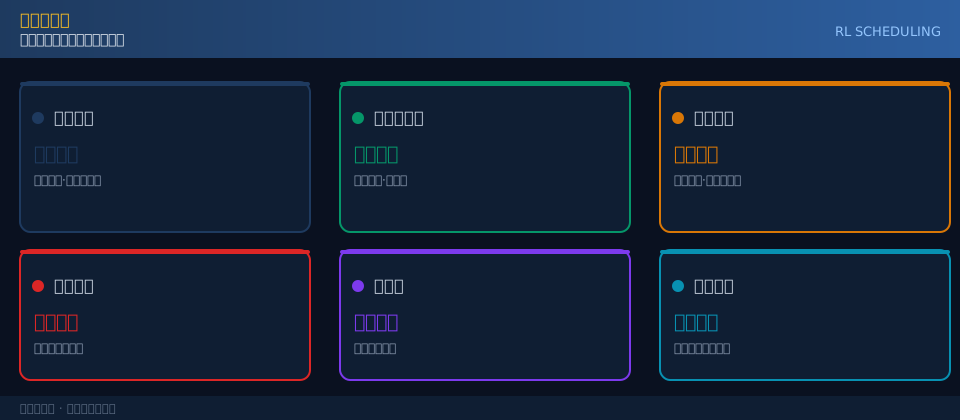
Side-by-Side Comparison: Efficiency, Robustness, Explainability, Cost
| Comparison Parameter | Rule-based Scheduling | Heuristic Algorithm | reinforcement learning | Decision Source | implementation cost |
|---|---|---|---|---|---|
| Scheduling Efficiency | Fair | Good | Near-optimal | Environmental Feedback | High |
| Robustness | Poor | Medium | Strong | Adaptive Dynamic | High |
| explainability | Strong | Medium | Weak | Strategy Opacity | Medium |
| Deployment Barrier | Low | Medium | High | Training Environment Required | High |
Choosing a Scheduling Method: A Scenario-Based Approach
No single scheduling method is inherently superior—the right choice depends on the complexity and dynamism of your operating environment.
For facilities with limited equipment, predictable task flows, and minimal variability, rule-based scheduling is sufficient. It is simple, reliable, and easy to maintain. When equipment fleets grow and tasks become more complex but operating conditions remain relatively stable, heuristic algorithms deliver the best return on investment—moderate implementation effort with solid results.
Reinforcement learning earns its keep in environments with large equipment fleets, dynamic task arrivals, and the need for real-time responses to disruptions. Its adaptive capability justifies the training cost in these high-variability settings. At Kelude, we assess the degree of operational dynamism first, then determine the appropriate level of scheduling sophistication—we don't adopt new technology for its own sake. For multi-crane coordination, the data access system can reference ISO 24619, the IoT interface specification for cranes.
Common Pitfalls in Deploying Reinforcement Learning
Misconception 1: Expecting RL to work magic from nothing. The performance ceiling of reinforcement learning is set by the quality of the training environment. If the environment model doesn't accurately reflect real-world conditions, the learned policy will fail on the shop floor. Training environments must closely mirror actual operating conditions.
Misconception 2: Overlooking explainability. Reinforcement learning decisions are notoriously difficult to interpret—it's hard to articulate exactly why a particular schedule was chosen. In production scheduling, where accountability matters, this opacity is a genuine concern. A pragmatic approach is to keep rule-based logic as a safety net: RL drives the primary decisions while rules provide a fallback layer.
Misconception 3: Attempting a big-bang replacement. Reinforcement learning should be introduced incrementally. Run it in parallel with existing rule-based or heuristic methods, conduct comparative verification, and only gradually transition control once the RL system proves its reliability. Kelude follows this disciplined path—parallel validation first, then phased adoption—when upgrading scheduling algorithms.
Three Scheduling Methods at a Glance
| Method | Principle | Advantage | Limitation | Application Scenarios |
|---|---|---|---|---|
| Rule-based Scheduling | Predefined Rules | Transparent & Stable | Rigid | Simple Regular Scenarios |
| Heuristic Algorithm | Search for Near-optimal | Superior Performance | Parameter Tuning Required | Complex Stable Scenarios |
| reinforcement learning | Trial-and-error Learning | Adaptive Dynamic | Hard to Train & Unexplainable | Dynamic Variable Scenarios |
FAQ: Reinforcement Learning for Crane Scheduling
Q: What is the fundamental difference between reinforcement learning scheduling and heuristic algorithms?
A: Heuristic methods rely on manually designed search rules to find near-optimal solutions. Parameters are tuned based on experience, and re-tuning is required when the scenario changes. Reinforcement learning, by contrast, does not presuppose search rules. Instead, the scheduling agent learns a policy through trial and error in its environment, using reward feedback to adapt to dynamic operating conditions. The key difference lies in where decisions come from: one is a human-designed algorithm, the other is a policy the machine learns from its environment.
Q: Which scheduling method should be used for a fleet of overhead cranes?
A: It depends on the complexity and dynamism of your operating conditions. With a small number of cranes and routine tasks, rule-based scheduling is sufficient. For larger fleets with complex but stable task patterns, heuristic algorithms offer the best cost-benefit ratio. Reinforcement learning is worth the investment only when you have many cranes, highly dynamic task arrivals, and the need to respond to disruptions in real time. Don't adopt new technology for its own sake—the scheduling method should match the complexity of the scenario. Applying reinforcement learning to a simple environment is simply wasteful.
Q: What is the biggest risk in deploying reinforcement learning for scheduling?
A: Poor explainability and inaccurate training environments. Reinforcement learning cannot clearly explain why it makes a particular scheduling decision, which is a concern in operations where accountability matters. That's why rule-based fallbacks should always be kept in place. If the training environment is not modeled accurately, the learned policy will fail when applied to the real workshop. Deployment should be gradual—run the system in parallel, conduct comparative verification, and only take over control once it proves reliable. Never replace an existing system in one step.
Q: Why is reinforcement learning considered the next step for fleet scheduling?
A: Because scheduling problems are shifting from static to dynamic. Random task arrivals, unexpected equipment failures, and fluctuating takt time on the production line are dynamic changes that rule-based and heuristic methods struggle to handle gracefully. Reinforcement learning, on the other hand, is naturally suited to learning adaptive policies in dynamic environments. This is not a linear improvement in performance—it represents a paradigm shift in decision-making, from human-defined rules to machine-learned policies.
For a closer look at the engineering implementation of scheduling algorithms, see Overhead Crane Fleet Scheduling Algorithms: Engineering Implementation of Multi-Crane Collision Avoidance and Task Allocation.
The next step for reinforcement learning in scheduling lies not in the algorithms themselves, but in how well they align with real-world operating conditions. Kelude Heavy Industry is committed to rule-based fallbacks, parallel verification, and gradual system replacement—turning reinforcement learning from a concept into reliable, engineered practice.
