

Smart Crane Energy-Saving Technology & Green Manufacturing Solutions
Why Are Overhead Cranes Such Major Energy Consumers?
Overhead cranes are among the most frequently operated and power-intensive equipment in any industrial facility. A 50t general purpose bridge crane, for instance, features a hoisting motor rated at 90kW — at full load, it consumes as much electricity as 40 household air conditioners running simultaneously. Industry statistics show that lifting equipment accounts for 12%–18% of total energy consumption in manufacturing plants, making it a critical area for energy management that cannot be overlooked.
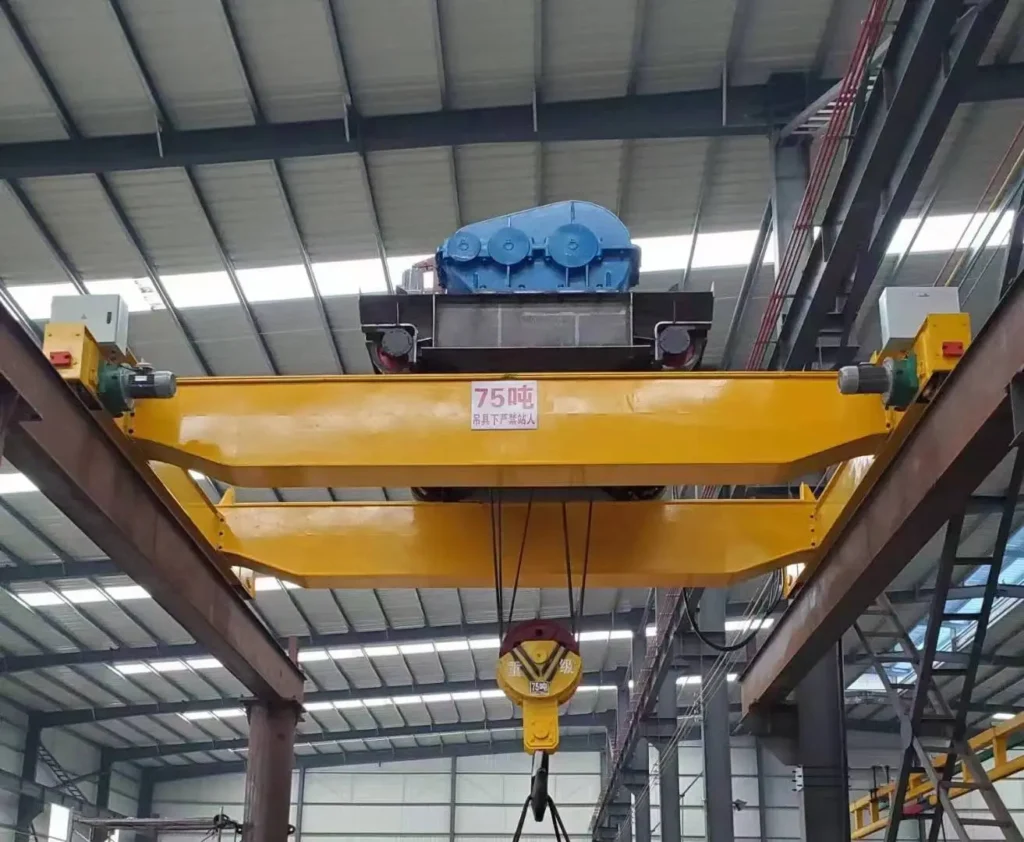
▲ Energy-efficient smart cranes in a green manufacturing facility
Five Proven Energy-Saving Technologies for Cranes
1. Regenerative Variable Frequency Drive (VFD)
In conventional cranes, braking resistors dissipate energy as heat during lowering and braking operations. With regenerative VFD technology, braking energy is converted back into electricity and fed into the power grid through a regenerative unit, achieving a recovery efficiency of over 95%. In applications with frequent lifting and lowering cycles, recovered energy can account for 25%–40% of total energy consumption.
2. Lightweight Structural Design
Through finite element analysis (FEA) optimization and the use of high-strength steel, crane dead weight can be reduced without compromising strength or stiffness. For every 1 ton of dead weight eliminated, the hoisting motor power can be reduced by approximately 3kW, saving roughly 15,000 kWh per year. Taking a 50t bridge crane as an example, optimized design can reduce dead weight by 15%–20%.
3. Smart Energy Management Systems
By collecting real-time data on motor current, lifting capacity, and travel distance, a per-crane energy baseline can be established. The system automatically identifies energy anomalies and provides optimization recommendations. For example, when the system detects a crane running idle for extended periods, it automatically sends an alert or switches the unit to standby mode.
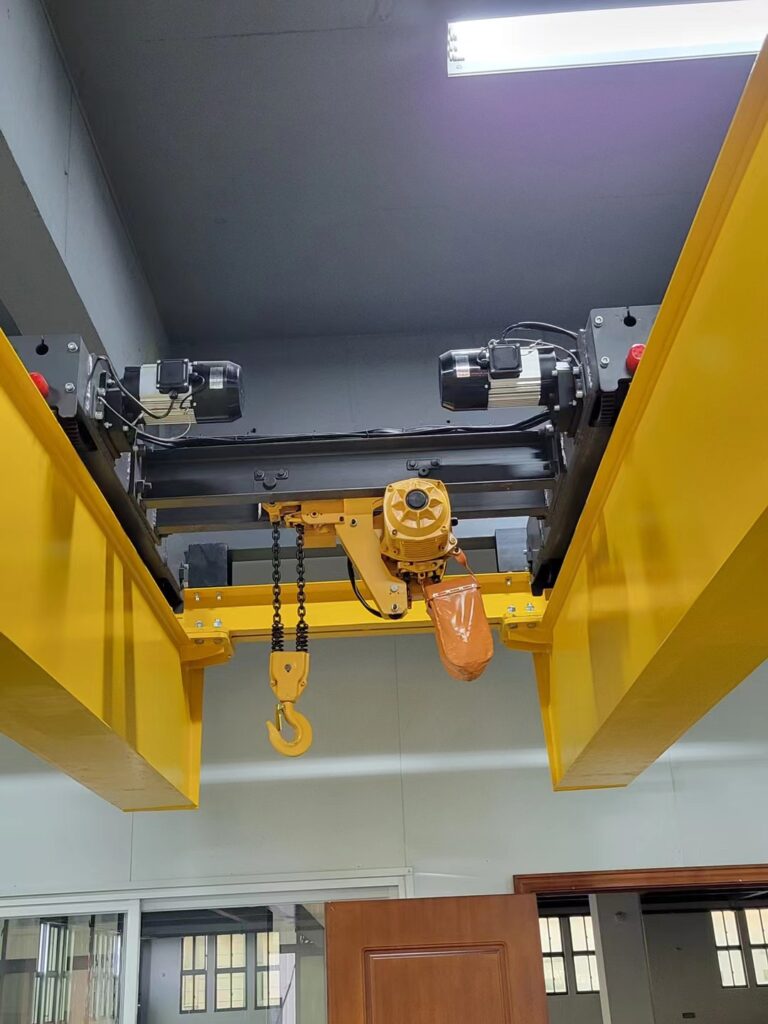
▲ Real-time monitoring dashboard of the smart energy management system
4. Dual-Motor Drive with Power Matching
For heavy-capacity cranes, a dual-motor drive configuration replaces the single-motor setup, allowing the system to engage one or both motors based on load requirements. Single-motor operation handles light loads, while dual-motor synchronized operation kicks in for heavy loads — delivering dynamic power matching and overall energy savings of 15%–25%.
5. LED Smart Lighting and Auxiliary Systems
Upgrading crane lighting systems from traditional halogen lamps to smart LED fixtures with occupancy and ambient light sensors enables automatic on/off control — lights turn on when personnel are present and off when they leave. This alone can save approximately 3,000 kWh per crane per year.
Green Manufacturing and Carbon Reduction in Cranes
Under the "dual carbon" strategy framework, green manufacturing for cranes spans the entire lifecycle:
- Production: Water-based eco-friendly coating processes reduce VOC emissions by 90%
- Operation: Full electrification replaces diesel power, achieving zero carbon emissions
- End-of-life: Metal structure recycling rate exceeds 95%, and motors and electrical controls can be refurbished for reuse
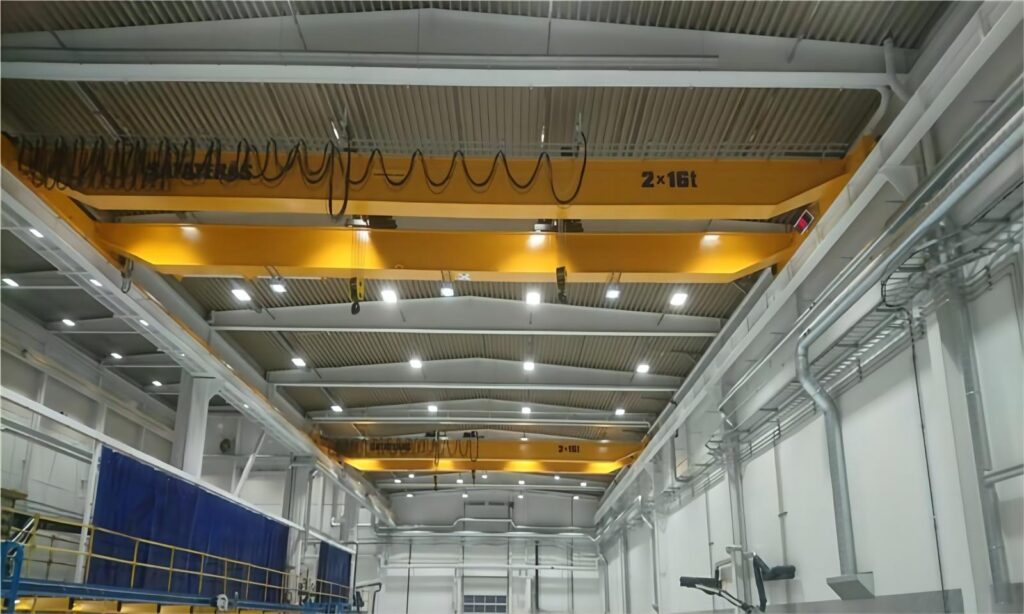
▲ Energy-efficient cranes in a green smart manufacturing plant
Kelude Green Crane Solutions
Kelude Heavy Industry's full product line has earned ISO 14001 Environmental Management System Certification and China Energy-Saving Product Certification. Every crane comes standard with three energy-saving modules—regenerative VFD, smart standby, and energy consumption detection—helping manufacturers accelerate their Green Manufacturing transition.
Energy-Saving Crane Technology: FAQs
Q: What energy-saving technologies do Smart Cranes use?
A: Key technologies include Variable Frequency Speed Control (saving 20%–40% energy), regenerative braking that feeds power back to the grid during Lowering (recovering 10%–30%), lightweight design that cuts Steel usage by 10%–20%, Permanent Magnet Synchronous Motors replacing asynchronous motors (5%–10% efficiency gain), and smart scheduling that reduces no-load operation.
Q: How are crane Energy Efficiency Classes determined?
A: Reference standards include GB 18613 for three-phase asynchronous motor efficiency limits and ISO 50001 for energy management systems. There is currently no dedicated national standard for crane system efficiency assessment; evaluation typically covers motor efficiency, drive train efficiency, and operational management.
Q: Which standards govern Green Manufacturing?
A: Green Manufacturing follows GB/T 36132 for green factory evaluation, GB 18613 for energy efficiency, and ISO 50001 for energy management. Crane lightweight design is verified for Strength per ISO 4301 (formerly ISO 4301).
