

Marine & Offshore Crane Selection Guide: Platform, Deck, LXD/DXT
Marine and offshore cranes fall into four main categories—offshore platform cranes, marine deck cranes, deck cranes, and accommodation ladder winches—each serving distinct applications: oil and gas production, cargo handling, deck operations, and personnel transfer. These machines differ fundamentally from land-based cranes in corrosion protection rating, explosion-proof requirements, dynamic load factors, and classification society certification.
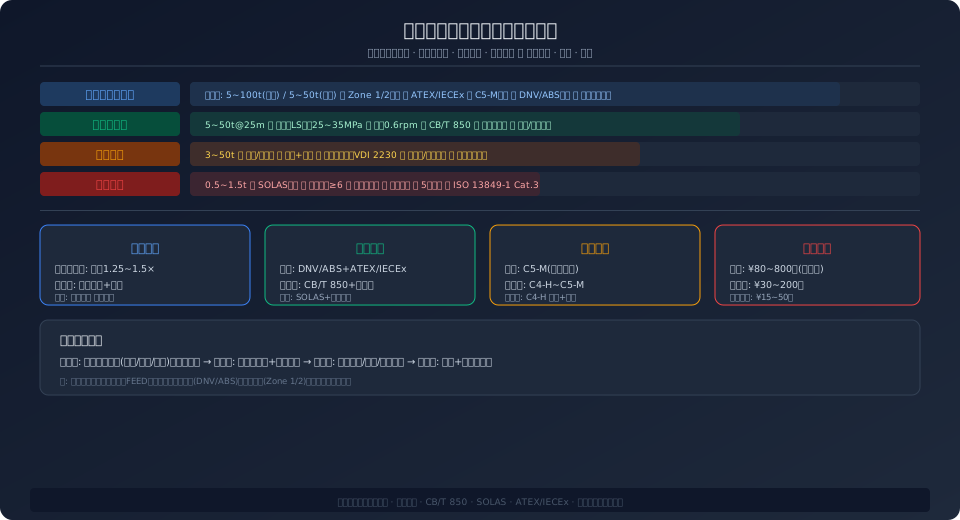
The demands placed on lifting equipment in offshore engineering and shipbuilding far exceed those of typical industrial applications. Salt-spray corrosion, vessel motion, wave-induced heave, hazardous-area zoning, and confined deck space—each factor pushes the design envelope further. Drawing on years of offshore project experience, Kelude Heavy Industry offers a systematic breakdown of the technical characteristics, application scenarios, and selection criteria for these four crane types, helping engineers quickly identify the right lifting solution during project planning.
From a global market perspective, the offshore crane sector is dominated by European players such as MacGregor (Finland), TTS (Norway), Heila (Italy), and Liebherr (Germany/Austria). The high entry barriers stem primarily from classification society certification requirements and track-record expectations—shipowners typically demand at least five successful reference installations of similar scope. Domestic manufacturers typically enter the market through smaller deck cranes and accommodation ladder winches, building certification credentials before advancing into offshore platform cranes. According to Offshore Energy and Clarksons Research data, the global market for new offshore platform crane installations is projected at approximately $3.2 billion in 2025, with a compound annual growth rate of 4.8%. Growth is driven by three key factors: offshore wind installation (particularly in Asia-Pacific and the North Sea), aging platform retrofits (North Sea and Gulf of Mexico), and deepwater oil and gas development requiring ultra-large cranes (100t+). China's shipbuilding industry has expanded rapidly in FPSO construction and offshore wind installation vessels, creating growing demand for domestically manufactured marine cranes—a strategic window for Chinese crane manufacturers to enter the offshore market.
The classification comparisons in this article for offshore platform cranes, marine deck cranes, deck cranes, and accommodation ladder winches are based on ISO 4301 Crane Design Standard as the technical benchmark, with classification society requirements referenced against TSG 51-2023 Safety Technical Specification for Special Equipment as the compliance baseline.
Offshore Platform Cranes: Primary Lifting Equipment for Oil & Gas Production
Offshore platform cranes are the core lifting equipment on offshore production platforms, drilling rigs, and FPSOs, handling drill pipe transfer, equipment module installation, and supply logistics. These cranes typically feature pedestal or gantry configurations equipped with wave compensation systems to counteract vessel heave motion. Lifting capacities range from 5t to 100t, with maximum working radii exceeding 50m.
In terms of design standards, offshore platform cranes primarily comply with three major frameworks: API Spec 2C (Specification for Offshore Pedestal Mounted Cranes), EN 13852 (Offshore cranes standard), and ISO 12483 (Technical requirements for offshore cranes). API 2C is the most widely applied standard in the international offshore oil and gas industry, providing detailed requirements for structural strength, safety factors, explosion protection class, and operator protection. Projects operating in Chinese waters must also satisfy CCS Rules for Classification of Mobile Offshore Units.
Corrosion protection is the foremost challenge for offshore platform cranes. The marine atmosphere's high salt concentration and humidity render the standard C4 corrosion protection level inadequate—most projects specify a C5-M high-durability coating system per ISO 12944, with zinc-rich epoxy primer (≥80μm), micaceous iron oxide intermediate coat (≥150μm), and polyurethane or polysiloxane topcoat (≥80μm), achieving a total dry film thickness of ≥320μm. Critical fasteners use 316L stainless steel or duplex stainless steel, and hydraulic lines are routed with stainless steel hard piping rather than rubber hoses.
Marine Deck Cranes: Workhorse Cargo Handling for Bulk Carriers & Multi-Purpose Vessels
Marine deck cranes are installed on the decks of bulk carriers, container ships, multi-purpose vessels, and heavy-lift ships for port cargo handling or ship-to-ship transfer operations at anchorage. The fundamental difference from land-based cranes lies in the dynamic environment: the crane must maintain load stability under vessel rolling (±5°), pitching (±2°), and heave motion, with the pedestal structure required to withstand additional inertial forces and overturning moments.
Modern marine deck cranes employ full hydraulic drive systems, with a diesel engine or motor driving the hydraulic pump station. Proportional multi-way valves control the three primary actuators: luffing cylinder, swing motor, and hoist winch. System working pressure typically ranges from 25 to 35MPa, with load-sensing variable displacement pumps to reduce energy consumption. Medium-capacity units (30–50t) have hydraulic oil tank capacities of approximately 800–1200L, fitted with water-cooled or air-cooled radiators to maintain oil temperature in the optimal 50–65°C range.
Safety systems on marine deck cranes include: load moment limiter (monitoring the ratio of actual load to rated load, with a 90% pre-warning threshold and automatic shutdown at 100%), dual-stage hoisting height limiter (deceleration plus stop), luffing angle limiter (minimum/maximum working radius protection), and an emergency manual pump for controlled load lowering in the event of hydraulic system failure. Per CB/T 850 requirements, the static load test is conducted at 1.25 times the rated load, and the dynamic load test at 1.1 times.
Deck Cranes: Versatile Lifting Solutions for Workboats & Offshore Support Vessels
Deck cranes are widely deployed on pipe-lay vessels, diving support vessels (DSVs), ROV support vessels, offshore wind installation ships, and ocean research vessels. Unlike marine deck cranes, deck cranes handle far more diverse work scopes—from subsea equipment deployment and submarine pipeline laying to wind turbine blade installation—demanding exceptional positioning accuracy, micro-motion control, and deepwater compensation capability.
The defining feature of deck cranes is the knuckle boom configuration. Compared to straight-boom marine deck cranes, knuckle boom cranes occupy minimal deck space when folded (collapsible to 3–4m height) while achieving working radii of 15–30m when fully extended. Large offshore deck cranes (from manufacturers such as MacGregor, TTS, and Heila) are available with active heave compensation (AHC) systems. These systems use a motion reference unit (MRU) to detect vessel heave acceleration in real time, commanding the winch to pay in and pay out wire rope at high speed to counteract heave displacement, achieving compensation accuracy of ±5cm in sea state Hs=3m.
Slewing bearing design represents another critical technical challenge for deck cranes. Given the long boom length and large load eccentricity (maximum overturning moment can reach several thousand kN·m), slewing bearings typically use three-row roller or combined ball-roller configurations. Bolt preload must be precisely calculated per VDI 2230, verified in three stages: minimum clamping force, working load, and fatigue strength. Bolts are manufactured from 10.9 or 12.9 grade alloy steel with Dacromet coating for marine corrosion resistance.
Accommodation Ladder Winches: Small but Critical Personnel Safety Equipment
Accommodation ladder winches are statutory safety equipment on vessels, used to deploy and recover the accommodation ladder for pilot boarding, crew access, and port inspector transit. SOLAS (International Convention for the Safety of Life at Sea) imposes mandatory requirements on the design, testing, and maintenance of these winches—which explains why, despite their modest lifting capacity (typically 500–1500kg), their safety standards and redundancy design rival those of much larger marine deck cranes.
The operating principle of an accommodation ladder winch differs fundamentally from that of a construction hoist: rather than simply lifting a load, it controls the ladder's inclination angle (typically 0° to 55°) by paying in or paying out wire rope. The winch drum must be fitted with an independent mechanical locking device and a manual release mechanism. The wire rope safety factor is taken as ≥6 per ISO 2408 (well above the ≥3.5–5 typical for general-purpose cranes), with rope termination using a wedge socket plus a minimum of three rope clips as a redundant arrangement.
Modern accommodation ladder winches feature dual-circuit hydraulic drive systems with redundancy: the primary circuit is controlled by a manual directional valve, while the emergency circuit uses an accumulator or manual pump to recover the ladder in the event of power loss. The electrical control system must pass classification society type approval testing (including inclination tests at ±22.5°, vibration tests from 2 to 13.2Hz, and electromagnetic compatibility tests), with the control box rated to at least IP56. All major classification societies (CCS, DNV, ABS, LR, etc.) maintain dedicated inspection rules for accommodation ladder winches.
| Comparison Parameter | offshore platform crane | Marinemarine deck crane | deck crane | accommodation ladder winch |
|---|---|---|---|---|
| Typical Lifting Capacity | 5~100t | 15~150t | 5~50t | 500~1500kg |
| Working Radius | 15~50m | 18~36m | 8~30m | — |
| Drive Type | Electro-hydraulic/Diesel Hydraulic | Electro-hydraulic Drive | Electro-hydraulic Drive | Hydraulic/Manual |
| Anti-corrosion Grade | C5-M/ISO 12944 | C4/C5-M | C4/C5-M | C4 |
| Explosion-proof Requirement | ATEX Zone 1/2 | Generally Not Required | Generally Not Required | Not Required |
| Core Standard | API 2C/EN 13852 Offshore cranes standard | CB/T 850/851 | EN 13852 Offshore cranes standard/DNV | SOLAS (Australian Standard)/ISO 2408 Steel wire ropes for general purposes — Requirements |
| wave compensation | AHC/PHCOptional | Generally Not Equipped | AHCCommon | Not Applicable |
| Classification Society Certification | CCS/DNV/ABS (British Standard) | CCS/DNV/ABS (British Standard) | CCS/DNV/ABS (British Standard) | CCS/DNV/ABS (British Standard)/LR |
| Certification Dimension | CCSChina Classification Society (CCS) | DNVDet Norske Veritas (DNV) | ABS (British Standard)American Bureau of Shipping (ABS) | LRLloyd's Register (LR) |
|---|---|---|---|---|
| Design Review | Drawings+Calculation Notes | Drawings+FEAReports | Drawings+Calculation Notes+FMEA | Drawings+Calculation Notes |
| Materials Certification | Factory Approval+heat number | Factory Approval+EN 10204 3.1 | Factory Approval+traceable | Factory Approval+3.1Certificates |
| Welding Workmanship/Process | WPS+PQR | WPS+PQR+EN 1090 Execution of steel structures standard | WPS+PQR+AWS D1.1 | WPS+PQR+EN 1090 Execution of steel structures standard |
| Non-destructive testing | UT/MT/PT 100% | UT/MT/PT 100%+RTSpot Inspection | UT/MT/PT 100% | UT/MT/PT 100%+RT |
| Type Test | static load1.25×/dynamic load1.1× | static load1.25×/dynamic load1.1× | static load1.25×/dynamic load1.1× | static load1.25×/dynamic load1.1× |
| Plan Approval Period | 4~8Weeks | 6~12Weeks | 6~10Weeks | 6~10Weeks |
Marine Crane Selection Guide: Four Types Compared
When selecting a marine crane type, three core constraints must be defined upfront: the operating scenario (platform, bulk carrier, work vessel, or all vessels), the load characteristics (frequent handling, precise positioning, or personnel safety), and classification society requirements (class rules and applicable standards). The simplified decision chain below walks through the typical selection logic:
①Oil & gas production platforms — Opt for offshore platform cranes designed to API Spec 2C, fitted with wave compensation, and with explosion protection class determined by the hazardous area classification.
②Bulk carriers / multipurpose vessels — Choose marine deck cranes with hydraulic drive, designed to CB/T 850, with particular attention to working radius and deck space footprint.
③Pipe-lay vessels / DSVs / wind turbine installation vessels — Select knuckle boom deck cranes with active heave compensation (AHC); positioning accuracy is the critical performance indicator.
④All SOLAS-regulated vessels — Accommodation ladder winches are mandatory, with dual-circuit hydraulic redundancy, a wire rope safety factor of ≥6, and type approval from the relevant classification society.
Marine Crane FAQ: Key Design & Certification Questions
Q: What are the biggest design differences between offshore platform cranes and land-based overhead cranes?
A: There are three key differences. First, the dynamic load factor — offshore platform cranes must apply a dynamic coefficient of 1.3–1.5 (per API 2C) to account for wave-induced additional dynamic loads, whereas land-based cranes typically use 1.1–1.3 per ISO 4301. Second, corrosion protection — offshore environments require at least C5-M (ISO 12944) with a total dry film thickness of ≥320 μm, while C3 is sufficient onshore. Third, explosion protection — on oil and gas platforms, hazardous areas are classified as Zone 1/2, and all electrical equipment must carry ATEX or IECEx certification.
Q: What is the typical working pressure for a marine deck crane hydraulic system, and what is the recommended oil temperature range?
A: The working pressure of a marine deck crane hydraulic system is typically 25–35 MPa, using piston variable displacement pumps with a load-sensing control system. For a medium-sized deck crane, the hydraulic oil tank capacity is approximately 800–1,200 L. Oil temperature should be maintained between 50–65°C; above 65°C an alarm triggers and the working speed is automatically reduced, and above 75°C the crane performs a forced shutdown. For cooling, medium and small cranes use air-cooled radiators, while large units are equipped with water-cooled plate heat exchangers.
Q: What is active heave compensation (AHC), and what compensation accuracy can be achieved?
A: Active heave compensation (AHC) uses a motion reference unit (MRU) to detect the vessel's heave acceleration in real time. After Kalman filtering, the system commands the winch motor to rapidly pay out or haul in the wire rope, counteracting the effect of vessel heave on the load position. In sea states with Hs = 3 m (significant wave height), typical compensation accuracy is ±5–10 cm. The system response time is typically <50 ms, with a winch dynamic response bandwidth of approximately 0.1–0.8 Hz. An accumulator bank is required to absorb instantaneous power peaks.
Q: How much do crane certification costs and lead times vary across the four major classification societies (CCS, DNV, ABS, LR)?
A: Certification costs vary significantly depending on crane type and capacity — a small accommodation ladder winch costs approximately $4,400–$7,400, a medium-sized deck crane $11,800–$22,200, and a large offshore platform crane $29,600–$59,200. In terms of lead time, CCS is typically the fastest at 4–8 weeks, while DNV, ABS, and LR generally take 6–12 weeks. The cost breakdown typically comprises: design review (30%–40%), factory inspection (20%–30%), type test witnessing (15%–25%), and certificate issuance (10%–15%). Final figures depend on the specific project contract.
Kelude has extensive design and manufacturing experience in the marine crane sector, offering end-to-end technical support from concept design through classification society certification. For project-specific solutions, please consult our engineering team.
