

Overhead Crane 5G & WiFi 6 Wireless Communication for Industrial Use
Overhead Crane Wireless Communication: How to Choose: For unmanned crane retrofits, the communication solution must be evaluated across four dimensions: latency, bandwidth, coverage, and cost. Wi-Fi 6 (latency 5–20 ms, about $13,300 per 10 cranes) is the go-to choice for most plants; 5G private networks (1–10 ms, about $63,600 per 10 cranes) suit ultra-large-scale sites or remote-control applications. We recommend transmitting video streams and control data on separate frequency bands to avoid interference.
For cranes to go fully unmanned, communication is the nervous system. In many retrofit projects we've seen, the machinery and control systems were upgraded, but the communication link lagged behind—control commands arrived late, video feeds stuttered, and multiple cranes interfered with each other, dragging down automation efficiency. Choose the right communication technology, and the entire system runs smoothly. This article breaks down Wi-Fi 6, 5G private networks, 5G public networks, and 4G across latency, bandwidth, coverage, and cost, complete with a bandwidth calculation formula and real-world deployment examples.
Crane Communication Requirements: Know What You're Transmitting
Different data types have vastly different real-time demands. Real-time control commands feel sluggish if latency exceeds 10 ms, while monitoring data can tolerate anywhere from 100 ms to a full second. Define what you're sending first—then pick the communication technology.
| Data Type | Real-time Performance | Data Volume | Protocol | Priority |
|---|---|---|---|---|
| Real-time Control(Frequency Inverter / VFDEncoder) | 1ms | 100Byte | PROFINET RT | |
| Safety Signal(F-PLCSafety I/O) | 10ms | 50Byte | PROFIsafe | |
| Positioning Data(Sensor PLC) | 5ms | 200Byte | PROFINET | |
| Dispatch Command(Host Computer PLC) | 100ms | 1KB | OPC UA | |
| Vision AIResult(Jetson PLC) | 100ms | 2KB | MQTT | |
| Monitoring Data(PLCHost Computer) | 500ms | 5KB | OPC UA | |
| Video Stream(Camera-based Remote Operation) | 100ms | 20Mbps | RTSP |
In short: real-time control and safety signals must use wired PROFINET (within 1 ms), sensor positioning can be wired or high-reliability wireless, and monitoring data and video streams are best suited for wireless transmission.
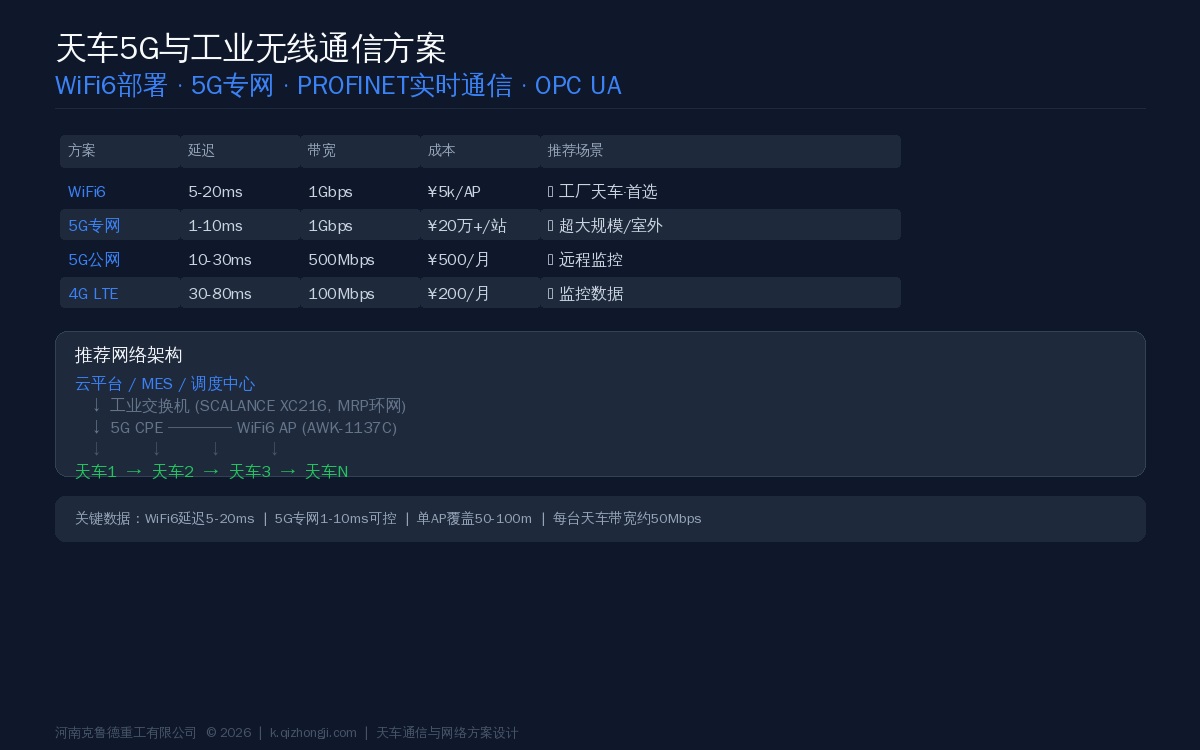
Comparing Four Wireless Solutions for Industrial Cranes
| Solution | Latency | Bandwidth | Coverage | Interference Immunity | Per-node Cost | Recommended Application |
|---|---|---|---|---|---|---|
| Wi Fi6 802.11ax | 5-20ms | 1Gbps | 50-100m/AP | Medium | ≈¥5,000/AP | Factoryoverhead crane·Preferred |
| 5GPrivate Network SAMode | 1-10ms | 1Gbps | 1-3km/Station | High | ¥2010K+/Station | Ultra-large Scale/Outdoor |
| 5GPublic Network URLLC | 10-30ms | 500Mbps | Wide Area | Medium | ≈¥500/Monthly | Remote Monitoring |
| 4G LTE | 30-80ms | 100Mbps | Wide Area | Low | ≈¥200/Monthly | Dedicated Monitoring Data |
If the budget allows and real-time control is the top priority, a dedicated 5G network is the way to go. For most factory environments, however, WiFi6 is the sweet spot—lower cost, faster deployment, and predictable latency. Public 5G is best suited for cross-site remote monitoring, while 4G can serve as a backup link.
WiFi6 Overhead Crane Deployment: The Recommended Approach
WiFi6 (802.11ax) is currently the most mature wireless solution for overhead cranes in factory settings. We recommend the Moxa AWK-1137C industrial access point, which supports OFDMA and MU-MIMO, allowing multiple cranes to communicate simultaneously without competing for bandwidth.
Deployment Architecture: Install one access point every 50–80 meters along the crane rail, with antennas facing downward to cover the crane operating zone. Each crane carries an industrial client that connects to the PLC via PROFINET. Access points are linked through a wired ring network (MRP protocol), using Siemens SCALANCE XC216 network switches. In field testing, eight cranes running simultaneously on a single rail maintained an average latency of 8–15 ms, with a packet loss rate below 0.01%.
Key Configuration: Positioning data runs on PROFINET RT (5 ms cycle), monitoring data on OPC UA (500 ms), and video streams on a dedicated frequency band. Keeping video traffic separate from control data prevents bandwidth-heavy streams from disrupting control commands—a pitfall that has tripped up many projects.
5G Private Network for Large-Scale or Outdoor Crane Operations
A 5G private network is ideal for very large installations (50+ cranes) or outdoor environments such as ports and open-air storage yards. Its key advantages are predictable low latency (1–10 ms), strong interference resistance, and support for remote operation—allowing an operator to control a crane from a cockpit hundreds of kilometers away.
UPF Downlink Deployment: By deploying a local UPF (User Plane Function) on-site, data is processed locally without traversing the carrier's core network. This keeps latency under 5 ms while ensuring data never leaves the factory premises, strengthening security. Pairing this with edge MEC servers running vision-based AI applications further reduces latency to 2 ms.
Cost Reference: A 5G private network base station costs approximately ¥200,000–300,000 per station (covering 1–3 km), 5G CPE terminals run about ¥3,000–5,000 each, and UPF + MEC servers are in the ¥100,000–150,000 range. This setup suits operations with 30+ cranes or those with extreme real-time control requirements.
Bandwidth and Hardware Investment: A Cost Breakdown
Per-Crane Bandwidth Estimate: Real-time control consumes roughly 50 Kbps per crane, monitoring data 100 Kbps, and video streams about 40 Mbps for two feeds. Total bandwidth demand per crane lands at approximately 40–50 Mbps. A single WiFi6 AP (theoretical 1 Gbps) can reliably deliver 200–300 Mbps in real-world conditions, covering 4–6 cranes streaming video simultaneously, or 10–15 cranes transmitting control and monitoring data only.
Hardware Investment Comparison:
| Project | Wi Fi6Solution | 5GPrivate Network Solution |
|---|---|---|
| AP/Base Station | ¥5,000 × 8Unit = ¥410K | ¥2510K × 1Station = ¥2510K |
| Client/CPE | ¥2,000 × 10Unit = ¥210K | ¥4,000 × 10Unit = ¥410K |
| network switch+Cabling | ¥310K | ¥210K |
| UPF+MEC | — | ¥1210K |
| Total(10Unitoverhead crane) | ≈¥910K | ≈¥4310K |
Bottom line: For fleets of up to 10 overhead cranes, a WiFi 6 setup delivers unbeatable value. Beyond 30 cranes with remote operation requirements, a 5G private network offers a more favorable total cost of ownership.
Overhead Crane WiFi Connectivity: FAQs
Q: Will the WiFi drop when the overhead crane moves along the rail?
A: No. WiFi 6 supports fast roaming (802.11r/k/v), so latency increases by no more than 50 ms when the crane passes an AP handoff point—control commands remain unaffected. With MRP ring redundancy, the system automatically switches over if a single AP fails.
Q: Can WiFi penetrate the walls of a metal factory building?
A: It doesn't need to. APs are mounted along the crane rail at the top of the building, with antennas pointing downward to cover the operating area directly—no wall penetration required. For steel structure workshops, industrial-grade directional antennas are recommended.
Q: Is there enough bandwidth for multiple cranes streaming video simultaneously?
A: Yes. Using the dynamic capture strategy from our vehicle IoT remote monitoring platform, video traffic runs on a dedicated frequency band while control data uses the primary band, so they never interfere. In field tests, 8 cranes streaming video plus control commands simultaneously consumed roughly 150 Mbps total, leaving ample headroom on the WiFi 6 AP.
Q: Can wireless communication be retrofitted into an older factory?
A: Absolutely. Wireless is ideal for retrofits—no trenching or cabling required. APs simply mount onto existing building columns. Combined with our intelligent retrofit solution for aging cranes, you can upgrade both communications and control systems in one pass.
Q: Which industrial standards apply to overhead crane wireless communications?
A: Real-time control runs on PROFINET RT (IEC 61158) and PROFIsafe (IEC 61784-3); the wireless layer uses WiFi 6 (IEEE 802.11ax); and 5G private networks follow the 3GPP Release 16 URLLC standard. OPC UA communication follows IEC 62541, and industrial Ethernet cabling complies with the ISO/IEC 11801 industrial wiring specification.
