

Overhead Crane Data Acquisition & Edge Computing
💡 An edge computing gateway is the backbone of overhead crane data connectivity to the cloud, delivering four critical capabilities: secure isolation, protocol conversion, local buffering, and store-and-forward data recovery. This guide provides a full hardware comparison table (Moxa / Siemens / Huawei / Jetson), an OPC UA data acquisition setup (80–120 variables per crane), real-world store-and-forward test results (600,000 records over 36 hours with zero loss), and cost estimates for three deployment scenarios.
Data only becomes valuable once it reaches the cloud—but getting it there safely and reliably from the crane's PLC is a step many teams overlook. Connecting the PLC directly to the internet is a security risk, running serial cables across the plant floor is impractical, and what happens when the network drops? An edge computing gateway solves all of this. Sitting between the overhead crane and the cloud platform, it reads PLC data, translates protocols, buffers locally, and resumes transmission after outages—making the entire data path industrial-grade reliable. This article walks through hardware selection, OPC UA data collection, protocol conversion, store-and-forward behavior, and deployment costs to show you exactly how to configure an edge computing gateway.
Why Overhead Cranes Need an Edge Gateway
Without an edge gateway, there are three common ways to push crane data to the cloud—each with its own drawbacks:
| Practice | Issue | Consequence |
|---|---|---|
| PLCDirect Internet Exposure | Security Risk | OT Network Exposure to Public Internet, Ransomware Attack Vector (e.g., Steel Plant Incident) |
| HMI/SCADA Read PLCData Relay | PCData Loss on System Crash | Monitoring Data Loss, Missed Alarms |
| Manual Report Export | Latency, Omission | Undetected Fault Precursors |
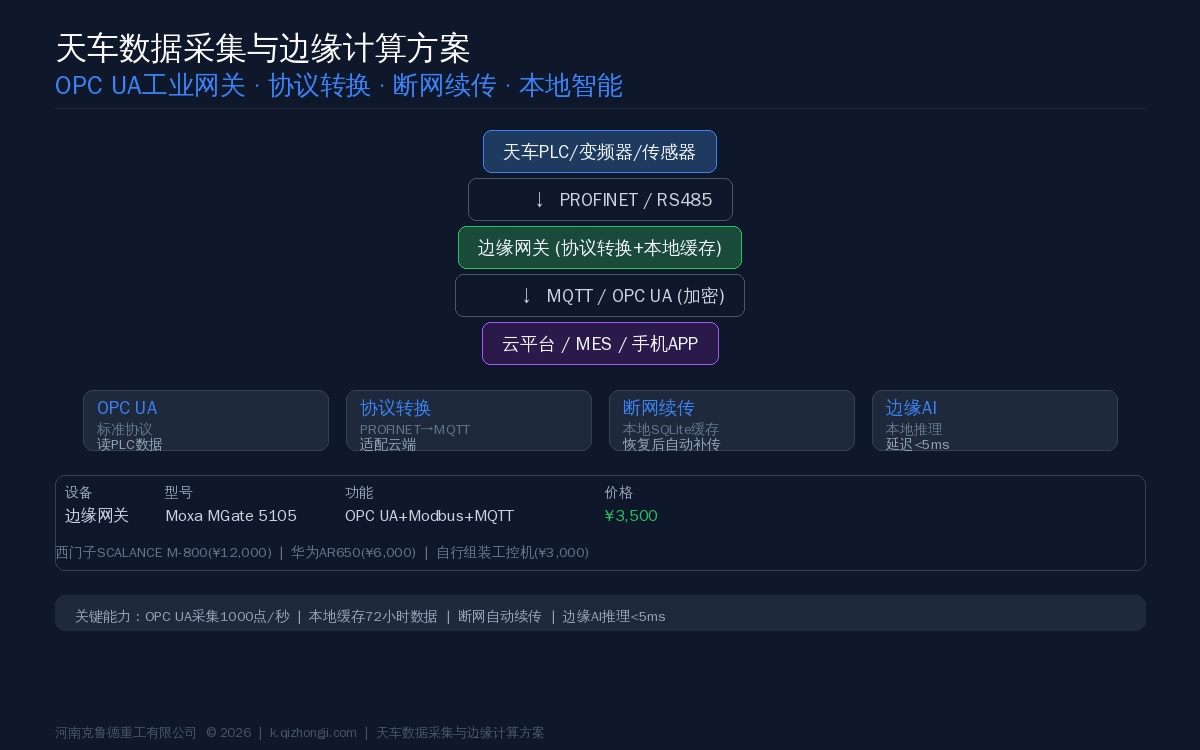
Edge gateways deliver four core capabilities: security isolation (keeping PLCs off the public internet), protocol conversion (PROFINET, MQTT, OPC UA), local data buffering (no data loss during 72-hour network outages), and edge AI (on-premise inference with sub-5ms latency).
Edge Gateway Hardware Selection Guide
| Model | Vendor | Core Functionality | Interface | Price | Recommended Use Case |
|---|---|---|---|---|---|
| MGate 5105 | Moxa | OPC UA+Modbus+MQTT | 2×GE, 2×RS232/485 | ¥3,500 | Standardoverhead crane·Best Value Option |
| SCALANCE M-800 | Siemens | PROFINETDirect Connection+OPC UA | 4×GE, PROFINET | ¥12,000 | S7-1500·Deep Integration |
| AR650 | Huawei | 5G+Industrial Router+Edge Computing | 4×GE, 2×RS485, Wi Fi6 | ¥6,000 | Wireless Scenario·Deep Integration5G |
| Jetson Orin NX | NVIDIA | Edge AIInference+Data Acquisition | USB3.0, M.2, GE | ¥5,500 | Vision Required AIProcessing L3/L4overhead crane |
| Self-Assemblyindustrial PC | — | Flexible Customization+Soft Gateway | On-Demand Configuration | ¥3,000 | Development Capability, Deep Customization Required |
Selection guide: For standard overhead crane monitoring, the Moxa MGate (¥3,500) offers the best value; if the crane PLC is a Siemens S7-1500 running PROFINET, the SCALANCE M-800 is recommended for deep integration; for unmanned cranes with visual AI (L3/L4), go with the Jetson Orin NX.
OPC UA Data Acquisition: What to Read from the PLC
OPC UA (IEC 62541) is the standard protocol for industrial data acquisition. An edge gateway connects to the PLC's OPC UA server as a client to read the variables defined in the PLC. No PLC program changes are required—as long as the PLC supports OPC UA (the entire S7-1200/1500 series does), you just configure the security certificates and start reading.
| Variable Group | Sample Variable | Data Type | Sampling Period |
|---|---|---|---|
| Operating Status | Running/Standby/Fault | Integer(0/1/2) | 1s |
| Position Data | Crane Bridge / Long Travel Position, Trolley Position, Lifting Height | Floating Point(m) | 1s |
| Load Position Data | Current Load, rated load | Floating Point(t) | 1s |
| Motor Parameter | Current, Rotational speed, Temperature, Torque | Floating Point | 1s |
| Frequency Inverter / VFDOperating Status | Frequency, Voltage, Fault Code | Floating Point/Integer | 1s |
| Safety Status | Limit switch, Overload Signal, E-Stop | Boolean | 100ms |
| Cumulative Data | Operating Hours, Cycle Count, Energy Consumption | Long Integer | 1h |
A typical edge gateway configuration reads 80–120 variables per polling cycle, with one cycle per second, generating roughly 5 KB/s of data. After compression and upload to the cloud platform, actual bandwidth usage stays well under 1 Mbps—more than manageable even over a 4G connection.
Offline Data Buffering: Stay Connected When the Network Drops
Unstable factory networks are the norm—power outages during maintenance, network switch reboots, or even fiber cuts from excavation. The edge gateway's local buffering capability is what determines whether remote monitoring can be trusted.
How it works: The gateway runs an embedded SQLite database. Under normal conditions, it streams data to the cloud platform in real time while also writing a local copy. When a network interruption is detected, it automatically switches to local-only write mode. Once connectivity is restored, it backfills the missing data to the cloud in timestamp order, ensuring no data corruption or misalignment from the outage window. In field testing, the gateway has sustained full-data local buffering for over 72 hours—a 128GB storage card holds roughly six months' worth of data.
During one deployment, a customer's plant experienced a 36-hour network outage caused by fiber optic cable work on site. After recovery, the gateway automatically backfilled approximately 600,000 data records, achieving 100% data integrity in the cloud with zero gaps.
Deployment Options and Cost Breakdown
| Recommended Use Case | Gateway Solution | Hardware Cost/Unit | Installation & Commissioning | Total Investment |
|---|---|---|---|---|
| 1-5Unitoverhead crane Entry-Level | Moxa MGate 5105 | ¥3,500 | ¥2,000 | ≈¥5,500/Unit |
| 10-30Unit Standard-ization | Siemens SCALANCE M-800 | ¥12,000 | ¥3,000 | ≈¥15,000/Unit |
| Unmanned Operationoverhead crane(L3/L4) | Jetson Orin NX + MGate | ¥9,000 | ¥4,000 | ≈¥13,000/Unit |
Unlike the two layers covered earlier—the vehicle IoT remote monitoring platform for cloud-level visibility and the 5G and industrial wireless communication solution for network connectivity—this article focuses on data acquisition and edge processing. Together, these three layers form a complete digitalization framework for unmanned overhead cranes.
Edge Computing Data Acquisition: FAQs
Q: Do I need to modify the PLC program to install an edge gateway?
A: No. OPC UA is a standard protocol natively supported by S7-1200/1500 controllers. You only need to configure security certificates and an IP whitelist—no changes to the ladder logic or SCL code in the PLC are required.
Q: Will the edge gateway slow down the PLC?
A: No. OPC UA reads have a negligible impact on PLC CPU utilization—in testing on an S7-1500, reading 100 variables increased CPU load by less than 2%. The gateway has its own dedicated processor, so it does not consume PLC computing resources.
Q: Will data be fully recovered after a network outage?
A: Yes. The gateway timestamps and caches all data locally, then automatically backfills to the cloud once connectivity is restored—no duplicates or gaps. In testing, 600,000 records were successfully backfilled after a 36-hour outage with 100% data integrity.
Q: What standards govern edge computing data acquisition?
A: OPC UA communication follows IEC 62541 (equivalent to Chinese standard GB/T 33863-2017). Data security complies with GB/T 22239-2019, the Chinese cybersecurity classified protection baseline. Industrial Ethernet cabling follows ISO/IEC 11801. Edge gateway devices must also meet CE/FCC industrial-grade certification requirements.
