

Smart Crane Retrofit Solutions & Cost Analysis: L1 to L4 Levels
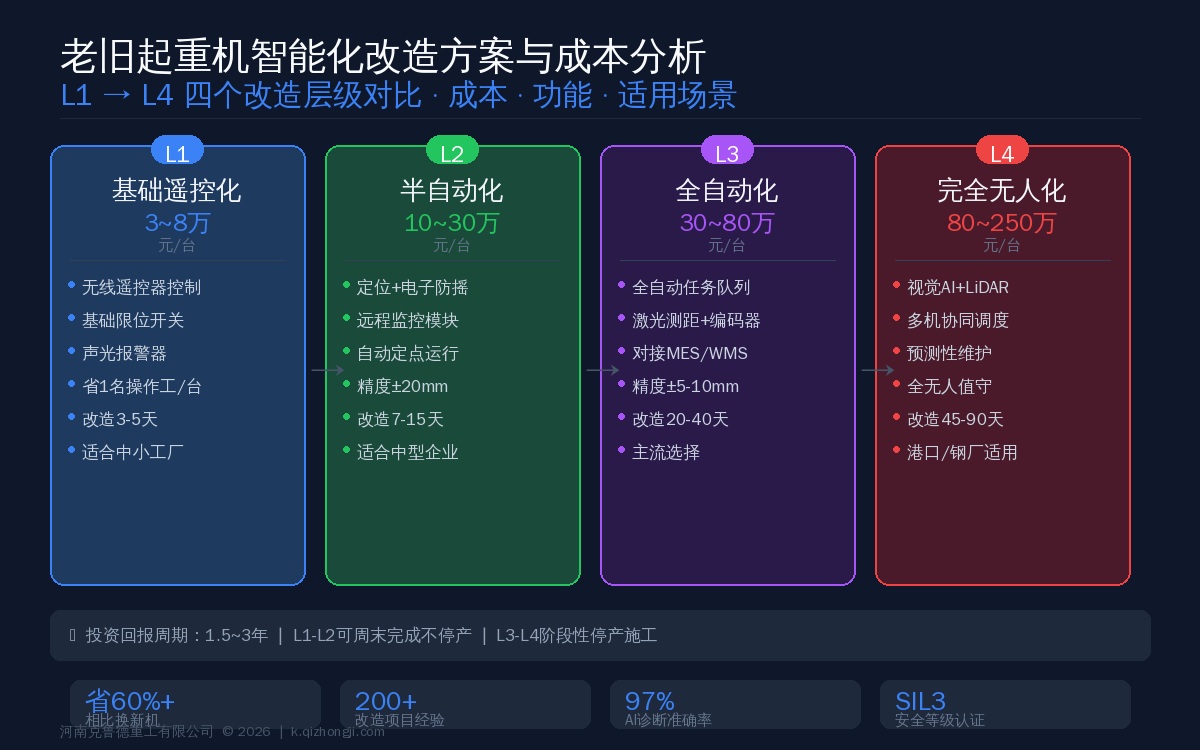
Smart Retrofit for Aging Overhead Cranes: Investment ranges from $30,000 to $2.5 million across four upgrade tiers — L1 Remote Control ($30,000–$80,000), L2 Semi-Automation ($100,000–$300,000), L3 Full Automation ($300,000–$800,000), and L4 Fully Unattended Operation ($800,000–$2.5 million). The retrofit keeps the existing mechanical structure and upgrades only the control system, saving over 60% compared to a new crane, with an ROI period of 1.5–3 years and an extended service life of up to 8–10 years.
Retrofitting an aging overhead crane is a cost-effective alternative to replacement. For installation and acceptance details, refer to our guide on Bridge Crane Installation, Commissioning & Acceptance. Typical investment ranges from $30,000 to $2.5 million depending on the level of automation required. This article breaks down the four upgrade tiers — from L1 basic remote control to L4 fully unattended operation — covering scope, applicable scenarios, cost ranges, and payback periods to help plant managers make an informed decision.
Why Retrofit Instead of Buying a New Crane
Many plants face a familiar challenge: the overhead crane in the workshop has been in service for over a decade — the mechanical structure is still sound, but the control system is outdated, making operation labor-intensive, inefficient, and lacking modern safety features. Replacing it with a new crane means high capital expenditure, long lead times, and the need to modify the runway rails and foundation.
Retrofitting offers a clear advantage: the existing mechanical structure (main girder, end carriages, crane rail) is retained, and only the control system, sensors, and safety devices are upgraded. Take a 10-year-old 32-ton bridge crane as an example — we've covered this in detail in our Complete Guide to Smart Bridge Crane Upgrades — a replacement unit would cost roughly $800,000–$1.2 million, while a semi-automated retrofit (L2) runs only $100,000–$300,000, saving over 60%. The retrofit can be completed in one to two weeks instead of several months.
Kelude Heavy Industry has completed numerous such projects. In one steel mill, six aging overhead cranes were converted from cab operation to ground-based remote control with remote monitoring at a cost of under $80,000 per crane. After the upgrade, each crane required one less operator per shift, saving over $400,000 annually in labor costs across all six units — the investment was recovered in under two years.
Four Retrofit Tiers from $30K to $2.5M
Retrofit solutions are categorized into four tiers based on the level of automation. The right choice depends on your budget, efficiency targets, and operating conditions.
L1 — Basic Remote Control ($30,000–$80,000 per Crane)
This is the entry-level upgrade. Cab operation is replaced with wireless remote control, supplemented by basic limit switches and an audible and visual alarm. Operators no longer need to climb into the cab — they can control the crane from any position on the floor, and one cab operator per crane can be eliminated. The retrofit takes 3–5 days and suits low-frequency applications or small-to-medium plants with limited budgets.
L2 — Semi-Automation ($100,000–$300,000 per Crane)
Building on L1, this tier adds a positioning system and electronic anti-sway control. The operator sets a target position via the remote control from the ground, and the crane automatically travels to the designated point with a positioning accuracy of ±20 mm. A remote monitoring module is also installed, allowing management to view equipment status, cumulative operating hours, and fault logs from the office. This tier suits mid-sized enterprises seeking higher efficiency with a moderate budget. Retrofit time: 7–15 days.
L3 — Full Automation ($300,000–$800,000 per Crane)
This tier delivers true unattended operation. The system automatically receives task queues, and hoisting, trolley, and crane bridge travel run fully automatically with a positioning accuracy of ±5–10 mm. Required additions include laser distance measurement, encoders, and a closed-loop anti-sway control system. The PLC is upgraded to a Siemens S7-1500 class controller and integrated with the plant's MES or Warehouse Management System (WMS), with seamless integration into the AI-Powered Unmanned Crane Dispatching System. Retrofit time: 20–40 days. This is currently the mainstream choice for large and mid-sized manufacturing plants and warehousing logistics projects.
Kelude's L3 solution uses a Siemens S7-1500F safety PLC with closed-loop anti-sway control, and the positioning system can be configured with either LiDAR or barcode tape. These systems are already deployed on production lines at CSIC and Baowu Steel.
L4 — Fully Unattended Operation ($800,000–$2.5 Million per Crane)
Building on full automation, this tier adds visual AI recognition, LiDAR obstacle avoidance, multi-crane collaborative dispatching, and Predictive Maintenance. The entire operation is unattended: the system automatically identifies the load, plans the travel path, avoids obstacles, and coordinates multiple cranes without collision. This tier is designed for high-frequency, high-intensity environments such as steel mills, port terminals, and large warehousing and logistics centers. Retrofit time: 45–90 days.
Kelude Heavy Industry's AI Predictive Maintenance for Smart Cranes — including the AI voiceprint rail-gouging diagnostic system and AI visual safety monitoring system — is already in commercial use with a diagnostic accuracy of 97%. These technologies can be directly integrated into L4 retrofit solutions.
5 Key Factors Driving Retrofit Costs
Two plants may receive quotes that differ by as much as 2x for the same L3 solution. The five factors below make the difference:
- Age of existing equipment: Units over 10 years old typically require mechanical refurbishment first (wheel replacement, rail repair), which accounts for 20–40% of the total retrofit cost.
- Positioning accuracy requirements: Sensors for millimeter-level accuracy cost several times more than those for centimeter-level accuracy.
- Safety level: The price gap between SIL2 and SIL3 safety PLCs is significant. Metallurgical and hazardous chemical industries typically mandate SIL3, while SIL2 is sufficient for general manufacturing.
- Communication solution: Wi-Fi 6 coverage is the most economical option; 5G private network communication requires additional base station infrastructure, significantly increasing cost.
- Site environment: High-temperature, dusty, or corrosive environments require special protection, adding 15–30% over standard ambient conditions.
ROI Analysis for Crane Retrofit Projects
For most retrofit projects, the payback period falls between 1.5 and 3 years. Take a Level 2 semi-automation upgrade as an example (approx. $22,200 per crane): eliminating one operator per shift saves roughly $17,700 in annual labor costs; remote monitoring reduces fault shutdowns, lifting equipment availability climbs from 85% to over 95%; and anti-sway control boosts handling efficiency by about 20–30%. In total, the investment is typically recovered within 15 to 18 months.
A Level 3 fully automatic solution costs around $74,000 and, with two fewer operators plus higher efficiency, pays for itself in roughly 2 to 2.5 years. The Level 4 option delivers the greatest combined benefit in high-frequency duty cycles.
Frequently Asked Questions About Crane Retrofits
Q: Will the retrofitted crane pass special equipment inspection?
A: Our retrofit designs are developed in line with ISO 4301 and TSG Q7015 inspection requirements from the outset. After the upgrade, we assist customers in obtaining acceptance from the local special equipment inspection authority.
Q: Will the retrofit disrupt our production schedule?
A: Level 1 and Level 2 retrofits can be completed over a weekend without any production downtime. For Level 3 and Level 4 upgrades, phased shutdowns are required, but our team develops a detailed construction plan to keep downtime to an absolute minimum.
Q: How much longer will an old crane last after a retrofit?
A: Mechanical refurbishment extends service life by 8–10 years, while a full electrical replacement can keep the crane in reliable operation for 10+ years.
Q: Does Kelude handle crane retrofit projects?
A: Kelude Heavy Industry undertakes retrofit projects across all levels from L1 to L4, with 200+ completed projects spanning steel, chemical, port, and warehousing industries. Visit our complete guide to intelligent bridge crane upgrades and retrofits for more case studies.
