

Grab Crane & Clamshell Crane Selection Guide for Waste-to-Energy
A grab crane is not just a crane—it's a complete system. Different waste types (municipal solid waste, biomass, hazardous waste, and bulk materials) require different grab bucket designs and feed processes. This guide covers grab selection logic, key design parameters, and common configurations for four operating scenarios: waste-to-energy, biomass, hazardous waste, and bulk material handling.
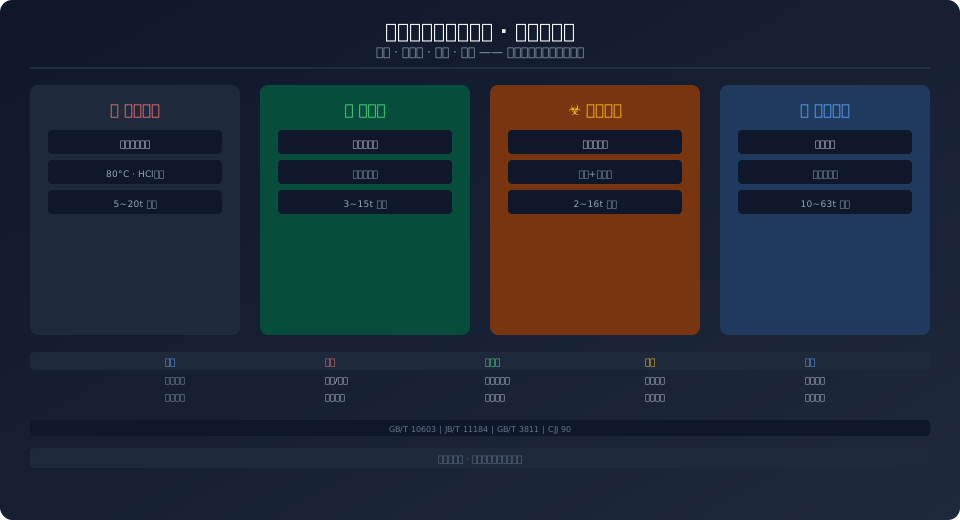
Grab Crane Configurations for Four Key Applications
| Operating Conditions | Recommended Grab (grab bucket) | Lifting Capacity | Core Challenges | Key Technologies |
|---|---|---|---|---|
| Waste-to-Energy Incineration | Four-Rope Charging+Multi-Jaw Clamshell Ash Removal | 5~20t | High Temperature HCl Corrosion | 304L/316LLining |
| Biomass | Hydraulic Multi-Jaw Curved Shell | 3~15t | Straw Wrapping and Blockage | PTFECoated Level Sensor Interlock |
| Hazardous Waste Disposal | Sealing Hydraulic Multi-Jaw | 2~16t | Leakagesafety level | Negative Pressure Sealing Hastelloy Dual Brake |
| Bulk Cargo Terminal | Four-Rope Heavy-Duty | 10~63t | High Wear Continuous Operation | Hardox Wear Plateλ≥2.2 |
Three Core Systems of Grab Cranes
A grab crane consists of three main components: the bridge travel mechanism, the hoisting and closing mechanism, and the grab bucket itself. The bridge travel mechanism handles horizontal positioning and is largely similar to that of a general purpose bridge crane—designing it per the ISO 4301 Crane Design Standard is sufficient. The hoisting and closing mechanism is the heart of the system: it must simultaneously drive two independent wire rope winding systems—the support rope and the closing rope—and the synchronization and tension ratio between them directly determine the grab's opening and closing performance.
Grab buckets are classified by drive type into four-rope grabs, electric-hydraulic grabs, and mechanical grabs. Four-rope grabs rely on differential wire rope movement to open and close, offering reliable construction but with closing force limited by rope tension. Hydraulic grabs use cylinders to drive multiple shells in synchronized closure, delivering high closing force and precise control—though the hydraulic lines require extra protection in dusty environments. Selection should be based on four criteria: material density, angle of repose, particle size, and corrosiveness.
Four-Step Grab Selection Guide
Step one: assess material density. For ρ<0.6t/m³, prioritize multi-shell hydraulic grabs; for ρ>0.8t/m³, four-rope grabs provide greater closing force. Step two: evaluate particle size. For bulky or irregular debris, multi-shell grabs with shells that open up to 180° are preferable; for fine-grained bulk materials, four-rope grabs with tighter closing clearances work better. Step three: consider corrosiveness and temperature—in waste incineration and hazardous waste applications, materials must be selected for high-temperature and acid resistance. Step four: review the duty cycle. For operations exceeding 6,000 hours per year, four-rope grabs offer longer service life; for intermittent duty, hydraulic grabs provide greater maintenance flexibility.
Comparing Four Grab Drive Mechanisms
| Drive Mechanism | open close Mechanism | Advantages | Disadvantages | Typical Applications |
|---|---|---|---|---|
| Four-Rope Grab | support rope+open close Rope Differential | Simple Structure, Wire Rope Long Service Life, Low Maintenance Cost | open close Force Limited by Rope Tension, Large Closing Gap | Incinerator Feeding, Bulk Cargo Terminal |
| Electric Hydraulic Grab | motor-driven hydraulic pump Hydraulic Cylinder Actuated Shell | open close High and Controllable Force, Tight Closing, High Grab Efficiency | Hydraulic Pipeline High Maintenance Demand, Seal Periodic Replacement | Multi-Jaw Clamshell Ash Removal, Hazardous Waste, Biomass |
| Machinery Grab (grab bucket) | Dead Weight+Lever Mechanism Closing | No External Power Source Required, Minimal Cost | open close Force Fully Dependent on Dead Weight, No Control Accuracy | Small Bulk Materials, Construction Waste |
| Single-Rope Grab (grab bucket) | Single Line Wire Rope+Tripping Mechanism | Can Be Used with Standard Hook crane Shared Use | open close Poor Reliability, Unsuitable for High-Frequency Duty | Temporary Bulk Handling |
Grab Crane Selection: Common Mistakes to Avoid
The first mistake is confusing "lifting capacity" with "grab payload." A grab crane rated at 10t typically handles only 5–7t of material per cycle—the remaining 3–5t is the grab bucket's dead weight. Many owners specify a "10t grab" in tenders when their actual requirement is "10t of material per grab"—which calls for a 16–20t grab crane, a cost difference of 40%–60%. This is why so many projects discover shortly after commissioning that the grab "isn't big enough"—the distinction between lifting capacity and grab payload was never clarified from the outset.
The second mistake is designing the grab bucket based on a single material parameter. In waste-to-energy plants, material density can swing from 0.4 to 0.9 t/m³ within a single day, while moisture content ranges from 40% to 65%. If the bucket volume is sized for an "average density of 0.6 t/m³," dry waste won't fill the grab in the morning, and wet waste will overload it in the afternoon. The correct approach is to verify against boundary conditions—build a three-dimensional matrix of density, moisture content, and bucket volume to ensure the grab operates without overloading or underfilling under extreme conditions. Per ISO 4301 Crane Design Standard regarding work duty and load spectrum, grab cranes typically operate at a classification of M5~M7—meaning all components must be verified for a combination of frequent start/stop cycles and medium-to-heavy loads.
The third mistake is overlooking the overall integration of the feeding system. A grab is not a standalone piece of equipment—its payload, duty cycle time, and travel speed must match the downstream feeder, crusher, and boiler grate speeds. A typical mismatch failure: the grab can lift 5t per cycle, but the feeder's throughput is only 30t/h—forcing the grab to operate in a "grab-wait-grab-wait" intermittent mode, achieving less than 60% actual utilization. During the selection phase, the grab, feeder, and incinerator should be designed as an integrated feeding system rather than selected piecemeal.
Frequently Asked Questions
Q: Can the same grab crane be used for both waste feeding and ash removal in a waste-to-energy plant?
A: Not recommended. Feeding requires a four-rope grab for maximum bucket volume and efficiency (3–8 minutes per cycle); ash removal requires a multi-shell grab that can conform to irregular pit bottoms. Sharing one grab reduces feeding efficiency by 30%–50%. Recommended setup: one four-rope grab for feeding plus one multi-shell grab for ash removal, both sharing the same bridge and trolley.
Q: Can the same grab be used for both biomass and waste-to-energy plants?
A: The mechanism can be shared, but the grab shell shape must be customized. Straw has a repose angle of 38°–48°, and straight shells tend to jam—curved shells with wider shell spacing (at least 3× the straw length) are required. Biomass moisture content fluctuates between 15% and 55%, so bucket volume must be verified at maximum moisture content.
Q: What is the payback period for a hazardous waste grab?
A: The purchase cost is 80%–150% higher than a standard grab, but a single leak incident—fines, shutdowns, and soil remediation—can run into millions of yuan. The actual payback period is 12–18 months—essentially insurance against a risk valued at around $740,000.
Q: Which standards apply to grab cranes?
A: Core standards: ISO 4301, GB/T 10603, JB/T 11184, GB/T 5972, GB 5085. For export, add EN 15011 Cranes — Bridge and gantry cranes and FEM 9.511.
For more grab crane configuration options, contact the Kelude technical team.
