
ASME B30.2 Bridge and Gantry Crane Safety Standard Explained
ASME B30.2 — Safety Standard for Bridge and Gantry Cranes is a key technical specification in the crane industry. Developed by the American Society of Mechanical Engineers (ASME), it is the most critical component of the B30 crane safety standard series, defining lifecycle safety requirements for bridge and gantry cranes across design and manufacturing, installation and commissioning, operation, inspection and maintenance, as well as retrofit and decommissioning.
The standard provides a unified technical basis for design personnel, inspection bodies, and end users. Kelude strictly implements the technical requirements of this standard throughout its product development and manufacturing process to ensure compliance and reliability.
Scope and Application of the Standard
ASME B30.2 specifies the technical requirements and safety indicators for bridge and gantry cranes, covering lifting appliances with a rated lifting capacity above 0.5 t. The standard applies not only to the design and manufacturing of new equipment but also provides clear technical guidance for the inspection, maintenance, and modification of cranes already in service. As a key element of the crane standard system, it aligns with the EN 13001 Crane Safety Standard series and ISO 4309 Wire Rope Inspection Standard, forming a comprehensive technical specification framework. The core technical parameters and safety factor requirements defined in the standard give design personnel a clear design basis, while also providing quantifiable acceptance criteria for type tests and factory acceptance tests conducted by third-party inspection bodies.

Core Technical Parameter Framework
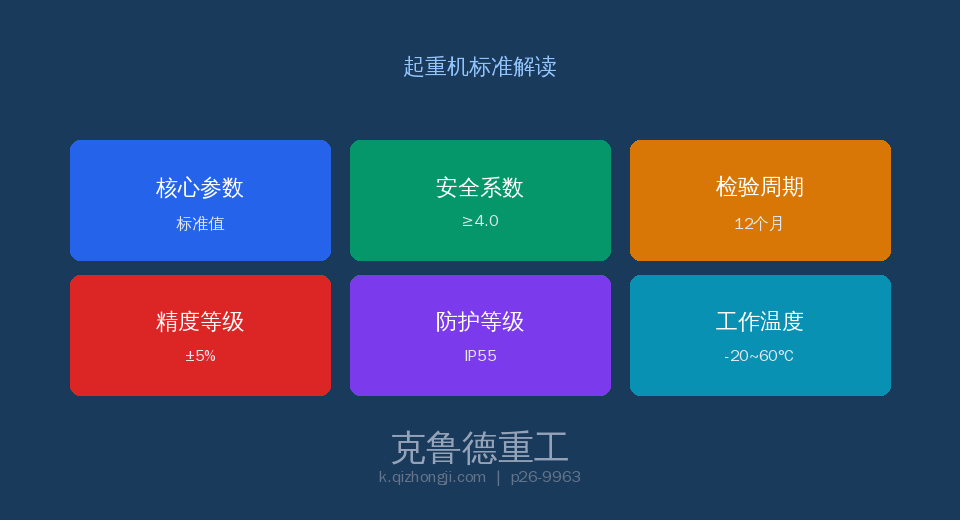
Under ASME B30.2, the design and manufacturing of bridge and gantry cranes must satisfy a stringent set of technical parameter requirements. These parameters are established on the basis of extensive test data and sound safety engineering principles, covering everything from material selection to structural design. The safety factor ranges specified in the standard account for fatigue life and limit load conditions under demanding operating environments. In practical engineering applications, design personnel must select appropriate parameter combinations based on the equipment's work duty classification, load spectrum, and operating conditions. The parameter cards below summarize the standard's key technical indicators:
Comparative Analysis of Key Technical Parameters
The comparison table below systematically contrasts the core parameters specified in ASME B30.2 with common engineering practice. All values shown are taken from mandatory or recommended clauses of the standard and should be strictly implemented during design and selection as well as factory acceptance testing.
| Item | technical requirements | Description |
|---|---|---|
| load marking | Four-Way Visibility, Character Height≥75mm | Nameplate+Sprayed Dual Marking, Including Testing Date |
| Hoisting / Liftinglimit switch | Counterweight+Electronicdual redundancy | Either Failure Independent Operation of the Other, Upper Trigger Distance Limit≥200mm |
| Brake | Hoisting / Lifting Dual Brake/Operation Unit Braking | normally closed type, Braking torque≥1.5Times Rated load moment |
| wind speed limit | Outdoor Service≤20m/s | 16m/searly warning,20m/sautomatic shutdown |
| Annual Inspection | Structure/Mechanism/Electrical/safety device Allcoverage | Report Retention Until Next Inspection Completed |
| main girder deflection | Full load≤L/800, No-load Camber≥L/1500 | Side bow / lateral bow≤L/2000, Level Instrument Measured |
Inspection Requirements and Intervals
ASME B30.2 sets forth explicit requirements for factory acceptance tests, type tests, and periodic inspections of bridge and gantry cranes. Factory acceptance testing is performed on each unit at the manufacturer's facility by the quality inspection department, and equipment that passes must be accompanied by a detailed inspection report and a certificate of conformity. For cranes in service, the periodic inspection interval is determined by the work duty classification and operating environment, typically not exceeding 12 months.
| Item | technical requirements | Description |
|---|---|---|
| metal structure | main girder deflection/Side bow / lateral bow/Weld Seam/Corrosion | Annual Load Test (Measured), Deflection≤L/800 |
| Hoisting mechanism | Drum/Wire Rope/Pulley/Brake | Annual Brake wheel Wear≤1.5mm, Wire Rope Per ISO 4309 Wire Rope Inspection Standard |
| safety device | Limit Switch/Overload Limiter/Buffer | Monthly Fullfunctional testand Recorded |
| electrical system | insulation/Grounding/Cable/Control Cabinet | Annualinsulation≥1MΩ(500V) |
Safe Operation and Management Requirements
Under ASME B30.2, safe operation and routine management are central to crane compliance. The standard places strong emphasis on operator qualification and training, requiring that all operators complete specialized training and hold the appropriate credentials before operating equipment. User units must establish a robust equipment file management system that documents the full installation, use, maintenance and inspection history of each crane. Any safety hazards identified must be addressed through the rectification procedure specified in the standard, keeping equipment in a safe and controllable condition at all times. The standard also imposes operational restrictions for extreme operating conditions.
ASME B30.2 Compliance: Key Questions Answered
Q: What are the main girder deflection requirements under ASME B30.2?
A: The standard specifies that the mid-span deflection of a bridge crane main girder under rated load must not exceed 1/800 of the span (L/800), which is more stringent than the ISO requirement of L/700. For a 30 m span, for example, the maximum allowable deflection at full load is 37.5 mm. Under no-load conditions, the girder must maintain a camber of at least L/1500. Side bow is limited to L/2000. Inspection is performed using a level instrument or total station for precise measurement, with readings recorded under both no-load and full-load conditions. If measured values exceed the limits, a structural safety assessment must be conducted and reinforcement measures implemented. Kelude performs deflection testing on every crane before shipment, and the Load Test Report is delivered with the equipment.
Q: What safety devices are required on a crane?
A: The standard requires the following safety devices: a Hoisting Height Limit Switch (with dual redundancy — counterweight plus electronic sensor), Travel Limit Switches at both ends of the trolley and bridge travel, an Overload Limiter (accuracy ±5%, cutting power at 110% of rated load), Buffers at both ends of the trolley and bridge, an Anti-Collision Device (when multiple cranes operate on the same runway), and an Anchor device (for outdoor gantry cranes). The standard specifies the installation position and trigger points for each device. All safety devices must undergo functional testing during monthly inspections; any device that fails must be taken out of service immediately and replaced. Limit switch trigger points must maintain a safety margin of at least 200 mm from the structural end stops.
Q: What inspection intervals apply to overhead cranes?
A: The standard defines three levels of inspection: daily inspection (functional checks before each use), monthly inspection (functional testing of all safety devices and mechanisms), and annual comprehensive inspection (full coverage of the metal structure, hoisting mechanism, travel mechanism, electrical system, and safety devices). Annual inspections must be carried out by qualified professional inspectors, with a detailed report recording all measurements and assessment results. This report must be retained until the next annual inspection is completed. Any issues identified during inspection must be rectified before the crane is returned to service. Inspection records form the core of the equipment safety file and serve as critical evidence for insurance claims and incident investigations.
Q: What qualifications must crane operators hold?
A: Operators must complete specialized training and obtain the required operating certification before being allowed to operate a crane. Training covers crane construction and operating principles, standard operating procedures, safety device functions and usage, load chart interpretation, hand signals, and emergency response procedures. Operator certifications require periodic revalidation, typically every three years. User units must maintain operator records documenting training and assessment results. Kelude provides complimentary on-site operator training at the time of delivery, along with a concise operating procedure card for users to post in a prominent location inside the operator's cab.
— Specialized in crane design and manufacturing, our products fully comply with the ASME B30.2 standard system, offering lifecycle service from solution design and manufacturing and installation to after-sales maintenance. To learn how this standard is applied in our equipment, contact our technical team for detailed technical documentation.