

GB/T 5905 Crane Load Test Procedure Guide
Crane Load Test & Type Test Procedures: A Complete Guide to GB/T 5905 Compliance. Load testing and type testing are essential for verifying the manufacturing quality, design parameters, and safety performance of cranes. The test methods, acceptance criteria, and operational procedures must strictly comply with GB/T 5905 "Cranes — Test Code and Procedures" and TSG Q0002 "Rules for Type Test of Lifting Appliances."
Crane load testing and type testing are fundamental to validating manufacturing quality, design specifications, and operational safety. These procedures must strictly adhere to the requirements of GB/T 5905 "Cranes — Test Code and Procedures" and TSG Q0002 "Rules for Type Test of Lifting Appliances." This article provides a comprehensive walkthrough of the entire load test and type test process, covering pre-test preparation, test conditions, step-by-step procedures, data recording, and acceptance criteria—serving as a practical reference for crane inspectors and equipment owners.
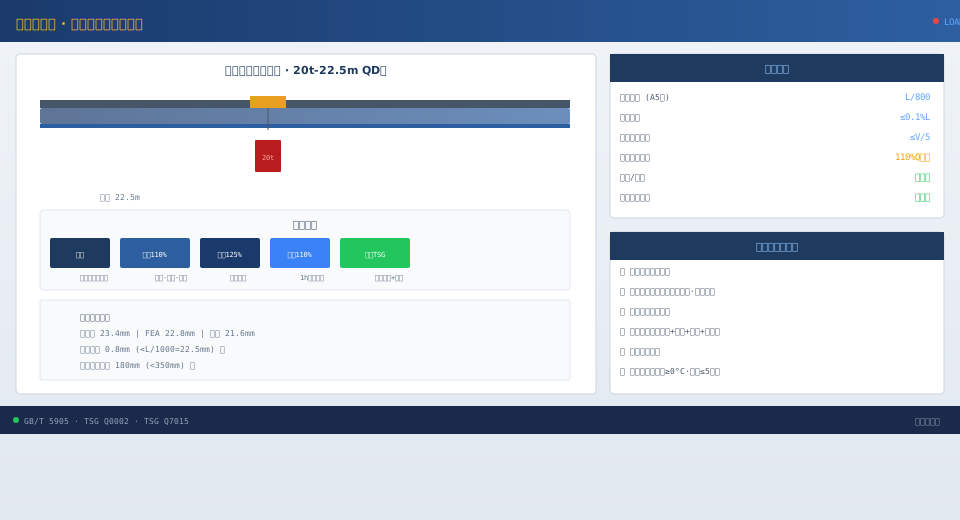
Crane Test Types and Applicable Scenarios
TSG Q0002
GB/T 5905-2011
TSG Q7015-2016
Pre-Test Preparation Checklist
Before commencing load tests, the following preparations are essential. The test area must be level and firm, with the test rail conforming to GB/T 10183. Rail end stops must be intact, and sufficient clearance must be maintained for safe testing. Test loads should consist of standard weights (e.g., cast iron weights or concrete counterweights) or a dedicated lifting spreader, with the total weight calibrated and accompanied by a valid calibration certificate. The permissible tolerance for the test load is ±1%. Required test instruments include a displacement sensor or level instrument (for measuring main girder deflection with an accuracy of at least 1 mm), a strain gauge (for measuring stress at critical points, if applicable), a stopwatch (for timing hoisting and travel operations, accurate to 0.1 s), a steel tape measure (for measuring travel distance and position, accurate to 1 mm), an infrared thermometer (for checking motor and VFD temperature rise), and a multimeter (for measuring electrical parameters). The test team must include a designated test supervisor, crane operator, measurement/recording personnel, and a safety observer. The test supervisor must hold a valid crane inspector qualification. A detailed test plan outlining the specific tests, conditions, procedures, and acceptance criteria must be prepared and approved prior to testing.
No-Load Test Procedure
The no-load test is the initial step in the load test sequence, designed to confirm that all mechanisms operate correctly without a load. The procedure includes: performing three full hoisting and lowering cycles (checking speed stability, brake synchronization and response time, and the reliability of limit switches); operating the crane bridge (long travel) for two full traverses across the runway (checking travel smoothness, wheel-to-rail alignment, and the effectiveness of bridge buffers and travel limit switches); operating the trolley (cross travel) for two full traverses (checking travel smoothness and the operation of trolley buffers and limit switches); and conducting a combined operation test where multiple mechanisms run simultaneously (verifying the electrical system's power supply capacity and communication stability under simultaneous load). Throughout the no-load test, monitor for abnormal noise or vibration and check all lubrication points for oil leaks. Any anomalies identified during this phase must be rectified before proceeding to load tests.
Rated Load Test (100% SWL)
The rated load test is performed at 110% of the rated load as per GB/T 5905. The procedure is as follows: First, lift the rated load (100% Q) approximately 100 mm off the ground and hold for 10 minutes, measuring the main girder deflection at mid-span. Next, increase the load to 110% Q and perform the following operations: three full hoisting and lowering cycles (checking lifting speed and braking distance—the braking distance must not exceed 1/5 of the stable lifting distance achieved in 1 minute); two full traverses of the crane bridge across the entire span (checking travel stability and synchronization of the two drive motors); two full traverses of the trolley along its entire travel (checking travel stability and positioning accuracy); and a combined operation test with hoisting, bridge travel, and trolley travel running simultaneously for at least 5 minutes. During the test, record the following data: maximum main girder deflection at mid-span (should not exceed L/700 to L/1000 under rated load, depending on the crane's work duty classification); permanent deformation (residual deflection of the main girder after unloading must not exceed 0.1% of the span); motor current and temperature rise for each mechanism; brake stopping distance and temperature rise; and the travel speed and noise level (in dB) for each mechanism.
Static Load Test Procedure
The static load test is conducted at 125% of the rated load to verify the load-bearing capacity of the crane's main structure and to check for any permanent deformation. The procedure involves: lifting the test load approximately 100 mm off the ground and holding for 10 minutes while measuring the main girder deflection at mid-span; then increasing the load to 125% of the rated load and holding for another 10 minutes; finally, unloading and re-measuring the main girder deflection to check for any residual deformation. The acceptance criteria for the static load test are: the main girder must not exhibit any significant plastic deformation under the 125% rated load, and the residual deflection after unloading must not exceed 0.1% of the span (for a 22.5 m span, this means a maximum permanent deformation of 22.5 mm). During the test, inspect critical weld seams on the main girder—including the fillet welds connecting the flange plate to the web plate, the connection welds of stiffeners to the web, and the welds joining the main girder to the end carriages—for any signs of cracks or weld failure. The static load test is mandatory for both routine (factory) tests and type tests. However, for routine tests, a sampling approach may be adopted (e.g., testing the first and last units of a production batch), whereas the type test requires the static load test to be performed on every unit.
Dynamic Load Test Procedure
The dynamic load test is conducted at 110% of the rated load to verify the load-bearing capacity and safety performance of all crane mechanisms under dynamic operating conditions. The test cycle for the dynamic load test is longer than that of the rated load test, with each mechanism required to run continuously for no less than 1 hour. Test procedure: the hoisting mechanism performs 10 full-stroke lifts and lowerings (including emergency stop tests, with one emergency stop during both hoisting and lowering to check braking distance and brake reliability), the crane travel mechanism performs 10 full-stroke round trips (including starting under full load and emergency stops), the trolley mechanism performs 10 full-stroke round trips, followed by a combined operation test of all mechanisms for at least 30 minutes to simulate cyclic operations under actual working conditions. During the dynamic load test, the running smoothness, braking reliability, temperature rise, and response consistency of the Electrical Control System are checked for all mechanisms. After the dynamic load test, the main girder is inspected for fatigue cracks and abnormal deformation at critical areas, all mechanism connecting bolts are checked for loosening, and brake band wear is verified to be within the normal range.
Test Records and Inspection Report Requirements
All test data and observations must be recorded in detail during testing. The test records shall include at least the following: basic crane information (model, Lifting Capacity, Span, Lifting Height, Work Duty Classification, and manufacturing serial number), test date and environmental conditions (temperature, humidity, wind speed), type and actual weight of test loads, test data for each test item (recorded in tabular form with design values, measured values, and deviation percentages), any abnormal conditions encountered during testing and corrective actions taken, and the test conclusion (pass/fail with details of any non-conforming items). The Test Report must be signed by the test supervisor, reviewed by the manufacturer's technical manager, and stamped by the inspection body for archival. Type Test reports must also be reviewed and filed with the special equipment inspection authority. Test Reports shall be retained for a period not less than the crane's design service life (typically 20 years).
