

Hazardous Waste Grab vs Standard: Sealing, Materials & Safety
Using a standard grab in a hazardous waste workshop is like carrying sulfuric acid in a grocery store plastic bag—the sealing won't hold, the materials are wrong, and nobody wants to be the one who stops the line when something goes wrong. The difference between a hazmat grab and a standard one isn't a few thousand dollars in materials—it's three safety barriers that each must pass inspection.
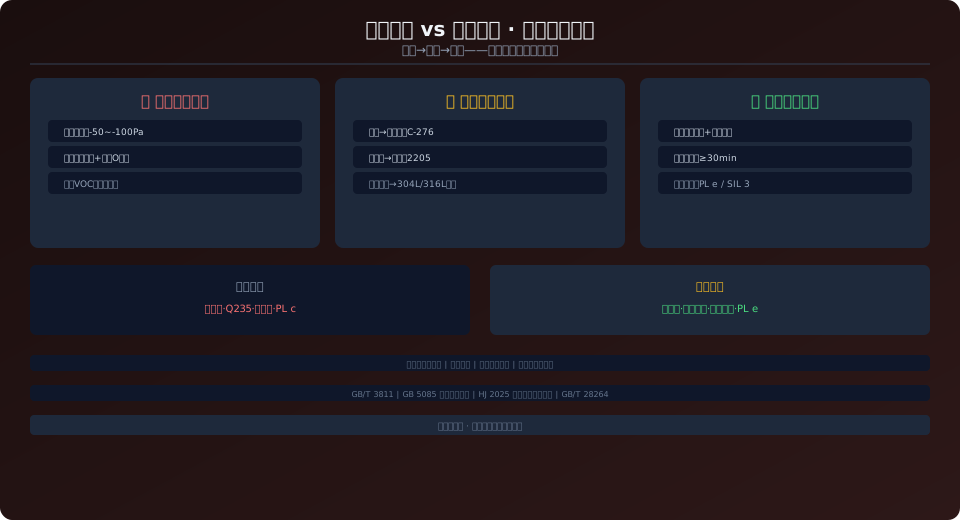
Why Standard Sealing Fails in Hazardous Waste Handling
Standard grab sealing is built around "as long as nothing big falls out"—a single skeleton oil seal on the shaft and asbestos rubber sheet for the flange gasket. That's fine for a bulk cargo terminal, but nowhere near enough for a hazardous waste workshop. A hazmat grab needs bidirectional sealing: nothing hazardous seeps out, and no air or moisture gets in—many hazardous wastes can self-ignite on contact with water or oxygen. The critical sealing points: ①Shaft seal—magnetic fluid seal plus dual FKM O-rings; the magnetic fluid forms a liquid barrier in the magnetic field for zero leakage. ②Hydraulic cylinder piston rod—silicone-coated aramid bellows protective sleeve. ③Clamshell contact surfaces—PTFE-wrapped stainless steel elastic gasket creates a soft seal. The final safeguard is an online VOC sensor that triggers an alarm and interlocks the grab to stop operation when levels exceed the limit.
Why Material Selection Matters for Hazardous Waste Grabs
| Corrosion Environment | Recommended Material | Temperature | Typical Application |
|---|---|---|---|
| Acidic(p H<3) | Hastelloy C-276 | ≤200°C | Chemical Residue, Spent Acid |
| Chloride Environment | Duplex Stainless Steel2205 | ≤300°C | Chloride-Containing Waste Liquid |
| High-Temperature Alkaline | Inconel 625 | ≤650°C | Incinerator Ash |
| General Purpose Anti-corrosion | 304L/316L+Lining | ≤400°C | Conventional Hazardous Waste |
Choosing the wrong material costs more than just corrosion perforation—the real danger is stress corrosion cracking (SCC). In chloride-rich environments, Q235B (≈S235JR) can develop micro-cracks in the weld heat-affected zone within weeks, invisible from the outside. That's why critical weld seams on hazardous waste grabs must undergo 100% Radiographic Testing (RT), plus surface penetrant testing (PT) every six months.
Third Line of Defense: How to Configure Safety Redundancy
Hazardous waste grabs must be equipped with dual-brake redundancy: the service brake and the Safety Brake are physically independent, so if either fails, the other locks within 0.5 seconds. Brakes must meet SIL 3 or PL e (ISO 13849-1)—a complete safety circuit spanning sensor redundancy (dual Encoder), logic controller (dual-channel safety PLC), and actuators (Double Brake). The power-loss magnetism retention system must sustain operation for at least 30 minutes to allow safe personnel evacuation. Per GB/T 28264 Safety Monitoring and Management System for Lifting Appliances, hazardous waste grabs must include an independent Safety Monitoring and Management System unit that records brake actuation time, pressure, and Wear for every cycle.
Hazardous Waste Classification and Grab Material Matching
Hazardous waste isn't a single material—it's a broad category. Under GB 5085 Identification Standards for Hazardous Wastes, waste falls into five classes: corrosive, toxic, flammable, reactive, and infectious. Each class attacks grab materials through a different corrosion mechanism, so there's no one-size-fits-all material. Corrosive waste (e.g., spent acids, caustic alkalis) primarily attacks the metal surface oxide layer, requiring high-alloy corrosion-resistant materials. Toxic waste (e.g., heavy-metal sludge, cyanide residue) may not corrode equipment directly, but a grab leak would be catastrophic—sealing requirements far outweigh material selection here. Flammable waste (e.g., spent solvents, paint residue) presents a key spark risk during grab open close cycles—copper alloy or beryllium copper grab shells are required, along with Explosion-Proof Electrical certification.
Infectious waste (medical waste) is the fastest-growing category—rising 8%–12% annually as healthcare capacity expands. Medical waste grabs face unique challenges: ① complex composition—syringe needles (puncturing Seals), gauze (fiber entanglement), and medicine vials (sharp fragments when broken); ② the need to minimize human contact before incineration—negative-pressure sealed grabs enable fully automated unloading, grabbing, and feeding, with operators working remotely behind glass partitions; ③ disinfection requirements—after each empty cycle, the grab shell interior must be automatically cleaned with steam or disinfectant. These demands make medical waste grabs the most technically challenging and most expensive subcategory of hazardous waste grabs—an 8t sealed medical waste grab can cost approximately $296,000 to $414,000.
SIL Certification Process and Cost Breakdown
| Certification Phase | Scope | Duration | Cost(10k CNY) |
|---|---|---|---|
| SILClassification | HAZOPAnalysis & Target Definition Safety Integrity Level (SIL) | 2~4Weeks | 3~5 |
| SILDesign | Safety Circuit Architecture Design, Component Selection | 4~8Weeks | 8~15 |
| SILVerification | FMEDAAnalysis, PFD/PFHCalculation | 3~6Weeks | 5~10 |
| Third-Party Review | TÜV/Exidaetc.notified body Review & Certification | 4~8Weeks | 10~20 |
The total investment for SIL certification is approximately $39,000–$74,000, with a timeline of 14–26 weeks. Many plant owners ask, "Can we skip SIL certification?" The answer is: if you simply need a grab bucket for lifting general waste, certification may not be required. However, if the grab handles cyanide-containing chemical waste, radioactive resin, or infectious medical waste—a drop could result in far more than equipment damage; it could cause casualties and environmental contamination. SIL certification is essentially a $39,000–$74,000 insurance policy against a potential accident that could cost tens of millions—or even hundreds of millions—in damages. In chemical parks across Europe, the US, and China, SIL certification is already a mandatory requirement for hazardous waste handling equipment; without it, your equipment won't even be granted access to the facility.
Emergency Response Planning for Hazardous Waste Grabs
Safety management for hazardous waste grabs shouldn't end at the design stage—once the equipment is in service, the quality of your emergency response plan determines how effectively losses can be minimized in the event of an incident.
A comprehensive emergency plan operates on three levels:
Level 1—Equipment-level response: Shutdown procedures for hydraulic oil leaks (leakage >100 mL), seal failure (VOC sensor alarm), or brake anomalies (braking torque dropping below 80% of rated value).
Level 2—Zone-level response: Procedures for safely lowering the grab to a secure height without contacting hazardous waste when it becomes stuck above the waste pit (due to power failure or control system malfunction).
Level 3—Plant-level response: Full evacuation routes, decontamination station activation, fire suppression linkage, and environmental monitoring protocols in the event of a grab drop causing hazardous waste release.
Recommended drill frequencies: monthly for equipment-level, quarterly for zone-level, and semi-annually for plant-level exercises. Drills must not become a checkbox exercise—after each drill, record the time taken for every action and compare it against the pre-defined "golden response window." Equipment-level response must achieve shutdown within 30 seconds, zone-level manual lowering within 5 minutes, and plant-level evacuation with decontamination station activation within 15 minutes. If two consecutive drills exceed these time limits, the plan must be revised or the equipment upgraded. These requirements aren't arbitrary—HJ 2025 Technical Specification for Hazardous Waste Collection, Storage, and Transportation sets explicit response-time requirements, and annual environmental and safety inspections will review your drill records.
Hazardous Waste Grab FAQ: Cost, Materials & Maintenance
Q: What's the typical investment for a hazardous waste grab?
A: Approximately 1.8–2.5 times the cost of a standard grab of the same capacity. A 10t hazardous waste hydraulic grab with sealing, Hastelloy lining, and dual brake system runs about $178,000–$266,000 (versus $89,000–$118,000 for a standard unit of the same capacity). The premium goes primarily into materials (Hastelloy costs 8–15 times more than 304L stainless steel) and the safety circuit (SIL3-certified system: $22,000–$37,000).
Q: Can I use standard stainless steel if my throughput is low?
A: No. 304L corrodes at 0.5–1 mm/year under typical hazardous waste conditions, meaning an 8 mm shell will develop through-wall perforation within 2–3 years. Additionally, 304L is not resistant to chloride-induced stress corrosion cracking (SCC). If budget is constrained, line the grab shell with a 3–5 mm Hastelloy overlay while keeping the main structure in 304L—this cuts cost by roughly 40% without compromising safety.
Q: What certifications are required for hazardous waste grabs?
A: Mandatory: Special Equipment Manufacturing License and Type Test Certificate of Conformity. Recommended: SIL certification and ATEX explosion-proof certification (for flammable/explosive hazardous waste). Per HJ 2025, a complete leak emergency response plan with drill records is also required.
Q: Does routine maintenance differ from standard grabs?
A: Significantly. Standard grabs only need monthly inspections; hazardous waste grabs require: ① visual inspection of seals and sensors after every operation; ② weekly helium leak testing under negative pressure; ③ monthly safety brake function testing; ④ quarterly wall thickness measurement plus PT flaw detection on weld seams; ⑤ semi-annual full SIL verification. Records must be retained for at least 5 years.
For hazardous waste grab safety design, consult the Kelude technical team—end-to-end support from material selection to SIL certification.
