

Cost of Upgrading Crane Anti-Corrosion Coating
📋 Key Summary
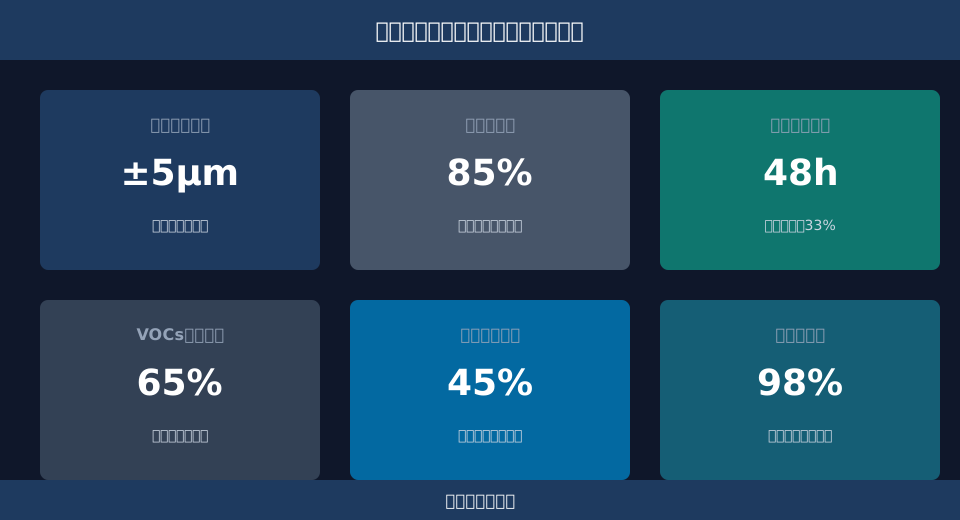
Upgrading crane anti-corrosion coatings to an automated production line increases overall manufacturing costs by approximately 12% to 15%, yet it reduces coating thickness tolerance to within ±5μm. Automation boosts spraying efficiency by 45%, cutting the surface treatment and painting cycle for a single 50-ton double-girder crane from 72 hours to 48 hours. Through intelligent formulation and precise execution, paint utilization rises from 60% to 85%, significantly lowering long-term operation and maintenance costs.
In the design and manufacturing of crane structures, anti-corrosion performance directly impacts service life and operational safety. Per FEM 1.001 Crane Design Specification, structural components must meet specific corrosion protection levels suited to their operating environment. Additionally, during equipment acceptance and routine inspections, coating adhesion and thickness are critical indicators verified under TSG 51-2023 Safety Technical Supervision Regulation. Introducing automation into the anti-corrosion coating process is not merely a technological upgrade but a strategic rebalancing of cost and quality.
Precision Control of Coating Thickness via Automated Spraying
Traditional manual spraying often struggles with uneven coating thickness when applied to large tonnage crane structural components. Kelude Heavy Industry’s automated spraying workshop employs six-axis linked robotic arms and high-pressure airless spraying systems to strictly control Dry Film Thickness (DFT) errors within ±5μm. For example, in the painting of main girders for standard European-standard double-girder cranes, the system sets a target DFT of 120μm, while the robotic arm’s spray gun maintains a constant travel speed of 0.8m/s.
To precisely calculate paint consumption and coverage efficiency, consider this engineering case study. Assuming a spray width of 0.4m and a robot movement speed of 0.8m/s, the coverage area per unit time is 0.4m × 0.8m/s = 0.32m²/s. If the required DFT is 120μm (0.12mm) and the selected paint has a volume solids content of 60%, the Wet Film Thickness must reach 120μm / 0.6 = 200μm (0.2mm). Consequently, the paint consumption volume per unit time V = 0.32m²/s × 0.0002m = 0.000064m³/s, or 64ml/s. This precise calculation allows the PLC Control System to adjust flow valves in real-time, ensuring uniform paint distribution across every inch of steel.
The direct benefit of automation retrofit is a significant reduction in material waste. Traditional manual spraying typically achieves only about 60% paint utilization, with much of the paint lost to atmospheric overspray. The automated production line optimizes spray gun trajectories and atomization pressure, boosting utilization to over 85%. For a single crane with a lifting capacity of 100t, featuring a structural component surface area of approximately 450m², savings in paint alone can reduce costs by roughly $15,360 per coat (based on approx. 15% savings).
Cost Accounting for Intelligent Surface Treatment & Shot Blasting
Coating adhesion depends heavily on the quality of substrate surface preparation. Automated shot blasting lines use variable frequency control to regulate steel grit flow and projection speed, consistently achieving Sa2.5 rust removal standards and maintaining surface roughness between 40μm and 60μm. Taking a large through-type shot blasting machine with a rated output of 40kg/min as an example, its main motor power is 110kW, with a steel grit consumption rate of approximately 0.8kg/m².
Following automated shot blasting, potential welding defects may become visible on the structural surfaces. The production line then automatically transfers components to inspection workstations, employing weld crack detection technology. Utilizing machine vision and automated ultrasonic flaw detection ensures the substrate is free of microscopic defects before primer application. This seamless workflow avoids secondary contamination and physical damage caused by multiple hoisting operations inherent in traditional methods.
The increased costs associated with automated shot blasting primarily stem from equipment depreciation and dust collection system upgrades. An automated shot blasting line capable of processing 200m²/h, equipped with a pulse dust collector and automatic steel grit separation/recycling system, requires an initial hardware investment approximately 40% higher than that of traditional open sandblasting booths. However, with a steel grit recovery rate of 98% and no need for manual waste sand cleaning, abrasive costs drop by 35% over the long term.
| Evaluation Criteria | Traditional Manual Method | automated production lineMode | Variance Analysis |
|---|---|---|---|
| Surface TreatmentGrade | Sa2.0toSa2.5Fluctuation | StableSa2.5Grade | automationEnsuredRoughnessandcleanlinessConsistency |
| coating thicknessError | ±20μmto±30μm | ±5μmwithin | Precisioncontrol systemReduced paint overconsumption andAnti-corrosionShortcoming |
| Paint Utilization Rate | Approximately60% | 85%or above | Trajectory Optimization and Atomizationcontrol systemSignificantly Reduced Material Waste |
| Per UnitCoating / paintingCycle | 72Hours | 48Hours | Continuous operationand Rapid Curing Shortened thedeliveryTime |
Energy Efficiency and Material Analysis of Eco-Friendly Water-Based Paint Mixing Systems
As environmental regulations tighten, the adoption of water-based industrial coatings in crane manufacturing is rising annually. Automated mixing systems utilize mass flow meters and precision agitators to reduce mixing time from 45 minutes (manual) to just 15 minutes. With a single batch capacity of 500L and a motor power of 5.5kW for agitation, these systems maintain viscosity fluctuations within a tight ±5% range.
During Material Handling in the mixing workshop, intelligent overhead cranes equipped with AI anti-sway algorithms ensure stability while transporting paint drums at high speeds (up to 60m/min). This prevents splashing or excessive air entrapment. The Kelude Heavy Industry technical team integrates system integration by linking crane operational data with the room’s environmental control. Once a drum is detected in position, the system automatically activates the constant temperature and humidity controls.
Automated water-based paint mixing demands strict environmental conditions. The mixing room requires an ambient temperature between 15°C and 30°C and Relative Humidity below 75%, maintained via a dedicated HVAC system. Micro-positive pressure ventilation is also required to prevent external dust contamination. Although this temperature control adds approximately 8kW of continuous energy consumption, it reduces VOC emissions by 65% compared to traditional solvent-based paints, eliminating costly exhaust treatment expenses.
| coating system | unit material cost(Yuan/kg) | automationLoss Rate | Comprehensive Square Metercost(Yuan/m²) | Applicable toenvironment |
|---|---|---|---|---|
| Epoxy Zinc-Rich Primer | 45.0 | 15% | 28.5 | HighCorrosionIndustrialenvironment |
| Water-basedPolyurethane Topcoat | 65.0 | 12% | 35.2 | Outdoor Areas with Intense UV Radiation |
| Epoxy MIO Intermediate Coat | 38.0 | 14% | 22.8 | Marine and High-Humidity Environmentsenvironment |
ROI Analysis of Automation Upgrades for Anti-corrosion Coating
Evaluating the return on investment (ROI) for an automation upgrade in anti-corrosion coating requires a detailed financial breakdown across three key dimensions: equipment depreciation, material savings, and labor reduction. The initial hardware investment for automated spraying and shot blasting equipment typically increases by approximately 30% to 40% compared to traditional manual methods.
Equipment depreciation is generally calculated over an 8-year period using the straight-line method, resulting in an annual depreciation cost of about 12.5% of the total equipment investment. In terms of labor cost, an automated production line reduces the coating crew size per crane from 6 workers to just 2 (one system operator and one assistant for loading and unloading). This represents a 45% reduction in labor expenses. Combined with improved paint utilization rates, the initial investment difference is typically recovered through operational savings within 3 to 4 years. Specific amounts are subject to the actual contract.
When providing high-end customization services for European Standard Double-Girder cranes ranging from 50t to 300t, Kelude Heavy Industry includes automated anti-corrosion as a standard configuration. This approach not only meets increasingly strict environmental and quality requirements but also significantly lowers maintenance costs throughout the equipment's lifecycle. Choosing Kelude means selecting a proven anti-corrosion process backed by data and ensuring reliable long-term returns. Routine maintenance for these automated systems primarily involves lubricating robotic arm joints and performing sensor calibration. Overall maintenance costs remain manageable, accounting for approximately 3% to 5% of the total equipment investment annually.
FAQ
Q: How much does automating the anti-corrosion production line increase direct equipment investment?
A: The introduction of automated spraying and shot blasting equipment increases initial hardware investment by approximately 30% to 40% compared to traditional methods. However, considering improved paint utilization and reduced labor needs, the investment difference is typically recovered within 3 to 4 years through savings in materials and labor costs. Specific amounts are subject to the actual contract.
Q: Can automated spraying effectively coat hard-to-reach areas of complex structural components?
A: Modern automated production lines are equipped with multi-axis linked robotic arms and 3D vision scanning systems that automatically identify workpiece profiles and plan coating paths. For complex internal areas such as stiffener plates in double-girder cranes, the robotic arms can adjust their posture to ensure coverage, achieving a blind-spot coverage rate of over 95%.
Q: What specific workshop environment requirements are needed for automated water-based paint mixing?
A: Water-based paints are sensitive to temperature and humidity. Automated paint preparation rooms must be equipped with constant temperature and humidity systems, typically requiring the ambient temperature to be controlled between 15°C and 30°C, with relative humidity below 75%. Additionally, the workshop should maintain slight positive pressure ventilation to prevent external dust from contaminating the paint.
Q: Is the routine maintenance cost for an automated anti-corrosion production line high?
A: Routine maintenance for automated equipment focuses on lubricating robotic arm joints, cleaning nozzles, and performing sensor calibration. Compared to traditional manual coating, maintenance costs are concentrated on electrical and control systems. Overall, maintenance expenses account for approximately 3% to 5% of the total equipment investment annually.
