

Overhead Crane Automation Acceptance: 5 Key Commissioning Tests
📋 Key Summary
Whether an automated overhead crane passes acceptance comes down to five commissioning indicators backed by measured data: positioning accuracy, anti-sway angle, acceleration/deceleration smoothness, takt time cycles, and interlock actions. This article breaks down the pass/fail thresholds and determination methods for each indicator, explains why interlock testing must trigger each function individually, and highlights three commonly overlooked issues that can let "paper intelligence" slip through.
In an automated overhead crane acceptance report, the real problems surface not in "does the feature exist" but in "do the indicators meet spec." Positioning accuracy is rated at ±5 mm — but does measured data drift to ±10? Anti-sway angle is rated at 1° — but is the load still swinging when the hook lands? Interlocks are claimed to be complete — but do they actually stop the crane when triggered?
The core of automation acceptance is converting every commissioning indicator from "rated" to "measured." Below, we walk through the determination methods for the five key indicators and interlock testing one by one.
Acceptance Standards: Which Specifications Define Commissioning Indicators
Automation acceptance is not without a basis. For retrofitted or newly installed cranes, load tests must follow the procedures in ISO 4310, the Crane Test Specification; parameter acquisition and data logging for Safety Monitoring Systems must comply with GB/T 28264-2017; and safety supervision requirements for limit switches and interlocks come from TSG 51-2023.
While most intelligent indicators such as positioning accuracy and anti-sway angle are not governed by a single mandatory standard, they are typically written into the contract as acceptance criteria. If the contract specifies ±5 mm, acceptance is measured against ±5 mm — failing to meet it is a breach of contract. This is the key to keeping "paper intelligence" out.
So the first step in automation acceptance is confirming that every indicator has a clear standard or contractual basis, then checking each item against it during acceptance with no gray areas. Kelude provides customers with an acceptance checklist before delivery, listing the basis and target value for each indicator.
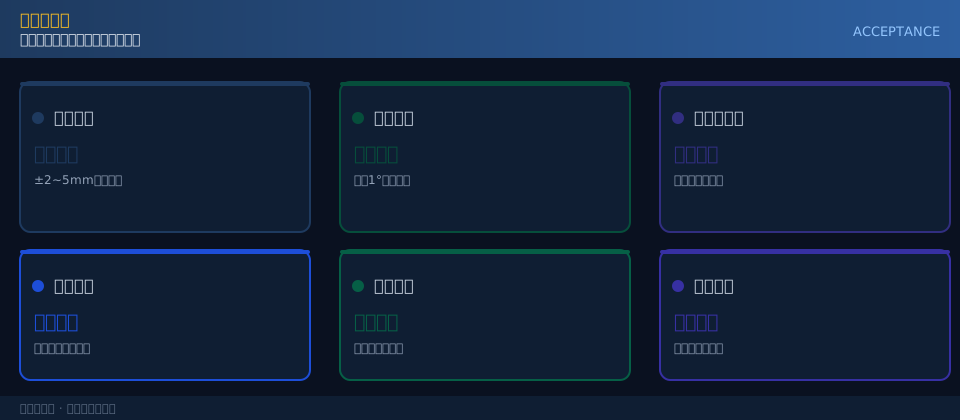
Five Key Commissioning Indicators: Accuracy, Sway, Takt Time, and Interlocks
First, positioning accuracy. Repeat positioning accuracy is the foundation of automation. Encoder, laser distance measurement, and Gray-code bus positioning systems all aim to consistently hold ±2 to 5 mm. Acceptance must measure repeat positioning accuracy — repeatedly stopping at the same target point and verifying the error stays within range, not a single lucky stop.
Second, anti-sway angle. The goal of anti-sway control is to keep the sway angle within 1° when lowering the hook, enabling one-shot positioning. Acceptance must measure sway angle at full load and normal operating speed — not "showcase data" from no-load, low-speed runs.
Third, acceleration/deceleration smoothness. Variable Frequency Speed Control must deliver smooth acceleration and deceleration without impact, which is critical for mechanical shock and load stability. Acceptance reviews whether the acceleration/deceleration curve is steady and free of abrupt speed changes.
Fourth, takt time cycles. The time for one loading/unloading or handling cycle must align with production line takt. Acceptance must measure the full cycle time including acceleration, deceleration, and interlock handshakes — not just steady-speed travel.
Fifth, interlock actions. Interlocks for overload, limit switches, area guards, and emergency stop must automatically trigger alarms, deceleration, or shutdown when limits are exceeded or activated. TSG 51-2023, the Safety Technical Supervision Regulation for Lifting Appliances, sets supervision requirements for various interlocks. Acceptance must trigger each one individually to verify — this is the last line of defense for automation safety.
Interlock Testing: Trigger Each Function to Verify Action
Interlock testing is the centerpiece of automation acceptance and the easiest step to rush through. The correct approach is to trigger each interlock individually and verify the actual response.
Four interlocks must be triggered and verified one by one:
Overload interlock — load to the alarm threshold to verify the alarm, then to the limit threshold to verify hoisting is cut off.
Limit switch interlock — manually drive the mechanism to the limit point to verify deceleration and stop.
Area guard — introduce a person or obstacle into the early warning zone and danger zone to verify graded alarms and shutdown.
Emergency stop interlock — press the emergency stop to verify immediate power cutoff.
The acceptance criterion for each interlock is that the action actually occurs — not that the function appears on a screen. Data collected without an alarm, or an alarm without a stop, both fail acceptance. Kelude records the trigger and response of every interlock with measured data during acceptance as delivery evidence.
Three Commonly Overlooked Acceptance Issues
First, substituting no-load data for full-load data. A small sway angle and high accuracy at no-load, low speed do not guarantee compliance at full load and normal speed. Acceptance must be performed at the actual load and speed of operating conditions.
Second, testing once instead of repeatedly. Indicators like positioning accuracy and sway angle are about repeatability and stability — a single pass could be luck. Acceptance requires repeated, continuous testing to examine the error distribution.
Third, verifying interlocks on screen only, not in action. Data collected and a screen lighting up do not mean the interlock can actually stop the crane. Every interlock must be triggered and measured to verify the action truly occurs. Kelude writes "measured data retention" into the acceptance clause in contracts, eliminating paper-based acceptance.
Five Commissioning Indicators and Target Values at a Glance
| CommissioningIndicator | Basis | Compliance Value |
|---|---|---|
| Positioning Accuracy | Contractual Agreement | RepeatabilityPositioning±2~5mm |
| anti-sway controlAngle | Contractual Agreement | lowering the hooksway angle1°Within |
| PlusDecelerationSmooth | GB/T 12668 | NonespeedSudden Shock |
| takt timeCycle | Contractual Agreement | Including PlusDecelerationHandshake Alignment Line |
| interlock action | TSG (Special Equipment Safety Technical Regulation) 51 Safety Technical Specification for Special Equipment-2023 Crane Safety Technical Supervision Regulation | Measured Over-Limit Alarm Shutdown |
| Data Traceability | GB/T 28264 Safety Monitoring and Management System | ParameterRecord Traceability |
Inspection Clauses for Automated Acceptance
| InspectionItem | standard basis | Judgment Criteria | CommonDefect |
|---|---|---|---|
| load test | ISO 4310 | rated loadNormal Operation Below | No-loadMisrepresentationFull load |
| Positioning Accuracy | Contract Measured Value | RepeatabilityPositioningStable Compliance | Single Measurement Only |
| anti-sway controlAngle | Contract Measured Value | Full loadCommonly UsedspeedStable Compliance | No-loadDemonstration Data |
| overloadinterlock | FEM 1.001 Crane Design Standard | Measured Alarm Cut-off | Alarm Only Withoutinterlock |
| limit switchinterlock | TSG (Special Equipment Safety Technical Regulation) 51 Safety Technical Specification for Special Equipment-2023 Crane Safety Technical Supervision Regulation | In PositionDecelerationOver-Limit Stop | Secondarylimit switchMissing |
| Zoneguards | ISO 23812 | Out of BoundsgradingShutdown | Blind Spot Notcoverage |
| emergency stopinterlock | TSG (Special Equipment Safety Technical Regulation) 51 Safety Technical Specification for Special Equipment-2023 Crane Safety Technical Supervision Regulation | emergency stopEffective on Power-off | emergency stopInvalid |
FAQ: Overhead Crane Automation Acceptance
Q: What's the difference between acceptance testing for automated cranes and standard cranes?
A: Standard acceptance focuses on load tests and safety devices. Automated acceptance adds measured verification of intelligent performance indicators—positioning accuracy, anti-sway angle, acceleration/deceleration smoothness, takt time cycles, and interlock actions. Most of these indicators lack a single mandatory standard, so they must be written into the contract as acceptance criteria and verified item by item through actual testing. The core difference is that automated acceptance prioritizes repeatability and measured performance over a one-off functional demonstration.
Q: What standards can we reference for automated commissioning indicators?
A: Load testing follows ISO 4310, safety monitoring data logging follows GB/T 28264-2017, limit switch and emergency stop interlocks must meet TSG 51-2023 regulatory requirements, and variable frequency speed control references GB/T 12668. Intelligent indicators like positioning accuracy, anti-sway angle, and takt time cycles are typically defined in the contract, with acceptance judged against the measured values specified there. The general rule: follow the standard where one exists, follow the contract where it doesn't.
Q: Which indicators deserve the closest attention during acceptance?
A: Focus on three: positioning accuracy repeatability, genuine interlock action, and full-load anti-sway angle measurement. For positioning, look at the error distribution across repeated stops—not a single attempt. For interlocks, trigger each one to verify it actually stops the crane, not just displays a status on screen. For anti-sway, measure the sway angle at full load and typical operating speeds—not an empty-hook demonstration. These three are the easiest to fudge and the most critical to whether automation actually performs in production.
Q: How do you determine whether automated system acceptance truly passed?
A: Check whether each indicator has documented measured data on file—not just a feature checklist. Look for continuous repeat-test records for positioning accuracy, item-by-item trigger logs for interlocks, and full-load sway angle measurements for anti-sway. These are the hard evidence. Only when the data is complete and meets the specified values has acceptance genuinely passed. If you only have functional screenshots without measured data, flag it and require retesting.
For detailed engineering practices on automated acceptance, refer to the commissioning approach in Crane Electrical Control System Design Full Process: From Schematic Drawing to PLC Program Commissioning.
Automated acceptance isn't about passing a feature checklist—it's about verifiable measured data. Kelude Heavy Industry writes documented measurement records for every indicator into its delivery terms, ensuring automation capability stands up to scrutiny rather than relying on marketing claims.
