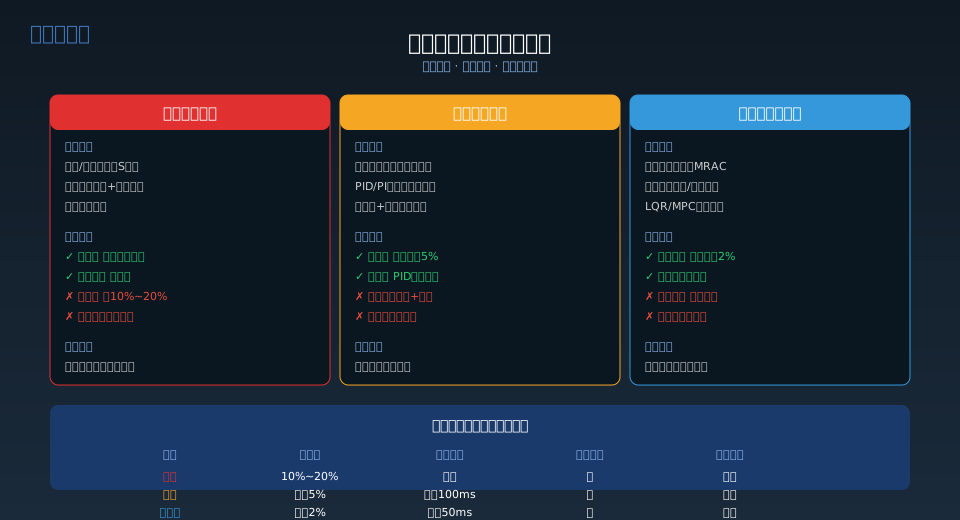

Crane Anti-Sway Control: Open-Loop vs Closed-Loop vs Adaptive

Crane anti-sway control algorithms fall into three categories: open-loop control (S-curve acceleration/deceleration, residual sway 10%–20%), closed-loop control (inclination sensor + PID feedback, residual sway below 5%), and adaptive control (MRAC/LQR/MPC, residual sway below 2%). Selection should weigh accuracy requirements, hardware cost, and implementation complexity.

Load sway during overhead crane hoisting is a major issue that undermines both operational efficiency and safety. Kelude has developed three anti-sway control algorithms for its intelligent crane systems—open-loop S-curve, closed-loop PID, and adaptive MRAC—covering everything from low-cost retrofits to high-precision automated hoisting. Below is an engineering comparison across four dimensions: control principle, accuracy indicators, hardware cost, and application scenarios.

The choice of anti-sway technology directly impacts hoisting efficiency and safety. For a detailed look at crane PLC Control System architectures, see Three-Tier PLC Control System Architecture for Overhead Cranes.

Comparison of crane anti-sway control algorithms

Anti-Sway Control Algorithms Compared: Open-Loop vs. Closed-Loop vs. Adaptive

← Scroll left / right to view full table →
Algorithm Type Control Principle Residual Sway Hardware Cost Application Scenarios
Open-Loop Control S-curve acceleration and deceleration 10%–20% Low (no additional sensors) Low-cost retrofits, general-purpose hoisting
Closed-Loop Control Inclination Sensor + PID feedback Below 5% Moderate (inclination sensor required) Precision hoisting, semi-automated operations
Adaptive Control MRAC / LQR / MPC Below 2% High (advanced controllers and sensors) Fully automated hoisting, high-precision positioning

Open-Loop Anti-Sway Control: S-Curve Deceleration for Cost-Effective Retrofits

Open-loop anti-sway control shapes the crane's acceleration and deceleration profile using an S-curve, eliminating the need for additional sensors. This approach is simple to implement and works well for retrofits where hardware changes are minimal. However, because there is no feedback mechanism, residual sway typically remains in the 10%–20% range, making it suitable for applications where moderate sway is acceptable.

Closed-Loop Anti-Sway Control: Inclination Sensor and PID Feedback

Closed-loop control adds an inclination sensor to measure the load's swing angle in real time. A PID controller adjusts the trolley and hoist motions to actively dampen sway, reducing residual sway to below 5%. This approach delivers significantly better accuracy than open-loop methods while keeping hardware costs moderate, making it a popular choice for semi-automated cranes and precision positioning tasks.

Adaptive Anti-Sway Control: MRAC, LQR, and MPC for High-Precision Hoisting

Adaptive control algorithms—such as Model Reference Adaptive Control (MRAC), Linear Quadratic Regulator (LQR), and Model Predictive Control (MPC)—continuously adjust control parameters based on real-time system dynamics. These methods achieve the highest precision, with residual sway below 2%, and are ideal for fully automated hoisting operations where load positioning accuracy is critical. The trade-off is higher hardware and implementation costs.

How to Choose the Right Anti-Sway Control Algorithm

Selecting the right anti-sway control algorithm depends on your specific requirements:

  • Budget-constrained retrofits: Open-loop S-curve control offers a low-cost entry point with minimal hardware changes.
  • Balanced performance and cost: Closed-loop control with an inclination sensor and PID provides a solid middle ground for most industrial applications.
  • High-precision automation: Adaptive control (MRAC/LQR/MPC) is the go-to choice for fully automated systems where sway must be minimized to near zero.

For a deeper dive into PLC Control System design for overhead cranes, refer to our three-tier PLC architecture guide.

← Scroll left / right to view full table →
Comparison Parameter Open-loop SCurve Closed-loop PID Adaptive MRAC/MPC
Control PrinciplePlus Deceleration Trapezoidal/SCurveInclination Sensor+PIDFeedbackModel Reference Adaptive+Optimal Control
Sensor RequirementNoneInclination Sensor×1Tilt Angle+Encoder+accelerometer
Residual Sway Rate10%~20%Less Than5%Less Than2%
Response timeReal-timeLess Than100msLess Than50ms
Disturbance Rejection CapabilityWeak(Unable to Handle Wind Load)Medium(Sensitive to Environmental Vibration)Strong(Adaptive to Load/Rope Length Variation)
Hardware CostLowMediumHigh
Commissioning ComplexitySimple(Parameter3~5Unit(s))Moderate(PIParameter Tuning)Complex(Model Identification+Parameter Tuning)
Controller RequirementPLCBuilt-in Ramp FunctionPLC+Analog Signal ModuleHigh Performance PLCOrindustrial PC
Application ScenariosLow Speed Light Load/Accuracy Low RequirementMedium-High Speed/Precision HoistingHigh Speed Heavy Load/Smart Factory

Key Engineering Implementation Details

Open-loop S-curve profile. Jerk (rate of change of acceleration) is the critical parameter, with a recommended range of 0.5–2 m/s³. Acceleration time scales with rope length: 3 seconds for a 2 m rope, 5 seconds for a 6 m rope. A timer is added to the deceleration buffer phase at the end of travel to prevent impact loads.

Closed-loop PID control. The inclination sensor is mounted at the end of the rope segment above the hook, with a measuring range of ±30° and an accuracy of 0.1°. P gain: 0.5–2.0; I integral time: 0.5–2 s; D derivative time: 0.05–0.2 s. Sampling period: 20 ms. Control logic: when the swing angle is in the same direction as travel, reduce speed; when opposite, increase speed.

Adaptive MRAC. The reference model uses a second-order pendulum dynamics equation with online identification of rope length and load mass. The LQR weight matrices Q and R are automatically adjusted based on rope length: shorter ropes increase Q (prioritizing swing suppression), while longer ropes increase R (limiting control effort). The MPC prediction horizon is 10 steps with a control horizon of 3 steps and a sampling period of 50 ms. Kelude Heavy Industry employs a hybrid approach in practice—genetic algorithm offline optimization combined with online adaptive correction—balancing real-time performance and optimality.

Open-loop Solution

Lowest Cost, No Additional Hardware Required, Suitable for Low Accuracy Operating Conditions

Closed-loop Solution

Accuracy Moderate, Controllable Commissioning Effort, Best Cost-Performance Ratio

Adaptive Solution

Accuracy Highest, Full Operating Condition Adaptivity, Suitable for Smart Production Lines

Selection Recommendation

Open-loop Preferred for Light Load Low Speed, Precision Hoisting Select Medium Loop

The anti-sway control system is designed and manufactured in compliance with the ISO 4301 Crane Design Standard and the JB/T 1306 standard. Kelude Heavy Industry's intelligent overhead cranes can be configured with three anti-sway control options. Each crane undergoes no-load and full-load swing angle calibration testing before leaving the factory, ensuring the residual sway rate remains within the specified range.

Anti-Sway Control System: Frequently Asked Questions

Q: How is the performance of the overhead crane anti-sway control system verified?

A: Using Kelude Heavy Industry's verification method as an example: the crane is operated at rated travel speed under no-load conditions, and the swing angle is measured with a high-speed camera. The open-loop control scheme achieves a residual sway of 10%–15%, the closed-loop scheme achieves 3%–5%, and the adaptive scheme achieves less than 2%. Full-load verification repeats the test at rated load, with data deviation within ±1%.

Q: Can anti-sway control be retrofitted to an existing crane?

A: The open-loop scheme requires only a PLC program upgrade (adding an S-curve function block to the ladder logic) — no additional hardware is needed. The closed-loop and adaptive schemes require the installation of an inclination sensor and/or encoder, with an installation period of 1–2 days and a cost of approximately $740–$2,960. The retrofit can be performed in place on the existing overhead crane.

Q: How much does anti-sway control affect lifting efficiency?

A: With the open-loop scheme plus S-curve, each lifting cycle adds 2–5 seconds (including acceleration/deceleration buffering). However, the operator no longer needs to wait for the load to stop swinging at the destination, resulting in an overall efficiency gain of 10%–20%. The adaptive scheme has virtually no impact on travel speed and can improve efficiency by more than 30%.

Q: Is anti-sway performance consistent across different rope lengths?

A: The open-loop scheme adapts poorly to varying rope lengths — the residual sway deviation between 5 m and 10 m ropes can reach 8%. The closed-loop PID scheme offers some robustness to rope length changes, with deviation kept within 3%. The adaptive MRAC scheme identifies rope length variations online and adjusts parameters accordingly, delivering consistent performance across all rope lengths.

Related News

contact

contact us

phone:
+86 13903802779

mail:3915269@qq.com

Working hours: Monday to Friday

Wechat
Wechat
SHARE
TOP