

How to Prove AI Model Reliability: Crane Test & Acceptance
📋 Key Summary
Proving an AI model's reliability before deployment is a challenge many manufacturers struggle to articulate. It comes down to three pillars—test set evaluation, robustness testing, and generalization testing—backed by documented measurements of hard metrics like accuracy, recall, and false alarm rate. This article explains what to test, how to test it, which indicators to track, and the most common acceptance pitfalls for AI inspection models.
📌 Positioning AI Inspection Acceptance Indicators
Accuracy: The proportion of correct predictions, but it can be misleadingly high when defects are rare.
Recall: The proportion of actual defects correctly identified—the most critical metric in safety-critical scenarios, where missed alarms carry the highest cost.
False alarm rate: The proportion of normal samples misclassified as anomalies. Excessive false alarms erode operator trust.
The most common mistake when accepting an AI inspection system is relying solely on a demo. A supplier runs a few carefully selected samples, everything looks perfect, and the system is signed off. But once deployed, false alarms and missed alarms surface across real operating conditions.
AI model reliability cannot be proven by a demo. It requires test set evaluation, robustness testing, generalization testing, and documented measurements of hard metrics. Here's a closer look.
What to Test for AI Inspection Acceptance: Test Set, Robustness, Generalization
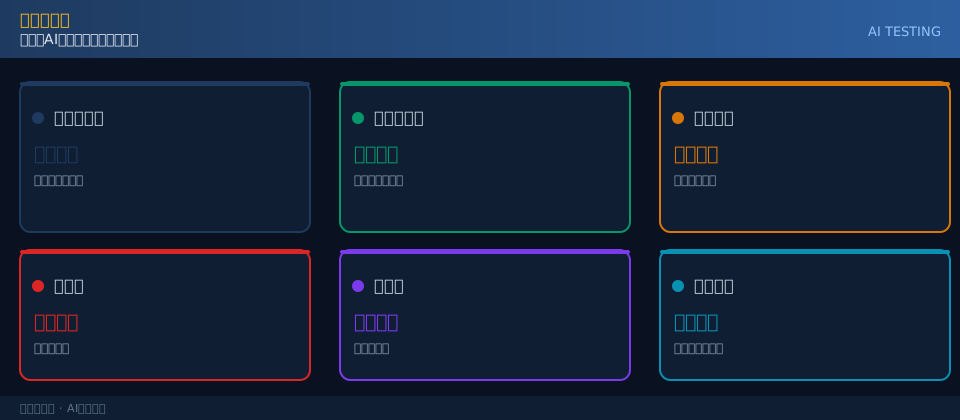
Pre-deployment acceptance of an AI model centers on three core areas.
First, test set evaluation. A portion of annotated data is held out from training and used exclusively to test the model. ISO 24621, AI Fault Diagnosis for Cranes, provides a framework for diagnostic model acceptance. How the model performs on this unseen data reflects its true capability.
Second, robustness testing. Inputs are perturbed—image noise, lighting changes, slight occlusions—to see whether the model holds up under interference. Industrial environments are complex, and a model with poor robustness will fail immediately upon deployment.
Third, generalization testing. The model is tested on operational data outside the training set, such as different load materials or shift times, to assess its adaptability to unseen operating conditions. Generalization determines whether the model can deliver long-term value.
How to Test: Holdout Sets, Cross-Validation, and A/B Comparison
Test methods must be rigorous; otherwise, the measured indicators are not credible.
The holdout set is the most fundamental approach. Data is split into training and test sets—training uses only the training set, testing uses only the test set, with strict separation to prevent the model from "peeking" at test data and inflating metrics.
Cross-validation is more rigorous. Data is divided into several folds, with each fold used once for testing while the rest is used for training. Averaging the results provides a more stable estimate of the model's true performance, making it suitable for smaller datasets.
A/B comparison is the final gate before deployment. The new model is pitted against the old model, or AI against human inspectors, on identical tasks to see which performs better—letting real results speak. Kelude Heavy Industry insists on holdout evaluation as the baseline and A/B comparison for critical scenarios during acceptance.
Which Indicators to Track: Accuracy, Recall, False Alarm Rate
AI inspection acceptance cannot rely on accuracy alone; multiple indicators must be reviewed together.
Accuracy reflects the overall proportion of correct predictions, but it has a trap: when defects are rare, a model that classifies everything as normal still achieves high accuracy. Therefore, accuracy cannot serve as the sole acceptance criterion.
Recall measures how many actual defects are caught—the metric that matters most in safety-critical scenarios. Missed alarms carry the highest cost, and low recall means real defects are slipping through.
False alarm rate measures how many normal samples are misclassified as anomalies. Too many false alarms exhaust maintenance teams' trust and eventually lead to alarm fatigue. Acceptance must consider accuracy, recall, and false alarm rate together, weighting recall and false alarm rate according to the application. Kelude Heavy Industry treats recall as a hard threshold in safety monitoring acceptance.
Most Common Acceptance Pitfalls
Pitfall one: the test set does not match the real data distribution. Testing on carefully curated, clean data yields impressive metrics, but the model collapses under real operating conditions. The test set must closely mirror actual operational data.
Pitfall two: tracking only a single metric. Looking at accuracy alone while ignoring recall and false alarm rate misses the most critical indicator for safety scenarios, rendering acceptance meaningless.
Pitfall three: no documentation. Without documented measurements of test results, there is no traceability when issues arise. GB/T 28264-2017, Safety Monitoring and Management System for Lifting Appliances, sets requirements for record retention and traceability. Kelude Heavy Industry documents the test set, indicators, and results throughout the process, serving as the basis for delivery and traceability.
AI Inspection Acceptance Indicator Reference
| AcceptanceItem | Test Subject | Method | CriticalIndicator | CommonDefect |
|---|---|---|---|---|
| test setEvaluation | Unseen Data Performance | Hold-out Setcross-validation | Accuracy | test setNoisy Data |
| robustnessTesting | Robustness Under Interference | AddnoiseIllumination and Occlusion | robustness | Ideal-Condition Testing Only |
| GeneralizationTesting | Noveloperating conditionsNon-Failure | Cross-operating conditionsData Testing | Generalization Capability | Single-Condition Testing Onlyoperating conditions |
| safety indicators | DefectExhaustive Coverage | recall rateField Testing | recall ratefalse alarm rate | Accuracy-Only Assessment |
Quick Reference of Standard Clauses for AI Inspection and Acceptance
| Standard | Clause Essentials | andAcceptanceRelationship |
|---|---|---|
| ISO 24621 | craneAI fault diagnosisFramework | diagnostic modelAcceptanceBasis |
| GB/T 28264 Safety Monitoring and Management System | safety monitoringTraceabilityrequirements | AcceptanceResult Archivingtraceability |
| ISO 4310 | crane test specification | Detectionfunctional testProcedure |
FAQ: AI Inspection Acceptance
Q: How is AI inspection acceptance different from traditional equipment acceptance?
A: Traditional acceptance focuses on mechanical and electrical functionality, while AI inspection acceptance also evaluates model performance on data. The key difference is that AI model reliability cannot be proven through demonstrations alone—it must be verified through test set evaluation, robustness, and generalization, along with measured accuracy, recall rate, and false alarm rate. Additionally, AI models are subject to drift, so acceptance is not a one-time event; continuous monitoring is required after deployment.
Q: Which indicator matters most when accepting an AI inspection system?
A: For safety monitoring applications, recall rate is the most critical indicator because it measures whether real defects are missed—and missed alarms carry the highest cost. A low recall rate means defects go undetected, creating serious safety hazards. For assistive notification systems, recall and false alarm rates can be balanced more evenly. In all cases, accuracy alone should never be the sole criterion, as it can be misleadingly high when defects are rare, masking underlying missed alarms.
Q: What makes a properly prepared test set?
A: Three requirements: the test set must match the real data distribution, be strictly isolated from the training set, and cover the full diversity of real-world operating conditions. It should closely reflect actual operational data after deployment—not carefully curated clean samples. It must not overlap with the training set, which would inflate performance metrics. It should also cover varying lighting conditions, operating scenarios, and defect types to truly validate generalization capability. Without a valid test set, the entire acceptance process is meaningless.
For practical guidance on AI inspection certification, refer to the approach outlined in "Overhead Crane AI Vision Inspection System Passes National Authority Certification with All Test Indicators Approved in a Single Attempt".
AI model reliability is proven by measured indicators, not demonstrations. Kelude makes test set evaluation, robustness, generalization, and documented recall and false alarm rate measurements standard practice in acceptance, ensuring AI inspection systems are verifiable before deployment.
