

AI Fault Diagnosis for Cranes: From Training to Deployment
📋 Key Summary
Many factories get stuck with AI models that are trained but never deployed—or if deployed, nobody monitors them and issues can't be traced. The missing piece isn't the algorithm; it's the engineering discipline that takes a model from training to production—that's MLOps. This article breaks down the six core elements—data versioning, model versioning, training pipelines, deployment, monitoring, and rollback—and explains how to put them into practice.
If your AI project hits any of the following pain points, the root cause is likely engineering, not algorithms:
① The model performs well in the lab but fails in production, and nobody can explain why.
② You want to update the model, but you don't know which version is currently running in production.
③ Three months later, you can't piece together the data, code, and parameters used for training.
④ When the model misbehaves, troubleshooting is manual—there's no monitoring or rollback.
This gap between training and deployment is exactly what MLOps fills. Let's dig in.
MLOps Prerequisites: Treat Models Like Software
The core principle of MLOps is managing AI models with the same rigor as software. Software has version management, pipelines, monitoring, and rollback—AI models need all of that, and then some, because they add the uncertainty of data and training into the mix.
Treating models like software means every training run and every deployment must be as traceable, reproducible, and reversible as a software release. Data versions align, model versions align, training runs can be reproduced, and you can roll back when something goes wrong.
This mindset shift is where engineering starts. Without it, AI projects stay stuck in the "researcher hand-crafts models, field staff maintains them by hand" stage. Kelude brings AI models under the same engineering management as software—that's the foundation for stable deployment. ISO 24621, AI Fault Diagnosis for Cranes, sets out the management requirements for model governance.
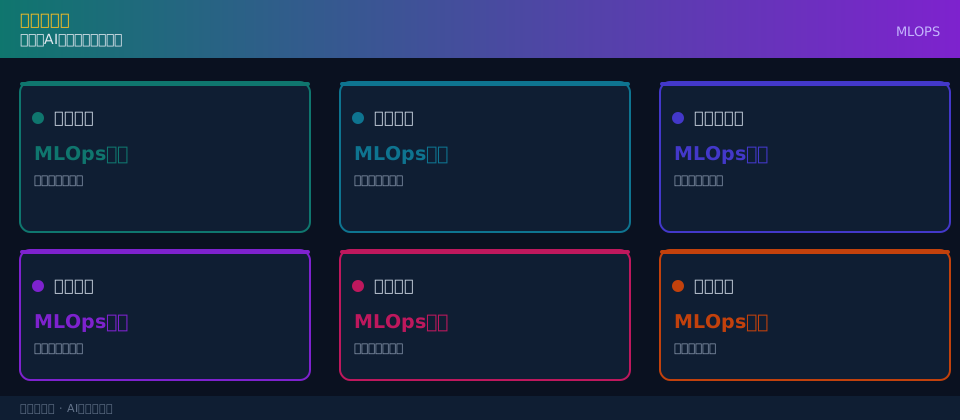
MLOps Parameter Configuration: Tuning the Six Elements
Each of the six MLOps elements has its own configuration essentials.
Data versioning records which dataset was used for each training run and where it came from, keeping training traceable and reproducible. ISO 24619, IoT Interface Specification for Cranes, defines the requirements for standardizing data access systems.
Model versioning assigns a version number to every trained model, logging its data, code, and indicators, so you always know exactly which version is running in production.
Training pipelines automate data processing, training, evaluation, and packaging—reducing manual intervention and improving reproducibility.
Deployment and release standardize how models go live. New models pass testing and follow a defined release process—no manual file copying.
Monitoring and alerting keep an eye on production indicators after deployment, triggering alerts when performance degrades, and helping prevent model drift.
Rollback mechanisms let you revert to the previous version with one click if a new model causes problems. These six elements are interlocking—miss one, and your engineering foundation is incomplete.
MLOps Implementation: A Step-by-Step Process
You don't need to implement MLOps all at once. Roll it out in priority order.
Step one: Get versioning under control. Make data and models traceable and reproducible first. This is the most basic and most urgent step—it solves the "I can't tell what's running in production" problem.
Step two: Set up monitoring and rollback. Once live, you need to track indicators and be able to roll back. This establishes the safety net—"when something breaks, we can contain the damage."
Step three: Build automated pipelines. String together training, evaluation, and packaging into an automated flow to boost efficiency and cut down on human error. Kelude follows this three-phase approach—versioning first, then monitoring and rollback, then pipelines—prioritizing control before efficiency.
Common MLOps Mistakes
Mistake one: Focusing only on training, ignoring deployment. All the effort goes into training accuracy while deployment, monitoring, and rollback are left blank—the model either never makes it to production or spirals out of control once it's there.
Mistake two: Version chaos. With no version management for data and models, you can't trace which dataset or model was used when something goes wrong—no reproduction, no traceability.
Mistake three: Manual releases. Deploying models by hand-copying files and tweaking configurations, with no standardized process, means every release is a gamble. In Kelude's AI engineering practice, version management, monitoring and rollback, and automated pipelines are the three non-negotiables.
MLOps Six-Element Configuration Comparison
| Elements | Problem Statement | Implementation Priority | Initial Cost | Consequence of Absence |
|---|---|---|---|---|
| Data Version | Trainingtraceable | Critical | Low | Non-Reproducible Training |
| Model Version | Production Version Clarity | Critical | Low | Unknown Deployment Artifact |
| Trainingassembly line | Processautomation | Medium | Medium | Manual Training Error-Prone |
| Monitoringrollback | Loss Mitigation Capability | Critical | Medium | No Mitigation, Full Exposure |
Quick Reference of Standard Clauses for MLOps
| Standard | Key Clauses | andMLOpsRelationship |
|---|---|---|
| ISO 24621 | craneAI fault diagnosisFramework | Model ManagementSpecification |
| ISO 24619 | craneIoT interfaceSpecification | Dataaccess systemStandard-ization |
| GB/T 28264 Safety Monitoring and Management System | safety monitoringTraceabilityrequirements | operational dataTraceability |
MLOps FAQ: Answers to the Most Common Questions
Q: How is MLOps different from traditional software DevOps?
A: DevOps manages code, while MLOps goes further to manage data and models as well. A software release is defined by its code version, but an AI model's version is a combination of data, code, and the model itself—a change in any one of these alters the outcome. Models also experience drift, requiring continuous monitoring and retraining after deployment, a challenge that traditional software doesn't face. In essence, MLOps extends DevOps by adding data and model management as two new critical dimensions.
Q: With a limited budget, where should we start with MLOps?
A: Start with version management. Tracking your data and model versions is the most fundamental, lowest-cost, and most urgent step. Next, implement monitoring and rollback capabilities to establish a safety net that limits damage when issues arise. Finally, build automated assembly lines to boost efficiency. The recommended sequence is: versioning first, monitoring and rollback as a safety net, and automation for efficiency gains. Don't rush into building a fully automated, large-scale platform from the start.
Q: How do I know if my AI team needs MLOps?
A: Look for signs of missing engineering discipline: models failing in production without a clear cause, uncertainty about which version is running live, scattered or incomplete training data and code, and troubleshooting that relies solely on manual investigation. If any of these symptoms sound familiar, you likely need MLOps. Conversely, if your models are only used for offline analysis, are rarely updated, and are maintained by a single person, the need for full-scale engineering is less urgent—solid version management may be sufficient.
Q: Why do AI models often fail after deployment?
A: The root cause is a lack of engineering rigor between training and deployment. Models are trained on lab data but face real-world operating conditions in production—a significant gap. Without engineering safeguards like monitoring, versioning, and rollback in place after deployment, teams are left fighting fires manually when problems arise. MLOps bridges this gap from training to production, making models traceable, reproducible, monitorable, and reversible, which eliminates the majority of deployment issues.
For a standardized approach to model interface capabilities after engineering, refer to the methodology outlined in Open Overhead Crane PHM Predictive Maintenance API Interface, Completed Data Integration with 30 MES Vendors.
The gap between AI model training and deployment is an engineering problem, not an algorithmic one. Kelude addresses this by implementing six core components—data versioning, model versioning, assembly line, deployment, monitoring, and rollback—making models as manageable and controllable as software, so deployment success is no longer left to chance.
