

Grab Crane Wear Parts Replacement Intervals: Bucket Teeth & Cylinder
The cutting edge plate, bucket teeth, hydraulic cylinder seals, and wire rope of a grab crane are high-wear consumables, with service lives ranging from 3 months to 2 years. The cutting edge plate must be replaced when wear exceeds 40% of its original thickness, or when the bucket tooth fracture rate surpasses 15%. Hydraulic cylinder seals are mandatorily replaced every 12 months or when leakage exceeds 5mL/h. Grab wire rope is scrapped per GB/T 5972-2016 when the number of broken wires reaches 5 within a length of 6d or 10 within one rope lay.
Grab cranes are widely used in port bulk cargo handling, steel mill scrap handling, and aggregate transshipment. They typically operate at work duty A6~A8, with 40–60 start-stop cycles per hour, generating high impact loads and rapid wear rates. As the grabbing device that directly contacts the material, the replacement interval of wear parts—cutting edge plate, bucket teeth, hydraulic cylinder seals, and wire rope—directly affects equipment availability and maintenance costs. The following analysis covers wear mechanisms, acceptance criteria, replacement intervals, and maintenance practices. For more on routine crane maintenance, see GB/T 5972-2016 — Cranes — Wire ropes — Care, maintenance, inspection and discard. Based on years of experience equipping grab cranes, Kelude has compiled the following replacement interval quick-reference table and acceptance criteria.
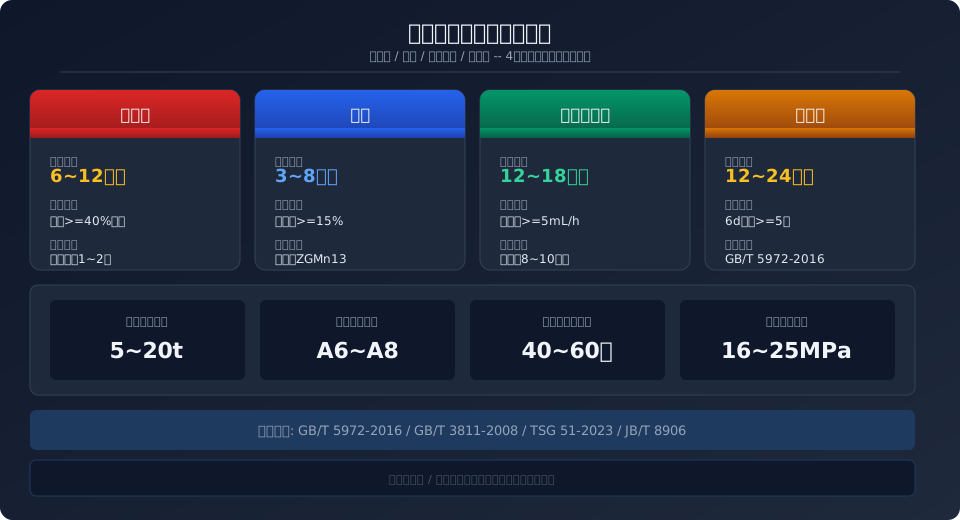
Grab Wear Parts Classification and Failure Mechanisms
Grab wear parts fall into four categories by function and failure mode. The cutting edge plate is an abrasive-wear component; prolonged friction with bulk material thins the plate, and once wear exceeds 40% of the original thickness, the grab fails to close fully, raising material spillage to 15%–20% of rated capacity. Bucket teeth are impact-fracture components that endure repeated shock loads when handling hard materials such as scrap steel and ore. Typical failure modes are chipped tips or complete tooth fracture—a single broken tooth does not stop operation, but a fracture rate above 15% requires replacing the entire set. Hydraulic cylinder seals are fatigue-aging components; O-rings and dust wipers gradually harden and crack under high pressure (16–25MPa) and dusty conditions, and leakage exceeding 5mL/h indicates seal failure. Wire rope is a fatigue-fracture component; the open-close action of the grab repeatedly bends the rope over pulleys and the drum. Per GB/T 5972-2016, the rope must be discarded when visible broken wires reach 5 within a length of 6d or 10 within one rope lay.
Failures of these four wear parts are not isolated. Worn cutting edges prevent the grab from closing fully, which in turn increases wire rope tension fluctuation (peaks can reach 1.8–2.2 times rated tension) and accelerates rope fatigue. Cylinder seal failure directly reduces grab open-close force; operators compensate by raising system pressure (15%–25% above rated), further shortening the life of seals and hydraulic components. A sound replacement interval strategy should therefore consider all four components from a system perspective.
Replacement Interval Quick-Reference for 4 Wear Parts
The table below lists replacement intervals, acceptance criteria, and precautions for each of the four wear part categories, based on actual statistics from A6~A7 grabs operating in ore and scrap steel service.
| Wear Parts Type | Normal Replacement Interval | Mandatory Replacement Criteria Standard | Precautions |
|---|---|---|---|
| cutting edge plate | 6~12months | Wearwear shall not exceed the original thickness40%or localized crack length not less than50mm | repairable by hardfacing overlay1~2times, each hardfacing pass extends service life3~4months |
| bucket teeth | 3~8months | Fracturerate not less than15%or tooth tip Wearlength not less than original length30% | scrap handling duty: inspect every shift, Fracturenot more than2teeth may remain in service |
| hydraulic cylinder Seal | 12~18months | external leakage not less than5mL/hor pressure holding10minpressure drop not less than15% | replacement Sealwhen Synchronizationinspect cylinder bore for scratch depth not exceeding0.2mm |
| Wire Rope | 12~24months | 6dbroken wires within one lay length not less than5broken wires in one strand or one lay not less than10wires or Diameter reductionor localized crack length not less than7% | refer to GB/T 5972-2016, Grab (grab bucket)rope selection: prefer compacted or Compacted strandconstruction |
Wear Criteria and Inspection Methods for Grab Buckets
Cutting Edge Plate Thickness Measurement — Use an ultrasonic thickness gauge (accuracy ±0.1 mm) to take five measurements evenly spaced along the length of the cutting edge plate, recording the minimum thickness value. New plates typically measure 20–30 mm thick (depending on grab bucket capacity). When the minimum thickness drops to 60% of the original value (e.g., from 30 mm to 18 mm), the plate must be replaced. Note that hardfacing repair layers can interfere with readings: the hardfaced zone has a hardness of HRC45–55 and a different acoustic velocity than the base metal, so calibration with a reference test block is required.
Tooth Fracture Rate Tracking — Maintain a tooth inventory log and record the number and location of broken teeth during each shift inspection. Grabs under 5 t typically carry 6–8 teeth, while 10–20 t grabs carry 8–12 teeth. When the fracture rate exceeds 15%, replace the entire set — mixing new and worn teeth is not recommended (a height difference of 5 mm or more between new and old teeth causes uneven load distribution, accelerating fracture of the new teeth due to overload).
Cylinder Seal Leakage Testing — With the cylinder fully extended at rated pressure (16–25 MPa), collect external leakage from the piston rod side in a graduated container for one hour and measure the volume. A leakage rate of 5 mL/h or more indicates seal failure. Internal leakage is detected via a pressure-holding test: extend the piston rod to full stroke, lock the hydraulic circuit, and monitor pressure — a drop of 15% or more within 10 minutes indicates excessive internal leakage.
Wire Rope Diameter and Broken Wire Inspection — Measure the rope diameter at three cross-sections using an optical flat or wire rope diameter gauge (accuracy ±0.01 mm) and record the minimum value. A diameter reduction of 7% or more relative to the nominal diameter requires discard. For broken wire detection, scan the full rope length with a wire rope flaw detector (magnetic flux leakage or visual method) and count visible broken wires within 6d and 30d lengths. For grab open-close ropes, pay particular attention to fatigue-induced broken wires at the pulley groove contact zone and at the grab connection points.
Maintenance Practices to Extend Grab Wear Parts Life
Periodic Cutting Edge Hardfacing Repair — When the cutting edge plate wears to 70% of its original thickness (approximately 21 mm remaining from 30 mm), perform hardfacing repair promptly. Use D212 or D322 wear-resistant electrodes (hardness HRC50–55) with a build-up thickness of 3–5 mm. Each plate can be hardfaced up to two times, extending service life by a cumulative 6–8 months. After hardfacing, perform PT or MT flaw detection to confirm there are no cracks before returning the plate to service.
Grab Open-Close Force Calibration — Calibrate the working pressure of the grab open-close cylinders quarterly to ensure it does not exceed the design rated pressure (typically 16–25 MPa). When cylinders operate at 15%–25% overpressure, seal life drops from 18 months to 6–8 months. Calibration can be achieved by adjusting the relief valve on the hydraulic power unit or by limiting parameters via the PLC. It is recommended to install a pressure sensor (range 0–40 MPa, accuracy ±0.5% FS) with a digital display on the hydraulic power unit so operators can monitor pressure in real time.
Regular Wire Rope Lubrication and Reversal — Apply surface lubrication to grab open-close wire ropes every 200 operating hours or every two weeks (use a wire rope-specific grease with a dropping point of at least 80°C and good penetration). Lubrication not only reduces micro-motion wear between strands but also prevents corrosion. After 1,000–1,500 operating hours, reverse the rope end-for-end so that the fatigue section moves from the pulley bending zone to a low-bending zone, extending service life by approximately 30%. Run the first shift after reversal at 50% load for break-in.
Tooth Material Upgrade — In scrap metal and ore applications, standard cast steel teeth (ZG35CrMo) last only 3–5 months. Upgrading to high-manganese steel (ZGMn13, hardness HB200–250, surface work-hardening to HRC45–52 under impact) or teeth with embedded tungsten carbide inserts (YG8, hardness HRA89–91) extends service life to 8–12 months. The material upgrade adds approximately 30%–40% to cost, but because it reduces downtime for replacements, the overall cost-effectiveness improves by more than 50%.
Kelude Heavy Industry incorporates all four maintenance practices above into the equipment delivery documentation package for grab crane systems, providing a wear parts life prediction model (based on a multiple regression algorithm using operating tonnage × cycle count × material hardness, with prediction deviation within 15%) to help users develop a scientific spare parts procurement and replacement schedule. For detailed wire rope inspection and discard criteria, refer to the provisions of GB/T 5972-2016 Specification for maintenance, inspection and discard of wire ropes for cranes available on this site.
Frequently Asked Questions
Q: At what wear level must the grab cutting edge plate be replaced?
A: The cutting edge plate must be replaced when wear reaches 40% of the original thickness. Hardfacing repair can be performed 1–2 times (using D212/D322 electrodes, 3–5 mm build-up per pass), adding 3–4 months of life per repair, for a cumulative extension of 6–8 months. After two repairs, the heat-affected zone in the base metal undergoes grain coarsening and toughness drops by approximately 30%–40%, making further hardfacing prone to cold cracking or brittle fracture in service — further repair is not recommended.
Q: What are the specific discard requirements for grab wire ropes under GB/T 5972-2016?
A: GB/T 5972-2016 requires immediate discard of grab wire ropes when any of the following conditions are met: 5 or more visible broken wires within a 6d length, 10 or more broken wires within one rope lay length, diameter reduction of 7% or more relative to the nominal diameter, or severe corrosion, waviness, or cage distortion. Because grab open-close ropes experience severe bending fatigue, face-contact or compacted strand rope constructions (such as 6xK36WS+IWRC) are recommended to improve bending fatigue life by approximately 40%.
Q: What is the normal leakage rate for hydraulic grab cylinder seals, and what are the replacement criteria?
A: Under normal operating conditions, external cylinder leakage should not exceed 1 mL/h. A leakage rate of 5 mL/h or more indicates seal failure. Oil analysis (quarterly sampling to check ISO 4406 Hydraulic fluid cleanliness standard and water content) can help predict seal life: when particulate contamination exceeds NAS Class 10 or water content exceeds 0.1%, seal wear accelerates by 3–5 times, and replacement should be scheduled earlier. The standard seal replacement interval is 12–18 months; in severe environments (dust concentration of 50 mg/m³ or higher), shortening the interval to 8–10 months is recommended.
Q: How much better is the wear resistance of high-manganese steel grab teeth compared to standard cast steel?
A: Mixing new and worn teeth causes uneven load distribution. When new teeth protrude 5 mm or more above worn teeth, they bear 130%–150% of the load share, accelerating fracture — teeth should be replaced as a complete set. High-manganese steel (ZGMn13) teeth self-harden on the surface to HRC45–52 under impact while the core retains toughness (HB200–250), resisting brittle fracture, and last approximately 2–3 times longer than standard cast steel (ZG35CrMo). Kelude Heavy Industry equips grabs for scrap metal and ore applications with high-manganese steel or tungsten carbide-insert reinforced teeth as standard.
Related Reading: GB/T 5972-2016 Specification for maintenance, inspection and discard of wire ropes for cranes | Crane Hydraulic Seal Selection and Maintenance Guide
Kelude Heavy Industry — Grab Crane Systems and Full Life Cycle Management for Wear Parts
