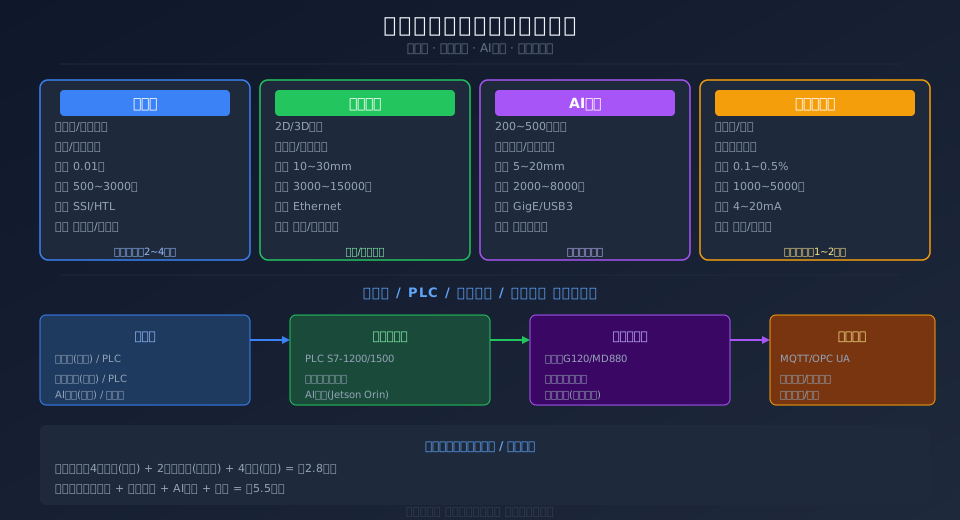
Overhead Crane Sensor System Selection & Architecture Design

Four core sensor types for intelligent overhead crane sensing systems: Encoders (position/speed feedback, $75–$445), LiDAR (anti-collision detection, $445–$2,220), AI vision (load identification, $295–$1,185), and Load Cells (mandatory per GB/T 28264-2017, Section 5.1.1, Table 1, Item 8, $150–$740). A closed-loop control chain is achieved through a PLC + Edge Computing fusion architecture. Kelude recommends a coordinated configuration of 4 encoders + 2 LiDAR units + 4 load cells for standard applications, adding AI vision and a Gray-code bus positioning system for unmanned overhead cranes.

The perception capability of an intelligent overhead crane directly dictates its level of automation and operational safety. Sensors form the foundation of this perception layer—encoders provide position and speed feedback, LiDAR perceives the surrounding environment, AI vision identifies loads and personnel, and load cells monitor the suspended load. However, data from any single sensor is inherently limited and noisy. Reliable perception requires fusing data from multiple sensors via a PLC and Edge Computing gateway. This article provides a systematic overview of the engineering implementation for intelligent crane sensing systems, covering sensor selection parameters, installation requirements, data fusion architecture, and full-chain design.

Full-chain architecture of an intelligent crane sensing system featuring encoders, LiDAR, AI vision, and load cells

Four-Layer Sensing Architecture and Data Flow

The sensing system of an intelligent overhead crane is structured into four layers based on the data processing flow: Sensor Layer—various sensors acquire raw signals (pulses, voltage, images), operating independently with distinct data formats; Data Fusion Layer—a PLC or Edge Computing box performs timestamp alignment, Kalman filter fusion, and AI inference on multi-sensor data to output a unified perception result; Control Execution Layer—VFDs and brakes execute actions like speed adjustment or stopping based on the perception results; Cloud Platform Layer—operational data is uploaded to a remote server via MQTT/OPC UA for long-term storage and analysis.

Data flows between these layers as follows: upstream from the Sensor Layer to the Fusion Layer (sensor data to PLC/Edge box), downstream from the Fusion Layer to the Control Layer (control commands to VFD/brakes), and upstream from the Fusion Layer to the Cloud Layer for monitoring data. Key design requirements include end-to-end latency from the sensor layer to the control layer of ≤20ms (from sensor acquisition to brake actuation), and latency from the sensor layer to the cloud layer of ≤1s (acceptable for remote monitoring). Kelude's sensing system architecture has achieved third-party SIL2 Safety Integrity Level certification. For specific algorithms related to sensor data fusion, please refer to our articles on multi-sensor fusion positioning.


Multi-Sensor Data Fusion Algorithms and Implementation

The core task of multi-sensor data fusion is to address the issues of "incomplete information, high noise, and inconsistent update rates from individual sensors." Taking crane position detection as an example—encoders offer real-time updates (1–10kHz) but suffer from cumulative errors (e.g., 100–300mm drift per 100m due to wheel wear), while LiDAR provides updates at 25–50Hz but introduces random measurement noise (±10–30mm). These data characteristics are complementary. The engineering solution for data fusion employs a Discrete Kalman Filter implemented in the PLC to achieve optimal estimation of the position state.

Kalman Filter Implementation for Crane Position Fusion: The state vector is X=[position, velocity]T, and the observation vector Z is the LiDAR ranging value. The system equation is X(k)=A·X(k-1)+B·U(k)+W(k), and the observation equation is Z(k)=H·X(k)+V(k). Here, A is the state transition matrix, B is the control input matrix, and H is the observation matrix. The process noise covariance Q and observation noise covariance R significantly impact filter performance—a higher Q/R ratio results in smoother filtering but slower response, while a lower ratio yields faster response but poorer noise suppression. Kelude's standard parameters implemented on a Siemens S7-1500 PLC are: Q=diag([0.1, 0.01]), R=100 (corresponding to a LiDAR standard deviation of ±10mm), achieving a post-filtering position estimation error of ±2mm (compared to ±30mm with a single LiDAR). This function block occupies approximately 8KB of code and has an execution time of 0.5ms.

Sensor Failure Detection and Switching Logic: When a sensor's data falls outside the 3σ range for 5 consecutive cycles, the system declares the sensor failed and automatically removes it from the fusion process, switching to a pure encoder-based dead reckoning mode (which has cumulative errors but maintains operation, with an error growth rate of approximately 3mm per 100m). Simultaneously, a sensor fault alarm is triggered. When the failed sensor recovers (data within 3σ for 5 consecutive cycles), the system automatically re-integrates it and re-initializes the Kalman filter. In Kelude's sensing systems, LiDAR and load cells support 1:1 redundancy; when the primary sensor fails, the backup sensor takes over seamlessly with a switching time of <50ms.


Sensor Selection Parameters and Installation Guide

← Scroll left / right to view full table →
Selection Parameter Encoder(Incremental) Li DAR(2D) AIvision camera Load Cell / Weighing Sensor
Specification ModelE6B2-CWZ6CLMS111/ TIM781MV-CE200-10GMJLBU/Pin-type
Accuracy1024~5000Pulses per revolution (PPR)±10~30mm±5~20mm(Detection)±0.1~0.5%F.S.
Update/Sampling RateReal-time(High-speed Counting)25~50Hz30fps(1920×1080)10~100Hz
Output SignalHTL (high-threshold logic)/TTL (transistor-transistor logic)DifferentialEthernet/RS485Gig E Vision4~20mA/RS485
Operating Temperature-10~+70°C-30~+50°C-20~+60°C-20~+65°C
Protection Rating (IP)IP54~IP67IP65~IP67IP40~IP65(Housing/Enclosure)IP65~IP68
Mounting Positionmotor shaft/Wheel AxleEnd Carriage/Main Girder BottomTrolley Frame Downward-facinghook block sheave/Fixed Pulley
Unit Cost500~3000CNY3000~15000CNY2000~8000CNY1000~5000CNY
Kelude RecommendedStandard Configuration(Per Unit2~4pcs)Coordination/Anti-collision Mandatoryunmanned overhead crane OptionalStandard Configuration(Per Unit1~2pcs)

Sensor Installation & Electrical Wiring Best Practices

Sensor installation quality directly impacts overhead crane positioning accuracy and overall system reliability. Encoder mounting requires motor shaft concentricity deviation ≤0.05mm (using a flexible coupling), and the mounting bracket's resonant frequency must be at least 3 times the crane's maximum operating frequency to avoid resonance zones. For LiDAR installation, a vibration-dampening base (Q235B steel plate, ≥10mm thick) must be welded to the end carriage, with an unobstructed optical path between the base and reflector plate—the emission window requires monthly cleaning. When the AI vision camera is mounted on the lower trolley frame for downward viewing, ensure its field of view covers a 3m×3m area below the hook, with no obstructions between the camera lens and the load; distortion calibration is performed before factory shipment.

Electrical Wiring Specifications: Sensor cables run through cable trays along the crane main girder. Power lines (VFD output 380V) and signal cables (encoder/LiDAR/weighing 4~20mA) must be routed in separate trays with a minimum spacing of 200mm. Signal cables should use twisted-pair shielded cable (BELDEN 9773 recommended for encoders, CAT5e SFTP for LiDAR, 2-core twisted-pair shielded for weighing sensors), with shield single-point grounding (grounded at the PLC side, floating at the sensor side). Waterproof cable glands (IP68) are required at cable tray entry/exit points, and IP67 aviation connectors for intermediate joints. Kelude Heavy Industry performs per-channel EMC testing on all sensing systems before shipment (IEC 61000-4-3 radiated immunity 10V/m/80MHz~1GHz, IEC 61000-4-4 fast transient immunity ±2kV/5kHz), with test records delivered alongside the equipment.

Sensor Protection & Maintenance Intervals: Encoder operating temperature range is -10~+70°C with IP54~IP67 protection rating. Check coupling tightening torque every 6 months (recommended M4 bolts at 2.5N·m). LiDAR emission windows should be cleaned every 3 months (using anhydrous ethanol + lint-free cloth) and factory recalibrated every 12 months. Load cells require online calibration every 12 months using standard weights (4 calibration points: 0%/50%/100%/125% of measuring range) with calibration accuracy of ±0.1%F.S. Kelude Heavy Industry offers periodic sensor calibration services, with priority response available through annual maintenance contracts.


Standard Sensing System Configurations from Kelude

Kelude Heavy Industry offers three standard sensing system configurations tailored to crane automation level and budget. Basic (Anti-Collision): 2 LiDAR units + 2 encoders + 1 load cell per crane, approximately $3,700 per crane. Standard (Semi-Automatic): Adds 1 AI vision camera + Gray-code bus positioning system for full-travel positioning, approximately $8,100 per crane. Premium (Fully Automatic): Fully redundant configuration with dual LiDAR + dual AI vision + dual load cells, approximately $11,800–$17,700 per crane. Kelude Heavy Industry provides end-to-end services including site survey, design, installation & commissioning, and remote operation & maintenance for all sensing systems.


← Scroll left / right to view full table →
Application ScenarioSensor ConfigurationAccuracyUnit Cost/CNYDeployment Quantity
anti-collision Entry-levelLi DAR×2±30mm6000~1000050+Unit
anti-collision EnhancedLaser×2+AIVision×1±10mm+Identification12000~2000012Unit
Coordinated SchedulingEncoding×2+Laser+Weighing±2mm15000~2500036Unit
unmanned overhead crane(Full Configuration)Gray-code bus positioning system+AI+Weighing±2~5mm35000~550008Unit
Basicanti-collisionEncoder×2±30mm2000~4000120+Unit

Frequently Asked Questions

Q: How do LiDAR and AI vision work together for overhead crane anti-collision? Can I use just one?

A: LiDAR and AI vision each have strengths and limitations in crane anti-collision scenarios, and we recommend using them together. LiDAR (2D) outputs direct distance measurements (accuracy ±10–30 mm), is unaffected by lighting conditions, and processes data quickly (25–50 Hz update rate) for direct PLC integration. However, it only detects objects within its horizontal scanning plane and cannot identify what the object is (person, load, or equipment). AI vision can classify objects (person/forklift/load) and covers a wide detection area (a 2 MP camera can cover a 20 m × 15 m zone), but it is sensitive to lighting and dust, with 30–100 ms inference latency. For basic anti-collision only, LiDAR alone is sufficient. If you need to distinguish personnel from loads, or monitor the area beneath the hook, AI vision is required. Kelude's standard configuration combines LiDAR-based anti-collision with AI vision safety monitoring.

Q: How do I choose between pin-type and column-type load cells for an overhead crane?

A: The pin-type load cell replaces the hook block sheave pin and measures the load directly. It offers ±0.3–0.5% F.S. accuracy, simple installation (just swap the original pin), and low cost (approx. $150–$450), making it the most common weighing solution for overhead cranes. Column-type load cells mount beneath the fixed pulley block base, providing higher accuracy (±0.1–0.3% F.S.) and better resistance to off-center loading, but installation requires shimming under the base, which means more retrofit work. Selection guide: for cranes up to 20 t, choose pin-type (best value); for 20–100 t, choose column-type (better accuracy and reliability); for over 100 t, use a multi-sensor arrangement (4 column-type cells summed through a junction box). Kelude ships all cranes with pin-type load cells as standard, individually calibrated before leaving the factory, and includes a metrology institute calibration certificate.

Q: How does multi-sensor data fusion ensure real-time performance and reliability?

A: The core of sensor data fusion lies in timestamp alignment and Kalman filtering. Each sensor's data arrives at the PLC at different times (encoder via real-time high-speed counter, LiDAR at 25 Hz over Ethernet, load cell at 10–100 Hz through an analog module). The PLC reads the latest value from each sensor every control cycle (typically 2–5 ms) and sorts them by timestamp. The Kalman filter fuses the encoder's high-frequency position data (real-time) with the LiDAR's absolute position data (25 Hz), producing a position estimate with ±5 mm error (vs. ±30 mm for LiDAR alone). Kelude has implemented a Kalman filter function block (FB) on the Siemens S7-1500, using approximately 8 KB of code and 0.5 ms execution time. If sensor data conflicts (e.g., encoder reads 100 m while LiDAR reads 95 m), the system prioritizes LiDAR as the absolute position reference and triggers encoder recalibration. For reliability, critical sensors (LiDAR/load cell) support redundant configurations.

Q: What retrofits are needed to add a sensor system to an older overhead crane?

A: The scope of retrofitting an older crane with a sensor system depends on the existing electrical control setup. If the crane already has a PLC (even if not networked), sensors can be wired into spare I/O module slots and logic programmed accordingly. If the crane uses relay control only, the control system must first be upgraded to a PLC (S7-1200 recommended, approx. $450 per unit) before sensors can be integrated. Sensor mounting retrofits: encoders require a mounting bracket on the motor's non-drive end (custom bracket approx. $75 each); LiDAR requires a mounting plate with vibration isolation on the end carriage or underside of the main girder (approx. $120 per set); load cells require replacing the existing hook block sheave pin with a pin-type sensor (approx. $150–$450 per set). For cabling, sensor cables must be routed through cable trays or conduits, keeping a minimum separation of 200 mm from power cables. Kelude offers complete retrofit packages for adding sensor systems to older cranes, with a site survey and proposal delivered within 3 days and installation completed in 7–15 days.

Related News

contact

contact us

phone:
+86 13903802779

mail:3915269@qq.com

Working hours: Monday to Friday

Wechat
Wechat
SHARE
TOP