
EAC vs CE Certification: 5 Key Differences for Cranes
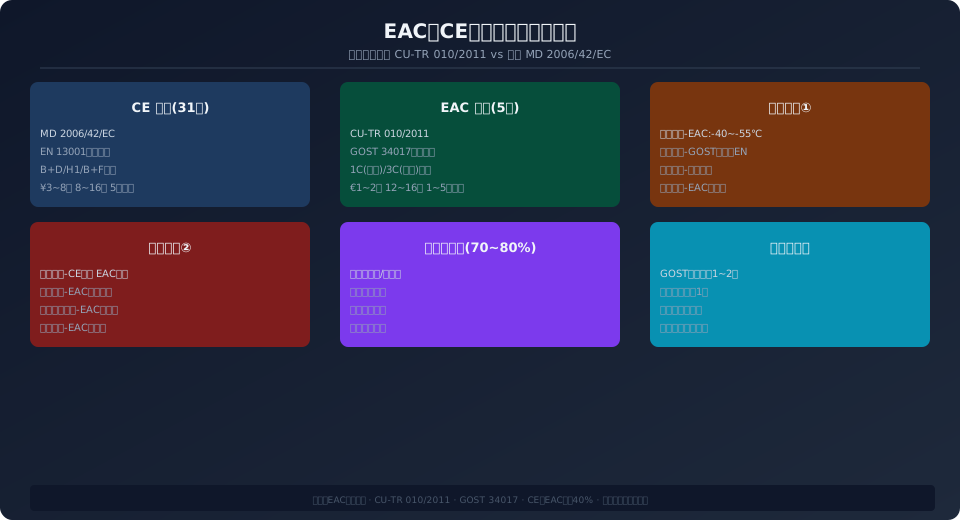
EAC Certification (CU-TR 010/2011) for the Eurasian Economic Union and CE Certification differ significantly across four dimensions: applicable countries, technical regulation references, factory audit requirements, and certification costs (EAC approximately €10,000–20,000). Cranes that already hold a CE certificate can take the simplified "CE-to-EAC" conversion path (supplementing CU-TR gap items, preparing Russian technical documentation, and appointing a local Authorized Representative), avoiding a full re-certification from scratch.
Many crane exporters, after completing CE certification, naturally look to sell their products in Russia, Kazakhstan, and other Eurasian Economic Union (EAEU) markets—only to find that their CE certificate "doesn't carry weight" there. The five EAEU member states (Russia, Belarus, Kazakhstan, Kyrgyzstan, and Armenia) do not accept the CE mark as proof of market access; instead, products must bear the EAC mark. Although both EAC (EurAsian Conformity) and CE certifications originate from the ISO/IEC conformity assessment framework, they differ significantly in technical regulations, audit procedures, and post-market surveillance. This article compares five core dimensions to help manufacturers decide whether to pursue EAC from scratch or build on an existing CE certificate with a gap assessment.
A key point to understand: CE and EAC are not mutually exclusive—an overhead crane exported to the EAEU can hold both CE and EAC certificates simultaneously (dual certification). This dual-certified approach offers a distinct bidding advantage with customers in markets like Kazakhstan, where both European and GOST standards are accepted. When performing structural calculations for EAC certification, design parameters referenced from ISO 4301 must be converted to the GOST standard system (e.g., GOST 34017-2016 Bridge Crane Design Specification) rather than directly applying the EN 13001 series.
Applicable Countries and Legal Framework
The EAEU comprises five member states—Russia, Belarus, Kazakhstan, Kyrgyzstan, and Armenia—where the EAC mark is uniformly recognized. The legal foundation is the Treaty on the Eurasian Economic Union Technical Regulation, with the applicable technical regulation for cranes being CU-TR 010/2011 Safety of Machinery. Similar to the EU Machinery Directive, cranes are classified as high-risk equipment (included in the "list of machinery requiring mandatory certification") and must be certified by an EAEU-accredited certification body rather than through a manufacturer's self-declaration.
Unlike CE certification, the EAEU requires foreign manufacturers to appoint an "authorized representative" registered as a legal entity within the Union's territory. This representative bears joint legal liability for product compliance. While the "EU authorized representative" under CE certification serves a similar function, the EAEU authorized representative carries considerably heavier responsibilities—in the event of a product safety incident, this representative faces direct investigation by local regulatory authorities and may even be subject to criminal liability.
Five-Point Side-by-Side Comparison
Technical Documentation: Key Differences Between CE and EAC
For manufacturers transitioning from CE to EAC certification, the most challenging hurdle is "Russifying" the technical file — it's not just a matter of translation, but also recalculating structural integrity to GOST Standard requirements. Two critical differences stand out:
①Load Combinations and Safety Factors — GOST 34017 specifies different load combination coefficients (γF) for bridge crane main girders compared to EN 13001 Crane Safety Standard: the dead weight coefficient is 1.15 under GOST versus 1.10 under EN, and the hoisting dynamic load factor is 1.30 under GOST versus 1.25 under EN. This means the same overhead crane will yield a design bending moment approximately 5%–8% higher when calculated per GOST methodology, requiring additional verification that the main girder strength still meets requirements.
②Climate Adaptability — In the EAEU region (particularly Siberia and Central Asia), the minimum design temperature typically ranges from -40°C to as low as -55°C, far below the -20°C standard for the EU. Material impact toughness (KV values) must be tested and certified at these low temperatures per GOST 9454, and the material certificates issued under the original CE certification usually do not cover such extreme low-temperature conditions.
③Russian Technical Passport — EAC Certification mandates that each crane be accompanied by a Russian-language "Technical Passport" covering technical parameters, main component specifications, service life, and maintenance intervals — a far more structured and standardized document than the user manual required under CE.
One practical detail worth noting is the EAC requirement for crane runway rails and foundations. Under the CU-TR 010/2011 technical regulation, manufacturers must submit a "foundation design calculation report" at the time of certification — meaning you must verify not only the structural safety of the crane itself, but also prove that the foundation supporting the erection crane (such as the factory building's crane runway girder or concrete columns) meets GOST Standard design requirements. This falls outside the scope of CE certification, which covers only the equipment itself — foundation compliance is governed by local building codes. If the EAEU customer's factory was built to old Soviet SNiP standards and the overhead crane is designed to EN standards, a "foundation compatibility statement" may be required to demonstrate that wheel load and load transfer satisfy GOST foundation design specifications. This document is typically prepared jointly by the Chinese crane manufacturer's structural engineers and a local Russian design institute, adding 1–2 weeks to the project timeline.
Another key difference between EAC and CE lies in the intensity of post-market surveillance — CE annual surveillance audits are typically announced 2–4 weeks in advance, whereas EAC surveillance audits can be conducted "unannounced" (surprise inspections). EAC regulations grant certification bodies the right to conduct on-site factory inspections at any time during the certificate's validity — although in practice most inspections are still pre-announced, the regulatory "right to surprise audit" means your QA system and production floor must remain in a constant state of "audit readiness." This means you cannot "breathe a sigh of relief" after obtaining the EAC certificate — you must continuously record quality data, maintain complete equipment maintenance logs, and keep personnel training records up to date throughout the year. For companies accustomed to the "cram before the audit" approach, this ongoing compliance requirement is the biggest challenge. We recommend treating EAC certification as an opportunity to embed "quality management into daily operations" rather than a one-off project — integrate certification requirements into your ERP or quality management system and shift from "passive audit preparation" to "proactive compliance."
③Russian Technical Passport — EAC Certification requires each crane to be accompanied by a Russian-language "Technical Passport" covering technical parameters, main component specifications, service life, and maintenance intervals — a far more structured and standardized document than the user manual required under CE.
Another critical practical detail: under EAC Certification, the "sample" is not shipped to an overseas laboratory — instead, a notified body representative travels to the factory in China to conduct a "type inspection under factory conditions" — which aligns with common CE practice. However, EAC inspectors typically require inspection record forms and test procedures in Russian, and pay particular attention to low-temperature winter scenarios (since winter operating conditions in the EAEU region have a significant impact on crane safety). We recommend translating the test procedure into Russian in advance and sending it to the certification body for review and approval before the inspection — this prevents last-minute adjustments when the inspector arrives on-site and finds that test methods do not comply with GOST Standard requirements. Additionally, EAEU certification bodies require more detailed functional testing of safety devices than CE — for example, the hoisting limit switch must not only be verified to "stop the crane when actuated," but also that "the secondary emergency limit switch operates independently if the primary limit fails" — the so-called "redundancy verification of safety functions," which is typically not required under CE audits.
Fastest Path for CE-Certified Manufacturers
Companies that already hold CE certificates for their cranes can save roughly 40%–50% on EAC certification costs:
①Reuse the CE Technical File (TCF) directly — 70%–80% of the content (electrical schematics, hydraulic schematic diagrams, WPQR, and non-destructive testing reports) can be carried over without modification.
②Fill only the gaps with GOST structural calculations — typically 1–2 weeks of engineering work.
③Engage a local authorized representative — they handle document submission and provide translation support during factory audits, at a cost of approximately €5,000–8,000. A full EAC certification from scratch takes about 12–16 weeks; converting from an existing CE can shorten that to 6–8 weeks.
EAC Certification FAQ
Q: What types of EAC certificates are available, and should I choose 1C or 3C?
A: There are two types of EAC certificates: ① 1C certificate (serial production) — similar to CE Module B+D, intended for manufacturers exporting standardized models in volume. Valid for up to 5 years, requires a factory audit, and costs €1,000–2,000 per audit plus €3,000–5,000 per year for surveillance. ② 3C certificate (single unit) — similar to CE Module B+F, intended for one-off non-standard cranes or project-based supply. No factory audit is required, but each unit must be tested individually, at a cost of €2,000–4,000 per crane. For serial exports (more than 5 units per year), 1C offers better value; for occasional single-unit shipments, 3C is a sensible starting point.
Q: Does EAC certification require testing in Russia? Can we test the prototype in China instead?
A: EAC certification does not mandate testing within the EAEU territory. Testing can be witnessed on-site at the manufacturer's facility in China by an authorized representative of an EAEU-accredited laboratory. The prerequisite is that test equipment (e.g., load test counterweights, strain gauges and measuring instruments) must meet GOST accuracy requirements — typically, the test benches at Chinese overhead crane factories are sufficient, but the test procedure and instrument calibration certificates must be submitted to the certification body for approval in advance. If certain special tests (e.g., low-temperature impact testing) cannot be performed in China, material samples can be sent to a Russian laboratory for supplementary testing by mutual agreement.
Q: Our Russian customer is asking for a "GOST-R certificate." How is that different from EAC, and do we need both?
A: GOST-R is the legacy Russian national certification system (a transitional scheme used before the EAC system was fully implemented in 2015). It remains valid only for a small number of product types not covered by CU-TR technical regulations. Cranes are explicitly covered under CU-TR 010/2011, and an EAC certificate carries full legal weight in Russia, replacing the need for GOST-R. If a customer still insists on "GOST-R," it is likely that their procurement department has not updated its internal specifications — we recommend presenting the relevant legal basis (the CU-TR 010/2011 regulation text) to clarify the matter.
Q: Are there any additional certification requirements for cranes in Kazakhstan?
A: Kazakhstan accepts EAC certificates uniformly under the EAEU framework. However, there is one additional requirement that deserves close attention: the industrial safety expertise review. Kazakh law requires that all equipment used at hazardous production facilities — including lifting appliances — undergo an on-site inspection by a licensed local industrial safety expert and be registered with the relevant government authority before it can be put into operation. This review falls outside the scope of EAC certification and must be carried out by a locally licensed organization in Kazakhstan. The review covers the equipment's installation foundation, operator qualifications, and emergency response plans, and typically takes one to two weeks. Many Chinese manufacturers assume that holding an EAC certificate is sufficient to ship equipment directly to a customer's plant in Kazakhstan and put it into service — only to find the equipment stuck at the industrial safety registration stage, unable to operate. This is a common and costly pitfall in EAC exports to Kazakhstan. We strongly recommend coordinating this review with your local agent or customer well in advance.
Looking at the global landscape for crane export certification, Chinese manufacturers are in a rare strategic window. Demand for infrastructure continues to grow across Belt and Road Initiative partner countries, and recognition of Chinese cranes for their cost-effectiveness has risen steadily year after year. Meanwhile, established European and American crane manufacturers are losing responsiveness in some emerging markets due to higher certification costs and longer lead times. The companies that move first to build a multi-market certification portfolio — a true "certification matrix" covering major economies — will hold a decisive compliance advantage in the global crane market for the next decade. What it takes to get there goes beyond engineering capability and capital investment; it requires clear strategic vision and sustained commitment from company leadership.
Kelude Heavy Industry specializes in the design and manufacture of European-standard high-end cranes, with a product range covering 50t–300t European Standard Double-Girder cranes. We strictly adhere to the ISO 4301 Crane Design Standard — Core Provisions and the FEM/DIN/EN international standard system, and have assisted numerous clients in preparing complete machine compliance documentation and technical files for CE, EAC, GSO, and other export certifications.
For export certification technical solutions or consulting, contact the Kelude Heavy Industry engineering team: 13903802779.