

How to Choose a Crane Operator Cab: Open vs Enclosed & AC Options
The GB/T 20303 series, "Cranes – Operator Cabs," serves as the core technical specification governing the working environment for crane operators. It covers key requirements for cab structural design, visibility, ventilation and heating, noise control, and electrical safety, and applies to the selection, manufacturing, and inspection of cabs for overhead and gantry cranes, among other types.
The crane operator cab is the primary workspace for operators, and its design directly impacts operational safety, efficiency, and operator health. In accordance with GB/T 20303.1-2016, "Cranes – Operator Cabs – Part 1: General Requirements," cabs must provide adequate structural strength, good visibility, a suitable working environment, and comprehensive electrical safety protection. This article provides a systematic overview of operator cab types, key technical parameters, configuration standards, and selection methods to serve as an engineering reference for equipment procurement and retrofit projects.
Cab selection must be coordinated with the overall crane design. Structurally, the cab must meet the connection strength and stiffness requirements of GB/T 3811-2008, "Cranes – Design Standard" (equivalent to ISO 4301). Electrically, it must comply with the control system and safety device provisions of TSG 51-2023, "Crane Safety Technical Supervision Regulation". The following sections analyze cab types and technical parameters in detail.
Operator Cab Types and Application Scenarios
Kelude Heavy Industry manufactures operator cabs in strict compliance with national standards. Based on structural configuration and environmental adaptability, crane operator cabs fall into four main categories: open-type cabs, enclosed cabs, insulated cabs, and climate-controlled cabs with heating and cooling. GB/T 20303.1-2016 specifies the applicable ambient temperature range, ventilation method, and protection rating (IP) for each cab type. When selecting a cab, factors such as ambient temperature, humidity, dust concentration, and noise levels at the installation site must be carefully evaluated.
Open-type cabs are suited for indoor, ambient-temperature environments (-5°C to 40°C). They feature a simple structure and good ventilation but offer limited protection against rain and dust. Enclosed cabs feature a fully sealed steel plate structure and are intended for outdoor use or dusty workshop environments, with a protection rating of at least IP54. Insulated cabs build on the enclosed design by adding a thermal insulation layer (rock wool or polyurethane foam, ≥30 mm thick), making them suitable for low-temperature environments down to -20°C. Climate-controlled cabs are equipped with an industrial air conditioning system with a cooling capacity of ≥3.5 kW and a heating capacity of ≥4.0 kW, maintaining a comfortable interior temperature of 18°C to 26°C even in extreme ambient conditions ranging from -30°C to 50°C.
Kelude Heavy Industry strictly follows the GB/T 20303 series in cab selection. Every cab supplied with our cranes undergoes type testing and is delivered with a visibility inspection report, noise test data, and protection rating certificate.
Technical Parameter Comparison of Four Cab Types
The table below provides a systematic comparison of the four cab types across four dimensions—applicable environment, protection rating, temperature range, and typical configuration—to support engineering selection decisions.
| Comparison Item | Open Type Cabin / Operator Cab | Enclosed Type Cabin / Operator Cab | Insulated Type Cabin / Operator Cab | Air-Conditioned Type Cabin / Operator Cab |
|---|---|---|---|---|
| Applicable Environment | Indoor Ambient Temperature Workshop | Outdoor or Dusty Environment Workshop | Outdoor in Cold Regions | Extreme High Temperature/Low Temperature Environment |
| Ambient Temperature | -5℃~40℃ | -10℃~40℃ | -30℃~40℃ | -30℃~50℃ |
| Protection Rating (IP) | IP23 | IP54 | IP54 | IP55 |
| Insulation Layer Thickness | None | None | ≥30mm Rock Wool/Polyurethane | ≥50mm Polyurethane Foam |
| Air Conditioning Configuration | None | Optional Fan | Electric Heating(≥2kW) | Cooling≥3.5kW/Heating≥4.0kW |
| noise limit | ≤85dB(A) | ≤82dB(A) | ≤80dB(A) | ≤75dB(A) |
| Reference Price Range | 0.8~1.510k CNY | 1.5~3.010k CNY | 3.0~5.010k CNY | 5.0~12.010k CNY |
Operator Cab Technical Parameters at a Glance
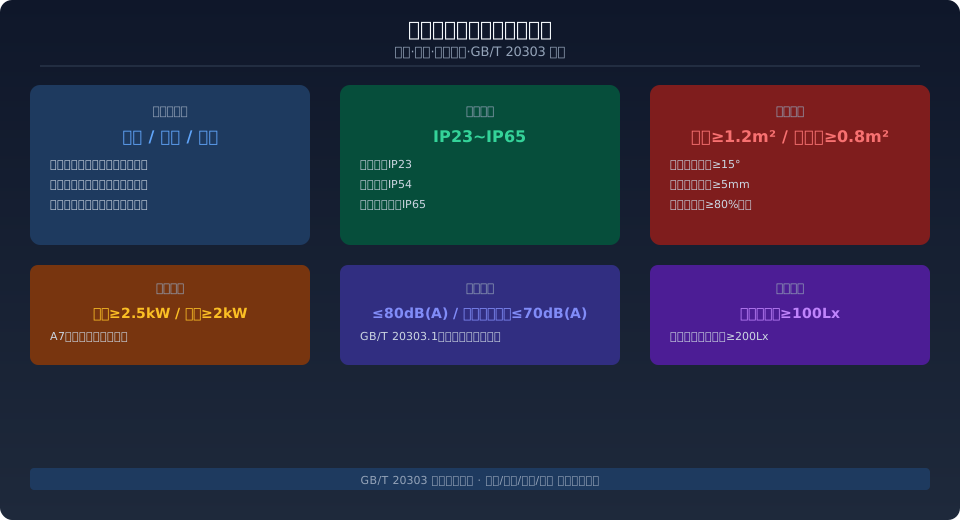
The six data cards below summarize the key technical specifications for operator cab selection, covering five critical areas: structure, visibility, environment, electrical safety, and ergonomics.
Kelude Heavy Industry recommends the optimal operator cab configuration based on the actual conditions of your workshop, offering a full range from open basic models to fully enclosed climate-controlled versions, with customization available for explosion-proof and anti-corrosion environments.
Operator Cab Design and Configuration Requirements
GB/T 20303.1-2016 sets out systematic technical requirements for operator cab design, covering five key areas: structural strength, visibility, operating space, environmental control, and electrical safety. The cab frame must be a welded steel-section structure capable of withstanding a uniformly distributed load of 3000 N/m² with a maximum deflection not exceeding 1/300 of the span. The cab must be secured to the crane's main structure using bolts or welding at no fewer than four connection points.
Visibility is a critical factor in cab selection. The standard specifies a seated operator eye height of 1200 mm (measured from the operator cab floor), with the lower edge of the front window no more than 1000 mm above the floor. The lower window must provide a vertical downward viewing angle of at least 60°. Front and side windows must use laminated safety glass (per GB 9656), while the lower window should be tempered glass with a protective grille. Safety glass must account for no less than 85% of the total glazing area.
Control Station Layout and Electrical Safety Requirements
The layout of the control station inside the cab directly affects operator comfort and productivity. The operator console should be 750–800 mm high, with an industrial seat adjustable in height (400–500 mm range) and backrest angle. The master controller (cross-handle or joystick controller) must be positioned within the operator's natural arm reach (radius ≤400 mm). The Emergency Stop Button should be placed in a highly visible position at the right front of the control desk, featuring a red mushroom-head design (diameter ≥40 mm) with an actuation force of ≤50 N.
For electrical safety, all exposed conductive parts of electrical equipment inside the cab must be reliably grounded, with the grounding conductor using a copper conductor of cross-sectional area no less than 16 mm². Cab lighting must use LED sources (color temperature 4000–5000 K, color rendering index Ra≥80), with console surface illuminance of at least 200 lx. For air-conditioned cabs, the power supply inlet must include a dedicated leakage protection device (trip current ≤30 mA), and the air-conditioning unit housing must be separately grounded. Noise levels inside the cab must comply with GB/T 20303.1: ≤82 dB(A) for enclosed cabs and ≤75 dB(A) for air-conditioned models.
Operator Cab Inspection Schedule and Maintenance Intervals
In accordance with TSG 51-2023 Crane Safety Technical Supervision Regulation and GB/T 20303.5-2016, the operator cab must be included in the crane's periodic inspection plan. The table below outlines the inspection items, technical requirements, and recommended intervals for each critical cab component.
| Inspection Comparison Item | Technical Requirement | Inspection Method | Recommended Interval |
|---|---|---|---|
| Structure Weld Seam Inspection | None Crack, None Corrosion Penetration | Visual+MTMagnetic Particle Inspection (MPI) | Annually |
| Connection Bolt Tightening | Torque Not Less Than Rated Value80% | Torque Wrench per Bolt Detection | Semi-Annually |
| Glass Integrity | None Crack, No Fogging, No Scratches | Visual+Light Transmittance Meter | Quarterly |
| Sealing Strip Aging | No Hardening, No Cracking, No Detachment | Manual Feel Elasticity Inspection | Semi-Annually |
| Grounding Resistance Testing | ≤4Ω | ground resistance tester | Annually |
| air conditioning system Inspection | Cooling/Heating Function Normal, Filter Cleaning | Start-up Operation Testing | Quarterly |
How to Select a Crane Operator Cab: A 5-Step Guide
Selecting the right operator cab requires a systematic decision-making process that starts with the operating environment and ends with the final configuration. The steps below outline this process in detail.
Step 1: Define the Operating Environment — Measure or confirm the annual temperature range, humidity levels (is relative humidity consistently above 85%?), dust concentration (exceeding 10 mg/m³?), and the presence of corrosive gases in the workshop where the crane will be installed. Use this environmental data to determine the base cab type from the four available options.
Step 2: Determine Visibility Requirements — Establish the number and position of windows based on the lifting spreader type and the specific work tasks. Bridge cranes typically require front and lower windows, while gantry cranes need additional side windows. For applications requiring precise load positioning—such as assembly work or mold handling—a lower window area of at least 1.2 m² is recommended.
Step 3: Define the Control Configuration — Select the master switch type (cross joystick or independent joysticks), seat specification (mechanical suspension or air suspension), and instrument panel layout. For operations that require simultaneous control of the crane bridge and trolley, a dual-handle independent control configuration setup is recommended.
Step 4: Define the Electrical Configuration — Specify the lighting (LED panel lights or spotlights), ventilation (axial fan or air conditioning), alarm systems (audible and visual alarm), and communication equipment (industrial intercom or camera monitoring screen). When sizing the air conditioner, estimate the cooling capacity at 40 W/m³ of cab volume.
Step 5: Verification and Acceptance — Confirm that the cab manufacturer holds a valid special equipment manufacturing license. Each cab must ship with non-destructive testing (NDT) reports for weld seams, CCC certification for the glass, and an electrical schematic. After installation, perform on-site verification of the viewing angle (using a laser distance sensor and protractor), noise levels (measured at the operator's position with a sound level meter, A-weighted), and grounding resistance.
Frequently Asked Questions
Related reading: Crane Hoisting Motor Overheating and Burnout: 7 Causes, Temperature Rise Standards, and Protection Solutions — Detailed guide to cab structure, visibility, noise, and ventilation/heating standards.
Q: What is the biggest practical difference between open-type and closed-type operator cabs? How much do the allowable noise levels and dust protection ratings differ?
A: Open-type cabs are designed for indoor, clean workshops with ambient temperatures between -5°C and 40°C and dust concentrations ≤5 mg/m³. Their allowable noise level is ≤85 dB(A), and they carry an IP23 protection rating, offering no protection against rain or dust ingress. Closed-type cabs, by contrast, feature an IP54 protection rating, which blocks solid particles ≥1 mm in diameter and splashing water from any direction. Their allowable noise level is lower, at ≤82 dB(A). For workshops in metallurgy, foundry, or cement industries where dust concentrations exceed 10 mg/m³, a closed-type cab is mandatory—an open cab in such an environment will suffer rapid failure of electrical contacts and controllers due to dust ingress, leading to maintenance costs that are 2 to 3 times higher.
Q: What mandatory requirements does ISO 20303-1:2016 impose on downward viewing angles and glass area in crane cabs? What if an existing cab doesn't comply?
A: The standard specifies the following: the lower edge of the front window must be no higher than 1000 mm from the operator cab floor; the lower window must provide a vertical downward viewing angle of at least 60°; and safety glass must account for no less than 85% of the front window area. A visible lower window area of ≥1.0 m² is the recommended value, but for foundry or assembly cranes requiring precise load positioning, this should be increased to ≥1.2 m². If an existing cab fails to meet the visibility requirements, the following retrofit options are available: ① Install an additional lower window below the front window (requires cutting the steel plate and reinforcing the frame); ② Replace standard glass with laminated tempered glass (5 mm + 0.76 mm PVB + 5 mm); ③ Add a high-definition camera in the lower window area with an in-cab display screen as an electronic visibility aid. Before any retrofit, the structural integrity of the cab must be re-evaluated to ensure that the new openings do not compromise the original structural strength.
Q: How much does a crane operator cab cost? What is the price difference between a heating/cooling air-conditioned model and a standard closed-type cab? Does the price include installation?
A: Approximate prices per unit are as follows: open-type cabs range from $1,200 to $2,200; closed-type cabs from $2,200 to $4,400; insulated cabs from $4,400 to $7,400; and heating/cooling air-conditioned cabs from $7,400 to $17,800 (including the industrial air conditioning unit, dedicated power distribution, and sealed insulation layer). An air-conditioned cab costs roughly $4,400 to $11,900 more than a standard closed-type cab, with the price difference driven primarily by the air conditioning system (industrial-grade units cost approximately $3,000 to $7,400) and the insulation materials (50 mm polyurethane foam wall panels cost about $1,500 to $3,000). These prices generally cover manufacturing costs but exclude on-site installation and freight—site hoisting and electrical wiring are billed separately, typically ranging from $700 to $2,200 per unit, depending on installation height and complexity.
Q: Why does the cooling performance of an air-conditioned cab degrade noticeably after 2–3 years of use? Is aging of the insulation and sealing strips the primary cause?
A: There are three main reasons for declining air conditioning performance: ① Seal aging—EPDM rubber seals begin to harden and crack within 3 years due to UV exposure and thermal cycling. Door frame gaps can widen from ≤2 mm to 5–8 mm, increasing cooling loss from an initial 5%–8% to 20%–30%. ② Clogged AC filters—in foundry and metallurgy workshops with high dust levels, filters that are not cleaned quarterly can see airflow drop by 40%–60%, reducing cooling capacity to below 50% of the rated value. ③ Moisture ingress in insulation—if water penetrates the polyurethane foam insulation (due to failed seals or blocked drain holes), the thermal conductivity rises from 0.022 W/(m·K) to 0.045 W/(m·K), halving the insulation effectiveness. Recommended solutions: replace the sealing strips annually (cost: approximately $30–$75), clean the AC filters quarterly, and perform an annual cooling capacity test before summer (the supply air temperature should be at least 8°C lower than the return air temperature).
Kelude Heavy Industry offers a full range of operator cab solutions for bridge and gantry cranes, supporting custom design and factory-installed options across all four types: open, closed, insulated, and heating/cooling air-conditioned. Every cab ships with non-destructive testing reports for weld seams, CCC certification for the glass, and an electrical schematic. Each unit undergoes individual viewing angle measurement and noise testing before leaving the factory, ensuring full compliance with ISO 20303-1:2016 and TSG 51-2023 Crane Safety Technical Supervision Regulation.
Kelude Heavy Industry: Overhead Crane & Hoist Solutions
Kelude Heavy Industry is a professional manufacturer of overhead cranes, gantry cranes, and electric hoists, offering a full range of material handling equipment for industrial applications. Our product line covers single-girder and double-girder bridge cranes, gantry cranes, explosion-proof cranes, and low-headroom hoists, engineered to meet the demands of workshops, warehouses, and heavy fabrication facilities.
Frequently Asked Questions
Q: What is the lead time for a standard overhead crane?
A: For standard single-girder cranes up to 10t, typical lead time is 30–45 days. Double-girder and custom-engineered cranes generally require 60–90 days depending on configuration and options.
Q: Do you provide installation services?
A: Yes, we offer turnkey installation services including on-site assembly, alignment, load testing, and operator training. Our technicians can also supervise local installation crews if preferred.
Q: What is the warranty period for Kelude cranes?
A: All Kelude cranes come with a 12-month warranty covering manufacturing defects. Extended warranty and preventive maintenance contracts are available upon request.
