

Overhead Crane Safety Training: Certified Operation Key Points
Why Overhead Crane Safety Training Matters
Overhead cranes are indispensable tools in industrial settings, but they also present significant risks. In the United States, the Occupational Safety and Health Administration (OSHA) and ASME B30 standards mandate that only trained and certified operators may run an overhead crane. In Europe, similar requirements are enforced under the Machinery Directive and ISO 4301 standards. Proper training is not just a legal obligation—it is the first line of defense against workplace accidents, equipment damage, and costly downtime.
This guide covers everything you need to know about overhead crane safety: certification requirements, standard operating procedures, essential safety practices, and the most common violations to avoid. Whether you are a first-time operator or a seasoned professional looking to refresh your knowledge, this resource will help you operate safely and confidently.
Operator Certification: What You Need to Get Started
Before you can operate an overhead crane, you must meet specific certification requirements. These are designed to ensure that every operator understands the equipment, the loads they handle, and the environment they work in.
Who Needs a Crane Operator License?
Anyone who operates an overhead crane—whether on a full-time, part-time, or occasional basis—must hold a valid operator certification. This includes floor-controlled cranes, cab-operated units, and remote-controlled systems. In the U.S., certification must be issued by an accredited organization and comply with OSHA 29 CFR 1910.179 and ASME B30.2 standards. In Europe, certification aligns with ISO 4301 and the Machinery Directive 2006/42/EC.
How to Get Certified
The certification process typically involves three steps:
- Classroom training covering crane components, load dynamics, safety regulations, and emergency procedures.
- Hands-on practical training under the supervision of a qualified instructor, where you practice actual crane operation, load handling, and communication signals.
- Written and practical exams that test your knowledge and skills. Upon passing, you receive a certification card valid for a specified period (usually 2–5 years, depending on the issuing body).
Recertification is required before your certification expires. This typically involves a refresher course and a re-examination to ensure your skills and knowledge are up to date.
Standard Operating Procedures for Safe Crane Use
Following a standardized operating procedure is the most effective way to prevent accidents. The steps below outline the safe workflow from pre-operation inspection to shutdown.
Step 1: Pre-Operation Inspection
Never operate a crane that has not been inspected. A thorough pre-shift inspection should cover:
- Wire ropes for fraying, kinks, or broken wires
- Hooks for deformation, cracks, or wear at the throat opening
- Brakes and clutches for proper adjustment and function
- Limit switches and emergency stop buttons
- Control buttons and remote for responsiveness and labeling
- Runway and trolley for obstructions or debris
- Load chain (if applicable) for wear or distortion
If any defect is found, tag the crane as "out of service" and report it immediately. Do not attempt to operate a crane with known issues.
Step 2: Planning the Lift
Before lifting, assess the load and the path. Confirm the load weight is within the crane's rated capacity. Check that the rigging equipment (slings, shackles, hooks) is rated for the load and in good condition. Plan the travel path to avoid obstacles, personnel, and overhead obstructions. Communicate the lift plan with the ground crew and signal person.
Step 3: Safe Lifting and Moving
- Take up slack slowly and lift the load a few inches to verify balance and rigging security.
- Use the crane's designated signal system (hand signals, radio, or voice) to coordinate movements.
- Keep the load as low as possible while traveling, and never swing the load over people.
- Move the crane smoothly—avoid sudden starts, stops, or reversals that could cause load swing.
- Never leave a suspended load unattended.
Step 4: Shutdown and Post-Operation
After completing the lift, land the load safely, disconnect the rigging, and raise the hook to a safe height. Park the crane in the designated area, turn off the power, and secure the controls. Complete any post-shift inspection or log entries as required by your facility.
Key Safety Practices Every Operator Must Follow
Beyond the standard procedures, certain safety practices are non-negotiable. These habits reduce risk and extend the life of your equipment.
- Never exceed the rated capacity. Overloading is the leading cause of crane failure and accidents. Always check the load weight and the crane's load chart before lifting.
- Maintain clear communication. Use standardized hand signals or two-way radios. Ensure the signal person is visible and the operator understands every command.
- Keep personnel clear of the load. No one should stand under or near a suspended load. Establish a danger zone around the lift area.
- Use the right rigging. Inspect all slings and shackles before use. Match the rigging type and size to the load and the lifting configuration.
- Beware of pinch points and entanglement. Keep hands and loose clothing away from moving parts, sheaves, and drums.
- Do not use the crane to pull or drag loads sideways. This creates dangerous side loading that can damage the crane structure and cause failure.
- Follow lockout/tagout procedures during maintenance or repair. Never service a crane while it is in operation or connected to power.
Common Violations and How to Avoid Them
Many workplace incidents involving overhead cranes stem from a handful of recurring violations. Recognizing these mistakes is the first step to preventing them.
| Common Violation | Why It's Dangerous | How to Avoid It |
|---|---|---|
| Operating without certification | Untrained operators lack the knowledge to handle loads safely or respond to emergencies. | Verify certification before allowing anyone to operate a crane. Schedule refresher training before credentials lapse. |
| Skipping pre-shift inspections | Undetected wear or damage can lead to sudden equipment failure during a lift. | Make inspections a mandatory part of the shift routine. Use a checklist and document findings. |
| Overloading the crane | Exceeding rated capacity stresses structural components and can cause catastrophic collapse. | Always confirm load weight. Install load indicators or overload protection devices where feasible. |
| Using damaged rigging | Frayed slings or deformed shackles can fail without warning, dropping the load. | Inspect all rigging before each use. Remove damaged items from service immediately. |
| Poor communication | Misunderstood signals can lead to unintended crane movements and collisions. | Standardize signals, ensure visibility, and confirm commands before acting. |
| Allowing personnel under suspended loads | A dropped load can cause severe injury or death. | Enforce a strict no-entry zone under loads. Use barricades or spotters to keep the area clear. |
Emergency Procedures and Incident Response
Even with rigorous training and adherence to procedures, emergencies can occur. Knowing how to respond quickly and correctly can minimize injury and damage.
If a Load Cannot Be Controlled
If the load begins to swing uncontrollably or the crane malfunctions, stop all movement immediately. Set the load down if it is safe to do so. If not, secure the area and evacuate personnel from the danger zone. Do not attempt to "catch" a swinging load or use your body to stop it.
Power Failure
In the event of a power outage, the crane will stop. If the load is suspended, do not attempt to lower it manually unless you have been trained in the manual lowering procedure. Secure the area and wait for power to be restored or for qualified maintenance personnel to assist.
Reporting Incidents
All incidents—even near misses—must be reported and documented. This allows your facility to identify root causes and implement corrective actions. Honest and timely reporting is a critical part of a strong safety culture.
Frequently Asked Questions About Crane Safety
Q: How often do I need to renew my crane operator certification?
A: Certification renewal intervals vary by issuing organization and local regulations. In the U.S., OSHA requires recertification every 3 years, though some employers or certifying bodies may require more frequent refresher training. In Europe, follow the schedule specified by your national authority or the certifying body. Always check your certification card for the expiration date.
Q: Can I operate an overhead crane if my certification is from another state or country?
A: In the U.S., OSHA certification is generally recognized across states, but some states or employers may have additional requirements. In Europe, certifications are typically recognized across EU member states under the Machinery Directive, but local regulations may apply. Always verify with your employer and local authorities.
Q: What is the difference between a "qualified" and a "certified" operator?
A: A "qualified" operator has demonstrated the knowledge and skills to operate a crane safely, often through training and experience. A "certified" operator has passed a formal examination administered by an accredited organization. OSHA requires certification for most overhead crane operators, while "qualified" status may be sufficient for certain limited tasks.
Q: Are there specific training requirements for remote-controlled cranes?
A: Yes. Operators of remote-controlled cranes must receive additional training on the specific remote system they will use, including emergency stop functions, range limitations, and response to signal interference. This training should be documented and included in the operator's certification record.
Q: What should I do if I see someone operating a crane unsafely?
A: Stop the operation if you can do so safely, or alert the operator and the supervisor immediately. Unsafe operation puts everyone at risk. Reporting unsafe behavior is not just your right—it is your responsibility.
Building a Culture of Safety Beyond Training
A: Certification and training are the foundation of crane safety, but they are not the whole picture. A truly safe workplace is built on a culture where safety is everyone's priority. This means:
- Encouraging open communication about hazards without fear of reprisal.
- Conducting regular safety meetings and toolbox talks focused on crane operations.
- Performing periodic audits of crane usage and operator performance.
- Investing in regular maintenance and timely repairs to keep equipment in top condition.
- Recognizing and rewarding safe behavior.
When safety is embedded in the daily routine, accidents become the exception, not the norm. Every operator, supervisor, and manager plays a role in making that happen.
This guide provides the essential knowledge for safe overhead crane operation. For specific requirements applicable to your facility, always consult your employer's safety program, the equipment manufacturer's manual, and the relevant local regulations.
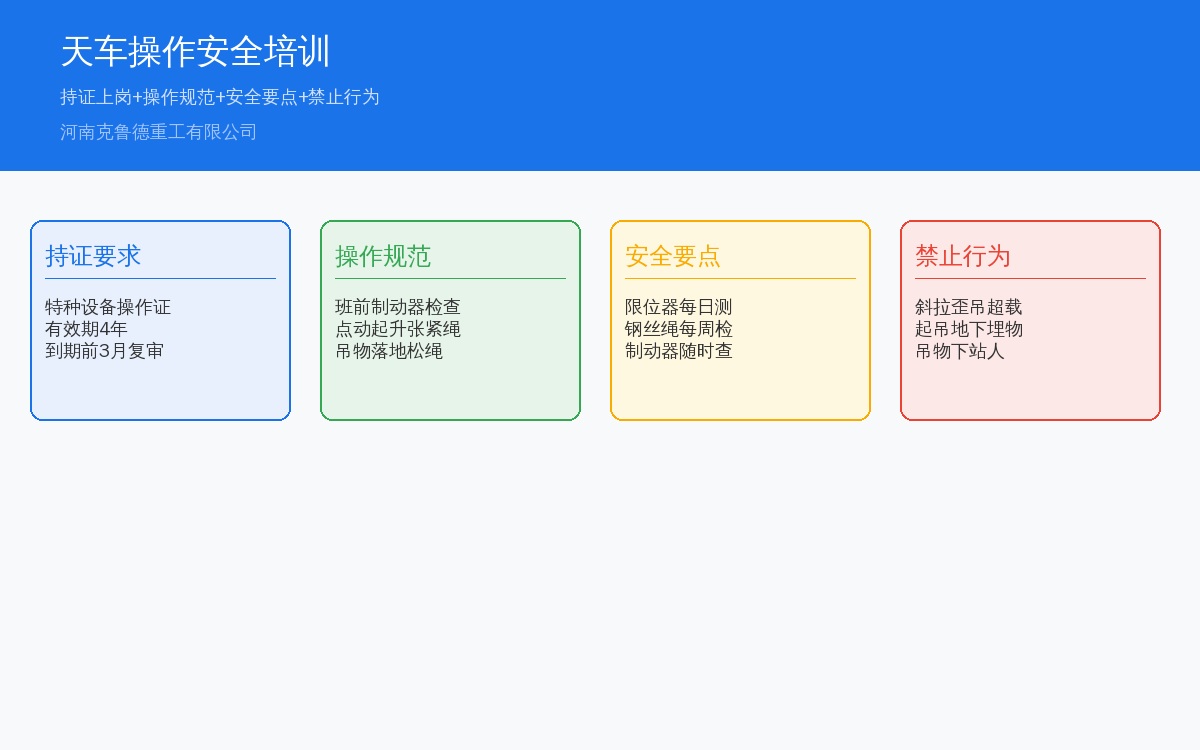
Overhead crane operators are classified as special equipment operators. Under the Special Equipment Safety Law and TSG Z6001, they must complete training and pass an assessment to obtain a special equipment operator certificate before being allowed to work. The certificate is valid for 4 years.
Operating regulations at a glance: 1) Pre-operation inspection — check the Brake for proper function, inspect the Wire Rope for wire breaks, verify the Limit Switch is intact, and confirm the Lifting spreader matches the load; 2) Hoisting — use Inching / Jog Mode to tension the Wire Rope first, confirm the load is stable, then proceed with normal Hoisting; 3) Traveling — coordinate the Crane Bridge and Trolley movements while controlling speed to prevent load sway; 4) Parking — after the load is set down, slacken the Wire Rope and raise the Hook to the upper Limit Switch position.
Prohibited practices: angled lifting, overload operation, lifting buried loads, standing under a suspended load, operating under the influence of alcohol, and running equipment with known defects. These rules are written in blood.
Operator Certificate Requirements
Overhead crane operators are classified as special equipment operators. Under the Special Equipment Safety Law and TSG Z6001 (Rules for Assessment of Special Equipment Operators), operating an overhead crane requires a Special Equipment Safety Management and Operator Certificate issued by the market supervision authority (project code Q2, limited to Bridge Crane / Overhead Crane operators). The certification process: register with a local special equipment operator examination body, complete theoretical training and practical training (approximately 1–2 weeks), sit for the unified exam (computer-based theory test plus practical assessment), and receive the certificate within 10 working days of passing. The certificate is valid for 4 years, and renewal applications must be submitted to the issuing authority 3 months before expiration. Renewal does not require retaking the exam, but you must provide 4 consecutive years of safe operation records and a no-accident statement.
New Operator Training Plan
A recommended training cycle for overhead crane operators is 2 months. Week 1: theoretical training — crane structural principle, safety regulations, operating procedures, and accident case studies. Weeks 2–4: shadowing — No-load operation under the guidance of a mentor to develop familiarity with the crane's controls and mechanisms. Weeks 5–7: Under load operation — performing Hoisting and transport tasks under direct supervision, focusing on load control and Anti-sway techniques. Week 8: independent operation assessment — a joint evaluation by the safety officer and supervisor; passing candidates receive an in-house operating permit. Refresher training is conducted every six months, with emphasis on accident case reviews and emergency drills.
FAQ
Q: How do I get an overhead crane operator certificate?
A: Register with a local special equipment operator examination body and complete the theoretical training and practical assessment. The market supervision authority issues the certificate upon passing. The certificate is valid for 4 years, and renewal is due 3 months before expiration.
Q: What actions are absolutely prohibited when operating an overhead crane?
A: Angled lifting, overload operation, lifting buried objects, standing under a suspended load, operating under the influence of alcohol, running equipment with known defects, using the Limit Switch as a normal stopping method, and dragging loads along the ground during Hoisting.
