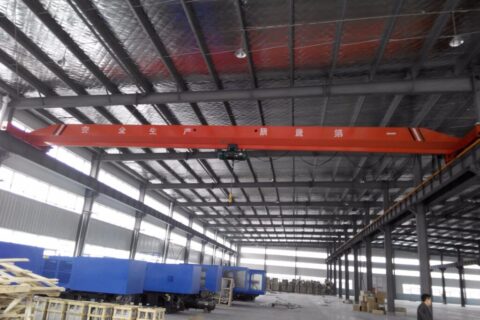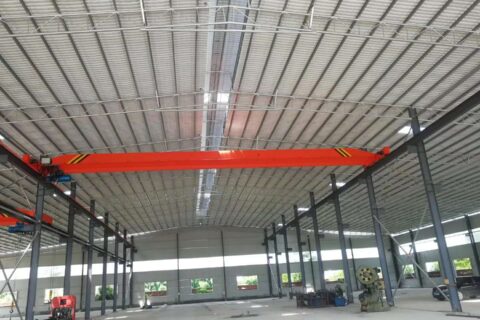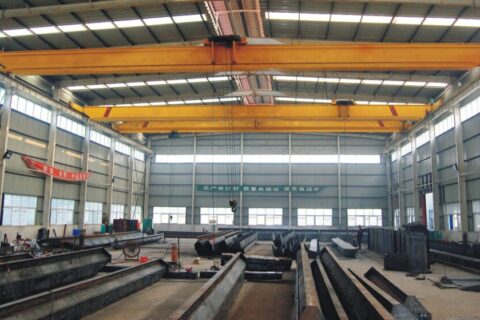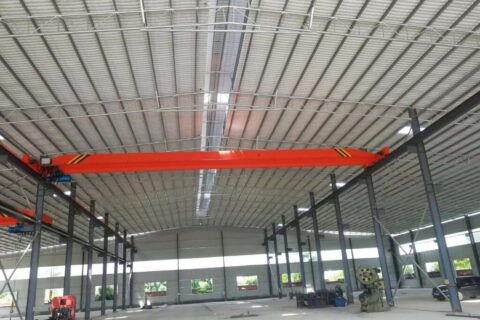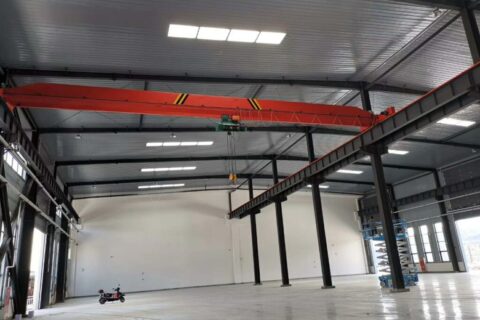

SL Type Manual Single-Girder Crane
1. Product Overview
The SL-type manual single-girder crane (also known as a hand-chain crane or manual trolley crane) is an electric-free overhead crane — the bridge travel, trolley travel, and hoisting are all driven by manual chain, paired with a hand chain hoist, with a lifting capacity of 0.2 to 20 tons. The biggest difference from an electric single-girder crane: no need for power cable installation, no electric sparks, and zero electricity cost. For applications with low lifting frequency, no three-phase power on site, or explosion-proof requirements but a budget that cannot afford an explosion-proof electric crane, the manual crane is the most cost-effective solution. This article details the specifications, structural features, and selection recommendations for the SL-type manual single-girder crane.
2. Specifications & Models
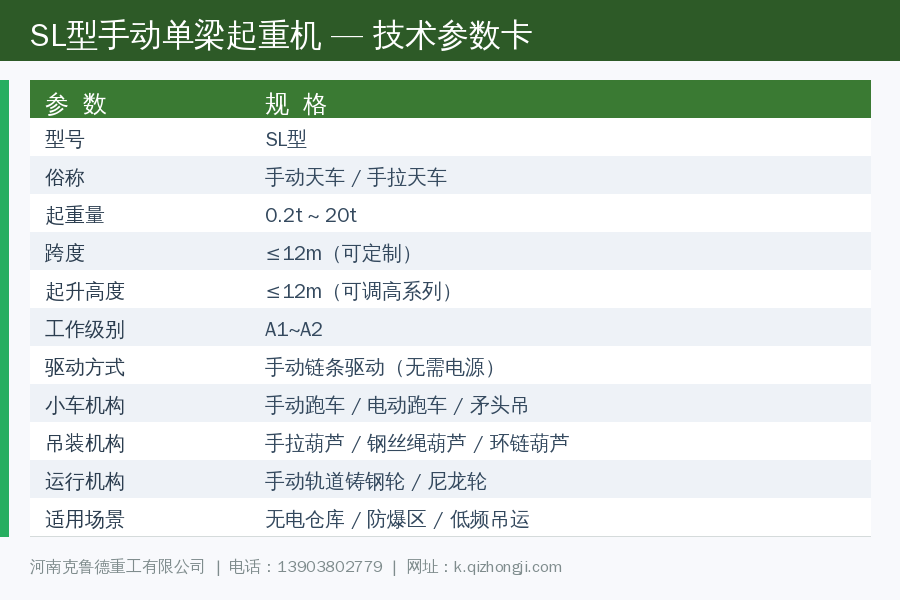
- Model: SL Type
- Capacity: 0.2 t to 20 t
- Span: ≤12 m (customizable)
- Lifting Height: ≤12 m
- Duty Class: A1 to A2
- Drive Mode: Manual chain drive (no power supply required)
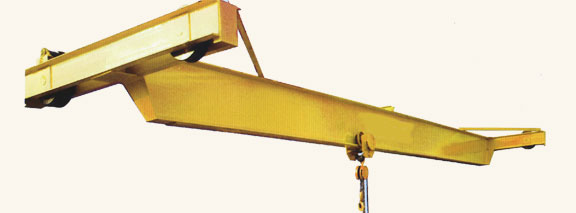
Product Images
3. Technical Specifications
| Item | Unit | Specification |
|---|---|---|
| Rated Lifting Capacity | Gn | 0.2T~16T |
| Span | L | ≤12m |
| Lifting Height | H | ≤12m |
| Power Supply | — | No Power Required |
| Duty Class | jc | A1~A2 |
| Travel Mechanism | Manual Cast Steel Wheel / Nylon Wheel | |
| Trolley Mechanism | Manual Trolley | |
| Hoisting Mechanism | Manual Chain Hoist |
4. Manual Crane vs. Electric Crane — How to Choose
Many people ask: what exactly makes a manual overhead crane better than an electric one? And when does it make more sense to go manual? The table below lays it all out:
| Comparison | SL Manual Crane | LDA Electric Crane |
|---|---|---|
| Power Source | Manual chain, no electricity required | Three-phase 380V electric |
| Lifting Capacity | 0.2~20t | 1~20t |
| Speed | Manual chain pull | 7~8m/min |
| Electricity Cost | Zero | Ongoing operating cost |
| Explosion Proof | Intrinsically safe, spark-free | Explosion-proof version costs 60%~80% more |
| Installation | Rail only | Requires wiring / busbar |
| Price | 0.5~80K | 1.5~200K |
| Typical Applications | Low-frequency / no-power / explosion-proof areas | Daily high-frequency workshop use |
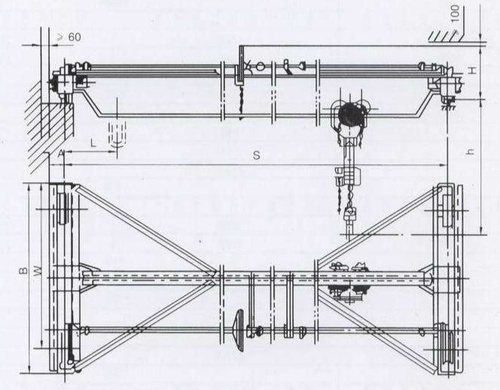
Structure Diagram
5. Component Parts
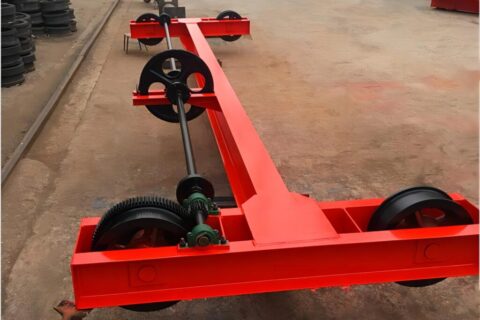
SL series manual single-girder crane consists of three parts: the bridge frame, manual traveling mechanism, and hand chain hoist. It features a simple structure with fully mechanical transmission.
◎ Bridge Girder
The main girder is fabricated from I-beam steel, while the cross beams are welded from channel steel and then integrated with the main girder. The bridge girder supports the full lifting load and its own weight. The SL type typically has a span not exceeding 12m, featuring a compact structure.
◎ Manual Travel Mechanism
Both the bridge and trolley are driven by manual chain — an operator pulls the chain to rotate the sprocket gear, which in turn drives the driving wheel along the track. The bridge travel is controlled by a ground operator pulling the chain to move the entire unit longitudinally, while the trolley chain controls the lateral movement of the hoist. The wheel set is available in cast steel or nylon (nylon recommended for explosion-proof applications).
◎ Hand Chain Hoist
Standard configuration includes a hand chain hoist (manual chain lifting), with an optional electric chain hoist available. The hand chain hoist requires no power supply, and lifting speed is manually controlled by the operator, ensuring safety and reliability. The combination of a manual overhead crane with a hand chain hoist is inherently explosion-proof by design—no electrical equipment means no ignition source from electric sparks.
VI. Scope of Application
SL series manual single-girder cranes are better suited than electric overhead cranes in the following three scenarios:
◎ Warehouses or workshops without three-phase power
Many small warehouses and remote factory sites lack 380V three-phase power, and running a three-phase cable can cost anywhere from tens of thousands to over a hundred thousand RMB. A manual crane only requires track installation — no wiring, no electricity bills. A complete SL series 3-ton manual crane costs under 20,000 RMB, far more economical than pulling power lines plus purchasing an electric crane.
◎ High explosion-proof requirements but limited budget
For scenarios requiring explosion-proof overhead cranes, such as chemical plant solvent warehouses, paint workshops, and flour mills, a certified explosion-proof electric overhead crane (LB series) costs 60% to 80% more than a standard electric overhead crane of the same capacity. Since manual overhead cranes have no electrical components, they inherently produce no sparks and are naturally safe in non-Zone 0 explosion-proof environments. An SL series crane fitted with nylon wheels delivers explosion-proof performance comparable to the LB series at only one-third of the price.
◎ Low-frequency lifting with only a few uses per day
Equipment maintenance, occasional loading/unloading, and hoisting of backup equipment—these scenarios may only require an overhead crane a few times a month. Purchasing an electric overhead crane is costly and maintenance-heavy (motors left idle for long periods are actually more prone to failure). A manual chain hoist requires no routine maintenance, and the chain only needs replacement every few years. With a service life of 10–15 years, it holds up better in storage than an electric overhead crane.
Parameter Specification Overview
7. After-Sales Service
SL series manual single-girder cranes are covered by a warranty against quality defects under normal operating conditions for one year from the date of sale. For products beyond the warranty period, our company provides repair services and charges a fee for the cost of replacement parts.
Manual Bridge Crane Maintenance Reminder: A manual bridge crane features a simple structure, and routine maintenance only requires periodically lubricating the chain and gears with oil, and inspecting the hoist hook for any deformation. It is recommended to check the chain for link wear every six months, and replace it promptly if stretching or deformation is found. Compared to electric bridge cranes, there is no need to worry about motor or electrical failures.
Price Reference (So You Know What to Expect): The price of an SL-type manual overhead crane is calculated based on lifting capacity and span. A 3-ton model with an 8-meter span runs roughly $10,000–$15,000, a 5-ton model about $18,000–$25,000, and a 10-ton model approximately $30,000–$50,000. Adding nylon wheels or a chain hoist increases the price by about $2,000–$5,000. For the same tonnage, an electric overhead crane (LDA type) costs around $30,000–$100,000—a manual crane saves you more than half the cost, with zero electricity bills, making it the more economical choice in the long run.
Availability & Lead Time: Common specifications (1–10 tons, span ≤ 12 m) are kept in stock year-round. Shipment takes 7–10 days after parameters are confirmed. Custom non-standard spans ship in 15–20 days. Every unit undergoes a full-load test before leaving the factory. On-site, all you need to do is install the rails and make the electrical connections (for motorized trolley models)—DIY-friendly.
When to Choose a Manual Crane—Three Questions to Ask Yourself
1. Is three-phase power available on site?
No: a manual crane is the only solution that doesn't require running electrical lines, saving tens of thousands on cabling. Even if three-phase power exists but is only occasionally used in a corner, a manual crane is still more cost-effective than running lines plus an electric crane.
2. How frequent is the lifting operation?
For workshops lifting dozens of times a day, go with electric (LDA type). For use two or three times a week or as emergency backup, manual is more cost-effective. Pulling a 1-ton load by manual chain takes about 2–3 minutes, which is perfectly adequate for low-frequency use. Buying the wrong type is a bigger loss than buying a pricier one — an electric overhead crane left unused will have its motor deteriorate from idleness just the same.
3. Are there explosion-proof requirements?
If explosion-proof is required but the budget doesn't stretch to an explosion-proof electric overhead crane, the inherently explosion-proof combination of a manual overhead crane + nylon wheels + hand chain hoist delivers safety on par with the LB explosion-proof model at just one-third of the LB's price.
Still not sure which model to choose? Send us your on-site working conditions (workshop dimensions + lifting weight + frequency), and we'll help you work out a solution. Span, lifting capacity, and lifting height — just those three figures, and we'll get back to you with a recommendation and quote within 10 minutes. When it comes to overhead cranes, choose Kelude — save yourself the detour.
Frequently Asked Questions
Q: Which is more cost-effective, the SL Series manual overhead crane or the electric overhead crane?
A: It depends on frequency of use. For daily workshop operations, an electric overhead crane saves more (manual chain pulling is time-consuming and labor-intensive). For use a few times a month, a manual overhead crane is more economical (zero electricity cost + virtually maintenance-free). A 3-ton manual overhead crane costs roughly $10,000–$15,000, while an electric model of the same capacity runs about $30,000–$50,000—the price difference covers years of operation.
Q: Can a manual overhead crane be installed outdoors?
A: Yes, but a rain cover is recommended. Manual overhead cranes are fully mechanical in transmission, resistant to moisture and dust, making them better suited than electric overhead cranes for simple outdoor shelter environments.
Q: What are the requirements for manual overhead crane installation?
A: Only a corbel and rail in the workshop are required—no busbar or cable installation is needed. The rail I-beam size is determined by the span and selected per the JB/T 1306 standard. Installation takes approximately 3 to 5 days, and we provide on-site survey and installation guidance.
Q: Many people ask: What exactly makes a manual overhead crane better than an electric one? When is a manual option more cost-effective? The table below spells it out clearly:
A: