

Selecting Crane Block Specifications: Matching the Block Multiplier to the Hoisting Speed
📌 Key Points Crane pulley blocks are the core components of a hoisting mechanism that change the direction of the wire rope and transmit power. ① The pulley ratio m = number of wire rope strands ÷ number of strands leading out of the drum; commonly used ratios range from 2 to 10; ② A higher ratio results in a greater lifting capacity but slower speed: when m = 2, the speed is 8–12 m/min; when m = 8, it is only 1.5–3 m/min; ③ Pulley materials include cast steel (ZG310–570) and MC nylon; ④ Krude Heavy Industry’s pulley blocks undergo a static load test at 1.5 times the rated load before leaving the factory, and the rope grooves are treated with medium-frequency quenching.
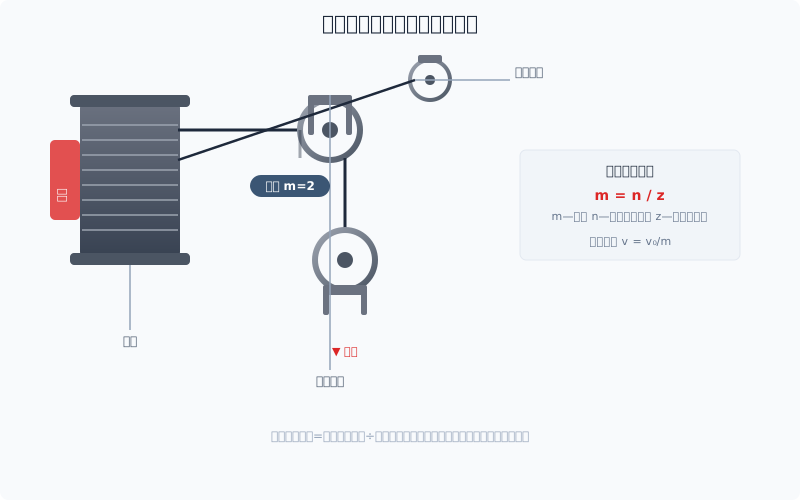
Matching the Pulley Ratio to the Lifting Speed
The pulley ratio is a key design parameter for hoisting mechanisms. A higher ratio results in more wire rope strands and greater lifting capacity, but also lower lifting speed. The selection of the pulley ratio requires balancing lifting capacity and operational efficiency:Single girder overhead craneCommon capacity factors range from 2 to 4; for double-girder overhead cranes, they typically range from 4 to 8; and for heavy-duty gantry cranes, they can reach 10. When selecting a model, Krude Heavy Industry calculates the optimal capacity factor by taking into account the lifting capacity, lifting height, and speed requirements.
| Lifting Capacity (t) | Recommended Odds | Number of pulleys | Lifting Speed (m/min) | Compatible Models |
|---|---|---|---|---|
| 1~5 | 2 | 2 | 8~12 | CD1/MD1 Electric Hoist |
| 5~16 | 3~4 | 3~4 | 5~8 | LD/LH Type Bridge |
| 20~50 | 4~6 | 5~8 | 3~6 | QD-Type Double-Girder Bridge Crane |
| 50~100 | 6~8 | 8~12 | 1.5~3 | Heavy-Lift Gantry/Metallurgical |
| ≥100 | 8~12 | 12~20 | 0.5~1.5 | Large-Scale Foundry/Shipbuilding |
Pulleys: Structures and Materials
Crane pulleys are classified by structure into fixed pulleys (mounted on the bridge or trolley frame to change the direction of the wire rope) and moving pulleys (which move up and down with the hook block to reduce effort and increase speed). Pulleys consist of a flange, hub, spokes, and rope grooves. Large pulleys are made of cast steel in a single piece, while small and medium-sized pulleys may be made of MC nylon or ductile iron. The ratio of the pulley diameter D to the wire rope diameter d (D/d) is a key design parameter that directly affects the wire rope’s bending fatigue life.
Cast steel pulleys (ZG310-570): Tensile strength ≥570 MPa, hardness HB 180–220; wear- and impact-resistant; suitable for heavy-duty applications (≥20 t) and high-temperature environments. After medium-frequency quenching, the hardness of the surface rope grooves can reach HRC 40–45, doubling the service life. The disadvantages are their heavy weight (approximately five times that of nylon pulleys) and high manufacturing costs.
MC Nylon Pulleys (Cast Nylon): With a density of only 1.15 g/cm³ (1/5 that of cast steel), a low coefficient of friction (0.08–0.12), minimal wear on steel wire ropes (extending their service life by 30%), excellent self-lubricating properties, and low operating noise. Suitable for temperatures ranging from -40 to +120 °C, they are widely used in light- and medium-duty cranes (≤20 t) and high-speed operating environments. Krude Heavy Industry’s MC nylon pulleys are manufactured using an oil-impregnated nylon formulation by default, offering 40% greater wear resistance than standard nylon.
Calculation of Pulley Diameter Ratio for Wire Rope Matching
GB/T 3811 specifies that the ratio of the pulley diameter D to the wire rope diameter d, D/d, must be ≥20 (M5 service class). The higher the D/d ratio, the lower the bending stress on the wire rope and the longer its service life. Krude Heavy Industry adheres to a standard of D/d ≥ 25, extending the bending fatigue life of the wire rope by 30% or more.
[Example 1] Given that an electric hoist has a lifting capacity of 5 t and a wire rope diameter of d = 11 mm, find the minimum pulley diameter.
According to GB/T 3811: D ≥ 20 × 11 = 220 mm; the standard diameter D is taken as 250 mm.
According to the Krud standard: D ≥ 25 × 11 = 275 mm; therefore, D is taken to be 315 mm.
[Example 2] For a 10-metric-ton overhead crane, a wire rope with a diameter (d) of 13 mm and a pulley diameter (D) of 400 mm are selected. Verify the D/d ratio.
D/d = 400/13 = 30.8 > 25 (Krud standard); the bending stress on the wire rope is low, resulting in a long service life.
The diameter of the pulley should also be coordinated with the diameter of the drum; the pulley diameter is generally set at 0.8 to 1.0 times the drum diameter to ensure that the bending stress on the wire rope is essentially the same on both the pulley and the drum.
Example of Calculating Pulley Ratio
The pulley ratio, m, is equal to the number of wire rope strands, n, divided by the number of wire rope leads on the drum, z. The ratio directly affects the hoisting speed and wire rope tension. The following are typical selection calculations:
[Example 3] A 10-metric-ton electric single-girder crane with a required hoisting speed of ≥5 m/min. The initial selection is a drum diameter D = 300 mm and a drum rotational speed n₀ = 15 r/min. Therefore, the drum linear velocity v₀ = πDn₀ = 3.14 × 0.3 × 15 ≈ 14.1 m/min. The required gear ratio m = v₀ ÷ v = 14.1 ÷ 5 ≈ 2.8; let m = 3. The actual hoisting speed v = 14.1 ÷ 3 = 4.7 m/min, which meets the requirement of ≥5 m/min for 90% and above and is acceptable for this project.
[Example 4] A 32-metric-ton double-girder overhead crane with a pulley ratio m = 6 and n = 12 wire rope strands (twin-drum drum, n = 2m). Tensile force per wire rope F = Q ÷ (n × η) = 32,000 ÷ (12 × 0.95) ≈ 2,807 kg ≈ 27.5 kN. Based on this tensile force, select a wire rope diameter d ≈ 18 mm; then, using the requirement D/d ≥ 25, determine the pulley diameter D ≥ 450 mm, and select a standard value of D = 500 mm.
Pulleys: Groove Dimensions and Wear Standards
The match between the rope groove dimensions and the wire rope diameter directly affects the wire rope’s service life. The groove pitch p = d + 3–5 mm, the groove radius R = (0.53–0.56)d, and the groove depth h = (0.25–0.4)d. If the groove is too shallow, the wire rope is prone to slipping out of the groove; if it is too deep, compression and deformation will accelerate wear.
Criteria for determining rope groove wear: ① Replace when the depth of the rope groove is worn down to 25% of its original dimension; ② Replace when the wall thickness of the rope groove is worn down to 80% of its original thickness; ③ If grooves or wavy wear appear in the rope groove, repair by turning (≤1 mm per turning operation); ④ Repair is required if the gap between the rope groove and the wire rope exceeds 2 mm due to wear on the groove radius. The rope grooves on Krude Heavy Industry pulleys undergo medium-frequency quenching treatment, resulting in a service life twice that of ordinary pulleys.
Selection and Maintenance of Pulley Bearings
Pulley bearings are designed to withstand radial loads and a small amount of axial load; self-aligning ball bearings (2000 series) or self-aligning roller bearings (22200 series) are commonly used. Bearing models are selected based on the pulley diameter and hub width: Pulleys with D = 200–315 mm are paired with 6205–6208 bearings, pulleys with a diameter of D = 400–630 mm are paired with 6309–6316 or 22210–22220 bearings. Under normal operating conditions, the bearing service life is ≥5,000 h.
Maintenance Requirements: ① Recharge with No. 2 extreme-pressure lithium-based grease once every 3 months; ② Disassemble, inspect, and clean the bearings annually, and replace the grease; ③ Replace immediately if the bearings make unusual noises or if the temperature rise exceeds 40°C (above ambient temperature). Krude Heavy Industry pulley bearings feature a double-sealed design (2RS) that is dustproof and waterproof, making them suitable for both indoor and outdoor environments.
Key Points for Routine Inspection of Pulleys
Daily Inspection by Operators: ① Visually inspect the surface of the pulley rope grooves for any visible wear grooves; ② Rotate the pulley to check for smooth rotation and any signs of binding; ③ Check for any foreign objects lodged in the rope grooves; ④ Listen for any abnormal friction noises during operation (periodic friction noises may indicate uneven wear on the rope grooves). Monthly Maintenance: Measure and record the depth and wall thickness of the rope grooves; remove grease and dirt buildup from the surface of the rope grooves; check the bearing seals for damage or oil leaks.
Considerations for Selecting Pulleys
Frequently Asked Questions
Q: Is a higher pulley ratio always better?
Answer: No. The higher the gear ratio, the slower the hoisting speed, and the greater the number of wire rope wraps, which accelerates wear and tear. Taking a 10-metric-ton crane as an example, the speed is 6 m/min at a gear ratio of 3 and 3.6 m/min at a gear ratio of 5, representing a difference in efficiency of 40%. When selecting a model, Krude Heavy Industry balances lifting capacity and operational efficiency to provide the optimal solution.
Q: How do I choose between nylon pulleys and cast steel pulleys?
A: For standard environments (-20 to +80°C), choose MC nylon pulleys, which are lightweight, low-noise, and extend wire rope service life by 30%. For high-temperature (>80°C) or heavy-load, high-impact applications, choose cast steel pulleys. Krude Heavy Industry has both materials in stock.
Q: At what point should a pulley rope groove be replaced due to wear?
Answer: The pulley must be replaced when the rope groove is worn down to 25% of its original depth, the groove walls are cracked, or the pulley flange is damaged. Krude Heavy Industry’s pulleys feature medium-frequency quenching treatment (HRC 40–45) on the rope grooves, resulting in a service life more than twice that of ordinary pulleys.
Q: What should I do if the pulley isn't turning smoothly?
A: First, check whether the bearings are low on lubricant or damaged. Then, check whether the pulley shaft is bent or if there are any foreign objects in the rope groove. The bearings in Krude Heavy Industry’s pulley blocks feature a double-sealed design; under normal operating conditions, they only need to be greased every 3 months.
The above is a comprehensive technical guide for selecting crane block specifications. Krude Heavy Industry offers a full range of cast steel and MC nylon pulleys and supports customization of non-standard pulley ratios and diameters based on customer drawings. For assistance with selection, please contact the Krude Heavy Industry technical team to receive a one-on-one solution.
